Written by: Luis Teran, Co-founder, CEO, TenantEvaluation
Key Takeaways
- HOA resident screening uses two distinct processes: HOA eligibility verification and owner financial screening. Clear role separation keeps each decision defensible.
- Written policies, objective criteria, and documented board decisions give associations a strong defense against Fair Housing complaints, FCRA challenges, and internal disputes.
- Correct FCRA adverse-action sequencing, individualized criminal-history assessments, and clear documentation standards protect both associations and applicants.
- Centralized platforms with biometric verification, board voting dashboards, and lease tracking streamline operations while keeping records audit ready.
Property managers and boards can streamline HOA resident screening workflows with TenantEvaluation. See how the platform handles the HOA side of the split.
What Is HOA Resident Screening? Defining the Two-Process Split
HOA resident screening is the process community associations use to verify that prospective residents meet eligibility requirements and will comply with community rules. HOA resident screening must be split into two distinct processes. The first is HOA eligibility and rule-compliance verification. The second is the owner’s financial and tenancy screening.
Most compliance failures occur when these two processes blur together. In Florida’s community management environment, CAMs and boards must be able to defend every screening decision against Fair Housing complaints, FCRA challenges, and internal board disputes. The structural question of who screens what is the foundation of that defense, and the sections that follow build the answer piece by piece: the written policy, the role-division matrix, FCRA sequencing, criminal-history assessment, board documentation, fee rules, and post-approval lease tracking.
Core Definitions and Operating Framework for HOA Resident Screening
A shared vocabulary prevents the process breakdowns that create compliance exposure. These terms define the HOA resident screening workflow:
- Eligibility verification: Confirming the applicant meets governing document requirements such as occupancy limits, age restrictions, and lease term minimums.
- Rule compliance: Verifying the proposed tenancy conforms to the association’s recorded declaration, bylaws, and rules.
- Application intake: Collecting the completed application, required documents, and signed authorizations.
- Identity verification: Confirming the applicant is who they claim to be, using government-issued ID and, where available, biometric confirmation.
- Document and lease review: Verifying that an executed lease, valid IDs, and all required documents are present and complete.
- Authorized screening: Running background and credit reports only after obtaining written authorization and confirming permissible purpose under the FCRA.
- Objective criteria review: Evaluating the application against the association’s written, non-discriminatory screening criteria.
- Approval or denial: Recording the board’s decision with rationale tied to objective criteria.
- Written notice: Delivering the decision to the applicant in writing, including FCRA-required adverse-action notices when applicable.
- Secure retention: Storing screening records in an access-controlled, encrypted system for the required retention period.
These elements connect HOA resident screening to association operations, resident approvals, governance, compliance, security, and administrative workflows. The role-division framework of owner, HOA, manager, and board governs who is responsible for each element.
See how the two-process split works in practice with TenantEvaluation.
The HOA Resident Screening Landscape: Trends Reshaping Community Association Operations
Community association screening is undergoing structural change, and boards can no longer rely on manual processes alone. The trends below show how CAMs, boards, applicants, and realtors now experience the process:

- Biometric identity verification: Document-based review is giving way to biometric confirmation. Credential theft incidents average $4.8 million per breach, and synthetic identity fraud is increasing across condo and HOA communities. Platforms now embed AI-powered liveness detection and selfie-to-ID biometric matching directly into the screening workflow.
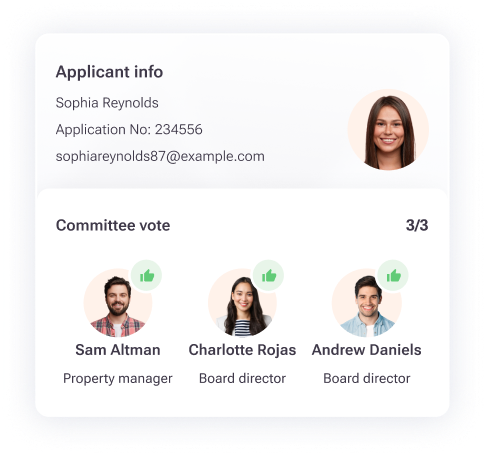
- Board voting dashboards: Email chains and spreadsheets are being replaced by centralized dashboards that give board members real-time access to application status, summarized reports, and a voting panel, with timestamped, auditable records.
- Centralized lease tracking: Lease management is moving from scattered folders and inboxes to connected platforms that provide real-time lease status from application to occupancy.
- Rising identity fraud: Stolen IDs, impersonation attempts, and synthetic identities represent a growing threat that traditional document-based screening cannot reliably prevent.
- Regulatory pressure: FCRA and Fair Housing compliance requirements are intensifying, and associations that rely on manual, undocumented processes face growing exposure.
Most generic tenant screening content is written for individual landlords, not community associations. HOA resident screening best practices for property managers must address the HOA-specific structural question of who screens what, which generic tools do not handle.
Role Division: Who Screens What in HOA Resident Screening
The role-division matrix is the operational core of a defensible HOA screening program. Each party has a defined scope:

- Owner/Landlord: Handles financial and tenancy screening, including credit, income verification, and rental history. This responsibility sits with the owner, not the HOA.
- HOA: Verifies eligibility and rule compliance, including governing document requirements, occupancy limits, age restrictions, and lease term conformance.
- CAM: Administers the process, including application intake, document collection, workflow management, and communication with all parties.
- Board: Reviews and votes on applications, including approval decisions, exception requests, and documented rationale.
The numbered workflow that connects these roles is straightforward:
- Application submission (applicant completes online application with required documents and payment)
- Identity verification (government ID validation and biometric confirmation where enabled)
- Document and lease review (executed lease, valid IDs, and required documents confirmed complete)
- Authorized screening (background and credit reports run after written authorization and permissible purpose confirmed)
- Objective criteria review (application evaluated against written, non-discriminatory screening criteria)
- Approval or denial (board votes with documented rationale tied to objective criteria)
- Written notice (decision delivered to applicant, with FCRA adverse-action notices sent if applicable)
- Secure retention (screening records stored in an access-controlled, encrypted system)
This division prevents the compliance failures that arise when the HOA conducts financial screening that belongs to the owner, or when the owner’s screening is treated as sufficient for HOA eligibility verification. Because each role carries its own accountability, documentation requirements, and timing obligations, a decision made by the wrong party is both procedurally invalid and hard to defend later.
Watch a board voting dashboard in action inside TenantEvaluation.
Compliance and Legal Standards in HOA Resident Screening
FCRA Adverse-Action Sequencing for HOAs
Under the FCRA, an adverse action notice is required whenever a decision is based “in whole or in part” on a consumer report, including denying a rental application, raising the rent or deposit, or requiring a co-signer, and landlords and property managers are subject to the same notice rules as banks. Getting the order wrong can itself create a violation, even when the underlying decision was justified. The required sequence for HOA contexts is:
- Written authorization: Obtain signed written authorization from the applicant before pulling any consumer report. Confirm permissible purpose.
- Pre-adverse action notice: Send the applicant a complete copy of the exact consumer report reviewed plus a CFPB-prescribed summary of FCRA rights before taking final adverse action.
- Five business day waiting period: A 1999 FTC advisory opinion treated five business days as a generally reasonable waiting period between pre-adverse action materials and the final decision, making five business days the de facto operational standard.
- Final adverse action notice: The final adverse action notice must include the name, mailing address, and phone number of the consumer reporting agency; a statement that the agency did not make the decision and cannot explain the reasons; notice of the right to a free copy of the report within 60 days; and notice of the right to dispute the report’s accuracy or completeness.
- Dispute and correction window: A consumer who receives an adverse action notice has 60 days to request a free copy of their consumer report, and any dispute filed with the reporting agency must typically be investigated and answered within 30 days. The CFPB’s tenant background check guidance and dispute process provides applicant-facing detail on these rights.
The FTC’s guidance on Using Consumer Reports: What Landlords Need to Know describes these steps for housing providers.
Criminal History Screening Without a Blanket Ban
HUD’s Office of General Counsel withdrew its 2016 memorandum on criminal records guidance effective September 25, 2025, stating that parties should not rely on the withdrawn materials as authoritative guidance. However, HUD’s withdrawal of its 2016 criminal records guidance did not amend the Fair Housing Act or vacate any court decision interpreting it; the statute and its judicial interpretations remain in force.
In Texas Department of Housing and Community Affairs v. Inclusive Communities Project (2015), the Supreme Court held that disparate impact claims are cognizable under the Fair Housing Act. Removing an agency regulation does not overrule a Supreme Court construction of the statute, so the practical effect of HUD’s proposed rule would be to leave standards to the courts rather than eliminate exposure.
A defensible individualized assessment for each applicant with reportable criminal history must document:
- Nature and severity of the offense and its relationship to housing safety
- Recency of the offense and any subsequent conduct
- Relevance to the safety of residents and property
- Mitigating factors presented by the applicant, including rehabilitation evidence, employment history, and community ties
A compliant criminal history framework does four things. It specifies which offense categories are relevant to housing safety. It establishes lookback periods beyond which older offenses are not considered. It excludes arrests and expunged or sealed records where required. And it completes a documented assessment for every applicant with reportable history, using the same form and analysis regardless of who is completing it. Applicants must have an opportunity to present mitigating information before a final denial is issued.
Board Approval Documentation
Board approval decisions must be documented with timestamped voting records, decision rationale tied to objective criteria, and audit trails that replace email chains. The documentation standard for denial decisions is objective, specific, and contemporaneous: record the specific criterion applied, the policy provision it comes from, and the evidence relied on. That standard matters most for denials, where any later challenge will focus on the written record. Anything subjective, such as how an applicant “seemed,” is legally indefensible, which is why the record has to be built from criteria rather than impressions.
TenantEvaluation is built specifically for community associations and management companies, and FCRA compliance is designed into the workflow from the start. The QuickApprove board voting dashboard replaces email chains with a connected, timestamped approval workflow inside TenantEvaluation, giving board members direct access to application status, summarized reports, and a voting panel with audit-ready records.
Common Challenges and Failure Points in HOA Resident Screening
The most common operational breakdowns in community association resident screening follow predictable patterns and fall into three groups.
Process failures include:
- Inconsistent processes applied differently across applications, creating disparate treatment exposure
- Manual bottlenecks and follow-up burden that consume staff time and delay approvals
- Unclear responsibilities between owner and HOA, which leads to duplicated or missing screening steps
- Incomplete information and missing documents that stall the workflow
Governance failures include:
- Weak oversight and undocumented decisions that cannot survive a Fair Housing investigation
- Approval workflows stuck in email chains and spreadsheets with no audit trail
Data and security failures include:
- Security gaps in handling sensitive applicant data, such as Social Security numbers, financial records, and consumer reports stored in email or shared drives
- Fragmented lease management with no centralized visibility from application to occupancy
- Disconnected payment collection separated from the onboarding workflow
As noted earlier, the two-process split is the primary prevention mechanism. Separating the processes structurally, with documented role assignments and a written policy, keeps responsibilities clear and decisions defensible.
Best Practices and Emerging Standards: A Written Screening Policy Blueprint
A written HOA resident screening policy is the operational and legal foundation of a defensible program. Every board should adopt the following sections:

- Authority from governing documents: Cite the specific declaration or bylaw provision that grants the association screening and approval authority.
- Objective criteria: Specify income thresholds, credit evaluation parameters, occupancy limits, lease term requirements, and any age-restriction requirements. Version-control the document so the criteria in effect on any decision date are identifiable.
- Prohibited criteria: Explicitly list the seven federal protected classes under the Fair Housing Act, which are race, color, religion, sex, national origin, familial status, and disability, along with any additional protected classes under Florida law.
- Criminal-history individual assessment procedure: Define which offense categories are relevant to housing safety, establish lookback periods, exclude arrests and expunged or sealed records, and require a documented individualized assessment for every applicant with reportable history using a consistent form.
- Adverse-action procedure: Document the FCRA-compliant sequence: written authorization, pre-adverse action notice with report and CFPB summary of rights, five business day waiting period, final adverse action notice, and 60-day dispute window.
- Appeal and review process: Provide applicants a defined window and process to present additional information or request reconsideration.
- Retention rules: Fair housing compliance records should be retained for a baseline of three to five years, with records relevant to an active or threatened complaint held under a legal hold.
A platform that enforces these policies in workflow terms, including identity verification, board voting, lease tracking, and payment handling, turns the written blueprint into daily practice. TenantEvaluation is built for the HOA side of this screening split and provides that operational layer.
- IDVerify: Biometric identity verification with AI-powered liveness detection, government ID authentication, and selfie-to-ID biometric comparison, which moves communities from document-based review to verified physical identity confirmation.
- QuickApprove: An accelerated approval workflow built for CAMs, boards, and property management teams, with real-time application tracking, automated communication support, customized approval letters, a personalized welcome package, and a board-ready voting dashboard inside one connected platform.
- Lease Tracking: Centralized, real-time lease visibility and lifecycle control from application to occupancy, connecting resident onboarding, unit data, approvals, and lease documentation into one streamlined, audit-ready workflow.
- 55+ Communities Verification: A built-in capability that helps Florida condos and HOAs standardize how age-restricted requirements are handled across applications, which reduces manual work and improves documentation consistency.
- TEpayments by Zinc: A connected payment workflow inside TenantEvaluation that collects application fees, deposits, and other required resident payments within the onboarding process. Payments go directly from the applicant to the association’s designated account, and TenantEvaluation never holds the funds.
TenantEvaluation has processed 100,000+ applications annually across 5,000+ communities, generating $150M for communities, and FCRA requirements are built into its workflows.
See lease tracking from application to occupancy in a live walkthrough.
Evaluation Criteria: How to Assess HOA Resident Screening Approaches
This framework helps boards and CAMs compare any HOA resident screening approach, system, or policy:
- Compliance readiness: Does the approach address FCRA adverse-action sequencing, Fair Housing individual assessment, and Florida-specific statutory requirements?
- Operational efficiency: Does it reduce manual follow-up, automate document collection, and accelerate approvals?
- Transparency: Do boards have real-time visibility into application status, and are applicants informed of their status and rights?
- Scalability: Can it handle high-volume seasons and multi-community portfolios without adding headcount?
- User experience: Is the workflow intuitive for applicants, CAMs, and board members?
- Auditability: Are decisions timestamped, documented, and retrievable for Fair Housing investigations or FCRA disputes?
- Risk controls: Does it include biometric identity verification, data encryption, and PCI-compliant payment handling?
When evaluating screening vendors, focus on security and data handling. Where is data hosted, who can access it, what encryption is used, and what is the breach notification process? A genuinely security-minded HOA software vendor will proactively disclose where its data is hosted, how often it is audited, and what happens in the event of a breach. Vagueness on these points is itself an answer.
The table below shows where generic tenant screening tools break down for associations. Board governance, governing-document mapping, and age-restricted verification are the three capabilities they consistently lack.
| Feature | HOA-Specific Platform (TenantEvaluation) | Generic Tenant Screening Software |
|---|---|---|
| Board voting dashboard | Yes — QuickApprove includes a dedicated board review and voting panel with timestamped records | No — designed for individual landlord decisions, not board governance |
| Governing document compliance | Yes — custom setup configured to each community’s declaration, bylaws, and Florida-specific requirements | No — generic criteria not mapped to association governing documents |
| Lease tracking from application to occupancy | Yes — centralized, real-time lease status (active, pending, expired, or missing) connected to onboarding workflow | Limited — lease management typically handled outside the screening platform |
| FCRA adverse-action workflow for HOAs | Yes — automated adverse action workflows built for community association contexts, with direct credit bureau reseller relationships | Generic — designed for landlord-tenant relationships, not HOA governance structures |
| 55+ community verification | Yes — 55+ Communities Verification standardizes age-restricted application handling for Florida condos and HOAs | No — not available in generic tenant screening tools |
The questions below address the points boards and CAMs raise most often when applying these criteria to their own communities.
Frequently Asked Questions About HOA Resident Screening
Who Is Responsible for Screening—the Owner, the HOA, or the Property Manager?
As covered in the role-division matrix above, the owner handles financial and tenancy screening, including credit checks, income verification, and rental history. The HOA verifies eligibility and rule compliance against its governing documents. The CAM administers the process by collecting applications, managing documents, and coordinating the workflow. The board reviews applications and votes on approval decisions. For applicants, the key point is that different parties control different decisions, which is why questions about status should go through the CAM or management office.
What Must a Property Manager Check When Screening a Prospective Resident?
Property managers administering the HOA side of the screening process must verify identity using government-issued ID and biometric confirmation where available. They must confirm eligibility against the association’s governing documents, verify rule compliance including lease term requirements and occupancy limits, and confirm that all required documents, including an executed lease, are complete and present. Financial screening, including credit and income verification, remains the owner’s responsibility and should stay outside the HOA or its manager’s scope.
How Do You Document Board Approval Decisions for Screening?
Board approval decisions must be documented with timestamped voting records that capture each board member’s vote, the date and time, and the basis for the decision tied to objective written criteria. Decision rationale should reference the specific policy provision applied and the evidence reviewed. All documentation should be stored in a centralized, access-controlled system that produces an audit trail replacing email chains and spreadsheets. Subjective language, such as notes about how an applicant “seemed” or a gut feeling about the household, is legally indefensible and should not appear in retained records.
How Do You Handle Criminal History Screening Without a Blanket Ban?
Handle criminal history through an individualized assessment for every applicant with reportable history. Consider the nature and severity of the offense, its recency, and its relevance to the safety of residents and property. Document the assessment using a consistent form applied to every applicant with reportable history, regardless of who completes it. Give the applicant an opportunity to present mitigating information, including rehabilitation evidence, employment history, and community ties, before a final decision is issued. Exclude arrests that did not result in conviction, and exclude sealed or expunged records. A written criminal history policy with defined lookback periods and documented individualized assessments is far easier to defend than a policy that exists only in practice.
Who Pays for HOA Resident Screening and What Can You Charge?
In Florida, condominium associations may charge a transfer or screening fee only if the declaration or bylaws authorize it, and the fee is capped at $100 per applicant under Florida Statutes section 718.112(2)(i), with spouses or a parent and dependent child treated as a single applicant. Florida’s HOA statute under Chapter 720 limits rental-related charges to what the governing documents authorize, without imposing the same specific dollar cap that applies to condominium associations. Fees must be tied to actual administrative costs and applied uniformly to every rented unit. A fee adopted by board operating rule with no basis in the recorded declaration or bylaws, or a fee far above any plausible screening cost, signals that the charge may be improper.
Conclusion: The Path to Defensible, Efficient HOA Resident Screening
A written policy and role-division matrix that separates HOA eligibility verification from owner financial screening prevent the compliance failures that produce Fair Housing complaints, FCRA challenges, and board disputes. Post-approval documentation that connects screening decisions to lease tracking and occupancy verification closes the operational loop from application to residency.
CAMs, LCAMs, and board members managing Florida community associations can use this guide as a foundation for evaluating their own processes, policies, and workflows. The structural question of who screens what, answered in writing and enforced consistently, remains the primary defense against compliance exposure.
TenantEvaluation is built specifically for the HOA side of the screening split, and FCRA requirements are integrated into its workflows. As the platform behind those 5,000+ communities, TenantEvaluation helps CAMs, boards, and property management teams screen defensibly, approve efficiently, and track every lease from application to occupancy.
Talk to a specialist about your community’s screening policy and see TenantEvaluation in action.
