Written by: Luis Teran, Co-founder, CEO, TenantEvaluation
Key Takeaways
- TenantEvaluation is the only tenant screening platform built exclusively for condo and HOA managers. It delivers board voting workflows, FCRA-compliant adverse action, 55+ documentation, and centralized lease tracking in one connected system.
- Generic landlord screening tools lack board approval dashboards, FCRA-focused architecture, and 55+ age-restriction documentation. These gaps create compliance risk and slow association operations.
- QuickApprove provides a single, audit-ready workflow for board review and voting without exposing raw consumer data. It replaces email chains and spreadsheets with real-time tracking and automated communication.
- Built-in 55+ Communities Verification and biometric IDVerify+ standardize age-restriction documentation and close document fraud gaps, helping Florida associations meet HOPA and FCRA requirements consistently.
- Associations can streamline lease lifecycle visibility and turn application fees into revenue with TenantEvaluation’s pay-per-application model. See how it fits your community in a short demo.
Why Generic Tenant Screening Fails Condo And HOA Managers
Generic landlord screening tools were designed for individual property owners, not community associations governed by boards, bylaws, and Florida statute. Three structural gaps make them inadequate for CAMs and LCAMs.
The Board Approval Gap. Landlord tools have no voting dashboard, no summarized applicant reports for board review, and no connected approval workflow. Boards end up reviewing raw documents over email, which creates delays, inconsistency, and a weak audit trail. Florida’s Condominium Act gives a condo board up to 60 days to act on a complete buyer application, and generic tools do not help boards manage that window.
The Compliance Gap. Under the FCRA (15 U.S.C. § 1681 et seq.), implemented by Regulation V (12 CFR Part 1022), any organization that uses a consumer reporting agency to screen applicants becomes a user of a consumer report and triggers FCRA obligations. These obligations include permissible purpose controls, standalone written disclosure, written authorization, and a two-step adverse action process. Generic tools rarely build these workflows for associations, which leaves boards and management companies exposed.
The 55+ Documentation Gap. Florida condos and HOAs operating under the Housing for Older Persons Act (HOPA) must maintain at least 80 percent of occupied units with at least one resident aged 55 or older under 24 CFR § 100.305, verify ages on a continuing basis, and publish policies demonstrating 55+ intent. Generic tools provide no standardized workflow for collecting or organizing this documentation.
The evaluation criteria in this guide reflect these gaps: association-specific fit, board approval workflow, FCRA-focused design, 55+ documentation support, lease tracking, identity verification, and pricing model.
How We Ranked These Platforms
Each platform below was evaluated against seven association-specific criteria. These include whether it was built for community associations or adapted from a landlord tool and whether it includes a dedicated board approval and voting workflow. The analysis also considers whether FCRA compliance is foundational, whether the platform supports 55+ age-restriction documentation, whether it provides centralized lease lifecycle visibility, whether it includes identity verification beyond document upload, and whether its pricing model aligns with association economics. No numerical scores are assigned. Platforms are ranked by overall fit for Florida CAMs, LCAMs, regional directors, and board members.
1. TenantEvaluation — Best Overall For Condo And HOA Managers
TenantEvaluation is built specifically for community associations and management companies, and FCRA compliance is baked into its architecture from the start. TenantEvaluation was founded in 2007 by property managers, board members, and software engineers with over 50 years of combined experience. Today it serves 5,000+ communities and processes roughly 100,000 applications a year, with a 4.8/5 Google rating and $150M generated for communities. It is a direct reseller of TransUnion and Equifax data, accessed under strict bureau rules with regular compliance reviews and audits.
The platform covers the full onboarding lifecycle. It manages application intake, document collection, background checks, biometric identity verification via IDVerify+, board approval via QuickApprove, lease tracking, and fee collection via TEpayments by Zinc inside one connected system. No other platform in this guide addresses every association-specific requirement in a single workflow.
See the association-specific platform in action with a live walkthrough.
2. Buildium — Best For All-In-One Property Management
Buildium offers broad property management features, including TransUnion-powered screening starting at $17 per screen and subscription plans from $62 per month. It generates adverse action letters automatically and supports general landlord workflows. It does not provide a dedicated board voting dashboard, a 55+ documentation workflow, or association-specific onboarding, so it functions as a general management tool rather than an association screening platform.
3. AppFolio — Best For Mid-To-Large Portfolio Automation
AppFolio provides property management, screening, and some onboarding features for larger portfolios. It supports automation for multifamily and mixed portfolios. Compliance and board-specific dashboards remain limited relative to association requirements, and the product is not designed around the CAM’s board-approval workflow or 55+ documentation needs.
4. TransUnion SmartMove — Best For Pay-As-You-Go Bureau Reports
TransUnion SmartMove offers three pay-as-you-go packages from $25 to $48 per screening with no subscription or minimums. It delivers bureau-grade credit, criminal, and eviction data. It does not include a board workflow, 55+ documentation support, lease tracking, or association-specific compliance architecture.
5. ApplyCheck — Best For Background-Check-Focused Workflows
ApplyCheck operates on the TazWorks platform and focuses on background checks. It delivers reports but offers limited applicant interaction features. It does not provide automated document review and redaction or the board-facing approval workflow that association governance requires.
6. Verify Screening Solutions — Best For Background-Check Delivery
Verify Screening Solutions also uses the TazWorks platform and centers on background-check delivery. It is not built for board voting, 55+ documentation, or lease lifecycle management. Associations that adopt it still need separate tools for governance workflows.
7. TurboTenant — Best For Independent Landlords
TurboTenant’s core platform is free for landlords, with applicants paying $55 per screening. It is designed for multifamily rental and individual landlord use. It does not address community association governance, board approval, or Florida-specific compliance workflows.
8. RentSpree And Avail — Best For Landlord And Rental Markets
RentSpree and Avail serve landlords and rental markets effectively with listing and screening tools. They do not address board voting, FCRA adverse action workflows for associations, 55+ documentation, or the operational requirements of Florida CAMs managing governed communities.
Across these platforms, one pattern stands out. None provide a structured way for a board to review, vote, and document decisions inside a single workflow. That gap drives the need for a deeper look at board approval capabilities.
Board Approval Workflows: The Core Differentiator
QuickApprove gives CAMs, boards, and property management teams a single connected workflow inside TenantEvaluation to review, communicate, approve, and complete onboarding. It replaces email chains and spreadsheets with real-time application tracking, so board members always know where an application stands. Automated communication and customized approval letters reduce manual follow-ups, and a personalized welcome package closes the loop once a decision is made.

The board-ready review and voting dashboard gives board members direct access to summarized applicant reports and a structured voting panel without exposing raw consumer data. This structure matters because a valid board approval letter must identify the property, name the buyer, reference the decision and date, and carry an authorized signature. Unsigned, undated, or misnamed letters create downstream problems with lenders and underwriters.
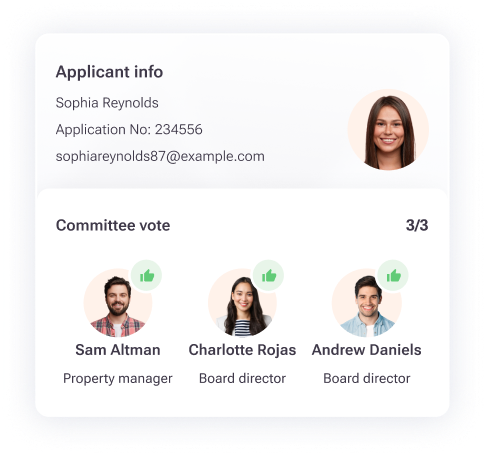
QuickApprove makes approvals faster, clearer, more consistent, and easier to manage while preserving control, compliance, and visibility. It supports high-volume seasons and communities with complex onboarding requirements.
FCRA Compliance And Audit Trails For Associations
Under the FCRA (15 U.S.C. § 1681 et seq.), a community association that orders a consumer report must have a permissible purpose and obtain written authorization on a standalone disclosure. If the report contributes to a denial, the association must issue an adverse action notice. That notice identifies the consumer reporting agency, states that the agency did not make the decision, and informs the applicant of the right to a free copy and to dispute inaccuracies. Skipping the pre-adverse action step has produced class action settlements ranging from hundreds of thousands to tens of millions of dollars, with statutory damages of $100 to $1,000 per violation even without proof of actual harm.
TenantEvaluation’s architecture addresses each of these requirements directly. It provides permissible purpose controls, automated adverse action workflows, clear separation between decision-making by the association and data provision by TenantEvaluation, and built-in audit trails for every application. As a direct reseller of TransUnion and Equifax data, TenantEvaluation accesses bureau data under strict bureau rules with regular compliance reviews and audits.
IDVerify+ strengthens permissible-purpose validation by confirming applicant identity before screening authorization. This alignment reinforces FCRA workflows and audit defensibility.
55+ Community Verification In Florida
Florida condos and HOAs operating as age-restricted communities must satisfy a three-prong test simultaneously. At least 80 percent of occupied units must have at least one resident aged 55 or older, the community must publish and follow policies demonstrating 55+ intent, and it must verify ages by survey at least every two years under HUD’s rules at 24 CFR Part 100, Subpart E. Acceptable proof of age includes a driver’s license, birth certificate, passport, immigration card, military ID, or a signed certification from a household member aged 18 or older. An association without a current age census may be unable to enforce its 55+ provision at all until a proper survey is completed.

TenantEvaluation’s 55+ Communities Verification is a built-in capability that helps Florida condos and HOAs standardize how age-restricted requirements are handled across applications. It reduces manual work, improves documentation consistency, and strengthens internal processes for Community Association Managers. This capability provides documentation-first workflow standardization and control and still leaves legal eligibility determinations and legal advice to counsel.
Lease Tracking And Occupancy Visibility
Lease Tracking inside TenantEvaluation delivers centralized, real-time lease visibility and lifecycle control from application to occupancy. It connects resident onboarding, unit data, approvals, and lease documentation into one streamlined, audit-ready workflow.
Lease status updates in real time, so a manager can see at a glance whether a unit is active, pending, expired, or missing. Lease documents are collected automatically during onboarding and tied to unit-level occupancy records. Every lease and resident activity is searchable and stored as an audit-ready digital record. This structure replaces spreadsheets and scattered email chains and removes operational blind spots that create compliance risk and slow down teams managing high onboarding volume.
See how centralized lease tracking connects your onboarding workflow from application to occupancy.
Pricing Models: Pay-Per-Application Vs. Subscription
TenantEvaluation uses a pay-per-application model with no upfront fees. TenantEvaluation deducts its service fee from the collected application fee and rebates the remainder back to the association or management company. This structure turns application processing into a compliant, controlled income stream rather than an operational cost.
TEpayments by Zinc is a configurable payment workflow integrated into the TenantEvaluation platform that collects application fees, deposits, and other required resident payments within the onboarding process associations already use. Each association defines what is collected and at which stage. Payments go directly from the applicant to the association’s designated account, and TenantEvaluation organizes the workflow without holding funds.
Subscription platforms such as Buildium (starting at $62/month) and AppFolio charge recurring fees regardless of application volume. Pay-as-you-go services such as TransUnion SmartMove ($25–$48 per screen) carry no monthly cost but provide no board workflow, lease tracking, or association-specific compliance architecture. For associations processing consistent application volume, TenantEvaluation’s revenue-sharing model aligns platform success with association revenue in a way subscription competitors do not match.
Applicant-paid screening fees are a standard market practice. Several states and cities cap application or screening fees, require itemized receipts, or mandate refunds in some situations, so associations should confirm applicable state and local rules and apply fees consistently across all applicants.
Biometric Identity Verification: Closing The Document Fraud Gap
Traditional document-based screening cannot reliably stop impersonation or synthetic identity fraud. A 2026 survey of 1,400 landlords and property managers found that 55% have caught or suspected that the person who moved in was not the person who applied, and 82% are worried about fraud in their tenant applications. Snappt’s 2026 Multifamily Fraud Report found that AI-assisted fraud, false rental histories, and synthetic identities have become impossible to spot without robust verification technology. AI-generated document fraud increased fivefold between April and December 2025 alone, according to Inscribe’s 2026 State of Document Fraud Report.
IDVerify+ embeds biometric identity verification directly inside the TenantEvaluation workflow using government ID validation, AI-powered liveness detection, and biometric selfie-to-ID comparison. All verification runs natively inside TenantEvaluation, so applicants and managers avoid external portals and workflow disruption. For a deeper look at how biometric screening is reshaping community association risk management, see TenantEvaluation’s dedicated analysis of biometric identity verification for HOA and condo communities.
IDVerify+ is configurable per condo or HOA and adapted to each community’s risk profile. It supports different community standards and strengthens approval confidence before risk enters the property.
Association-Focused Features To Prioritize
Board Approval Workflows
A purpose-built association screening platform must provide digital panels for board review and voting without exposing raw applicant consumer data. Summarized applicant reports, timestamped voting records, and a connected approval workflow form the minimum standard for defensible board decisions.
Association Compliance
55+ age-restriction documentation, community rule tracking, and Florida-specific workflow configuration function as core operational requirements for Florida CAMs managing governed communities. A platform that handles these items consistently reduces risk and saves staff time.
FCRA Compliance
Permissible purpose controls, standalone written disclosure, written authorization, automated adverse action workflows, and built-in audit trails for every application form the foundation of a legally defensible screening program under Regulation V (12 CFR Part 1022).
Use this checklist when presenting a platform recommendation to your board:
- Board voting dashboard with summarized applicant reports
- Built-in audit trails for every application decision
- FCRA-focused design with permissible purpose controls and automated adverse action
- 55+ age-restriction documentation workflow
- Centralized lease tracking and real-time occupancy visibility
- Fee and deposit collection connected to the onboarding workflow
- Revenue-sharing or pay-per-application pricing model with no upfront fees
- Direct credit bureau reseller relationships (not third-party scraping)
- Biometric identity verification embedded in the screening workflow
Comparison: Association-Specific Criteria
The table below scores four leading platforms against the criteria that matter most to associations. TenantEvaluation is the only option that covers every association-specific requirement in one connected workflow.
| Criterion | TenantEvaluation | Buildium | AppFolio | TransUnion SmartMove |
|---|---|---|---|---|
| Board Voting Dashboard | Yes, dedicated board review and voting panel via QuickApprove | No dedicated board voting dashboard; screening is manager-facing | No dedicated board voting dashboard for associations | No board workflow; applicant-initiated pay-as-you-go reports only |
| 55+ Verification Support | Yes, built-in 55+ Communities Verification for Florida condos and HOAs | No dedicated 55+ documentation workflow | No dedicated 55+ documentation workflow | No 55+ documentation support |
| Lease Tracking | Yes, centralized, real-time Lease Tracking from application to occupancy | Lease management available within broader platform; not association-onboarding-connected | Lease management available within broader platform; not association-onboarding-connected | No lease tracking |
| FCRA-First Design | Yes, direct TransUnion and Equifax reseller, permissible purpose controls, automated adverse action, built-in audit trails | Generates adverse action letters automatically; TransUnion-powered; not association-specific compliance architecture | FCRA compliance features present; not designed around association-specific permissible purpose and board separation requirements | FCRA-compliant bureau reports; no association-specific adverse action workflow or audit trail |
| Pricing Model | Pay-per-application, no upfront fees, revenue-sharing rebate to association | Subscription from $62/month plus per-screen fees ($17–$20) | Subscription-based; per-screen fees vary by plan | Pay-as-you-go; $25–$48 per screen; no subscription |
Frequently Asked Questions
What Is The Best Tenant Screening Software For Condo And HOA Managers?
TenantEvaluation is the best tenant screening software for condo and HOA managers. It is the only platform built exclusively for community associations and management companies and covers board approval workflows, FCRA-compliant adverse action, 55+ age-restriction documentation, centralized lease tracking, biometric identity verification, and connected fee collection in one system. FCRA compliance sits at the core of the platform’s design.
How Does HOA Screening Differ From Landlord Tenant Screening?
HOA and condo screening involves a board of directors in the approval decision and requires FCRA-compliant adverse action workflows that separate data provision from the association’s decision-making authority. It must accommodate 55+ age-restriction documentation for qualifying communities and provide audit trails that satisfy Florida official-records requirements. Landlord screening tools are designed for individual property owners and do not address these association-specific requirements. TenantEvaluation is built around these distinctions from the ground up.
What Is FCRA Compliance For Condo Associations?
FCRA compliance for condo associations means establishing a permissible purpose, disclosing and obtaining written authorization before pulling a report, and following a two-step adverse action process if a report contributes to a denial. The detailed compliance section above walks through each step and shows how TenantEvaluation automates them with audit-ready records.
How Does Screening Software Handle 55+ Community Applications?
A platform built for 55+ communities standardizes how age-restricted documentation is collected and organized across applications. It replaces fragmented manual processes with a consistent, structured workflow. TenantEvaluation’s 55+ Communities Verification reduces manual work, improves documentation consistency, and strengthens internal operational control for Florida condos and HOAs. It supports the biennial age-survey requirements under HUD’s rules at 24 CFR § 100.307 while leaving legal guidance and eligibility determinations to counsel.
How Do Pay-Per-Application And Subscription Pricing Models Compare For Associations?
Subscription models charge a recurring monthly fee regardless of application volume, which creates fixed overhead in both peak and slow seasons. Pay-per-application models align cost with activity and, in TenantEvaluation’s case, include a revenue-sharing structure that rebates a portion of the collected application fee back to the association or management company. For associations with consistent application volume, the pay-per-application model with revenue sharing is usually the more economical and strategically aligned choice.
Conclusion: Making The Board-Ready Recommendation
Generic tenant screening was built for landlords and misses board approval workflows, FCRA adverse action architecture, 55+ documentation standardization, and lease lifecycle visibility. These four requirements define association screening. Every platform in this guide serves some screening need, and TenantEvaluation is the only one built from the ground up for community associations and management companies with FCRA compliance at its core.
When you present a platform recommendation to your board, the checklist above gives you the criteria. TenantEvaluation gives you a yes on every item, and the track record cited earlier shows how it performs at scale.
Bring a board-ready recommendation to your next meeting with a focused TenantEvaluation demo.
