Written by: Luis Teran, Co-founder, CEO, TenantEvaluation | Last updated: August 31, 2026
Key Takeaways for Condo and HOA Screening
- Generic landlord tools like Zillow, TurboTenant, and Avail focus on basic credit and background checks. They do not include board voting dashboards, governing document enforcement, or age-restricted verification that condo and HOA communities require.
- HOA tenant screening platforms need FCRA compliance with direct credit bureau relationships, biometric identity verification, and built-in audit trails to reduce association liability.
- Board approval workflows often create operational bottlenecks. Platforms with dedicated voting dashboards and real-time tracking shorten approval cycles and cut manual follow-ups for CAMs and boards.
- 55+ community verification and lease tracking are specialized capabilities missing from generic platforms. Florida associations managing age-restricted properties rely on these features to maintain compliance and occupancy control.
- TenantEvaluation is purpose-built for community associations and delivers an integrated system for board approvals, 55+ verification, lease tracking, and FCRA compliance. See how TenantEvaluation supports your association’s full workflow.
Why Generic Tenant Screening Fails for HOAs
Manual screening processes, compliance risks, and board approval bottlenecks shape the daily reality for Community Association Managers across Florida. The tools that dominate the landlord market, including Zillow, TurboTenant, and Avail, are engineered for single-family rentals. Generic tools focus on credit reports and basic background checks, but they do not provide board voting dashboards, governing document enforcement, age-restricted community verification, or the audit trails associations require.
The scale of the problem is significant. Approximately 68% of rental properties in Palm Beach County are subject to HOA governance, so most Florida rental transactions carry association-specific compliance obligations that generic tools ignore.
The cost of using the wrong tool compounds quickly. At communities like PGA National in Palm Beach Gardens, a master-planned community with approximately 6,000 residential units, board review cycles run every 2–3 weeks, so a late application submission can delay occupancy by an additional 2–3 weeks. A platform that cannot track application status in real time, notify the right parties automatically, or surface a board-ready approval package turns every cycle into a manual fire drill.
This guide compares the top platforms for condo and HOA managers, including TenantEvaluation, ApplyCheck, AppFolio, Buildium, and Vantaca, using an evaluation framework aligned with association workflows.
Key Criteria for Evaluating Screening Platforms for Condos and HOAs
CAMs and boards need a clear evaluation framework before comparing platforms. HOA resident screening software must support the full association workflow from application intake through occupancy, not just pull a credit report. The must-have features for tenant screening for community associations include:
- FCRA compliance with direct credit bureau reseller relationships with TransUnion and Equifax, instead of third-party data scraping
- Board approval workflows with a dedicated voting dashboard for board members
- Biometric identity verification to confirm applicant identity before approval
- Age-restricted community verification for 55+ properties with documentation consistency
- Lease tracking for condo associations, providing real-time visibility from application to occupancy
- Payment collection integrated into the onboarding workflow
- Built-in audit trails for every application that support FCRA compliance for HOA screening
TenantEvaluation is built specifically for community associations and management companies, with FCRA compliance at the core of the platform. It delivers on every criterion above through purpose-built features: QuickApprove, IDVerify, 55+ Communities Verification, Lease Tracking, and TEpayments by Zinc. Generic platforms address some of these needs partially, while TenantEvaluation connects them in a single system designed for associations.

Condo & HOA Tenant Screening Platforms Comparison Table
The comparison below highlights how five platforms handle board approvals, identity verification, and association-focused compliance. As you review it, focus on which platforms provide dedicated board voting dashboards, native identity verification, and specialized association features, because these capabilities determine whether a platform can truly support association governance.
| Platform | Board Integration | Identity Verification | Compliance & Specialized Rules |
|---|---|---|---|
| TenantEvaluation | QuickApprove board voting dashboard with real-time application tracking, automated communication support, customized approval letters, and a personalized welcome package, all inside one connected platform for CAMs, Boards, and property management teams | IDVerify biometric verification with government ID validation, AI-powered liveness detection, and biometric facial matching, fully embedded in the TenantEvaluation workflow without an external portal | FCRA-focused design with direct TransUnion and Equifax reseller relationships, strict permissible purpose controls, automated adverse action workflows, 55+ Communities Verification, Lease Tracking, and audit trails for every application |
| ApplyCheck | Limited board integration with standardized background check processing and no documented dedicated board voting dashboard | Standard ID and background checks delivered through TazWorks infrastructure | Data security supported by Tazworks, whose systems are certified to adhere to SOC 2 and PCI DSS compliance standards, without specialized 55+ verification or association-grade lease tracking |
| AppFolio | Board member portals with shared documents, reports, and financial dashboards, but no dedicated board voting dashboard or association-native voting workflow documented in public materials | Standard SSN and background validation with Snappt fraud detection embedded in FolioScreen for document fraud | Broad property management suite covering multiple property types and positioned for professional management companies with diverse portfolios, with limited association-specific screening depth |
| Buildium | Board member portals and HOA/COA violation tracking, without a specialized board-voting dashboard or deep association-governance workflow | Integrated TransUnion screening that provides background checks, credit reports, and eviction history | General-purpose platform serving residential rentals, community associations, affordable housing, and student housing. Buildium’s Association Tenant Tracking feature, announced in 2016, allows adding, tracking, and emailing owners and tenants in association units, but does not include 55+ verification or association-specific lease tracking depth. |
| Vantaca | Board and resident portals with mobile board tools for reviewing ARC requests, voting, and pulling reports, built primarily for management company back-office operations | No native screening module, and identity verification is not a documented Vantaca capability | Community management focus with configurable workflow automation, without tenant screening or lease tracking comparable to rental-focused screening software |
Board Approval Workflows in Tenant Screening Platforms
The board approval bottleneck ranks among the most expensive operational problems in community association management. Applications stall in email chains, spreadsheets, and manual follow-ups. Board members lack clear visibility into what needs attention, and managers spend hours chasing status updates that a platform should surface automatically.
The QuickApprove board voting dashboard accelerates resident approvals by replacing that fragmented process with a single connected workflow inside TenantEvaluation. It gives CAMs, Boards, and property management teams real-time application tracking, automated communication support, and reduced manual follow-ups. The platform also generates customized approval letters and a personalized welcome package while maintaining control, compliance, and visibility.

Board members access a dedicated panel with summarized applicant reports and a structured voting workflow. Managers track application progress in real time and trigger automated communication at each stage.
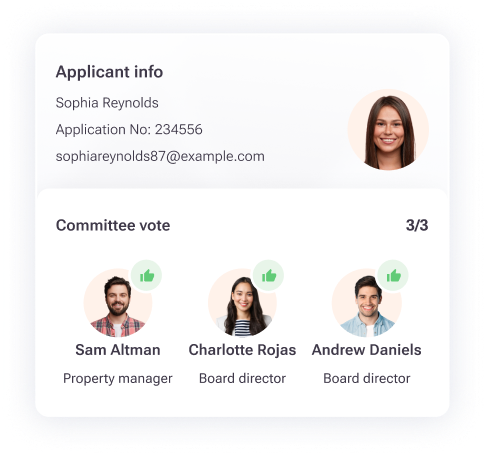
This creates a board-ready approval process suited to high-volume seasons and communities with complex onboarding requirements. Competitors often rely on email chains or provide board portals without a dedicated voting workflow. AppFolio offers board member portals, but its published materials do not document a dedicated board voting dashboard. Buildium provides board portals without a specialized board-voting workflow. Vantaca includes mobile board tools for voting on ARC requests, yet it functions as a community management system rather than a screening platform and does not connect board decisions to a resident application and background check workflow.
Age-Restricted Community Verification for 55+ Associations
Florida has one of the highest concentrations of 55+ communities in the country, and each community carries specific documentation requirements under federal age-restricted housing rules. Manual processes create inconsistent communication, incomplete documentation, and growing administrative burden for CAMs and boards that manage multiple properties.
TenantEvaluation addresses this directly with its built-in 55+ Communities Verification, which reduces manual work by standardizing application handling and enforcing documentation consistency across age-restricted properties. The capability is built for Florida Condos and HOAs, tailored to Community Association Managers, and improves operational efficiency while strengthening internal processes. None of the competing platforms in this comparison provide a comparable built-in capability for age-restricted community verification.

FCRA Compliance and Data Security for Associations
FCRA compliance for HOA screening functions as a core requirement, not an optional enhancement. The FTC requires consumer reporting agencies to verify that clients are legitimate, obtain certifications that reports will be used only for housing purposes, follow reasonable procedures to assure maximum possible accuracy, and provide consumers with access to their files and the right to dispute inaccurate information. Platforms that rely on third-party data scraping or lack association-specific compliance depth create liability exposure for the communities they serve.
TenantEvaluation is built specifically for community associations and management companies, with FCRA compliance at the foundation of the platform. Its proof points include direct credit bureau reseller relationships with TransUnion and Equifax, rather than gray-market or offshore data sources. The platform enforces strict permissible purpose controls and automated adverse action workflows. It also maintains a clear separation between decision-making by the association and data provision by TenantEvaluation, with built-in audit trails for every application.
FCRA filings hit 8,369 in 2025, up 37.4% over 2024, with first-quarter 2026 filings running roughly 40% ahead of the prior year, so choosing a compliant platform directly affects association risk management.
Review TenantEvaluation’s FCRA-focused workflow for your community.
Lease Tracking and Payments for Complete Operational Control
Lease tracking for condo associations now functions as a core operational requirement. Missing or outdated lease copies, manual expiration tracking, disconnected spreadsheets, and the absence of centralized lease visibility create blind spots that slow teams and increase compliance risk tied to incomplete records.
TenantEvaluation’s Lease Tracking delivers centralized, real-time lease visibility and lifecycle control from application to occupancy. It connects resident onboarding, unit data, approvals, and lease documentation in one streamlined workflow, which reduces manual follow-ups and scattered email chains. Real-time lease status, automated lease document collection during onboarding, unit-level tracking, and audit-ready digital lease records replace spreadsheets and email threads that create operational guesswork.
Payment collection runs through the TEpayments by Zinc connected payment workflow inside TenantEvaluation. Application fees, deposits, and other required resident payments are collected within the onboarding process associations already use. Payments move directly from the applicant to the Association’s designated account, and TenantEvaluation never holds the funds. Each Association defines what is collected and at which stage, so the workflow adapts to the property’s process instead of forcing a universal sequence.
Scenario-Based Recommendations for Florida Associations
Three common scenarios show where platform differences matter most for Florida associations.
Scenario 1: Small self-managed HOA in Florida. A volunteer board needs a simple approval process, compliance protection, and no dedicated IT staff. TenantEvaluation’s QuickApprove gives the board a voting dashboard without adding administrative burden. FCRA-focused design reduces the liability exposure that manual processes create.
Scenario 2: Large property management company with multiple associations. A regional director managing a portfolio of communities needs scalability, consistency across properties, and audit trails. TenantEvaluation serves 5,000+ communities and processes approximately 100,000 applications per year. Centralized Lease Tracking and the TEpayments by Zinc connected payment workflow streamline operations across the entire portfolio inside one platform.
Scenario 3: 55+ community in Florida. An age-restricted community needs documentation consistency, occupancy control, and a structured process for handling eligibility requirements. TenantEvaluation’s 55+ Communities Verification and Lease Tracking support consistent documentation and real-time occupancy visibility across applications.
Frequently Asked Questions
What is the difference between tenant screening for landlords and condo/HOA screening?
Condo and HOA screening requires capabilities that generic landlord tools do not provide. Associations need board approval workflows with a dedicated voting dashboard, governing document enforcement, age-restricted community verification for 55+ properties, and audit trails that support FCRA compliance specific to community governance. A landlord tool pulls a credit report and returns a result. An association screening platform manages the full workflow, including application intake, identity verification, background checks, board review, approval documentation, lease tracking, and payment collection, inside one connected system. The compliance obligations also differ, because associations must apply screening criteria consistently across every applicant, maintain complete audit trails, and ensure adverse action workflows meet FCRA requirements within the context of fair housing rules that apply to community governance.
Can an HOA require a background check for tenants?
An HOA can require background checks for tenants, but the policy must be written into board policy or a governing-document amendment, applied evenly to every covered applicant, and reviewed by an attorney before use. HUD guidance under the Fair Housing Act treats an automatic ban on any applicant with any criminal record as a potential source of disparate-impact liability, because criminal conviction rates differ by race nationally. Individualized review that weighs the type of offense, how long ago it occurred, and evidence of rehabilitation reduces fair housing liability compared to blanket disqualification policies. Associations should also confirm whether local ban-the-box rules apply in their jurisdiction before finalizing a rental screening policy. A platform with built-in audit trails and consistent criteria application supports the documentation needed to defend screening decisions.
What is a board voting dashboard in tenant screening?
A board voting dashboard is a dedicated interface within a screening platform where board members can review resident applications, access summarized screening reports, and cast votes digitally. This replaces email chains and spreadsheets with a connected, auditable approval process. In a purpose-built platform like TenantEvaluation, the dashboard gives board members real-time visibility into application status, flags items that need attention, and records each vote with a timestamp for the audit trail. This differs from a general board portal that shares documents and financial reports. A voting dashboard is designed specifically for the resident approval workflow and connects the screening result to the board decision inside one system without requiring board members to manage separate tools or email threads.
How does 55+ community verification work in screening platforms?
In a specialized platform like TenantEvaluation, 55+ Communities Verification standardizes how age-restricted requirements are handled across applications. The platform embeds documentation requirements into the application workflow instead of relying on manual communication, PDFs, and follow-up emails to collect and verify age-related documentation. This approach reduces manual work for CAMs, improves documentation consistency across applicants and communities, and creates more structured records for internal operational control. The capability supports documentation and consistency and does not replace legal guidance. Associations should work with legal counsel to ensure their governing documents and screening policies align with applicable federal and state requirements for age-restricted housing.
What should community associations look for in FCRA-compliant screening platforms?
Community associations should prioritize platforms with direct credit bureau reseller relationships, meaning data comes from TransUnion or Equifax under strict bureau rules instead of third-party aggregators or gray-market sources. Automated adverse action workflows are essential, because the platform should generate compliant notices when an application is denied or receives less favorable terms based on a consumer report, including the required CRA contact information and the applicant’s right to dispute. Built-in audit trails for every application provide the documentation needed to demonstrate consistent criteria application, which forms the strongest defense in a fair housing complaint. Permissible purpose controls that ensure reports are only pulled for legitimate housing evaluation purposes, along with clear separation between the association’s decision-making role and the platform’s data provision role, signal a compliance-first design.
Conclusion: Choosing a Screening Platform for Condo and HOA Governance
Generic tenant screening tools fail community associations because they are built for landlords and do not reflect the board approval workflows, age-restricted verification requirements, and FCRA compliance obligations that define association governance. Platforms that serve associations most effectively are built specifically for this context instead of adapted from multifamily or single-family landlord tools.
TenantEvaluation leads in compliance and association-specific features across every dimension of this comparison. The platform combines the QuickApprove board voting dashboard, IDVerify biometric identity verification, 55+ Communities Verification, Lease Tracking, and the TEpayments by Zinc connected payment workflow inside one platform built for community associations and management companies, with FCRA compliance at its core.
See how TenantEvaluation can streamline your association’s screening and onboarding process.
