Written by: Luis Teran, Co-founder, CEO, TenantEvaluation | Last updated: September 7, 2026
Key Takeaways
- Integrated tenant screening platforms use layered technology that combines biometric identity verification, AI document forensics, direct-source financial checks, and synthetic identity detection.
- Biometric verification stops impersonation by confirming applicants are real people who match their government-issued ID through liveness detection and facial matching.
- AI-driven document forensics and direct-source verification work together to defeat fake documents by analyzing metadata, formatting, and income directly from payroll and banking sources.
- Synthetic identity detection cross-references data from multiple sources to expose identities built from mixed real and fake information that single checks often miss.
- Community associations benefit from specialized, FCRA-compliant solutions like TenantEvaluation, which protect against application fraud while supporting governance and compliance.
The Growing Threat Of Application Fraud In Residential Communities
Fraudulent applicants now target condos, HOAs, and multifamily properties with increasingly sophisticated tactics. The 2024 NMHC Pulse Survey found that 93.3% of property managers experienced rental application fraud in the past 12 months, with 84.3% reporting falsified income documentation as the most common type. Synthetic identity fraud has surged from 1.4% to 11% of all reported fraud in a single year, overtaking true identity theft as a fraud classification. The average rental housing provider now writes off nearly $1 million in bad debt due to fraudulent applications.
For community associations, fraud risk intersects with governance obligations, board liability, and FCRA compliance. Security issues from unverified occupants, financial losses from evictions, and regulatory exposure from negligent screening all converge once fraud reaches a community. Integrated tenant screening fraud detection has become core operational knowledge for Community Association Managers. TenantEvaluation is built specifically for this environment, with FCRA compliance embedded in the platform’s core.
See TenantEvaluation’s multi-layered fraud detection in action by booking a demo.
How Integrated Tenant Screening Platforms Detect Fraud With Layered Defenses
Fraudsters constantly adjust their tactics when a single detection layer blocks them. AI-generated fake documents are easier than ever to produce, with template farms and generative tools selling clean, professional-looking pay stubs and bank statements for a few dollars. A platform that combines multiple, cross-referencing layers catches what single checks miss. Four core layers define integrated tenant screening fraud detection:
- Biometric Identity Verification, which confirms the applicant is a real person who matches their ID
- AI-Driven Document Forensics, which detects forged or altered pay stubs, bank statements, and IDs
- Direct-Source Financial Verification, which confirms income and employment at the source instead of relying on uploads
- Synthetic Identity And Cross-Source Detection, which exposes identities built from mixed real and fake information
Layer 1: Biometric Identity Verification
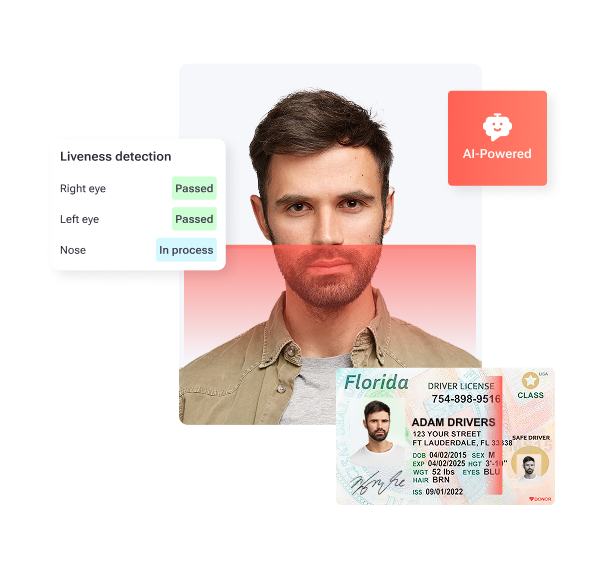
Biometric identity verification confirms that an applicant is a real person who matches their government-issued ID. It runs through three components in sequence.
Government ID Validation scans the front and back of a driver’s license or passport. It checks embedded security features, barcodes, and authenticity markers that document editing tools cannot replicate. AI-Powered Liveness Detection requires a real-time selfie and uses AI to confirm the person is physically present. Facial Biometric Matching then compares the selfie to the ID photo using facial landmark recognition.
This combination stops impersonation and synthetic identities at the point of entry. A stolen ID becomes useless when the platform requires a live selfie that must biometrically match the ID photo. An applicant who submits a stolen ID and tries to pass a screen replay of a photo as a selfie is flagged immediately. Liveness detection confirms the applicant is not physically present.
TenantEvaluation’s IDVerify+ embeds this entire process directly into the screening workflow. Verification results appear inside the screening report with ID authenticity confirmation, liveness status, and biometric match results, giving Community Association Managers a documented, audit-ready identity record for every applicant.
Layer 2: AI-Driven Document Forensics
AI-driven document forensics reviews uploaded pay stubs, bank statements, and IDs for tampering that manual review often misses. The analysis operates across four dimensions.
Metadata Analysis checks whether a PDF was created or edited in a tool like Photoshop instead of a legitimate payroll or banking system. Font And Layout Inconsistency Detection identifies mismatched fonts, misaligned columns, or formatting anomalies that signal post-creation editing. Pixel-Level Anomaly Identification surfaces blurry logos, edited transactions, or visual artifacts introduced during manipulation. Mathematical Verification confirms that year-to-date earnings match pay-period amounts, that tax withholdings calculate correctly, and that bank balances carry forward properly across statements.
When an applicant alters a pay stub to show higher income, the platform’s document forensics detects the edit. The year-to-date total does not match the pay-period math, and the PDF metadata shows creation in an editing tool rather than a payroll system. Document fraud is the fastest-growing screening problem. Automated forensics reduces human error by flagging suspicious documents for structured review instead of relying on visual inspection alone.
Layer 3: Direct-Source Financial Verification
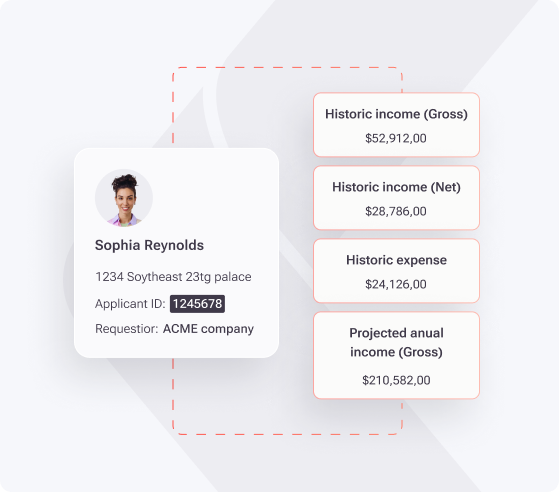
Direct-source verification confirms income and employment directly from the originating system instead of from applicant-uploaded copies. This approach removes the attack surface that document fraud exploits.
Verification Of Income And Employment (VOIE) connects to payroll providers, employers, or bank data networks to pull real-time income and employment history. Payroll Integrations link to systems that connect to over 8,100 payroll processors, covering salaried workers and gig economy freelancers alike. Bank Account Data Aggregation reads real transaction history and recurring deposits to confirm income streams when payroll data is unavailable.
The anti-fraud advantage comes from validating the source of truth. Source-based verification defeats AI-generated pay stubs because the system checks the underlying records. An applicant who claims a $90,000 salary with a polished pay stub is exposed when the direct-source check shows current unemployment.
TenantEvaluation’s IncomeEv report solution contacts employers directly. It goes beyond self-reported data to confirm employment and income with documented verification results that support board-level approval decisions.
Layer 4: Synthetic Identity And Cross-Source Detection
Synthetic identity fraud combines real, stolen, manipulated, and fabricated identity attributes that do not collectively represent one genuine person. Static identity checks, identity verification, and credit bureau data can struggle to detect synthetic identities deliberately designed to appear stable and credible. The issue often comes from artificial consistency.
Integrated platforms address this through cross-source detection across three mechanisms. SSN Cross-Referencing checks whether the Social Security number is valid and matches the applicant’s name and date of birth. Address History Analysis flags addresses that do not match public records or credit bureau data. Portfolio-Wide Pattern Matching connects applications across multiple properties to catch coordinated fraud rings using duplicate phone numbers, employer details, or banking tokens that no single-property review would surface.
When an applicant uses a real SSN with a fake name, the platform’s cross-source check reveals the mismatch. The SSN belongs to a different person, and the application is flagged for review before approval proceeds.
Discover how cross-source detection and biometric verification work together by requesting a demo.
The Compliance Framework For Fraud Detection Platforms
Fraud detection technology must operate inside a strict legal framework. Three regulatory pillars shape how integrated platforms function.
The FCRA (Fair Credit Reporting Act) requires permissible purpose for pulling consumer reports and adverse action notices when information in a report contributes to a denial or conditional approval. This includes co-signer requirements, larger deposits, or higher rent, along with consumer dispute rights. Platforms must maintain documented audit trails for every application to demonstrate compliance.
FTC Enforcement has made the cost of non-compliance clear. The FTC’s July 2026 action against RentGrow resulted in a proposed $2.25 million civil penalty for alleged FCRA violations, including failure to maintain reasonable accuracy procedures and mishandling consumer disputes. Tenant screening companies that lack deduplication controls, complete source documentation, and proper dispute handling face direct regulatory exposure.
HUD Guidance from April 2024 states that the Fair Housing Act applies to tenant screening “including when algorithms and AI are used,” and housing providers remain responsible for outcomes. The association owns the impact of the tool it uses.
TenantEvaluation operates as a highly compliant provider in the community association space. It maintains direct credit bureau reseller relationships with TransUnion and Equifax, strict permissible purpose controls, automated adverse action workflows, and built-in audit trails for every application.
Why Community Associations Benefit From A Specialized Screening Platform
Community associations need screening tools that reflect their governance structure, board oversight, and compliance requirements. HOAs and condos operate under governing documents, board voting rules, and Florida-specific regulations that require workflows designed for their environment.
TenantEvaluation delivers these capabilities across every stage of onboarding.
- QuickApprove accelerates resident approvals with a dedicated board review and voting dashboard, real-time application tracking, automated communication support, customized approval letters, and a personalized welcome package. It supports high-volume seasons and communities with complex onboarding requirements.
- 55+ Communities Verification standardizes age-restricted application handling across Florida condos and HOAs. It reduces manual work, improves documentation consistency, and strengthens operational efficiency while supporting compliance-related processes.
- Lease Tracking provides centralized, real-time lease visibility from application to occupancy. It connects resident onboarding, unit data, approvals, and lease documentation in one audit-ready workflow that replaces spreadsheets and scattered email chains.
- TEpayments By Zinc collects application fees and deposits within the onboarding process, with payments going directly from the applicant to the Association’s designated account. TenantEvaluation organizes the workflow but never holds the funds.
TenantEvaluation is designed exclusively for community associations and management companies. It offers a board dashboard for approvals, FCRA-first compliance design, direct credit bureau reseller relationships, and Florida-specific expertise across more than 5,000 communities and approximately 100,000 applications processed annually.

Key Concepts Recap For Community Association Managers
What Is Synthetic Identity Fraud In Tenant Screening?
Synthetic identity fraud combines real, stolen, manipulated, and fabricated identity attributes that do not represent one genuine person. A common pattern pairs a real Social Security number with a fake name and employment record. Detection is difficult because individual elements can appear valid when checked separately. Integrated platforms address this by cross-referencing SSN validation, address history, and portfolio-wide pattern matching that surfaces reused profiles across properties.
What Are The Most Common Red Flags For Tenant Fraud?
Common red flags include income figures that do not match employment details, documents with mismatched fonts or formatting anomalies, year-to-date totals that do not reconcile with pay-period math, and PDF metadata showing creation in an editing tool instead of a payroll system. Address mismatches with public records and applicants who resist identity verification or pressure managers to skip steps also raise concern. High credit inquiry velocity matters: applicants with 15 or more credit inquiries in the seven days before applying carry a 32% charge-off rate within one year, compared with approximately 9% for the overall applicant population.
Why Do Community Associations Choose Specialized Screening Platforms?
Community associations operate under governing documents, board voting requirements, age-restriction rules, and Florida-specific compliance obligations. HOA and condo boards need transparency into the approval process, documented voting records, and audit trails that support compliance readiness. Platforms built specifically for community associations combine fraud detection, board approvals, lease tracking, and payment collection in one workflow, which reduces administrative burden while maintaining a strong compliance posture.

Conclusion: Protect Your Community With Integrated Fraud Detection
Fraud detection for residential communities works best as a multi-layered, integrated approach. Biometric identity verification, AI-driven document forensics, direct-source financial verification, and synthetic identity detection work together because fraudsters adapt around single checks. Platforms must be FCRA-compliant by design, with automated adverse action workflows, documented audit trails, and direct credit bureau reseller relationships that protect associations from liability.
Community associations benefit from solutions built for their governance structure rather than generic rental tools. TenantEvaluation delivers the fraud detection layers described above alongside board-ready approval workflows through QuickApprove, biometric verification through IDVerify+, age-restricted community support through 55+ Communities Verification, centralized lease lifecycle control through Lease Tracking, and connected payment collection through TEpayments By Zinc.
