Written by: Luis Teran, Co-founder, CEO, TenantEvaluation | Last updated: June 22, 2026
Key Takeaways
- Biometric liveness detection combined with AI-powered document validation blocks impersonation and synthetic identity fraud before board review.
- Florida communities face elevated fraud risk because of dense condo markets, transient populations, and AI tools that create convincing fake documents.
- Layered verification technology, including facial biometric matching, ID authenticity checks, and FCRA-compliant screening, replaces unreliable manual document review.
- Integrated platforms cut approval times by up to 70% while maintaining compliance with FCRA, fair housing statutes, and 55+ documentation requirements.
- TenantEvaluation delivers native biometric fraud detection and board-ready workflows purpose-built for Florida HOAs and condo associations.
Why Florida Associations Face Higher Tenant Screening Fraud Risk
Florida’s dense condo and HOA market, large transient population, and active rental activity across Miami, Fort Lauderdale, Tampa, and Orlando create outsized identity fraud risk in tenant screening. Generative AI tools available in 2026 let bad actors produce convincing fake pay stubs, forged leases, and fabricated government IDs at low cost and high volume. Traditional document-based screening, where a manager reviews an uploaded PDF, cannot reliably distinguish a real document from a sophisticated digital forgery.
The financial stakes are significant. The Internet Crime Complaint Center’s 2024 Annual Report recorded potential losses exceeding $12.5 billion in 2023, and this national trend translates directly to Florida community associations. When fraudulent applicants enter communities through inadequate screening, associations operating under FCRA and state fair housing statutes face compounding liability that mirrors the exposure documented in these national figures. Fraud detection technology for tenant screening in Florida communities has shifted from a competitive differentiator to an operational necessity.
CAMs and boards managing 55+ age-restricted communities, gated developments, and high-rise condos carry even greater exposure. A single fraudulent occupant can trigger legal disputes, insurance complications, and reputational damage that manual review processes cannot reliably prevent.
Key Terms for Florida Biometric Tenant Screening
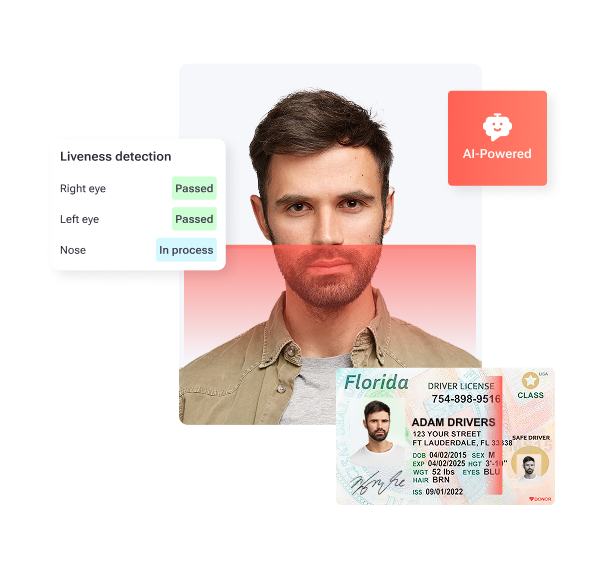
Biometric identity verification for condos is a multi-layer process that validates an applicant’s physical identity against a government-issued document using facial biometric comparison, liveness detection, and ID authenticity checks, all within the screening workflow. This approach moves communities from document-based review to confirmed physical identity before approval.

AI document fraud in tenant screening describes the use of generative AI tools to fabricate or alter application documents, including pay stubs, bank statements, leases, and government IDs, to deceive screening systems that rely on visual or manual review alone.
FCRA (Fair Credit Reporting Act) governs how consumer reports, including tenant screening reports, are obtained, used, and disclosed. It requires permissible purpose, written applicant authorization, and adverse action procedures when screening data influences a housing decision.
Liveness detection is a biometric technique that confirms a submitted identity document or facial image represents a live, physically present individual, not a photo, video replay, or digitally generated substitute. A simple photo of an ID is no longer sufficient for remote onboarding because fraudsters can submit screenshots, printed copies, replayed videos, or fabricated images instead of a real physical document.
Market Trends Shaping Fraud Detection for Florida Communities
The passive liveness detection market shows accelerating institutional adoption. The passive liveness detection market was valued at $1.2 billion in 2024 and is projected to reach $7.8 billion by 2033, growing at a CAGR of 22.5%. AI-based technologies now drive much of this growth.
The vulnerability of single-layer systems is well documented. Peer-reviewed studies on presentation attack detection show that face recognition systems can be vulnerable to spoofing attacks. For Florida community associations relying on document uploads alone, this creates a structural gap that generative AI document forgery exploits directly.
Financial institutions have already moved toward integrated biometric workflows. Many now use automated remote onboarding processes that combine document liveness detection and facial matching. Florida community associations now face the same fraud vectors that drove that institutional shift and need similar layered defenses.
How Biometric Fraud Detection Fits Florida Association Workflows
Biometric screening changes daily workflows for a CAM managing a portfolio of 20 communities. When an applicant submits a government ID and completes a guided selfie verification, the system runs automated liveness detection, facial biometric comparison, and ID authenticity validation before the application reaches board review. Boards then receive a summarized verification result, marked confirmed, flagged, or failed, alongside the full screening report, without manual document inspection.
TenantEvaluation’s QuickApprove accelerated approval workflow connects this verification layer to a board-ready dashboard. Board members see real-time application status, can vote inside the platform, and review AI-generated applicant summaries in one place. Communities using this integrated approach report approval time reductions of up to 70%, with teams recovering up to 50 hours of staff time per day that previously went to manual follow-ups, document chasing, and email-based board coordination.

For 55+ age-restricted communities, TenantEvaluation’s 55+ Communities Verification standardizes how age-restricted application requirements are handled. This structure reduces manual work and improves documentation consistency, which serves as a critical operational control for Florida HOAs managing HOPA-related documentation.
Compliance, Liability, and Governance for Florida Associations
The FTC states that landlords may obtain consumer reports for housing decisions only when they have a permissible purpose and must obtain written permission from the applicant before ordering the report. This requirement applies directly to every Florida HOA and condo association using tenant screening reports.
When a consumer report influences a housing decision, including denial, a higher deposit, or a co-signer requirement, FCRA adverse action notice obligations apply. These obligations require written notice identifying the consumer reporting agency and the applicant’s rights to a free report copy and dispute process.
The FTC Disposal Rule requires reasonable measures to prevent unauthorized access to consumer report information when it is no longer needed, which directly affects how Florida associations store and destroy screening data. Florida’s fair housing statute prohibits making housing unavailable or changing terms because of protected characteristics, requiring consistent verification standards across all applicants.
TenantEvaluation is built specifically for community associations and management companies, with FCRA compliance as the foundation, not an afterthought. As a direct reseller of TransUnion and Equifax data, TenantEvaluation maintains strict permissible purpose controls, automated adverse action workflows, built-in audit trails, and PCI Level 1 data security. These controls keep associations protected from liability exposure at every stage.
Where Traditional Screening Fails Florida CAMs and Boards
Florida CAMs and boards report consistent operational failure points when they rely on traditional screening stacks. Manual document review creates bottlenecks during peak application seasons, especially in coastal markets with high seasonal turnover. Boards that operate through email chains and spreadsheets lack real-time visibility into application status, which creates delays that frustrate applicants and realtors while increasing administrative burden on managers.
Identity fraud exposure remains the most structurally significant gap. Communities relying on document uploads cannot confirm that the person submitting an application matches the identity on the submitted ID, which creates an impersonation vulnerability that synthetic identities exploit directly. These synthetic identities, constructed from real data fragments, pass document-only checks without triggering any alert because there is no physical presence verification. Compounding this gap, generative AI tools in 2026 produce forged pay stubs and bank statements that are visually indistinguishable from authentic documents under manual review, so even legitimate-looking documentation may support a fraudulent identity.
Lease management issues compound the problem. Missing or outdated lease copies, manual expiration tracking, and disconnected spreadsheets create occupancy blind spots that affect compliance readiness and board decision-making. Without a direct connection between applications and active leases, associations carry operational risk that accumulates over time.
Best Practices and New Standards for Florida Screening
Modern identity verification increasingly combines liveness detection, document authenticity checks, face matching, fraud analytics, and step-up authentication because single-layer verification is no longer sufficient against sophisticated spoofing. The emerging standard uses a layered eKYC framework aligned with ISO/IEC 30107 standards for presentation attack detection.
For Florida community associations, best practice now starts with biometric liveness detection embedded natively in the screening workflow, not redirected to external portals, because fragmented verification creates gaps that fraudsters exploit. That biometric foundation should connect to FCRA-compliant adverse action automation so legal compliance does not become a separate manual process. Board-ready dashboards then replace email-based approval chains by surfacing verified applicant data in real time, while standardized 55+ documentation workflows address the unique compliance requirements of age-restricted communities. Finally, centralized lease tracking connects onboarding records to ongoing occupancy management and closes the loop between approval and active residency.
TenantEvaluation’s IDVerify delivers government ID validation, AI-powered liveness detection, and biometric selfie-to-ID comparison natively inside the screening workflow. QuickApprove delivers the acceleration described earlier through real-time tracking, automated communication support, and a board-ready voting dashboard, while maintaining control, compliance, and visibility. 55+ Communities Verification standardizes age-restricted application handling for Florida HOAs and condos. Lease Tracking connects onboarding, approvals, unit data, and lease documentation into one centralized, audit-ready workflow.
How to Evaluate Fraud Detection Platforms in Florida
Florida CAMs and boards evaluating screening platforms can apply six criteria: Florida HOA and condo focus, board-ready dashboard, native biometric integration, FCRA reseller status, lease tracking capability, and 55+ community support. Generic screening tools built for multifamily rentals do not address board governance workflows, Florida-specific compliance requirements, or age-restricted documentation needs.
TenantEvaluation meets all six criteria as a purpose-built platform for Florida community associations, serving 5,000+ communities and processing approximately 100,000 applications annually. Its FCRA-first design, direct TransUnion and Equifax reseller relationships, and native biometric verification through IDVerify position it as the leading integrated solution in this category.
| Criteria | TenantEvaluation | ApplyCheck / Verify Screening Solutions | Snappt | AppFolio |
|---|---|---|---|---|
| Florida HOA/Condo Focus | Purpose-built for Florida community associations | Generic background check platforms using TazWorks, not HOA-specific | Fraud detection focus, not HOA-specific | Broad property management, not HOA-specific |
| Board Dashboard | Dedicated board voting and review panel via QuickApprove | Not available | Not available | Limited, not board-governance focused |
| Native Biometric Integration | Native liveness detection, facial matching, and ID validation via IDVerify | Not available natively | Document fraud detection, biometric liveness not confirmed | Basic ID verification, not biometric-native |
| FCRA Reseller Status | Direct TransUnion and Equifax reseller, FCRA-first design | TazWorks-based, reseller status varies | Not a credit bureau reseller | Screening offered, reseller structure not equivalent |
| Lease Tracking | Centralized, real-time lease lifecycle control built into platform | Not available | Not available | Basic lease management, not onboarding-connected |
Core Technologies Behind Tenant Screening Fraud Detection
Fraud detection in tenant screening in 2026 relies on a layered technology stack rather than a single tool. The primary technologies in use are:
- Biometric liveness detection: Confirms physical presence of the applicant using AI-powered analysis of facial movement and depth, which prevents photo or video spoofing attacks.
- Government ID authentication: Validates security features including barcodes, MRZ data, holograms, and optically variable ink. Document liveness detection confirms that the submitted identity document is physically present, enabling automated decision-making instead of manual review.
- Facial biometric matching: Compares a live selfie to the portrait on the submitted government ID using facial landmark recognition.
- AI document fraud detection: Analyzes uploaded documents, such as pay stubs, bank statements, and leases, for digital manipulation signatures that indicate AI-generated forgery.
- FCRA-compliant background screening: Provides criminal records, eviction history, credit, and income verification accessed through direct bureau relationships under permissible purpose controls.
Effective eKYC journeys require a layered workflow with liveness testing, document authenticity checks, and face matching within one process. TenantEvaluation’s IDVerify, described earlier, delivers this layered stack natively inside the screening workflow.
Choosing the Right Fraud Detection Tool for Florida Communities
The most effective fraud detection tools for Florida HOAs and condos share four characteristics: native biometric integration, FCRA-first compliance design, board-ready governance workflows, and Florida-specific configuration. Generic tenant screening platforms built for multifamily rentals lack the board dashboard, adverse action automation, and 55+ documentation capabilities that Florida community associations require.
Evaluation criteria for Florida communities include:
- Native biometric liveness detection embedded in the screening workflow, not redirected to external portals
- Direct credit bureau reseller status, such as TransUnion and Equifax, with permissible purpose controls
- Automated adverse action workflows that meet FCRA requirements
- Board-ready dashboard with voting capability and real-time application tracking
- 55+ community documentation standardization for age-restricted HOAs and condos
- Centralized lease tracking connected to onboarding and approval records
TenantEvaluation meets all six criteria and has generated $150M for Florida communities through its revenue-sharing model, reflecting the scale mentioned earlier.
AI Document Fraud Risks in Florida Tenant Screening
AI document fraud in Florida tenant screening involves generative AI tools that produce or alter application documents, including pay stubs, bank statements, government IDs, and lease agreements, to deceive screening workflows that rely on visual or manual review. In 2026, these tools are widely accessible and produce output that passes standard document inspection without triggering alerts.
The primary AI document fraud vectors affecting Florida community associations are:
- Fabricated pay stubs and income documents: Generated using AI tools that replicate employer formatting, fonts, and tax data with high visual fidelity.
- Altered bank statements: Real statements digitally modified to inflate balances or remove negative entries.
- Forged government IDs: AI-generated identity documents that pass visual inspection but fail biometric and security-feature validation.
- Synthetic identity applications: Combinations of real and fabricated personal data that pass database checks but do not correspond to a real, present individual.
Countering AI document fraud requires a shift from document review to biometric-confirmed identity. ID document liveness detection reduces presentation-attack risk during remote verification by confirming that the submitted identity document is physically present. The IDVerify capability discussed above addresses these AI document fraud vectors by combining biometric facial matching with the ID validation and liveness detection already described, confirming applicants are real, present, and matched to their identification before approval decisions are made.
Frequently Asked Questions
Does FCRA apply to HOA and condo tenant screening in Florida?
Yes. FCRA applies whenever a community association or management company obtains a consumer report, including credit, criminal, or eviction history, to make a housing decision. This requirement includes written applicant authorization before ordering the report and adverse action procedures when the report influences a denial, deposit increase, or co-signer requirement. Florida associations must also apply consistent screening standards across all applicants to comply with the state’s fair housing statute.
What is the difference between document verification and biometric identity verification?
Document verification reviews the content and formatting of a submitted ID or supporting document. Biometric identity verification confirms that the person submitting the application is physically present and matches the identity on the document, using liveness detection and facial biometric comparison. Document verification alone cannot prevent impersonation or synthetic identity fraud. Biometric verification adds a physical presence confirmation layer that document review cannot replicate.
How does TenantEvaluation handle adverse action requirements?
TenantEvaluation automates adverse action workflows as part of its FCRA-first platform design. When a screening report influences a housing decision, the platform generates the required adverse action notice identifying the consumer reporting agency and the applicant’s rights to a free report copy and dispute process. This automation reduces manual compliance burden for CAMs and boards and maintains a complete audit trail for every application.
Can TenantEvaluation support 55+ age-restricted communities in Florida?
Yes. TenantEvaluation’s 55+ Communities Verification is a built-in capability that standardizes how age-restricted application requirements are handled across applications for Florida HOAs and condos. It reduces manual work, improves documentation consistency, and strengthens internal operational controls, supporting CAMs and boards managing HOPA-related documentation without replacing legal guidance.
Conclusion and Next Steps for Florida CAMs and Boards
Fraud detection technology for tenant screening in Florida communities has evolved beyond document review. Generative AI document forgery, synthetic identities, and biometric spoofing now require layered verification stacks that combine liveness detection, facial biometric matching, ID authentication, and FCRA-compliant background screening inside a single, board-ready workflow.
Florida CAMs, property managers, and HOA and condo boards reviewing their current screening stack should assess whether their platform delivers native biometric integration, automated FCRA adverse action workflows, a dedicated board dashboard, 55+ documentation standardization, and centralized lease tracking, or whether those capabilities sit in disconnected tools or do not exist.
TenantEvaluation is built specifically for Florida community associations and management companies, with FCRA compliance as the foundation, not an afterthought. With the scale and track record described above, plus a 4.8/5 Google rating, TenantEvaluation is the purpose-built platform for communities that require more than generic screening.
Evaluate TenantEvaluation against your community’s screening requirements in a personalized demo.
