Written by: Luis Teran, Co-founder, CEO, TenantEvaluation | Last updated: September 20, 2026
Key Takeaways
- A tenant evaluation platform automates application intake, screening, and board-ready packages, replacing manual workflows with auditable processes.
- TenantEvaluation is purpose-built for Florida condo associations and brings board voting, FCRA compliance, 55+ verification, and biometric ID checks into one platform.
- Boards retain full approval authority while the platform supplies data only, which supports FCRA compliance and keeps decision-making lines clear.
- Florida associations must follow statutory fee caps, servicemember timelines, and fair housing rules, and TenantEvaluation is designed around these requirements.
- TenantEvaluation helps Florida condo associations streamline tenant screening, maintain compliance, and generate revenue while preserving board control.
See How TenantEvaluation Keeps Boards In Control
What A Tenant Evaluation Platform Does For A Florida Condo Association
A tenant evaluation platform for Florida condo associations digitizes and automates every step from application intake to board approval. The strongest options collect applications, gather required documents, run credit and background screening, and deliver a structured package to the board for a vote. This workflow replaces paper forms, email chains, and manual follow-ups with a single auditable process. The platform’s value is measured at the board’s decision point.
Board Authority And Platform Responsibilities
Every Florida CAM and board member should confirm who makes the approval decision before choosing a screening vendor. TenantEvaluation maintains a clear separation between data provision and decision-making. The platform supplies screening data, document collection, and workflow. The association retains decision-making authority.
This division matters legally. Under FCRA § 1681m(a)(3), an adverse action notice must state that the consumer reporting agency did not make the decision to take the adverse action. That requirement confirms that the board, not the platform, is the decision-maker of record. TenantEvaluation’s QuickApprove board voting dashboard gives board members direct access to summarized applicant reports and a structured voting workflow. This setup preserves board authority and eliminates the email chains that slow decisions.

Florida Screening Rules And Application Limits
Florida condo boards derive their tenant approval authority entirely from their governing documents. Under Florida’s Condominium Act (Chapter 718), a condo association’s authority to approve or reject a lease must be expressly granted in the declaration, articles of incorporation, or bylaws. If those documents are silent, the association generally lacks the right to require approval or charge a related fee.
Permissible screening criteria under Florida law and federal fair housing guidance include the following categories:
- Credit: A documented minimum credit score applied uniformly to all applicants.
- Income: A pre-set income-to-rent ratio or debt-to-income threshold, documented in board minutes or a board-adopted policy.
- Rental History: Prior evictions, unresolved lease violations, and negative landlord references reflecting nonpayment or repeated rule violations.
- Criminal History: HUD’s April 2016 guidance treats blanket criminal-record bans as high-risk for disparate-impact Fair Housing Act violations. Any criminal-history criterion must weigh the nature and severity of the offense, time elapsed, and evidence of rehabilitation.
- References: Landlord and personal references, applied consistently to every applicant.
Two operational constraints shape how a platform must work. Florida’s statutory tenant approval fee is capped at $150 per applicant under Fla. Stat. § 718.112(2)(i), with no fee charged on renewal with the same tenant. When a rental applicant is a servicemember, the association must complete review and provide written notice of approval or denial within seven days of submission. Missing that deadline forfeits the right to block the lease.
How 55+ Communities Verify Age Eligibility During Screening
Florida 55+ communities operate under the federal Housing for Older Persons Act (HOPA) exemption at 42 U.S.C. § 3607(b). This exemption requires a three-prong test: at least 80% of occupied units have a resident 55 or older, the community publishes and adheres to policies demonstrating 55+ intent, and it verifies ages by survey at least every two years.

Under 24 C.F.R. § 100.307(d), reliable documentation of age includes a driver’s license, birth certificate, passport, immigration card, military identification, any other official document containing a birth date, or a signed certification by any household member 18 or older asserting that at least one occupant is 55 or older. Any one of these documents suffices.

TenantEvaluation’s 55+ Communities Verification standardizes how age-restricted applications are handled across communities. That consistency reduces manual work for Community Association Managers. The feature is built for Florida condos and HOAs and is designed to strengthen internal processes, while legal counsel continues to guide policy.
With the legal requirements established, boards then need to see which platforms actually deliver on them. The comparison below evaluates the options Florida associations most often consider.
Comparison Table: TenantEvaluation Vs. Applycheck Vs. Verify Screening Solutions Vs. Smartmove Vs. Appfolio/Buildium
The table below compares five common platforms and highlights where each fits and where it falls short for community association governance.
| Platform | Best Fit | Key Limitation |
|---|---|---|
| TenantEvaluation | Florida condo associations and management companies requiring end-to-end onboarding, board voting, FCRA-first compliance, biometric identity verification, and 55+ Communities Verification in one purpose-built platform | Designed specifically for community associations; not a general-purpose rental tool |
| Applycheck | Background check orders for associations already managing their own document workflow | Built on the TazWorks platform, focuses on background checks with no applicant interaction portal and no automated document review or redaction, and no board voting dashboard |
| Verify Screening Solutions | Background check orders for associations already managing their own document workflow | Also built on the TazWorks platform with the same structural limitations as Applycheck, including no board voting, no automated document review or redaction, and no applicant-facing workflow |
| Smartmove | Individual landlords screening single-family rentals | No board voting dashboard, no audit trail built for association governance, no 55+ verification, and workflows that do not match community association needs |
| Appfolio / Buildium | Broad property management portfolios requiring accounting, maintenance, and basic screening in one subscription | Generic tools lack board voting and audit trails purpose-built for community association governance, and the monthly subscription model adds fixed overhead regardless of application volume |
Compare TenantEvaluation To Your Current Process
Vendor Evaluation Checklist For The Board Packet
The following 15 questions are structured for a vendor demo and can be copied directly into a board packet.
- Does the platform maintain a clear separation between data provision (vendor) and approval authority (board)?
- Does the platform include a dedicated board voting dashboard with timestamped, auditable votes?
- Is biometric identity verification (government ID validation, liveness detection, facial biometric matching) built natively into the screening workflow?
- Does the platform generate FCRA-compliant adverse action notices automatically, identifying the reporting agency and the applicant’s dispute rights?
- Is the platform a direct reseller of TransUnion and Equifax data, or does it rely on third-party data aggregators?
- Does the platform enforce the Florida $150 tenant approval fee cap and flag servicemember applications for the seven-day review deadline?
- Is pricing per application or per unit per month, and does the revenue model return application fee revenue to the association?
- Does the platform include automated document redaction of sensitive PII (Social Security numbers, banking details)?
- Does the platform support 55+ Communities Verification with documentation consistency across applicants?
- Does the platform provide a complete, searchable audit trail from application submission through final decision?
- Is the platform PCI Level 1 compliant with end-to-end encryption?
- Does the platform support accelerated approval workflows for high-volume seasons while keeping board oversight in place?
- Does the platform collect application fees and deposits within the onboarding workflow, with funds going directly to the association’s account?
- Does the platform provide centralized, real-time lease tracking from application to occupancy?
- Is the platform built specifically for Florida community associations, or adapted from a generic rental or property management tool?
Bring These Questions To A Demo
Cost And Revenue Model For Florida Boards
Pricing is the next question boards ask after working through the checklist. Tenant evaluation platforms use two primary pricing structures. Per-unit-per-month subscription models (AppFolio, Buildium) charge fixed overhead regardless of application volume, which creates costs even in low-turnover periods. Per-application models charge only when an application is processed, so cost aligns directly with activity.
TenantEvaluation operates on a per-application, revenue-sharing model. The platform deducts its service fee from the collected application fee, and the remainder is returned to the association or management company. Because the fee is only charged when an application is processed, the platform can be cost-neutral or revenue-generating for the association, with no upfront fees. The fee collection itself runs through TEpayments By Zinc, which collects application fees, deposits, and other required resident payments within the onboarding workflow. Payments go directly from the applicant to the association’s designated account, so TenantEvaluation never holds the funds.
Getting Started With TenantEvaluation
If the checklist and comparison above point toward TenantEvaluation, the capabilities below show how the platform maps to the requirements covered in this article.
- QuickApprove provides an accelerated approval workflow with real-time application tracking, automated communication support, customized approval letters, a personalized welcome package, and a board-ready voting dashboard.
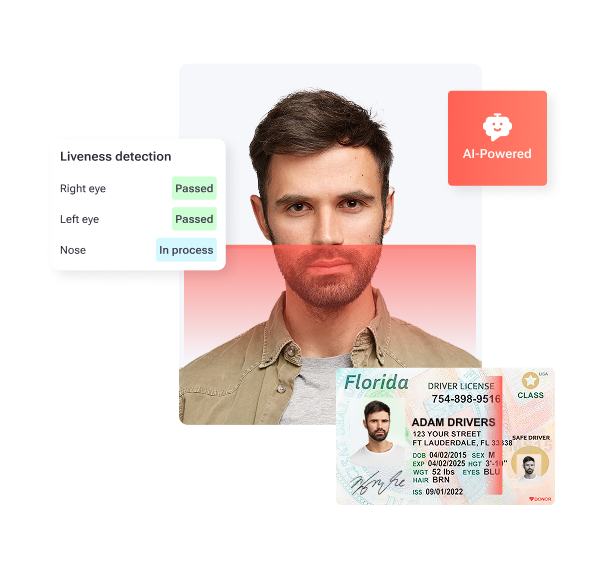
- IDVerify+ delivers biometric identity verification using government ID validation, AI-powered liveness detection, and facial biometric matching, all running inside the TenantEvaluation workflow.
- 55+ Communities Verification standardizes age-restricted application handling and supports documentation consistency for Florida condos and HOAs.
- Lease Tracking offers centralized, real-time lease visibility and lifecycle control from application to occupancy, connecting onboarding, unit data, approvals, and lease documentation in one audit-ready workflow.
- TEpayments By Zinc supports a connected payment workflow for application fees, deposits, and required resident payments, configurable per association, with funds going directly to the association’s designated account.
TenantEvaluation has processed more than 100,000 applications annually across over 5,000 communities, generating $150 million for associations, with a 4.8/5 Google rating.
Frequently Asked Questions
Who Approves A Tenant In A Florida Condo Association?
The board of directors approves or denies a tenant. A tenant evaluation platform supplies screening data, document collection, and workflow, and it does not make the approval decision. This division of labor is the same FCRA requirement described above, which mandates that adverse action notices state that the consumer reporting agency did not make the decision. Florida condo boards must also ensure their governing documents expressly grant approval authority before exercising it, and must apply written, objective screening criteria uniformly to every applicant.
What Documents Can A Florida Condo Board Require From A Tenant?
Florida condo boards may require documents supporting permissible screening categories. Typical examples include government-issued photo ID, proof of income such as pay stubs, tax returns, or bank statements, credit authorization, rental history and landlord references, and written consent for background and credit checks. Criminal history may be considered, but only through individualized assessment of the nature and severity of the offense, time elapsed, and evidence of rehabilitation. Blanket criminal-record bans carry significant Fair Housing Act disparate-impact risk. Boards may not require documents that probe into federally or locally protected characteristics, and must apply the same document requirements to every applicant without exception.
How Do 55+ Communities Document Age Eligibility During Screening?
As covered in the 55+ verification section above, 24 C.F.R. § 100.307 accepts any one of several official documents, such as a driver’s license, birth certificate, passport, or signed household certification, as proof of age. Communities must refresh their surveys at least every two years and maintain a summary available for inspection. The same 55+ verification workflow described earlier in this article applies within TenantEvaluation.
How Much Should A Florida Condo Association Pay For Tenant Screening?
The answer depends on the pricing model the association selects. Per-unit-per-month subscriptions create fixed overhead regardless of application volume, while per-application pricing aligns cost with actual activity. TenantEvaluation’s revenue-sharing model deducts its service fee from the collected application fee and returns the remainder to the association, which can make the platform cost-neutral or revenue-generating without upfront fees. As noted earlier, Florida caps the tenant approval fee at $150 per applicant and prohibits charging it on renewal with the same tenant. Boards should evaluate total cost of ownership, including staff time saved, compliance risk reduced, and revenue returned, alongside the per-application fee.
Start Your Florida Compliance Review
