Written by: Luis Teran, Co-founder, CEO, TenantEvaluation
Key Takeaways
- Florida condo associations benefit from screening platforms built for board-governed approval workflows instead of generic landlord tools.
- TenantEvaluation serves as the benchmark with QuickApprove, IDVerify, 55+ verification, lease tracking, and automated adverse action notices.
- Generic tools like TransUnion SmartMove, Avail, RentPrep, RentSpree, TurboTenant, and Condo Control leave the full approval workflow with the CAM or board.
- Screening Link and Applycheck add some association support but still require manual handling of board voting, 55+ documentation, and audit trails.
- Associations can run their entire approval process inside TenantEvaluation’s connected platform. See how the full workflow fits together.
Why TenantEvaluation Is the Benchmark Platform
TenantEvaluation solves the full resident screening and onboarding workflow for community associations and management companies. It focuses on board-governed approvals instead of generic rental use cases. FCRA compliance sits at the core of the platform. TenantEvaluation is a direct reseller of TransUnion and Equifax data and serves more than 5,000 communities with roughly 100,000 applications processed each year, a 4.8/5 Google rating, and $150M generated for communities.
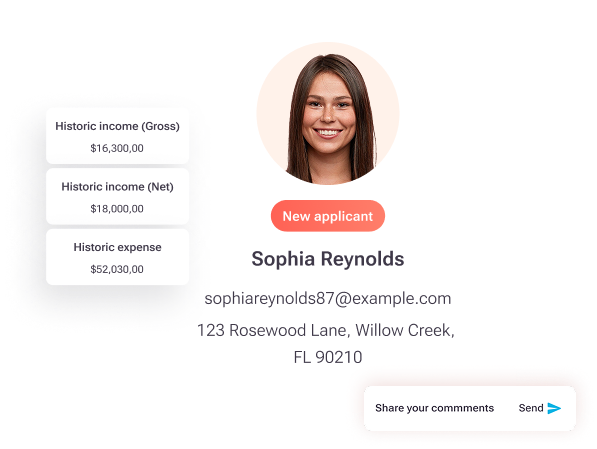
The benchmark capability set includes:
- QuickApprove — an accelerated approval workflow built for CAMs, boards, and property management teams. It includes a board-ready review and voting dashboard, real-time application tracking, automated communication support, customized approval letters, and a personalized welcome package so teams keep control, compliance, and visibility.
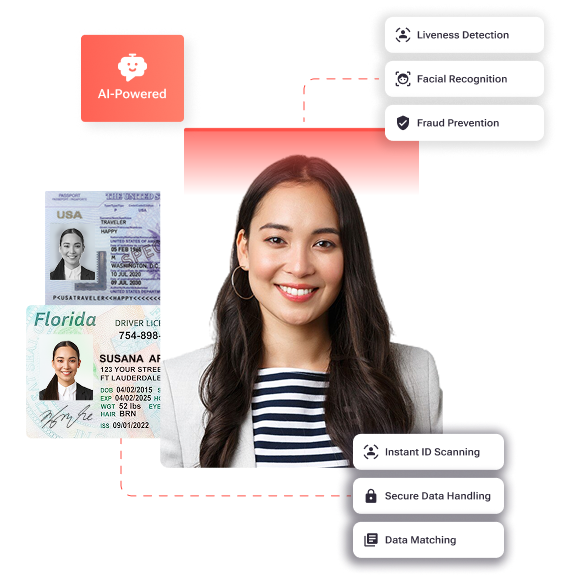
- IDVerify — biometric identity verification embedded directly into the screening workflow, with government ID validation, AI-powered liveness detection, and selfie-to-ID biometric matching.
- 55+ Communities Verification — a built-in capability that gives CAMs and boards one standardized way to collect and refresh age documentation for age-restricted communities, replacing email-and-PDF handling.
- Lease Tracking — centralized, real-time lease visibility and lifecycle control from application to occupancy. It connects resident onboarding, unit data, approvals, and lease documentation inside one platform.
- TEpayments by Zinc — a connected payment workflow that collects application fees and deposits during resident onboarding. Payments go directly to the association’s designated account and TenantEvaluation never holds the funds.
See the full benchmark platform in action.
The Florida Condo Approval Workflow, Mapped End to End
Florida condominium associations operate under Chapter 718 of the Florida Statutes, which grants the association approval rights over leases and sales as defined in the recorded declaration. The approval workflow breaks into six clear stages. Every screening alternative shifts ownership of these stages either to the platform or back to the CAM and board.
Stage 1 — Application Intake and Property Code. “Handled” means the applicant receives a property code, creates an account, and completes a fully digital application with intelligent form logic. “Pushed back” means the CAM emails a PDF, chases incomplete submissions, and re-enters data manually.
Stage 2 — Document Collection. “Handled” means the platform automatically checks for executed leases, valid IDs, and required community documents and rejects incomplete submissions. “Pushed back” means the CAM reviews uploads one by one and follows up by email.
Stage 3 — Identity Verification. “Handled” means biometric verification with government ID validation, liveness detection, and selfie-to-ID matching runs inside the platform before the application proceeds. “Pushed back” means the CAM manually inspects uploaded ID copies with no fraud-detection layer.
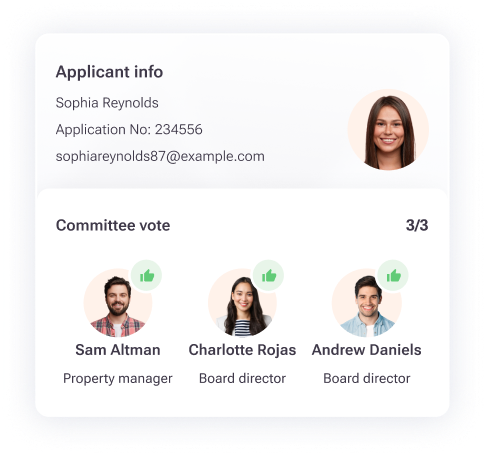
Stage 4 — Board Review and Vote. “Handled” means board members use a dedicated voting dashboard with AI-generated applicant summaries and timestamped vote records. “Pushed back” means the board votes over email chains with no audit trail.
Stage 5 — Adverse Action. “Handled” means the platform automates pre-adverse and final adverse action notices, including the FTC-required Summary of Rights and reporting agency identification. “Pushed back” means the CAM drafts and sends notices manually. A willful failure to send an adverse action notice under the FCRA exposes the violator to statutory damages of not less than $100 and not more than $1,000 per consumer, plus punitive damages and attorney’s fees, while negligent noncompliance exposes the violator only to actual damages and attorney’s fees.
Stage 6 — Record Retention and Audit Trail. “Handled” means every application, document, vote, and notice is stored in a searchable, audit-ready digital record. “Pushed back” means records live across folders, inboxes, and spreadsheets with no centralized retrieval.
The core decision for any board is who owns this approval workflow and how much of it the platform actually handles.
Walk through all six stages in one connected platform.
With that six-stage framework in mind, the next step is to see which vendors truly cover those stages. Two alternatives market themselves directly to community associations.
The Association-Specific Alternatives: Screening Link and Applycheck
Two vendors position their services for community associations rather than individual landlords. The table below compares Screening Link and Applycheck against TenantEvaluation across four capabilities that determine who controls the approval workflow.
| Alternative | Built For Community Associations? | Board Voting Dashboard? | 55+ Verification Supported? | Who Holds the Screening Data? |
|---|---|---|---|---|
| TenantEvaluation | Yes, built exclusively for community associations and management companies | Yes, dedicated board review and voting panel with timestamped audit trail | Yes, 55+ Communities Verification built in | Association retains full audit trail inside the platform |
| Screening Link | Partial, South Florida-based consumer reporting agency with local statutory expertise | No | No built-in workflow | Screening Link as consumer reporting agency |
| Applycheck | Partial, turnkey onboarding and board portal positioning; TazWorks-powered background check tooling | Partial, board portal positioning; end-to-end workflow ownership remains with the CAM | No built-in workflow | TazWorks platform; association-specific audit trail not confirmed |
Screening Link is a South Florida-based consumer reporting agency operating since 2001, headquartered in Fort Lauderdale, Florida, with an office in Davie, Florida. It provides local statutory expertise and screening reports relevant to Florida condo associations. It does not automate the full onboarding workflow, a board voting dashboard, a 55+ documentation workflow, or adverse action automation. The CAM or board handles those stages manually after receiving the report.
Applycheck positions itself as a turnkey onboarding and board portal solution and uses TazWorks-powered background check tooling. It supplies reports and offers board portal access. It leaves the association-specific audit trail, 55+ verification, and end-to-end approval workflow ownership with the CAM or board. The platform provides data, and the association manages the decision chain.
Generic Tools and What You Still Do Yourself
Generic landlord screening tools focus on individual landlords or large rental portfolios instead of community governance. For each tool below, condo-specific tasks such as board voting, 55+ documentation, and audit trails remain with the CAM or board.
TransUnion SmartMove delivers credit, criminal, eviction, and income reports in three tiers priced at $25, $40, and $49 per screening. It is applicant-initiated and report-only. The association still handles board review and vote, document collection, 55+ age verification, adverse action notice issuance, and association-grade audit trail creation. SmartMove supplies reports but does not make the approval decision, so the association manages the entire decision trail.
Avail offers tenant screening and rent collection for individual landlords. The association still manages board voting, document collection, 55+ workflow, adverse action automation, and the association audit trail. No board dashboard exists.
RentPrep provides background screening reports. The association still performs every stage of the condo approval workflow beyond the report itself, including board review, document verification, adverse action, and record retention.
RentSpree runs the rental application and screening together and includes reference checks in its $49.99 report. The association still handles the board voting dashboard, 55+ documentation workflow, adverse action workflow, and association-specific audit trail. Services such as RentSpree provide the screening report, and the housing provider retains the FCRA obligation to send an adverse action notice if the report drives a denial.
TurboTenant focuses on screening, applications, and payments for multifamily rentals. The association still manages board voting, 55+ verification, adverse action, and the association-specific audit trail. Screening data sits outside the association’s governance workflow.
Condo Control is a community management platform with document and communication features. The association still manages integrated screening, board voting on applications, 55+ documentation, adverse action automation, and a connected audit trail from application intake through final decision.
This shift from generic tools to fee structure raises a practical question for boards: who pays for screening and how funds flow through the workflow.
Who Pays for Tenant Screening in a Florida Condo Association
Applicant-paid application fees are the standard structure. Under Florida law, a condominium association’s lease or transfer approval fee may not exceed $150 per applicant, with a husband and wife or a parent and dependent children counted as a single applicant. HOAs do not share this statutory cap, so their fee rules come from the association’s governing documents.
The association or management company can define how it collects fees and can run a revenue-sharing model. TenantEvaluation deducts its service fee from the collected application fee and rebates the remainder back to the association or management company. This structure turns application processing into a compliant, controlled income stream rather than a cost center.
With TEpayments by Zinc, payments go directly from the applicant to the association’s designated account, and TenantEvaluation never holds the funds. Because each association defines what is collected and at which stage, the capability adapts to the property’s existing process instead of forcing a universal sequence. This alignment means the CAM stops chasing payments across disconnected tools.
FCRA Obligations That Stay With the Association
A vendor’s FCRA compliance claim does not make the association’s screening policy compliant. The association retains four obligations that no vendor can absorb.
Permissible Purpose. Under the FCRA, a consumer report may only be obtained for a permissible purpose, such as a valid housing or tenancy decision. The association must certify that purpose before ordering any report.
Consistent Written Screening Criteria. Setting a rigid minimum credit score can create fair housing issues if it has a disparate impact on protected classes. The association must document its threshold in writing and apply it identically to every applicant. A screening score or recommendation does not replace the rental decision itself, and the housing provider remains responsible for its criteria, decision, notices, fair treatment, and applicable local requirements.
Adverse Action Notices. Under 15 U.S.C. § 1681m, a landlord must send an adverse action notice when a credit report contributes to a denial or worse rental terms. The notice must identify the consumer reporting agency and state that the agency did not make the decision. It must also inform the applicant of their right to a free copy within 60 days. Skipping the notice can result in statutory damages up to $1,000 per violation, plus actual damages and attorney’s fees.
Record Retention and Audit Trail. Screening records should be retained per applicable federal and state schedules, and consumer information should be disposed of according to FTC disposal rules. The association owns this obligation and must be able to produce a defensible record.
TenantEvaluation supports these obligations with direct credit bureau reseller relationships with TransUnion and Equifax, strict permissible purpose controls, automated adverse action workflows, clear separation between decision-making by the association and data provision by TenantEvaluation, and built-in audit trails for every application. IDVerify+ further strengthens permissible-purpose validation by confirming identity before screening authorization, which reinforces FCRA-aligned workflows and audit defensibility.
These FCRA duties sit alongside another major compliance area for Florida boards: 55+ and age-restricted community documentation.
55+ and Age-Restricted Community Documentation
Under the federal Housing for Older Persons Act (42 U.S.C. § 3607(b)) and Florida’s mirror provision (FS § 760.29(4)), a 55+ community must continuously satisfy three conditions. At least 80% of occupied units must have at least one resident age 55 or older. The community must publish and follow policies that show its intent to operate as 55+ housing. It must also verify ages by survey at least every two years under HUD rules at 24 CFR Part 100, Subpart E.
HUD’s rule at 24 CFR § 100.307 allows the routine occupancy verification process to be folded into a community’s normal sale and lease approval workflow. This structure makes the association screening process the natural point where age documentation is collected and refreshed. Florida 55+ communities commonly impose tenant approval procedures with a processing window before occupancy and require age verification of every occupant because a tenant counts toward the community’s 80% compliance calculation.
For Florida condos and HOAs, fragmented manual processes with emails, PDFs, and repeated follow-ups create inconsistent documentation, higher risk in audits or disputes, and unnecessary administrative burden. 55+ Communities Verification is a built-in capability within TenantEvaluation that gives CAMs and boards one standardized workflow for collecting and updating age documentation. It replaces ad hoc email handling with consistent records. It functions as a workflow and documentation tool rather than a legal verification system and does not replace legal guidance.

Frequently Asked Questions
What Is the TenantEvaluation Workflow in Florida?
TenantEvaluation in Florida refers to a connected workflow that covers application intake, document collection, background and credit screening, identity verification, board review and vote, and approval or denial with any required adverse action notice. The platform supports the full governance process instead of only producing a background check report.
Who Pays for Tenant Screening in a Florida Condo Association?
Typically the applicant pays an application fee. For condominium associations, Florida law caps the transfer or lease approval fee at $150 per applicant, with a husband and wife or a parent and dependent children counted as one applicant. HOAs are not subject to the same statutory cap, so their fee rules come from the governing documents. Associations and management companies can structure fee collection and may use a revenue-sharing model where the vendor’s service fee is deducted from the collected application fee and the remainder is rebated back to the association or management company.
How Far Back Does a Condo Association Background Check Go?
Screening reports typically cover criminal and eviction history within federal, state, and local limits. The FCRA restricts reporting of certain adverse information beyond seven years for most records, although convictions have no federal time limit. The association’s written screening criteria should specify the lookback period the board adopts and apply it uniformly to every applicant. Arrest records that did not lead to a conviction require careful policy review under HUD fair-housing guidance, which cautions against blanket exclusions that may create disparate impact on protected classes.
Do Condo Boards Benefit From Board Voting Dashboards for Approvals?
No Florida statute requires a board voting dashboard as a matter of law. Without one, boards often vote over email chains and spreadsheets with no timestamped audit trail, no centralized record of who voted and when, and no direct connection between the vote and the underlying application documents. A board-ready review and voting dashboard keeps the decision inside one connected, auditable workflow, which reduces liability exposure and makes the association’s record more defensible if a denied applicant disputes the outcome.
How Do 55+ Communities Verify Age-Restricted Applicants?
55+ communities verify age through a routine documentation process folded into the sale and lease approval workflow. Federal rules at 24 CFR § 100.307 accept any one of several documents as reliable proof of age, including a driver’s license, birth certificate, passport, immigration card, military identification, or a signed certification from any household member age 18 or older stating that at least one occupant is 55 or older. The community must survey its entire occupancy at least every two years to confirm the 80% threshold and must preserve inspectable survey documentation. TenantEvaluation’s 55+ Communities Verification standardizes this handling across applications and improves documentation consistency for Florida condos and HOAs.
Conclusion: Choosing Who Owns the Approval Workflow
The comparison across alternatives points to one structural decision. Every board must decide who owns the approval workflow and how much of it the platform manages. Screening Link and Applycheck bring association-specific context but leave significant manual work with the CAM or board. Generic landlord tools such as SmartMove, Avail, RentPrep, RentSpree, TurboTenant, and Condo Control deliver reports and leave the entire governance workflow with the association.
The association’s FCRA obligations around permissible purpose, consistent written criteria, adverse action notices, and record retention remain in place regardless of vendor marketing. The platform that handles the greatest share of the workflow reduces the association’s exposure and simplifies its paperwork.
Use the six-stage workflow from earlier in this article as the buyer’s checklist when you evaluate any alternative. TenantEvaluation is the benchmark platform for community associations and management companies, with FCRA compliance built into the design rather than added later.
See how every stage of the Florida condo approval workflow fits together inside one connected, audit-ready platform.
