Written by: Luis Teran, Co-founder, CEO, TenantEvaluation
Key Takeaways
- Community association board management separates governance, where the board sets policy and votes, from execution, where the manager handles daily operations.
- First-term directors must understand the legal limits on individual authority, because only the full board can approve budgets, contracts, assessments, and rule changes.
- Proper meeting procedures, including notice, quorum, recorded votes, and compliant minutes, keep decisions legally valid under Florida law and reduce liability.
- Directors must disclose conflicts of interest, recuse themselves when needed, and maintain professional conduct to uphold fiduciary duties and avoid selective enforcement claims.
- Once governance decisions are made, platforms like TenantEvaluation’s lease tracking tools streamline resident screening, lease tracking, and onboarding, which reduces liability and administrative work for boards and managers.
What Community Association Board Management Actually Means
The governance-execution split shapes what a director does every day. Because the manager handles vendors, staff, and daily operations, a director’s role stays focused on oversight. Your core job is to attend meetings, vote, review materials, and oversee the manager’s work against board policy. Anything that looks like running the property yourself, such as directing staff, negotiating with vendors, or deciding alone, falls outside that role.
Board of directors responsibilities include:
- Governance and collective decision-making
- Adopting and amending the annual budget
- Setting enforcement policy
- Approving contracts and special assessments
- Directing and evaluating the manager
- Exercising fiduciary judgment on behalf of the membership
Management company duties include:
- Drafting the budget for board approval
- Collecting assessments and handling bookkeeping
- Coordinating maintenance and vendor work
- Tracking covenant violations against board-set policy
- Administering records and notices
- Handling emergency response within delegated authority
The board approves the budget, and the manager drafts it. The board sets enforcement policy, and the manager tracks violations. When boards try to perform operational work themselves, directors burn out and their governance decisions suffer.
Five Core HOA Board Positions And Their Roles
A typical HOA or condo board has five positions: president, vice president, secretary, treasurer, and directors-at-large, who serve as non-officer directors.
- President: Presides over meetings, sets the agenda with the manager, signs contracts the board has already approved by vote, and serves as spokesperson. The president cannot commit the association alone, cannot hire or fire vendors without a board vote, and cannot direct the attorney without board authorization. The president holds one vote, the same as every other director.
- Vice President: Assumes the president’s role when absent and typically owns a defined area of oversight such as a committee or capital project. This seat’s duties vary widely between associations, so the bylaws provide the reliable answer.
- Secretary: Serves as custodian of records, including minutes, notices, membership records, and correspondence. Accurate minutes are the primary evidence that the board followed a sound process, which is what the business judgment rule protects.
- Treasurer: Oversees finances, builds the budget with the manager, reviews monthly statements, monitors reserve funding, and reports to the board in plain language. A treasurer does not need to be an accountant and, in a professionally managed association, should not perform the bookkeeping.
- Directors-At-Large: Vote on board decisions, lead or join committees, liaise with residents or vendors, oversee special projects, and serve as emergency backups if an officer cannot perform their duties, steps down, or is removed.
Under Florida Statute §720.303(1), governance authority rests with the board of directors as a body. The president runs the meeting but holds one vote, just like every other director.
Limits On An HOA President’s Authority
Under Florida law, governance authority is vested in the board as a body, and no individual officer can exercise that authority alone.
The president’s role is defined by the association’s bylaws and Florida’s Not-for-Profit Corporation Act (§617.0841), which states that each officer has “the authority and shall perform the functions set forth in the bylaws.” Typical functions include presiding at meetings, executing already-authorized documents, serving as spokesperson, and acting in genuine emergencies subject to later ratification.
Actions that require a formal board vote include:
- Adopting or amending the annual budget
- Levying special assessments
- Entering into contracts
- Hiring or firing vendors
- Adopting or changing rules
- Filing lawsuits or settling claims
- Amending governing documents
- Spending outside the approved budget
If a president signs a contract the board never approved, the vendor may have an enforceable contract through apparent authority, which leaves the association liable and the president in breach of fiduciary duty. Consult association counsel before signing anything the board has not voted on.
How Board Decisions Are Made In Florida
Board decisions require a properly noticed meeting with a quorum present, a motion, a second, and a majority vote, with narrow exceptions.
Meetings: Under Fla. Stat. §720.303(2)(a), a meeting of the board of directors of a Florida HOA occurs whenever a quorum of the board gathers to conduct association business; §718.112(2)(c) governs condominium board meeting notice and open-meeting requirements. Meetings must be open to members except for attorney consultations on litigation and personnel matters.
Notice: Under Fla. Stat. §720.303(2)(c)1., notices of all HOA board meetings must specifically identify agenda items and be posted in a conspicuous place at least 48 hours in advance, except in an emergency. For special assessments or rule changes on unit use, 14-day mailed, delivered, or electronically transmitted notice is required in addition to posting.
Quorum: Under Florida Statute 718.112(2)(b), quorum for a Florida condo board meeting is a majority of the directors unless the bylaws specify a different number. If quorum fails, the board cannot conduct business, and the minutes must note “no quorum, meeting adjourned.”
Voting: Under Fla. Stat. §720.303(2)(c)3., directors may not vote by proxy or secret ballot at board meetings, except that secret ballots may be used in the election of officers. Each director’s vote or abstention must be recorded in the minutes.
Action Without A Meeting: Florida Statutes §718.112(2)(c) for condominium associations and §720.303(2) for HOAs permit board action without a meeting only by unanimous written consent of all board members, so a simple majority is not enough. Using written consent as a workaround for open meeting requirements is improper.
What Happens If The Board Loses Quorum? Florida HOA and condo boards may discuss issues without a quorum present, but they cannot vote or take official action without a quorum. The board can cure by ratifying any action through a re-vote at a properly noticed subsequent meeting.

Private Board Conversations And Florida Law
Two board members can discuss association business privately, yet serial communications that effectively make decisions outside a noticed meeting create liability.
A meeting occurs when a quorum gathers to conduct association business. Two directors usually do not constitute a quorum, but if those two directors are the president and vice president and they agree on a course of action, they may have effectively decided the matter without board authorization.
Email and text messages are official association records that can be used as evidence in disputes, enforcement actions, and legal proceedings. Directors may use email as a means of communication but may not cast a vote on an association matter via email.
If you are unsure whether a conversation crosses the line into an improper meeting, consult association counsel before acting on it.
Who Takes Minutes And What Should Never Be In Them
The board secretary holds responsibility for meeting minutes, although a management representative may draft them for the secretary’s review.
Minutes carry high liability in community association board management, because they serve as the association’s primary legal record.
Who Is Responsible: The board secretary is legally responsible for preparing and maintaining meeting minutes in most associations; in smaller communities this role may fall to the board president or another designated officer. The secretary signs the final approved minutes to certify their accuracy.
Florida-compliant minutes must include:
- Date, time, and location of the meeting
- Type of meeting, such as regular, special, or emergency
- Whether proper notice was given and how
- Directors present, including in person, remote, or absent, and confirmation of quorum
- Each agenda item considered
- Each motion made, who seconded, the vote count, and any abstentions
- Material discussion summarized neutrally, rather than a full transcript
- Any owner comment made on a motion
- Action items assigned, to whom, with deadlines
- Adjournment time
Minutes must never include:
- Personal opinions or board member debate
- Homeowner commentary beyond noting that the forum occurred
- Emotional statements or characterizations
- Letters or other correspondence
- Legal strategy discussions
- Sensitive details such as delinquency amounts, violation descriptions, and personal homeowner data
- Confidential content of executive session
Executive Session: In the open minutes, record only the time and general category, such as “legal consultation” or “personnel matter.” Keep confidential details in separate, restricted-access executive session minutes. Any action that results from the session must be taken and recorded in open session.
Download the Florida Board Meeting Compliance Checklist to keep these requirements at your fingertips at every meeting.
HOA Board Code Of Ethics And Director Conduct
Conflicts Of Interest: A conflict arises when a director’s personal, financial, or external interests could influence, or appear to influence, their duty to act in the association’s best interests. Under Fla. Stat. §718.3027, when a condominium director or officer has an actual or presumed conflict, the proposed activity must be listed on the meeting agenda, all related documents attached, and approval requires a two-thirds affirmative vote of all other directors present.
Unprofessional Conduct: Selective enforcement of rules violates the duty of good faith and creates a selective enforcement defense that can invalidate the association’s ability to enforce the rule entirely. Retaliation against homeowners, sharing confidential association information, and deciding without adequate information each breach a specific fiduciary duty.
Annual Declarations: Best practice is an annual conflict-of-interest statement where directors confirm any interests that could reasonably come up again.
When you are unsure whether a relationship rises to a conflict that requires recusal, disclose it and let the board decide, or consult association counsel.
Overseeing The Manager And Vendors
Setting Expectations: The board directs, and the manager implements. Define annual expectations together in writing. A manager can handle collecting assessments, bookkeeping, maintenance coordination, architectural requests, notices, covenant enforcement tracking, records administration, and emergency response.
Reviewing Performance: Evaluate the manager’s performance annually, in writing, based on well-defined and mutually agreed-upon expectations.
Non-Delegable Board Duties: The board cannot delegate voting on association business, adopting the annual budget, setting policy, approving contracts and assessments, exercising fiduciary judgment, or directing and evaluating the manager.
If the board is considering terminating the management company or a major vendor, consult association counsel before acting to avoid breach-of-contract liability.
Florida Compliance And Official Records
Meeting Notice: Under Fla. Stat. §720.303(2)(c)1. for HOAs and §718.112(2)(c)1. for condos, notice of all board meetings must specifically identify agenda items and be posted in a conspicuous place at least 48 hours in advance, except in an emergency. For special assessments or rule changes on unit use, 14-day mailed, delivered, or electronic notice is required.
Official Records Retention: Under Fla. Stat. §720.303(4)(a), the association’s official records carry a 7-year retention clock unless the governing documents require longer. Bids must be kept for 1 year. Ballots, sign-in sheets, and proxies must be kept for at least 1 year after the election, vote, or meeting.
The full text of Florida Statutes Chapter 720 (HOAs) and Chapter 718 (Condominiums) is publicly available. When in doubt about notice requirements, record retention, or inspection requests, consult association counsel before the meeting.
Compliance is only half the job, though. The other half is deciding who carries out the day-to-day work, whether the board itself or a hired manager.
Self-Management Vs. Hiring A Management Company
Self-Management: The board handles both governance and execution. This model works for small, low-complexity associations with engaged directors who have time and relevant expertise. Risks include burnout, inconsistent enforcement, compliance gaps, and difficulty scaling as the community grows or ages.
Hiring A Management Company: The board governs, and the manager executes. This model suits larger associations, communities with complex amenities, or boards whose directors lack time or expertise. The non-delegable board duties remain with the board regardless of management structure.
Whichever model you choose, the execution layer that follows board decisions often consumes the most time. Resident screening, application approval, lease tracking, and payment collection create both workload and liability for boards and CAMs.
TenantEvaluation focuses on that execution layer for community associations and management companies, with FCRA compliance built into the foundation. With 5,000+ communities and approximately 100,000 applications processed per year, TenantEvaluation supports the operational workflows that follow board governance decisions.
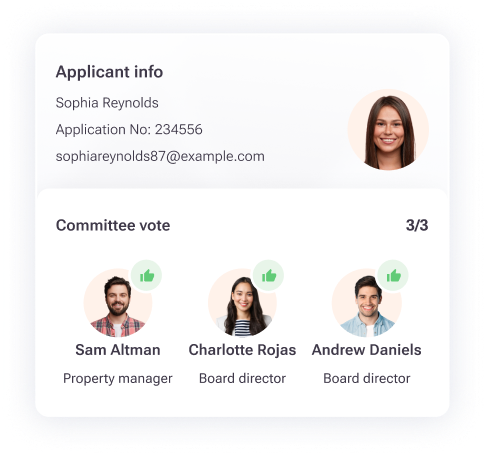
Key platform capabilities include:
- QuickApprove: An accelerated approval workflow with real-time application tracking, reduced manual follow-ups, a board-ready review and voting dashboard, customized approval letters, and a personalized welcome package, while preserving control, compliance, and visibility.
- IDVerify+: Biometric identity verification with government ID validation, AI-powered liveness detection, and selfie-to-ID biometric matching, built for condo and HOA risk environments.
- Lease Tracking: Centralized, real-time lease visibility and lifecycle control from application to occupancy. The platform connects resident onboarding, unit data, approvals, and lease documentation into one streamlined, audit-ready workflow that replaces spreadsheets and scattered email chains.
- TEpayments By Zinc: A connected payment workflow inside TenantEvaluation that collects application fees and deposits during resident onboarding. Payments go directly to the association’s designated account, and TenantEvaluation never holds the funds.
Verify Screening Solutions offers background checks but lacks applicant interaction and fully automated document review and redaction. ApplyCheck is described as similar. TenantEvaluation provides an all-in-one platform designed for community associations rather than generic rental screening.
The table below compares how three platforms handle that execution layer, so you can see how a purpose-built association platform differs from generic background-check tools.
| Feature | TenantEvaluation | ApplyCheck | Verify Screening Solutions |
|---|---|---|---|
| Built For Community Associations | Yes | No, generic background checks | No, generic background checks |
| Board-Ready Dashboard | Yes | No | No |
| FCRA Compliance Foundation | Yes | Partial | Partial |
| Automated Document Review/Redaction | Yes | No | No |

Frequently Asked Questions
Can Two Members Of The Same Household Serve On An HOA Board?
Eligibility for board service by members of the same household depends on state law and the association’s governing documents. Some associations require board members to be homeowners with their names on the title. Others explicitly prohibit two members of the same household from serving simultaneously to prevent decisions from consistently tipping in a single household’s favor. Florida law does not impose a blanket prohibition, but the association’s bylaws may. Directors should review the governing documents before accepting a nomination and consult association counsel if the bylaws are ambiguous.
What Is Unprofessional Conduct Of A Board Member?
Unprofessional conduct includes selective enforcement of rules, retaliation against homeowners, sharing confidential association information outside authorized channels, making decisions without adequate information, and acting outside the scope of authority granted by the governing documents and Florida law. Each of these behaviors breaches a specific fiduciary duty of loyalty, good faith, or care. Florida HB 1203, effective July 1, 2024, introduced criminal penalties for certain director conduct, including a third-degree felony for knowingly soliciting or accepting kickbacks and a first-degree misdemeanor for intentionally destroying or failing to maintain accounting records.
Who Can I Complain To About My HOA?
The Florida Department of Business and Professional Regulation (DBPR) accepts complaints about HOA governance violations. For condominium associations, the DBPR Ombudsman may also be involved. The Community Associations Institute (CAI) provides educational resources and referrals to qualified community association attorneys. For disputes involving recall, election irregularities, or records access, Florida Statute §720.311 requires pre-suit mediation for many HOA disputes before proceeding to circuit court.
Conclusion And Next Steps
First-term directors must navigate complex procedural requirements, including meeting notice, quorum, voting, minutes, conflicts of interest, and manager oversight, often with limited time and no dedicated legal budget. The mechanics covered in this guide give you the operational foundation: what you can and cannot do alone, how decisions get made legally, how meetings and minutes work, how to oversee a manager without micromanaging, and where the main liability traps sit.
The governance mechanics in this guide only pay off when the execution layer behind them holds up. That is where a purpose-built platform like TenantEvaluation fits, by handling screening, approvals, lease tracking, and payments so the board can stay focused on policy.
