Written by: Luis Teran, Co-founder, CEO, TenantEvaluation
Key Takeaways
- Community association management software centralizes accounting, payments, work orders, communication, document storage, and violations for HOAs and condos. Most platforms still leave resident screening and onboarding to manual processes or separate tools.
- Three pricing models dominate the market: per-unit monthly, flat subscription, and quote-only enterprise. Hidden minimums and fees can significantly inflate effective costs for smaller communities.
- Core feature categories include financial management, maintenance, communication portals, document storage, and compliance workflows. Resident screening and onboarding remain the most common gap in standard CAM platforms.
- TenantEvaluation fills this gap with FCRA-compliant screening, biometric identity verification, lease tracking, and payment collection. It serves thousands of communities and processes a high volume of applications each year.
- For a complete community association management stack, pair your CAM platform with a specialized screening and onboarding layer.
How HOA Management Companies Choose Their Software Stack
Management model and community type drive software selection. Self-managed boards, professional management companies, standard communities, and 55+ age-restricted properties each have different needs. Choosing the wrong platform for your model creates friction that configuration cannot fix.
A practical decision framework runs in four steps:
- Identify your management model: self-managed board, single-association management company, or portfolio management firm.
- Count your units and associations: unit count determines pricing tier and whether monthly minimums inflate your effective per-door cost.
- List the operational gaps you want to close: accounting, communications, violations, work orders, resident screening, lease tracking, or payment collection.
- Decide whether you need a full CAM platform, a specialized screening and onboarding layer, or both.
According to Vantaca’s 2026 HOA software buyer’s guide, the modern CAM platforms most commonly encountered include Enumerate, PayHOA, Smartwebs, Vantaca, and CINC Systems, with Vantaca and CINC Systems described as the two market leaders. Each covers some combination of financial management, maintenance, communications, document storage, and violations. Two of them, AppFolio and Buildium, also include resident screening as a basic add-on: AppFolio’s FolioScreen™ Trusted Renter generates FCRA-compliant reports, and Buildium integrates TransUnion and On-Site screening into its application process. These add-ons still do not replace a dedicated screening and onboarding layer.
That gap is where TenantEvaluation operates. Founded in 2007 and purpose-built for community associations and management companies, TenantEvaluation is the recommended first choice for the screening, onboarding, compliance, lease tracking, and payment layer. It serves a large footprint of communities and processes a significant volume of applications annually, with partners including RealManage, Castle Group, Vesta, FirstService Residential, Campbell Property Management, and Associa.
See how the screening layer fits your current CAM platform.
How Much Does Community Association Management Software Cost?
Three pricing models dominate the market, and each has a different trap for buyers who do not read the fine print.
Per-unit monthly pricing is the most common model. Industry comparisons place the typical range at $1 to $5 per unit per month, used by platforms including Buildium and AppFolio. The trap is the monthly minimum. AppFolio’s Core plan carries a roughly $298 monthly minimum and a 50-unit minimum, meaning an 80-home association pays an effective $3.73 per home, which more than doubles the advertised rate. A monthly minimum is the single most misleading number in HOA software pricing. Divide the minimum by your unit count before comparing platforms.
Flat monthly subscription pricing charges a fixed amount regardless of unit count, sometimes with a per-unit component above a threshold. PropMIS uses a hybrid model of $99 per month plus $3 per unit above 10 units. RunHOA charges a flat $399 per year for unlimited units. This structure rewards larger communities but may be thin on features for complex associations.
Quote-only enterprise pricing applies to platforms like CINC Systems, Vantaca, and Enumerate. Enumerate publishes a $500-per-month software minimum, requires an annual contract, and charges a one-time implementation cost. Shortlisting three vendors that hide pricing commits a buyer to three sales cycles before they can put three numbers side by side.
Free tiers deserve a clear-eyed look. Free HOA software tiers universally lack general ledger accounting, financial reporting, budget management, architectural reviews, violation tracking, elections, and audit trails. Free tiers also carry no compliance layer for screening.
TenantEvaluation’s model is structurally different from all three. It operates on a pay-per-application basis with no upfront fees. A revenue-sharing model deducts TenantEvaluation’s service fee from the collected application fee and rebates the remainder to the association or management company. This structure makes the screening and onboarding layer cost-neutral or revenue-generating instead of a monthly subscription line item.
Core Feature Categories to Evaluate
Cost is only half the decision. What you actually get for that cost matters more. The following six categories cover the operational areas that matter most in a CAM platform evaluation, and each one includes a practical question to bring into demos.
Financial management covers dues billing, assessment schedules, reserve tracking, accounts payable and receivable, bank reconciliation, and financial reporting. Association accounting requires four capabilities that generic small-business accounting tools do not provide: per-unit ledgers, assessment schedules, reserve tracking, and delinquency aging. Because reserve tracking is a core requirement, the demo question to ask is whether the platform separates operating and reserve funds automatically or requires manual journal entries.
Maintenance and work orders covers vendor management, repair request intake, work order routing, and status tracking. Ask whether work orders connect to the violation workflow or sit in a separate module.
Communication portals cover homeowner portals, board announcements, mass email and text, and statutory notice delivery. Florida condominium associations with 25 or more units must maintain a compliant website or mobile-friendly platform with required records accessible by January 1, 2026, and HOAs with 100 or more parcels were required to have a compliant website by January 1, 2025 under HB 1203. Ask whether the platform satisfies these statutory disclosure requirements out of the box.
Document storage covers governing documents, meeting minutes, contracts, inspection reports, and financial statements. Ask how records are exported if the association changes platforms, and what happens to records after cancellation.
Compliance and violations/ARC covers violation tracking, escalation ladders, fine workflows, architectural review requests, and hearing documentation. Florida HOAs must give an owner at least 14 days’ written notice of the right to a hearing before imposing a fine or suspension, and the hearing must be held before an independent committee rather than the board. Ask whether the platform automates this notice sequence or requires manual tracking.
Resident screening and onboarding is the category many overviews omit. It also represents the largest operational gap in most CAM platforms. The next section covers this layer in detail.
Does CAM Software Handle Resident Screening and Onboarding?
Most CAM platforms do not handle screening and onboarding at the depth community associations need. They treat resident communication as the finish line and leave screening, identity verification, lease tracking, and fee collection to spreadsheets, email chains, or disconnected third-party tools.
TenantEvaluation is built specifically for this layer and is built for FCRA compliance from the start. Its capabilities cover the full onboarding lifecycle.
All-in-one 100% online application platform runs on web and mobile. It covers digital document collection, e-signatures, background checks via SafeCheck+, credit checks through direct reseller relationships with TransUnion and Equifax, and income verification via IncomeEV. Compliance controls sit underneath all of it, including strict permissible purpose limits, automated adverse action workflows, and built-in audit trails. Decision-making stays with the association, while TenantEvaluation provides the data.
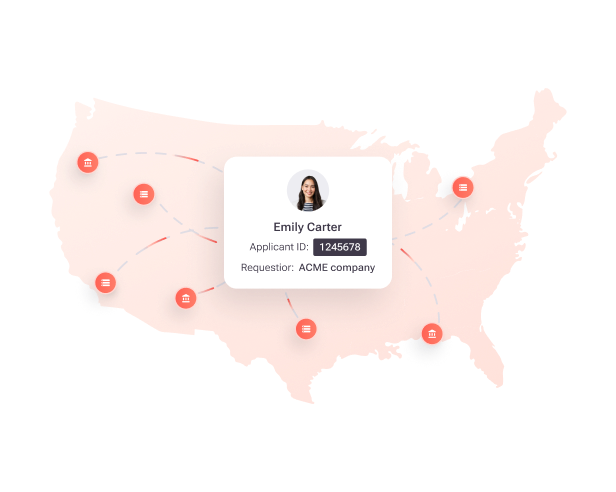
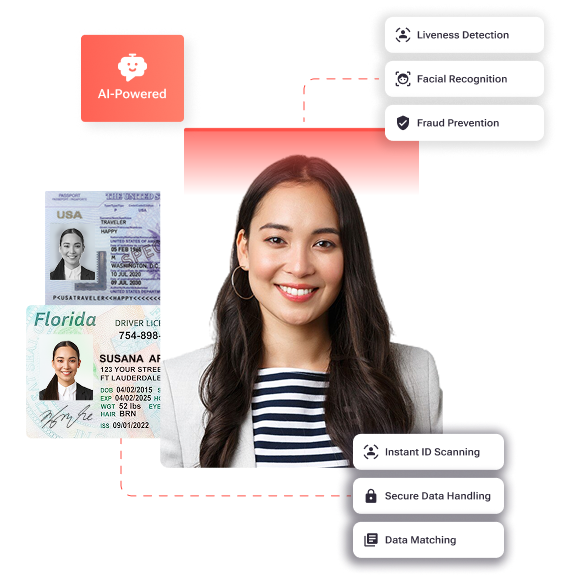
IDVerify is biometric identity verification running natively inside the screening workflow. It combines government ID validation, AI-powered liveness detection, and biometric selfie-to-ID comparison. Basic document review is no longer enough because an uploaded image does not prove the ID is authentic, the applicant is physically present, or the person matches the document. IDVerify moves communities from document-based review to biometric-confirmed identity, with a fraud-prevention layer configurable per community and per portfolio.
QuickApprove is an accelerated approval workflow built for CAMs, boards, and property management teams inside one connected platform. It delivers real-time application tracking, a board-ready review and voting dashboard, automated communication support, customized approval letters, and a personalized welcome package. Communities gain faster, clearer, more consistent approvals while maintaining control, compliance, and visibility. It is designed for high-volume seasons and communities with complex onboarding requirements.
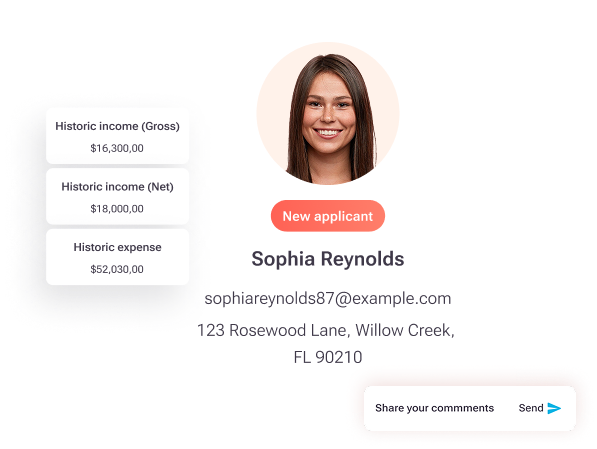
Lease Tracking provides centralized, real-time lease visibility and lifecycle control from application to occupancy. Real-time lease status (active, pending, expired, or missing), automated lease document collection, unit-level tracking, and audit-ready digital records replace the spreadsheets and scattered email chains that create operational blind spots and compliance risk.
TEpayments By Zinc is a connected payment workflow inside TenantEvaluation that collects application fees, deposits, and other required resident payments during onboarding. Payments go directly from the applicant to the Association’s designated account, and TenantEvaluation never holds the funds. Each association defines what is collected and at which stage.
55+ Communities Verification is built for Florida condos and HOAs managing age-restricted communities. It standardizes how age-restricted application requirements are handled across applications, reduces manual work, supports documentation consistency, and strengthens internal processes without replacing legal guidance.

These six capabilities show how a complete screening and onboarding layer works in practice. Walk through the full onboarding workflow with a TenantEvaluation specialist to see how it fits your communities.
Self-Managed HOA vs. Professional Management: Which Software Fits?
Management model and community size shape the right software stack. The table below shows that the CAM platform layer changes with community size and management model, while the screening-and-onboarding layer stays consistent across all four situations.
| Community Situation | CAM Platform Layer | Screening & Onboarding Layer |
|---|---|---|
| Self-managed, under 50 units | Flat-fee or low-cost per-unit platform (e.g., PayHOA, RunHOA, KindHOA) | TenantEvaluation, pay-per-application, no upfront cost, revenue-sharing offsets cost |
| Professionally managed, single association | Purpose-built CAM platform with full accounting and violation workflows | TenantEvaluation with FCRA-compliant screening, IDVerify, QuickApprove, Lease Tracking |
| 55+ age-restricted community | CAM platform with document storage and disclosure compliance | TenantEvaluation with 55+ Communities Verification for standardized age-restricted application handling |
| Large portfolio or enterprise management company | Enterprise CAM platform (CINC Systems, Vantaca, Enumerate) with multi-association accounting | TenantEvaluation with portfolio-level configuration, board dashboards, audit trails, and compliance defensibility |
Self-managed communities under 50 units often still run screening manually. This is where spreadsheet screening breaks down and where TenantEvaluation’s revenue-sharing model pays for itself. Professionally managed companies and enterprise portfolios need portfolio-level configuration, board dashboards, audit trails, and compliance defensibility. TenantEvaluation serves both ends, from small self-managed communities to large enterprise management companies.
What the Demos Won’t Tell You
Choosing the right stack is only half the work. The other half is understanding what the sales demo leaves out. Four recurring pain points surface after the demo ends.
- Implementation lift and data migration can surprise teams. Enterprise HOA software onboarding and migration fees start in the hundreds of dollars and can reach five figures, with 4–8 week implementation timelines being normal. Ask for the implementation scope in writing before signing.
- Board adoption resistance slows rollouts. Volunteer boards need intuitive interfaces and minimal training. Platforms built for professional management companies often have steep learning curves for board members who log in once a month.
- Hidden fees often sit in payment processing. ACH transactions usually cost pennies, but card payments run 2.9% or more. Some platforms also charge a flat EFT fee per transaction. At 300 homes paying monthly, a $2.35 per-EFT fee adds up to $8,460 a year.
- Screening still done in spreadsheets remains common. Most CAM platforms do not surface this gap in their demos because they do not solve it. Teams discover it after go-live when the first application arrives.
TenantEvaluation’s verifiable proof points include a long operating history, thousands of communities served, roughly six figures of applications processed annually, $150M generated for communities, PCI Level 1 compliance, end-to-end encryption, automatic redaction of sensitive PII, and a 4.8/5 Google rating.
Florida-Specific Considerations
Florida is one of the largest and most actively regulated community association markets in the United States. Florida has approximately 48,000 community associations governing millions of residents, and the 2024–2025 Florida legislative sessions produced material changes to Chapters 468, 553, 718, and 719, while Chapter 720 was left largely unchanged.
Key Florida-specific factors that affect software selection:
- Florida requires CAMs to hold a professional license when they receive compensation for management services and the association contains more than 10 units or has an annual budget exceeding $100,000. Software must support the audit trails and recordkeeping that CAM license renewals and DBPR oversight require.
- Florida condominium buildings three habitable stories or higher must complete a Structural Integrity Reserve Study (SIRS) at least every 10 years, with compliance statements filed with the state. Software that handles document storage and disclosure must be able to surface these records on demand.
- 55+ age-restricted communities in markets including Miami, Fort Lauderdale, Palm Beach, Tampa, St. Petersburg, Clearwater, Sarasota, Fort Myers, Orlando, and Jacksonville face peak application seasons that amplify every manual process. TenantEvaluation is built for Florida-specific regulations and workflows, with customized setups that match each community’s governing documents and screening criteria.
- Florida condominium associations with 25 or more units must maintain a compliant website or mobile-friendly platform with required records accessible by January 1, 2026. Confirm that your CAM platform satisfies this requirement before selecting it.
Frequently Asked Questions
What Is the Best Software for Community Management?
No single platform fits every community. The answer depends on management model, unit count, and which operational gaps need closing. Full CAM platforms, including PayHOA, AppFolio, CINC Systems, Vantaca, Buildium, Enumerate, TownSq, and Condo Control, handle accounting, communications, violations, and work orders. As noted earlier, some include basic screening add-ons, but these do not match a purpose-built screening layer. TenantEvaluation is the strongest fit for the broader screening, onboarding, and payment layer, and it works alongside any CAM platform rather than replacing it.
What Software Do HOA Management Companies Use?
Professional management companies typically use enterprise CAM platforms such as CINC Systems, Vantaca, or Enumerate for portfolio-level accounting and operations. Self-managed communities more commonly use per-unit or flat-fee platforms like PayHOA, TownSq, or Buildium. Across both segments, the screening and onboarding layer, including FCRA-compliant background checks, identity verification, lease tracking, and payment collection, is usually handled separately. TenantEvaluation serves both self-managed communities and large enterprise management companies, including firms like RealManage, FirstService Residential, and Associa.
How Much Does Community Association Management Software Cost?
The three main pricing models are per-unit monthly, flat monthly subscription, and quote-only enterprise pricing. As covered above, each model carries its own hidden-cost traps, such as monthly minimums, implementation fees, or payment-processing markups. TenantEvaluation operates on a pay-per-application model with no upfront fees and a revenue-sharing structure that rebates part of the application fee to the association or management company, which often makes it cost-neutral or revenue-generating.
Does CAM Software Handle Resident Screening?
Most CAM platforms do not include deep resident screening capabilities. They usually lack FCRA-compliant background checks, direct credit bureau data from TransUnion and Equifax, biometric identity verification, automated adverse action workflows, and application-fee collection inside the onboarding process. These functions are typically left to spreadsheets, email chains, or disconnected third-party tools. TenantEvaluation is purpose-built to fill this gap and is built for FCRA compliance from the start.
What Is the Best HOA Software for Self-Managed Communities?
Self-managed communities under 50 units typically do well with affordable, simple platforms such as PayHOA, RunHOA, KindHOA, or TownSq for accounting, communications, and violations. The gap these platforms share is resident screening. Most self-managed communities still run screening manually, which is where errors, compliance exposure, and revenue loss accumulate. TenantEvaluation’s pay-per-application model with no upfront fees suits self-managed communities that cannot justify a monthly screening subscription but still need FCRA-compliant processes and biometric identity verification.
Conclusion: Narrow the Market to Two Options
The decision framework stays simple. Identify your management model, understand the pricing model and what the monthly minimum does to your effective per-door cost, confirm which feature categories you need, and decide whether you need a full CAM platform, a specialized screening and onboarding layer, or both.
Full CAM platforms handle accounting, payments, work orders, communication, documents, and violations. TenantEvaluation handles the layer those platforms leave open: FCRA-compliant resident screening, biometric identity verification via IDVerify, accelerated approvals via QuickApprove, centralized lease tracking, connected payment collection via TEpayments By Zinc, and standardized age-restricted application handling via 55+ Communities Verification. The platform is built for compliance from the ground up and tailored to community associations and management companies.
Build your complete community association management stack with TenantEvaluation.
