Written by: Luis Teran, Co-founder, CEO, TenantEvaluation
How This Screening Model Pays for Itself
- Florida associations can shift screening costs to applicants while earning rebates that create zero-net-cost or profit per application.
- Manual screening workflows consume 4.8 hours of labor per vacancy and increase FCRA and Fair Housing risk through inconsistent processes.
- TenantEvaluation operates as a direct TransUnion and Equifax reseller with bureau agreements, strict permissible-purpose controls, and automated FCRA compliance.
- QuickApprove, IDVerify+, Lease Tracking, and TEpayments work together to speed board decisions, prevent fraud, centralize leases, and route payments directly to associations.
- Associations can review these revenue-sharing and automation capabilities at TenantEvaluation and turn screening into a revenue asset.
The Real Cost of Chasing Fees and Board Approvals
Florida CAMs and LCAMs managing 100 to 5,000+ units carry heavy operational costs that generic screening tools ignore. NARPM’s 2025 State of Property Management survey reports that property managers using manual workflows spend an average of 4.8 hours of administrative labor per vacancy on screening and leasing tasks. Manual CV screening alone costs about $0.73 per resume in recruiter time, before any report fee.
Labor inefficiency is only half the problem. Manual board approval workflows also create significant liability exposure. Paper-based or non-FCRA-compliant tools leave associations without the audit trails required for fee and approval documentation and demand consistent, documented screening criteria. Inconsistent application of screening standards, even with the same form, is a frequent source of Fair Housing complaints in Florida. Every manual touchpoint becomes a potential compliance gap.
How the TransUnion Reseller Model Works for Associations
TenantEvaluation acts as a direct reseller of TransUnion and Equifax data and follows strict bureau rules with regular compliance reviews and audits. The platform does not use gray-market or offshore data sources. The cost-shifting structure follows a simple sequence:
- The applicant pays the application fee online during onboarding.
- TenantEvaluation deducts its service fee from that collected amount.
- The remainder is rebated directly to the association or management company.
This structure removes upfront screening costs for the association. The ROI analysis then focuses on labor savings, vacancy reduction, and rebate accumulation, not report fees. Most residential property managers already pass screening fees to applicants as application fees, so the per-application cost to the property manager is effectively $0.
800-Unit Florida Portfolio: What the Margins Look Like
An 800-unit Florida condominium or HOA portfolio with moderate annual turnover typically processes around 120 applications per year. Each application carries an applicant-paid fee that sits within the statutory limits for that community type. TenantEvaluation deducts its screening and platform service fee from that amount and returns the remaining margin to the association as a rebate.
TenantEvaluation’s fee structure operates within the statutory limits established under §718.112 for condominiums and Chapter 720 for HOAs. Spouses or a parent and dependent children count as a single applicant for fee purposes. Exact service fee splits are configured per portfolio based on volume and fee structure.
Vacancy cost recovery amplifies the impact of these rebates. Automation shortens screening time and reduces vacancy-related revenue loss. When you combine faster approvals with labor savings and per-application rebates, the association’s position typically shifts from cost center to zero-net-cost or profit.
FCRA Compliance Architecture Built for Resellers
The FTC’s enforcement history makes FCRA compliance mandatory for any reseller model. The FTC’s $2.25 million civil penalty against RentGrow, a reseller that failed to maintain reasonable accuracy procedures, disclose data sources, and handle disputes correctly, shows how risky weak compliance can be.
TenantEvaluation addresses these risk vectors through a layered FCRA compliance design. At the foundation, direct credit bureau reseller relationships with TransUnion and Equifax ensure legitimate data sources, not third-party scraping. These bureau relationships require strict permissible-purpose controls on every data request, which TenantEvaluation enforces automatically. When a consumer report contributes to a denial, automated adverse action workflows trigger the required notices under 15 U.S.C. §1681m. Throughout the process, decision-making authority stays with the association or board, while TenantEvaluation provides data and workflow automation. Built-in audit trails capture every application step with timestamps and searchable records, creating the documentation regulators expect.
Written consent is required before running background checks or credit reports under the FCRA, and willful noncompliance can result in statutory damages of $100 to $1,000 per violation. TenantEvaluation collects this consent digitally within the application before any bureau query begins.
QuickApprove: Board Decisions in Days, Not Weeks
QuickApprove is TenantEvaluation’s accelerated approval workflow for CAMs, boards, and property management teams inside one connected platform. It replaces email chains and spreadsheets with real-time application tracking, a structured board approval process, automated communication, customized approval letters, and a personalized welcome package. Boards keep control, compliance, and visibility while moving faster.
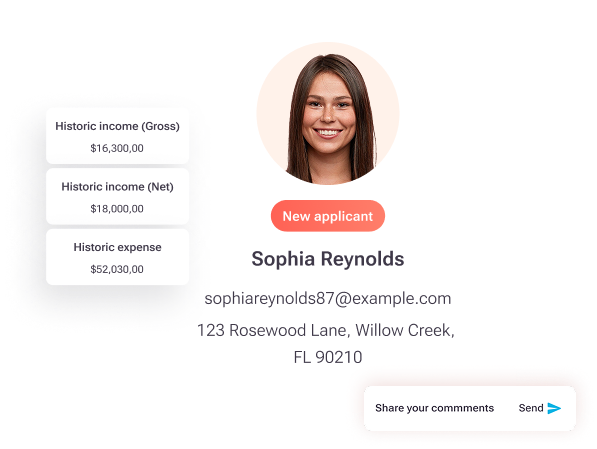
Board members use a dedicated review and voting dashboard with AI-generated applicant summaries and timestamped vote records. Automated screening workflows shorten time-to-decision, which directly protects association revenue during busy application seasons. Florida law also requires HOAs and condominium associations to process applications from active-duty service members and issue written approval or denial within seven days. QuickApprove helps boards meet that deadline consistently.
Schedule a demo today to see the QuickApprove board dashboard in action.
IDVerify+: Biometric Identity Checks Inside the Application
IDVerify+ adds automated KYC verification directly inside TenantEvaluation. The workflow includes government ID validation, AI-powered liveness detection, facial landmark recognition, and biometric selfie-to-ID comparison without sending applicants to external portals. Verification results appear inside the screening report as ID authenticity status, liveness status, biometric match result, and a redacted ID copy for compliance records.

The fraud environment that justifies this layer is severe. Sumsub’s Q1 2025 identity fraud trends report shows a 311% increase in synthetic identity document fraud in North America between Q1 2024 and Q1 2025. A 2024 NMHC survey found that 93.3% of owners, managers, and developers experienced rental application fraud in the prior 12 months, including 70% who encountered fraudulent identity information. The Snappt and CLEAR partnership identified over 5,400 fraudulent applications and prevented more than $10 million in potential bad debt within six months, which shows the scale of recoverable loss when biometric verification is applied consistently. IDVerify+ also strengthens permissible-purpose validation by confirming identity before screening authorization, which supports FCRA-aligned workflows and audit defensibility.
Lease Tracking: One View from Application to Move-In
Lease Tracking is a centralized operational feature inside TenantEvaluation that connects resident onboarding, unit data, approvals, and lease documentation in one audit-ready workflow. It provides real-time lease status visibility, including active, pending, expired, or missing leases. It also automates lease document collection during onboarding, ties unit-level tracking to occupancy records, and replaces spreadsheets and scattered emails with a searchable digital history.
Boards gain a clearer picture of occupancy and resident activity across communities. CAMs avoid manual follow-ups and reduce compliance risk from incomplete or disconnected records. Every lease stays connected, searchable, trackable, and ready for audit from application through occupancy.
TEpayments by Zinc: Direct-to-Association Payment Flow
TEpayments by Zinc is an integrated payment workflow inside TenantEvaluation that collects application fees, deposits, and other required resident payments during onboarding. Funds move directly from the applicant to the association’s designated account, and TenantEvaluation never holds the money. Each association defines what to collect and at which stage, so the capability adapts to the property’s existing process instead of forcing a rigid sequence.
Boards receive traceable payment records and clear visibility into where funds go. This structure removes spreadsheet tracking and email chasing and replaces them with a single, auditable payment trail.
How TenantEvaluation Compares to SmartMove, Findigs, AppFolio, and RealPage
SmartMove and Findigs focus on applicant-facing screening and deliver credit and background reports. They do not provide revenue-sharing rebates to associations, board voting dashboards, biometric identity verification, or centralized lease tracking. Their pricing models charge a flat fee to the landlord or applicant with no margin returned to the association.
AppFolio and RealPage operate as broad property management platforms with screening modules. Both rely on monthly per-unit subscription fees, which create fixed costs instead of a zero-net-cost or profit-generating structure. They do not offer a dedicated board review and voting panel, a Florida-specific FCRA reseller compliance architecture, or the combined QuickApprove, IDVerify+, and Lease Tracking stack in a single ecosystem built for community associations.
TenantEvaluation uses a pay-per-application model with revenue-sharing that aligns the platform with client success. There is no monthly subscription and no upfront fee. The platform has processed 100,000+ applications annually across 5,000+ communities and has generated $150 million for those communities, a scale that generic screening tools and broad property management platforms have not matched in the Florida community association segment.
Frequently Asked Questions
Is the TransUnion reseller model legitimate for Florida HOAs?
Yes. TenantEvaluation is a direct reseller of TransUnion and Equifax data and operates under bureau agreements with strict permissible-purpose controls, regular compliance reviews, and no gray-market data sources. Florida HOAs and condominium associations fall under the FCRA when they obtain consumer reports, and TenantEvaluation’s architecture, including written consent collection, automated adverse action notices, and clear separation between data provision and decision-making, fits this regulatory environment. Florida Statutes §718.112 caps condominium transfer fees at $100 per applicant, while Chapter 720 imposes no statutory cap on HOA fees. TenantEvaluation’s fee structure operates within these limits.
How quickly can an 800-unit portfolio see positive ROI?
Larger portfolios often reach payback within several months when vacancy savings enter the calculation. A portfolio with moderate annual turnover generates a steady flow of applications each year, and a positive rebate margin per application can create substantial gross annual rebates before labor savings are counted. Adding staff-time savings, where NARPM’s 2025 benchmarks show automation reduces the administrative labor mentioned earlier from 4.8 hours to under 1.2 hours per vacancy, and vacancy duration recovery, the combined ROI is usually positive within the first year. Exact timelines depend on turnover rate, configured fee structure, and current manual labor costs.
What board-access features does TenantEvaluation provide?
TenantEvaluation’s QuickApprove workflow includes a dedicated board review and voting dashboard that gives board members real-time access to application status, AI-generated applicant summaries, and a structured voting panel for approvals. All board actions are timestamped and auditable. This setup replaces email chains and spreadsheets with a connected approval process inside TenantEvaluation, so boards can decide faster without losing control, compliance, or visibility. The dashboard is a distinctive capability in the Florida community association market, and generic screening tools and broad property management platforms do not offer an equivalent board-specific interface.
How does TenantEvaluation maintain FCRA separation?
FCRA compliance for resellers requires a clear boundary between the entity that supplies consumer report data and the entity that makes adverse decisions based on that data. TenantEvaluation maintains this separation by providing screening data and workflow automation while the association or board makes the approval or denial decision. Written applicant consent is collected digitally before any bureau query. Adverse action notices trigger automatically when a consumer report contributes to a denial, and audit trails attach to every application. IDVerify+ confirms identity before screening authorization, which reinforces permissible-purpose validation and FCRA-aligned workflows. This architecture is tailored to community associations rather than generic rentals and reflects the compliance standards that distinguish TenantEvaluation from non-bureau-affiliated screening tools.
Conclusion: Turn Screening into a Revenue Asset
Florida community associations managing 100 to 5,000+ units can move from manual, liability-heavy screening workflows to a zero-net-cost or profit-generating model. The TransUnion reseller structure, with applicant-paid fees, association rebates, automated FCRA compliance, and board-controlled approvals, already operates in the field. TenantEvaluation has delivered this model at scale, with the track record described earlier.
The platform combines revenue-sharing economics with QuickApprove board voting, IDVerify+ biometric fraud prevention, centralized Lease Tracking, and TEpayments by Zinc direct-to-association payment flow inside one FCRA-first ecosystem built for Florida community associations and management companies.
Schedule a demo today to see how the exact margin model can be configured for your portfolio.
