Written by: Luis Teran, Co-founder, CEO, TenantEvaluation | Last updated: July 12, 2026
Key Takeaways for Florida Condo and HOA Boards
- Application fees can become a reliable revenue stream for Florida condo and HOA communities when collection is automated and consistently enforced.
- Revenue-sharing platforms collect fees automatically at submission with zero upfront costs, so each processed application generates net income for the association.
- FCRA compliance, biometric identity verification, and strong audit trails reduce fraud risk and protect associations from legal exposure.
- Modern HOA tools such as board dashboards, centralized lease tracking, and 55+ community verification speed up approvals while preserving oversight and documentation.
- TenantEvaluation helps Florida communities grow application fee revenue through its revenue-sharing model; learn more.
How Revenue Sharing Increases Application Fee Income
A revenue-sharing model for HOA and condo application processing is simple. The platform collects the application fee from the applicant during online submission, deducts its service cost, and sends the remaining amount to the association or management company. The association pays nothing upfront, and revenue is generated with every application processed.
This model differs from subscription-based software, where the association pays a fixed monthly or annual fee regardless of application volume. Under a pay-per-application structure, the platform’s incentives align directly with the association’s throughput. More applications processed create more revenue for both parties.
For this revenue-sharing model to work reliably, automated collection is essential. When fees are collected manually by check, cash, or wire, collection rates drop and reconciliation becomes labor-intensive. Revenue leakage also becomes difficult to audit. Automated collection inside the application workflow closes these gaps and keeps fee income predictable.
FCRA-compliant screening forms the third pillar of this model. Under the Fair Credit Reporting Act, any consumer report used in a housing decision requires written applicant authorization and a documented permissible purpose. When a denial is based in part on the report, the association must issue a written adverse action notice that identifies the reporting agency and explains the applicant’s dispute rights. Screening criteria and fee structures must be documented in writing before any money is collected to support auditability under both FCRA and Florida law.
Zero-Upfront-Cost Platforms for Reliable Fee Collection
Zero-upfront-cost tools remove the capital barrier that blocks many self-managed communities and smaller HOAs from adopting digital platforms. Instead of paying for software before seeing results, the association funds the platform through a small portion of each application fee.
The daily workflow under this model stays straightforward. An applicant receives a property code, creates an account, completes the application online, and pays the fee digitally. The platform then routes the net amount to the association after deducting its service fee. The process removes manual invoicing, check processing, and reconciliation spreadsheets.
This streamlined workflow stands in sharp contrast to the bottlenecks that plague communities still using manual processes. Common issues include delayed fee collection when applicants submit paper checks, lost revenue when fees are waived informally, and staff time spent chasing incomplete applications. Each problem creates a direct cost for the association that a zero-upfront-cost digital platform can remove.
TenantEvaluation operates on this exact model. Having generated $150 million for communities across 5,000+ associations and approximately 100,000 applications processed annually, the platform’s revenue-sharing structure drives those results. There are no monthly software fees. Fee income is created instead of consumed.
FCRA-Compliant Screening and Fee Workflows
FCRA compliance in HOA and condo application fee collection rests on several clear requirements. First, the association must establish permissible purpose before accessing any consumer report. For housing decisions, the applicant provides written authorization and the association certifies that the purpose is housing-related.
Audit trails are essential for this process. Every application decision should be traceable, including who reviewed the file, what they reviewed, when they reviewed it, and on what basis they made a decision. Manual workflows often create gaps in this record. Digital platforms with automated audit logging close those gaps and keep records consistent.
HOA and condo screening processes must comply with Florida’s Fair Housing Act (Chapter 760), which prohibits discrimination based on race, color, national origin, sex, disability, familial status, and religion. Additionally, background or credit checks must follow HUD’s criminal-history guidance, which advises against broad exclusions that could create disparate-impact fair-housing risk.
TenantEvaluation is built with FCRA compliance as the foundation, not as an add-on. As a direct reseller of TransUnion and Equifax data, the platform accesses bureau data under strict bureau rules with no gray-market or offshore sources. Automated adverse action workflows, strict permissible purpose controls, and comprehensive audit trails for every application help keep associations protected from liability.
Best HOA Software Features for Fee Collection in 2026
Most HOA fee collection tools fail in four predictable areas. They lack automated collection before review begins, a strong identity verification layer, centralized lease tracking, and a board-facing dashboard. Each missing piece introduces its own risk and slows revenue.
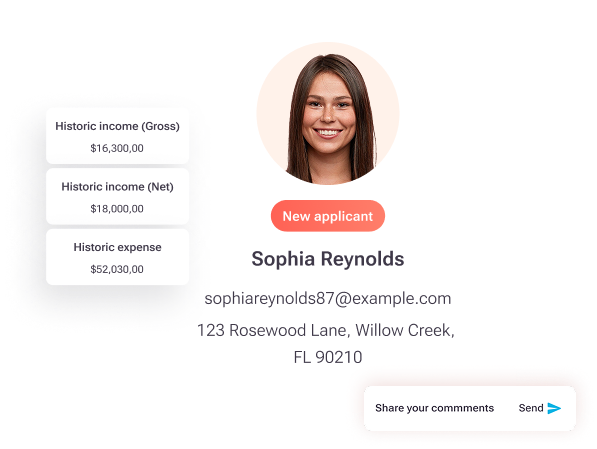
Best practices for 2026 address each failure point with a specific capability.

- Automated collection before review: Collecting fees at submission removes collection risk and reduces administrative work. Fees that are collected after review often go unpaid and require staff follow-up.
- Biometric identity verification: IDVerify from TenantEvaluation adds AI-powered liveness detection, government ID validation, and biometric facial matching directly inside the screening workflow. Communities move from document-only review to confirmed physical identity, which reduces fraud.
- Centralized lease tracking: Lease Tracking inside TenantEvaluation connects resident onboarding, unit data, approvals, and lease documentation in one real-time, audit-ready workflow. This structure replaces spreadsheets, missing leases, and guesswork from application through occupancy.
- Board dashboards: QuickApprove gives board members direct, real-time access to application status, summarized applicant reports, and a voting panel. Boards gain faster approvals and clear oversight without losing control, compliance review, or visibility.
Competitors such as ApplyCheck and Verify Screening Solutions rely on the TazWorks platform and focus mainly on background checks without deep applicant interaction, automated document review, or board-facing dashboards. Broader property management platforms like AppFolio and RealPage charge monthly subscriptions and are not tailored to community associations.
Schedule a demo today to see TenantEvaluation’s board dashboard, biometric verification, and lease tracking in a single workflow.
Florida-Specific Rules for HOA and Condo Application Fees
Florida communities operate under two primary statutory frameworks, depending on their structure. Condominium associations governed by Chapter 718 face a statutory cap on transfer and approval fees. Under Florida’s Condominium Act, the statutory cap on condominium transfer and approval fees is $150 per applicant, with spouses and dependent children counted as one applicant, subject to CPI adjustment.
Homeowners’ associations governed by Chapter 720, Florida Statutes, are not prohibited from charging transfer, capital contribution, or resale fees, which are relatively common. This distinction gives HOAs more flexibility when structuring application fee revenue.
For 55+ age-restricted communities, documentation requirements add another layer of operational complexity. 55+ Communities Verification inside TenantEvaluation standardizes how age-restricted requirements are handled across applications. This structure reduces manual work, improves documentation consistency, and strengthens operational efficiency and control for Florida condos and HOAs. It is a documentation-first workflow tool designed for Community Association Managers and supports internal compliance processes without replacing legal guidance.

Florida Statute 83.425 preempts local governments from regulating rental application terms, fees, or the screening process, so counties and municipalities such as Orange County, Hillsborough County, Orlando, and Tampa cannot impose additional rules on top of state law. Communities operate under a single statewide framework, which simplifies compliance when a capable platform is in place.
Revenue Model Comparison for Florida Communities
| Feature | TenantEvaluation (Pay-Per-Application) | Subscription-Based Platforms | Manual / No Platform |
|---|---|---|---|
| Upfront Cost | None | Monthly or annual fee required | None (but high labor cost) |
| Revenue Sharing | Yes, net fee rebated to association after service deduction | No, association pays platform regardless of volume | No structured model |
| FCRA Compliance Infrastructure | Automated audit trails, adverse action workflows, permissible purpose controls, direct bureau reseller | Varies, often not built for community associations | Manual, high liability exposure |
| Biometric ID Verification | IDVerify: liveness detection, government ID validation, biometric facial matching, integrated into the workflow | Typically absent or via external portal redirect | Not available |
| Board Dashboard | QuickApprove: real-time tracking, voting panel, summarized applicant reports | Rarely included, not built for HOA or condo boards | Not available |
| Lease Tracking | Centralized, real-time, audit-ready, connected to onboarding lifecycle | Separate module or not available | Spreadsheets and email chains |
| 55+ Community Handling | 55+ Communities Verification: standardized, documentation-first workflow | Not available | Manual, inconsistent |
| Application Processing Time | 5–10 minutes | Varies, often days with manual steps | 5–10 days |
Frequently Asked Questions
How does revenue sharing work for Florida HOAs and condo associations using TenantEvaluation?
TenantEvaluation collects the application fee from the applicant during the online submission process and deducts its service fee. The platform then rebates the net amount directly to the association or management company. There are no monthly software costs, no upfront fees, and no manual invoicing. The association generates revenue from every application processed through the platform. The $150 million figure cited earlier reflects how this model has performed across more than 5,000 associations.
What are the Florida statutory caps on application fees for condominiums, and how do HOAs differ?
Condominium associations governed by Florida Statute Chapter 718 may charge a maximum transfer or approval fee of $150 per applicant, with spouses and dependent children counted as one applicant. This cap is subject to CPI adjustment. Homeowners’ associations governed by Chapter 720 are not subject to the same statutory cap and may charge transfer, capital contribution, or resale fees as permitted by their governing documents. Florida Statute 83.425 also preempts local governments from imposing additional rules on application fees or screening processes, so the statewide framework applies uniformly.
How does TenantEvaluation support board oversight without slowing down the approval process?
QuickApprove gives board members a dedicated review and voting dashboard inside TenantEvaluation. Board members see real-time application status, AI-generated applicant summaries, and a structured voting workflow that replaces email chains and spreadsheets. The result is faster, clearer, and more consistent approvals without removing board oversight, compliance review, or decision-making authority. QuickApprove is designed for high-volume seasons and communities with complex onboarding requirements and operates inside one connected platform alongside document collection, screening, and lease tracking.
What does FCRA compliance require from Florida community associations when collecting application fees and running background checks?
As detailed in the compliance section above, FCRA requires written authorization, documented permissible purpose, and adverse action notices when denials rely on consumer reports. TenantEvaluation handles these requirements through automated adverse action workflows, strict permissible purpose controls, and detailed audit trails for every application. As a direct reseller of TransUnion and Equifax data, the platform accesses bureau data under strict bureau rules with no third-party scraping or gray-market sources.
How does TenantEvaluation handle 55+ age-restricted community applications in Florida?
55+ Communities Verification is a core capability inside TenantEvaluation that standardizes how age-restricted application requirements are handled. It reduces manual work for Community Association Managers, improves documentation consistency, and strengthens operational efficiency and internal controls for Florida condos and HOAs. The feature is designed as a documentation-first workflow tool that supports internal compliance processes and improves record consistency without replacing legal guidance or guaranteeing regulatory compliance.
Conclusion: Upgrade Your Application Fee Process
Florida condo and HOA communities that rely on manual application fee collection face a compounding set of problems. Revenue leaks through inconsistent collection, compliance exposure grows with incomplete audit trails, fraud risk rises with document-only screening, and administrative bottlenecks slow approvals for applicants, realtors, and boards.
The evaluation framework for new tools is straightforward. A platform worth adopting in 2026 should collect fees automatically at submission, share net revenue with the association at no upfront cost, and maintain FCRA-compliant audit trails with direct bureau data access. It should also include biometric identity verification as a standard feature, provide a board-facing approval dashboard, support centralized lease tracking from application to occupancy, and handle Florida-specific requirements such as 55+ community documentation.
TenantEvaluation meets every criterion on that list. Built specifically for community associations and management companies, not generic rentals, it is the only platform in the Florida market that combines revenue sharing, QuickApprove board dashboards, IDVerify biometric verification, 55+ Communities Verification, centralized lease tracking, and FCRA-first compliance infrastructure in a single connected workflow.
Schedule a demo today and see how much revenue your community’s application process can generate.
