Written by: Luis Teran, Co-founder, CEO, TenantEvaluation | Last updated: July 24, 2026
Key Takeaways for Florida CAMs and Boards
- Layered tenant application screening with document authentication, biometric verification, direct verification, synthetic identity checks, and automated references cuts fraud far more than document-only review.
- Biometric identity verification with liveness detection and facial matching stops deepfake IDs and impersonation that pass visual document inspection.
- Direct verification pulls income and employment data from payroll and bank sources, so AI-generated pay stubs and bank statements never enter the process.
- Synthetic identity detection cross-references SSN issuance, address history, and biometric signals to expose manufactured credit profiles that still show clean reports.
- TenantEvaluation delivers these FCRA-compliant controls in one platform built for Florida community associations; schedule a demo at TenantEvaluation’s platform to reduce fraud exposure and administrative burden.
The Operational Fraud Pressure on Florida Communities
Florida community associations operate in one of the highest-rent, highest-fraud-pressure rental markets in the country. A National Multifamily Housing Council Pulse Survey found that 93.3% of rental housing providers experienced fraud in the prior twelve months, with 84.3% encountering falsified pay stubs or income documentation and 70% reporting identity theft or fraudulent ID documents.
The threat has accelerated sharply. Detected AI-generated document fraud increased nearly fivefold between April and December 2025 across Inscribe’s network. Document fraud in rental applications now contributes to significant losses across U.S. industries.
For CAMs and boards, the downstream cost is concrete and recurring. Application fraud is expensive to unwind, and manual document review cannot keep pace with increasingly sophisticated tactics. Florida’s high-rent, remote-leasing environment creates a structural vulnerability that only layered, biometric-backed screening can close. The following five mechanisms work together to create that layered defense, and each one targets a specific fraud pattern that document-only review misses.
Five Screening Mechanisms That Work Together
The table below compares how document-only checks perform against biometric and layered verification across each mechanism, along with the resulting fraud reduction impact.
| Mechanism | Document-Only Checks | Biometric + Layered Verification | Fraud Reduction Impact |
|---|---|---|---|
| Document Authentication | Visual inspection, misses AI-generated forgeries | AI-powered metadata, structural, and math analysis | Catches altered financials |
| Biometric Identity Verification | Not available | Government ID validation, liveness detection, facial matching | Blocked 5,400+ fraudulent applications and prevented $10M in bad debt in six months in one deployment |
| Direct Verification | Relies on applicant-uploaded documents | Payroll and bank-data pulls bypass uploaded files | Defeats AI-generated pay stubs and bank statements at the source |
| Synthetic Identity Detection | Clean credit reports pass undetected | Cross-references SSNs, address histories, and biometric signals | 11% of frauds now involve a synthetic identity—an eight-fold global increase over 2024 |
| Automated Reference Checks | Accepts applicant-provided contacts | Validates via public records and independently sourced numbers | Exposes fake landlord letters and voice-cloned references |
Document Authentication That Catches AI Forgeries
AI-powered document authentication reviews pay stubs, tax returns, and bank statements for tampering that visual review cannot see. Document forensics analyzes PDF metadata, structural integrity, producer field extraction, and deduction math on income documents to detect generative AI-fabricated files that match rental income thresholds. Flagged documents often show template-based manipulation that would slip past a quick glance.
Key red flags during document review include:
- PDF metadata showing creation dates after the document’s stated pay period.
- Deduction math that does not reconcile with stated gross income.
- Font or layout inconsistencies across a single document.
- Producer field identifying a consumer PDF editor rather than payroll software.
- Bank statements with transaction patterns that do not match stated employer pay schedules.
Biometric Identity Verification Inside the Workflow
Biometric identity verification moves Florida communities from document-based review to identity confirmation tied to a live person. TenantEvaluation’s IDVerify embeds government ID validation, AI-powered liveness detection, and biometric facial matching directly inside the screening workflow, with no external portals and no extra steps for CAMs.
Biometric identity verification pairs a government ID scan with forensic analysis, a live selfie using passive liveness detection, and face matching to confirm the applicant is the person shown on the ID, defeating deepfake IDs and video-based impersonation attacks. A complete identity verification stack relies on two independent layers: document forensics to validate document authenticity, followed by biometric liveness detection plus face matching to confirm the presenter is the person named on the document.
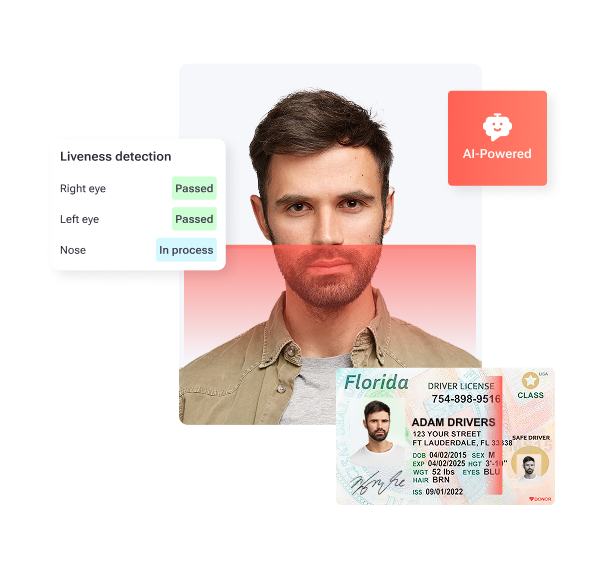
Biometric verification surfaces several critical red flags:
- Liveness check failure indicating a photo, mask, or deepfake submission.
- Facial match score below threshold between selfie and ID photo.
- ID barcode data that does not match the printed fields on the document.
- Security feature anomalies on government-issued ID.
See IDVerify in action and learn how biometric verification stops impersonation fraud before it reaches your approval queue.
Direct Verification of Income and Employment
Direct verification bypasses applicant-uploaded documents by pulling income and employment data from authoritative sources. Payroll-direct income verification defeats AI-generated pay stubs by retrieving income data directly from the employer or payroll provider rather than from uploaded documents. Bank-data direct verification defeats AI-generated bank statements by using a read-only bank feed instead of uploaded screenshots or PDFs.
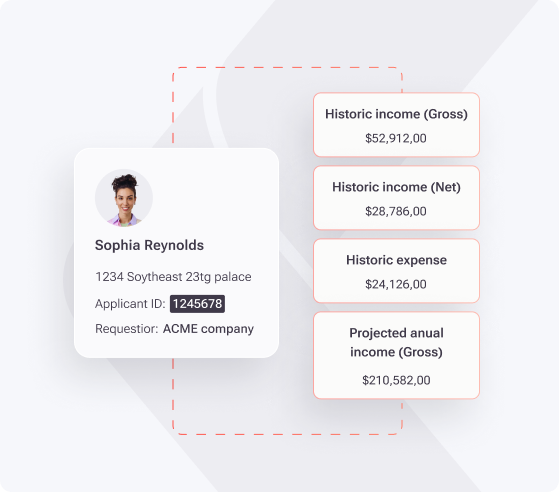
Direct verification commonly uncovers these red flags:
- Income figures on uploaded pay stubs that do not match payroll-system data.
- Bank deposit history inconsistent with stated employment income.
- Employer phone number provided by the applicant that differs from the independently verified corporate number.
- Employer that cannot be located through public business records.
Synthetic Identity Detection for Clean Credit Files
Synthetic identities are engineered to produce clean credit reports, so document-only screening rarely catches them. Synthetic identity document fraud grew 311% in North America between Q1 2024 and Q1 2025 and now represents a growing share of global fraud. Synthetic identity fraud involves fraudsters stitching together new identities from various stolen identity attributes over months, representing a shift from short-term opportunism to long-term goals.
Common red flags for synthetic identities include:
- SSN issuance date that postdates the applicant’s stated birth year.
- Thin or recently established credit file inconsistent with stated age and income.
- Prior address history showing unusually high address density in a short period.
- Biometric liveness failure or facial mismatch against the ID on file.
- VOIP or disposable contact information created within the past ninety days.
Automated Reference Checks That Expose Fake Landlords
Automated reference checks validate employers and prior landlords through independent public records instead of applicant-supplied contacts. Cross-checking prior-landlord claims against county property records confirms whether the named landlord actually owns the prior address, exposing AI-generated reference letters and voice-cloned landlord references used in organized rental fraud.
Reverse phone and email reputation checks can flag VOIP numbers, disposable addresses created within ninety days, or contacts associated with fake references. TenantEvaluation’s screening workflow incorporates eviction history, prior landlord verification, and personal reference checks into a single audit-ready report.
Key red flags in reference verification include:
- Prior landlord name that does not match the property owner of record in county records.
- Reference phone number identified as VOIP or created within ninety days.
- Employer reference that cannot be verified through a publicly listed corporate number.
- Inconsistencies between stated rental history and eviction court records.
Florida Liability, FCRA Rules, and 55+ Communities
Florida CAMs and boards operate at the intersection of the Residential Landlord and Tenant Act (Chapter 83), the Fair Credit Reporting Act, and the Fair Housing Act. When a screening result leads to denial, landlords must issue an adverse action notice within a reasonable timeframe that states the decision, identifies the reporting agency and its contact information, includes an FCRA notice of rights, and offers a copy of the consumer report along with dispute instructions.
In Palm Beach County, 68% of Fair Housing complaints originate from the tenant screening process, with first-offense civil penalties starting at $16,000 before compensatory damages or attorney fees. Documentation consistency becomes the primary legal defense available to boards and CAMs.
TenantEvaluation is built with FCRA compliance as the foundation, not an afterthought. The platform maintains automated adverse action workflows, built-in audit trails for every application, and strict permissible purpose controls as a direct credit bureau reseller of TransUnion and Equifax data. IDVerify strengthens permissible-purpose validation by confirming identity before screening authorization, which reinforces FCRA-aligned workflows and audit defensibility.
For age-restricted communities, TenantEvaluation’s 55+ Communities Verification helps Florida condos and HOAs standardize how age-restricted requirements are handled across applications. This reduces manual work, improves documentation consistency, and strengthens operational efficiency and control. The capability supports internal compliance-related processes while leaving legal guidance with counsel.
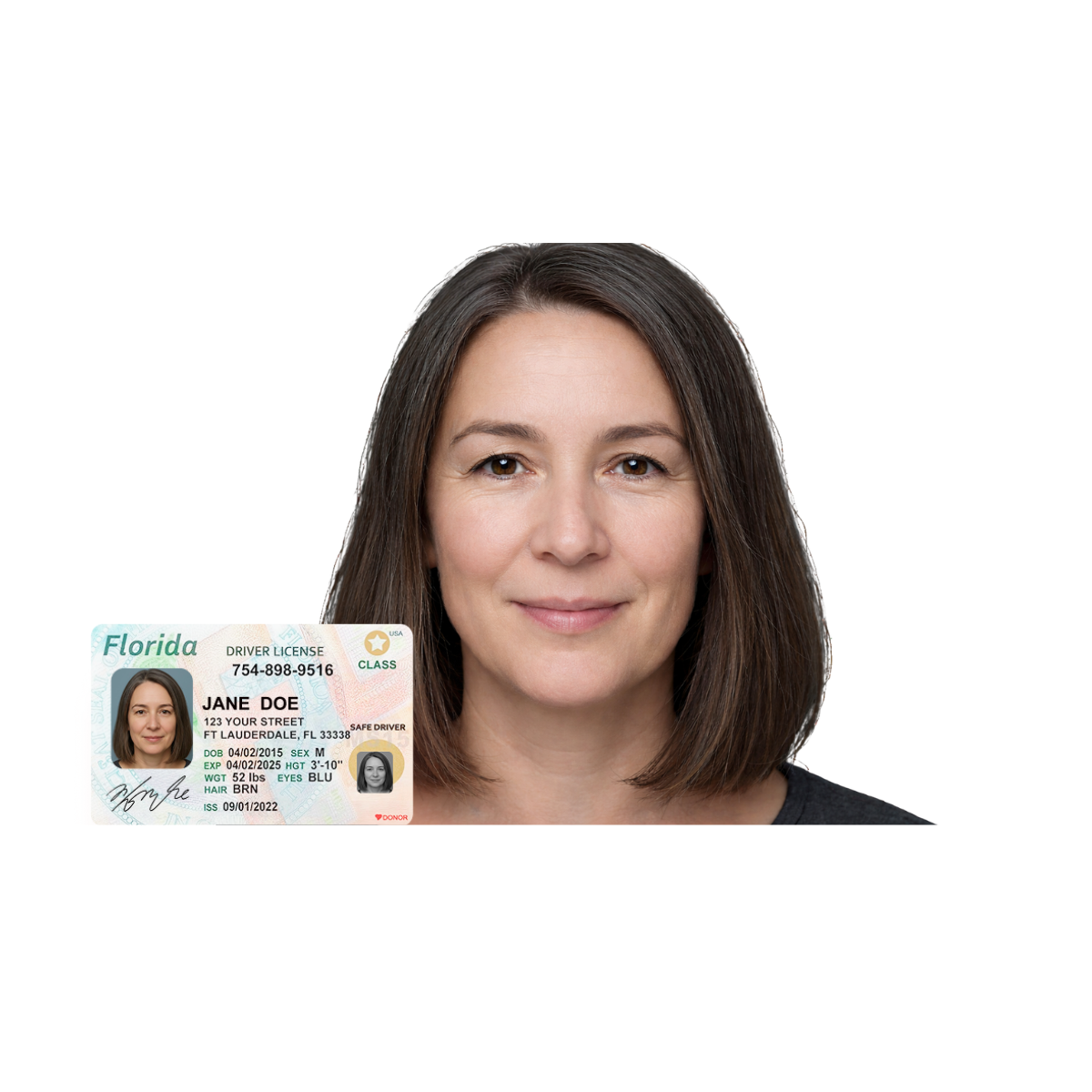
Request a walkthrough of TenantEvaluation’s FCRA compliance features to see how automated adverse action workflows and built-in audit trails protect your association.
ROI Example: $240K Savings and Faster Approvals
A Florida-based management company that switched to TenantEvaluation achieved measurable, board-ready results. By replacing manual document review with TenantEvaluation’s layered screening platform, the company freed up 50 hours per day for their team, cut processing time by 50%, and generated $240,000 in total annual savings at $10 per hour per property. The elimination of paper-based sensitive data handling also reduced liability exposure and ensured bank-level data encryption across all applicant records.
The QuickApprove accelerated approval workflow drives much of the time reduction. QuickApprove is built for CAMs, boards, and property management teams inside one connected platform, delivering real-time application tracking, automated communication support, customized approval letters, a personalized welcome package, and a board-ready approval process. It accelerates resident approvals without sacrificing control, compliance, or visibility, and it supports high-volume seasons and communities with complex onboarding requirements.

For boards evaluating the investment case, fraud incidents are costly to mitigate. The average eviction costs property managers between $3,500 and $10,000 when factoring in legal fees, lost rent, and property turnover expenses. Preventing even a small number of fraudulent placements per year can recover the operational investment many times over.
Implementation Steps for CAMs and Boards
TenantEvaluation supports a phased rollout that fits existing community workflows:
- Community profile configuration: TenantEvaluation configures each community’s governing documents, screening criteria, credit score thresholds, income requirements, and custom document requirements into the platform.
- FCRA consent and disclosure setup: Standalone written applicant authorization forms are configured per community, with automated adverse action notice workflows enabled from day one.
- IDVerify+ activation: Biometric identity verification is enabled per condo or HOA, configured per property portfolio, and adapted to each community’s risk profile, supporting different community standards without a one-size-fits-all approach.
- QuickApprove board dashboard onboarding: Board members receive access to the dedicated review and voting panel with AI-generated applicant summaries, real-time application status, and a connected approval workflow that replaces email chains and spreadsheets.
- Lease Tracking integration: Centralized, real-time lease visibility and lifecycle control connects resident onboarding, unit data, approvals, and lease documentation into one audit-ready workflow from application to occupancy.
- Ongoing audit and review: Built-in audit trails, monthly demographic reporting, and documented decision logs support annual fair housing reviews and regulatory defensibility.
Frequently Asked Questions
What is tenant application screening and how does it reduce rental fraud risk?
Tenant application screening is a structured process that evaluates a prospective resident’s identity, income, credit history, rental history, and background before an approval decision. It reduces rental fraud risk by layering five independent verification mechanisms: document authentication, biometric identity verification, direct verification, synthetic identity detection, and automated reference checks. A fraudster must defeat multiple independent controls at once instead of slipping past a single document review. Each mechanism addresses a distinct fraud vector, and when they operate inside one FCRA-compliant platform, cross-referenced consistency checks make fraudulent applications much harder to sustain.
Why is biometric identity verification more effective than document-only checks for Florida rental applications?
Document-only checks confirm that a credential exists and appears authentic, but they cannot confirm that the person submitting the application is the person named on that credential. Biometric identity verification closes this gap by pairing government ID validation with AI-powered liveness detection and facial biometric matching, which confirms physical presence and identity authenticity in a single workflow. In Florida’s high-volume, remote-leasing environment, where in-person meetings often do not occur, liveness detection becomes critical because it defeats printed photos, masks, pre-recorded videos, and deepfake submissions that would otherwise pass a document-only review. TenantEvaluation’s IDVerify+ delivers this biometric layer natively inside the screening workflow, so CAMs see verification results, including ID authenticity, liveness status, and biometric match result, embedded directly in the screening report.
What FCRA obligations apply to Florida community associations when screening tenant applicants?
Florida community associations and their CAMs must obtain written, signed applicant authorization before pulling any credit or background report, on a form separate from the rental application. When a consumer report contributes to a denial or less favorable terms, such as a higher deposit, an adverse action notice must be issued promptly, identifying the reporting agency, informing the applicant of their right to a free copy of the report within 60 days, and providing dispute instructions. Screening criteria must be applied uniformly to every applicant to avoid Fair Housing Act disparate-impact liability, and all decisions, consent forms, and communications should be retained for three to five years. TenantEvaluation is built with FCRA compliance as the foundation, with automated adverse action workflows, built-in audit trails, and direct credit bureau reseller relationships with TransUnion and Equifax that help keep community associations protected from liability exposure.
How does synthetic identity fraud affect Florida HOAs and condos, and how is it detected?
Synthetic identity fraud combines a real but unmonitored Social Security number with fabricated biographical data such as name, address, and date of birth, then ages the resulting credit profile over months until it appears legitimate. Because the credit file is real, document-only screening and standard credit checks frequently pass synthetic identities without flagging them. Detection requires cross-referencing SSN issuance data against the applicant’s stated date and place of birth, analyzing prior-address density for unusual patterns, and performing biometric liveness checks to confirm a real, present individual exists behind the application. Florida’s high-rent market and prevalence of remote leasing make it an attractive target for synthetic identity fraud, and rapid growth in this fraud category means communities relying on document-only review face increasing exposure with each application cycle.
How long does it take to implement TenantEvaluation’s screening platform for a Florida community association?
TenantEvaluation configures each community’s profile, including governing documents, screening criteria, credit thresholds, income requirements, and custom document requirements, before go-live, so the platform aligns with the association’s specific bylaws and Florida regulatory requirements from day one. Application processing through the platform typically takes 5 to 10 minutes for applicants, compared to 5 to 10 days under manual processes. Once live, QuickApprove’s accelerated approval workflow moves applications from submission to decision faster, with real-time tracking, automated communication support, and a board-ready voting dashboard that replaces email chains and spreadsheets. TenantEvaluation has processed more than 100,000 applications annually across 5,000+ communities, and the platform’s pay-per-application revenue model means communities generate income from the process instead of incurring upfront subscription costs.
Conclusion: From Document Review to Biometric-Backed Protection
Manual document review alone cannot stop AI-generated rental fraud in 2026. Florida CAMs and boards need a layered approach with document authentication, biometric identity verification, direct verification, synthetic identity detection, and automated reference checks, delivered inside a single platform built for FCRA compliance from day one.
TenantEvaluation is built specifically for Florida community associations and management companies. With IDVerify for biometric-backed identity confirmation, QuickApprove for accelerated board-ready approvals, 55+ Communities Verification for age-restricted documentation consistency, and centralized Lease Tracking from application to occupancy, TenantEvaluation delivers the operational control, fraud prevention, and compliance infrastructure that Florida communities require.
Get started with TenantEvaluation and move your Florida community from document review to biometric-backed fraud prevention.
