Written by: Luis Teran, Co-founder, CEO, TenantEvaluation | Last updated: July 30, 2026
Key Takeaways for Florida Rental Denials
- Florida community associations must rely on objective, written screening criteria and apply them the same way to every applicant to avoid Fair Housing Act violations and penalties up to $26,262.
- Legally defensible denial reasons include insufficient income-to-rent ratio, unsatisfactory credit history, negative rental or eviction records, and relevant criminal convictions assessed on an individual basis.
- Associations must obtain written FCRA consent, send compliant adverse action notices, and keep complete denial files for at least two to five years to withstand audits and complaints.
- Consistent documentation of every decision, including screening reports, decision records, and adverse action notices, protects against litigation and shows uniform application of criteria.
- TenantEvaluation streamlines Florida CAM compliance with automated workflows, audit-ready records, and board-ready approval tools. Request a personalized demo to see how it standardizes every denial reason and notice.
1. Insufficient Income-to-Rent Ratio
Florida law sets no statutory income minimum, but associations may establish a written threshold. The industry standard is gross monthly income of at least three times the monthly rent (the 3x rent rule), equivalent to rent no more than 30% of gross monthly income. The same multiplier must apply to every applicant for the same unit.
To confirm income fairly, associations should collect the same types of documents from every applicant.
- Two most recent pay stubs
- Two prior years of tax returns (self-employed applicants)
- Signed offer letter from a new employer
- Bank statements covering 60–90 days
- Social Security or investment income statements
TenantEvaluation’s IncomeEV report verifies income beyond self-reported data by contacting employers directly and ties an auditable income record to each application.

2. Unsatisfactory Credit History and Scoring Bands
Florida associations may establish credit screening criteria, and they must apply those criteria uniformly to all applicants. Best practice is to use bands such as “meets,” “conditional,” or “does not meet” instead of a single hard cutoff score, supported by a written exception process.
To support consistent credit decisions, associations should maintain the following records in every file.
- Credit report from a direct bureau reseller
- Written scoring bands defined in the screening policy
- Documented exception log if any waiver is granted
TenantEvaluation is a direct reseller of TransUnion and Equifax data and delivers bureau-grade credit reports inside the screening workflow.
3. Negative Rental History and Prior Landlord Issues
Unsatisfactory rental history, including late payments or lease violations, is a recognized legitimate nondiscriminatory denial basis in Florida. Associations should cross-reference landlord names against the county property appraiser database to detect fabricated references.
Rental history reviews should rely on written, verifiable records rather than informal impressions.
- Written landlord reference from two to three prior landlords
- Eviction history search results
- Property appraiser cross-reference notes
TenantEvaluation’s SafeCheck+ includes eviction history and reference verification and creates a timestamped record for every application file.
4. Prior Eviction Judgment Standards
Federal FCRA rules limit eviction actions and judgments on tenant screening reports to seven years, and Florida follows these rules without additional state exemptions for eviction history, as long as criteria are applied consistently to all applicants.
Eviction-based denials should rest on clear records and a written standard.
- Eviction court record from the applicable county clerk
- Written policy stating the association’s eviction history standard
TenantEvaluation’s screening reports surface eviction records and attach them directly to the applicant file to support board review inside QuickApprove.
5. Relevant Criminal Conviction History Review
Florida permits criminal history review, and individualized assessment rather than blanket bans is recommended. Associations should focus only on convictions relevant to property or resident safety, and arrest records alone never provide a valid denial basis.
A fair criminal review process relies on consistent reports and written assessments.
- Nationwide criminal background report
- Sex offender registry search
- Written individualized assessment form noting offense type, severity, and time elapsed
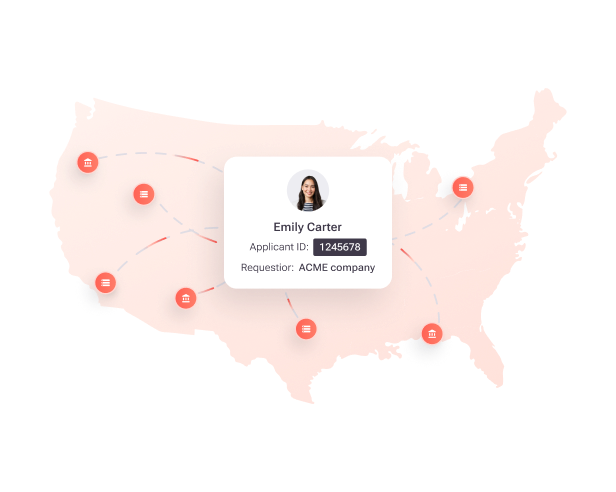
TenantEvaluation’s SafeCheck+ delivers nationwide and global criminal records, FBI Most Wanted checks, and sex offender registry results in one report.
6. Falsified or Inaccurate Application Information
False information on a rental application can support a denial when the policy states that falsification results in denial.
Associations should document both the misrepresentation and the proof that confirms it.
- Signed application with a falsification-equals-denial clause
- Documentation of the specific discrepancy discovered
- Comparison of submitted documents against verified data
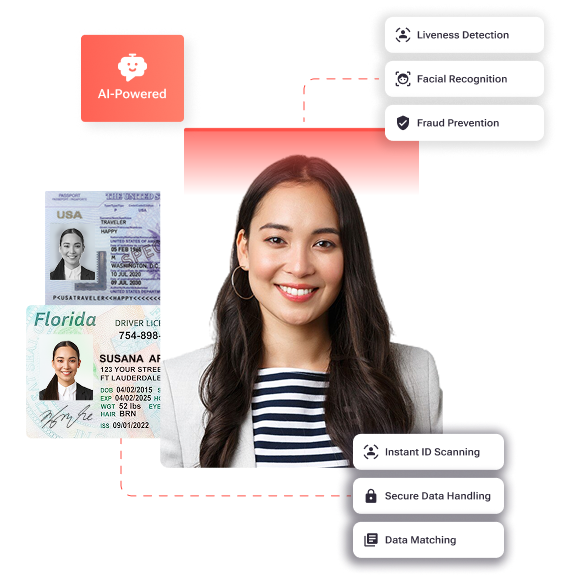
IDVerify uses AI-powered liveness detection and biometric selfie-to-ID comparison to confirm applicant identity before the file reaches board review and reduces impersonation and synthetic identity risk.
See how TenantEvaluation builds an audit-ready denial file for every application with a guided demo.
7. Failure to Meet Occupancy Standards
Clear written rules and accommodation logs help show that occupancy standards are applied fairly.
- Written occupancy policy referencing unit size and bedroom count
- Consistent application of the standard across all units of the same type
- Reasonable accommodation request log
TenantEvaluation’s custom setup encodes each community’s occupancy rules into the application workflow and prevents inconsistent application at intake.
8. Incomplete Application Submission
Every applicant should see the same checklist and face the same submission requirements.
- Written checklist of required documents disclosed before submission
- System record showing which documents were missing at submission
TenantEvaluation’s intelligent form logic rejects incomplete submissions automatically and creates a timestamped record of what was missing and when.
9. Failure to Provide Written Consent for Background Check
Florida landlords and community associations must obtain written authorization from the applicant before running any credit or background check. An applicant who refuses to authorize screening cannot be processed under FCRA-compliant criteria.
Consent records should be clear, consistent, and easy to retrieve.
- Signed FCRA authorization form with date and applicant signature
- Written disclosure of the screening company’s identity
TenantEvaluation captures written consent electronically within the application and stores the signed authorization in the applicant’s audit file.
10. Unstable Employment or Income History
Employment stability reviews should rely on documented verification and a written standard.
- Employment verification letter or direct employer contact record
- Written policy defining minimum employment tenure or income continuity
- Bank statements showing consistent deposit history
TenantEvaluation’s IncomeEV report contacts employers directly instead of relying only on self-reported data and produces a verifiable employment record.
11. Applicant Under Minimum Age Requirement
Florida law removes the disability of nonage at age 18 under Fla. Stat. § 743.07 and grants persons 18 and older the same rights to enter contracts as persons 21 and older. An applicant who cannot legally execute a contract cannot be approved.
Age-based denials must rest on clear ID checks and a written policy.
- Government-issued ID confirming date of birth
- Written policy stating the minimum age requirement
IDVerify validates government-issued ID authenticity and embeds the result directly in the screening report, confirming age at the point of identity verification.
12. Age-Restricted Community Requirements for 55+ Housing
Florida condos and HOAs operating under the Housing for Older Persons Act must verify that at least one occupant per unit is 55 or older and that 80% of occupied units meet that threshold. Failure to satisfy documented age requirements is a permissible denial basis when criteria are applied consistently.
Age-restricted communities should maintain clear proof of age and occupancy for each file.
- Government-issued ID confirming qualifying occupant’s age
- Signed occupancy affidavit
- Community’s current occupancy survey records
TenantEvaluation’s 55+ Communities Verification standardizes application handling for age-restricted communities, reduces manual work, and supports documentation consistency across every application.

13. Application Timing Rules and Active-Duty Service Members
Under Fla. Stat. § 83.683, Florida landlords and associations must process a servicemember’s rental application and notify the applicant in writing of approval or denial within 7 days of submission. If the association does not issue a timely denial, it must lease the unit to the servicemember when all other terms are satisfied. This statutory protection applies only to active-duty service members.
For all other applicants, failure to complete the application within the association’s stated deadline is a permissible denial basis.
- Written policy stating the application completion deadline
- Timestamped record of submission and any incomplete-application notices
- Separate tracking flag for active-duty service member applications
TenantEvaluation’s Lease Tracking capability provides centralized, real-time lease visibility and lifecycle control, connects resident onboarding, unit data, approvals, and lease documentation, and keeps every deadline and timestamp audit-ready.
Adverse Action Notice Requirements in Florida
Under 15 U.S.C. § 1681m, if a rental application in Florida is denied based on information in a consumer report, the association must provide an adverse action notice. For housing decisions, FCRA rules do not require a pre-adverse action notice or a waiting period before issuing the final adverse action notice.
A compliant adverse action notice must include all required disclosures to the applicant.
- The name, address, and phone number of the consumer reporting agency that supplied the report
- A statement that the agency did not make the denial decision and cannot explain the specific reasons
- The applicant’s right to request a free copy of the report within 60 days
- The applicant’s right to dispute inaccurate or incomplete information directly with the agency
- The credit score used, if applicable, and the principal reasons the score was not higher
Property managers should send the adverse action notice within a reasonable time. TenantEvaluation’s automated adverse action workflows generate compliant notices within the platform and reduce manual drafting errors.
Watch a live walkthrough of TenantEvaluation’s automated adverse action workflow.
How to Document Denials for Audits
Florida landlords should retain all documents from denied rental applications for at least two years to cover the statute of limitations for fair housing complaints. Because fair housing litigation can extend beyond the initial complaint period, best practice is to retain Fair Housing records for five or more years from the action.
A complete denial file must contain specific core elements that show what the association knew and decided.
- Completed application with signed FCRA authorization, timestamped at submission
- Screening reports, including credit, criminal, eviction, and income verification outputs
- Decision record that lists the specific criterion applied, the supporting evidence, and the outcome (deny, conditional, or approve)
- Adverse action notice with a copy of the notice sent, delivery confirmation, and date
- Screening criteria version that shows the exact written policy in effect on the decision date
A legal hold must be applied immediately when litigation is threatened, a complaint is filed, or an audit is initiated, and it requires retention of all related denial records regardless of the standard schedule. TenantEvaluation’s built-in audit trails timestamp every action and store the complete file in a searchable, centralized record.
Board-Ready Denial Documentation Checklist
Before a board votes on a denial, each member should be able to confirm a short list of facts from the application file.
- Screening criteria version, which is the written policy in effect at the time of the application
- Criterion failed, which is the specific, objective reason the applicant did not qualify
- Supporting evidence, such as the report, document, or verified data that confirms the failure
- Consistent application confirmation, which is evidence that the same criterion was applied to all recent applicants for the same unit type
- Adverse action notice status, confirming that the notice was generated, sent, and logged with a timestamp
- Reasonable accommodation review, with notation that no pending accommodation request was overlooked
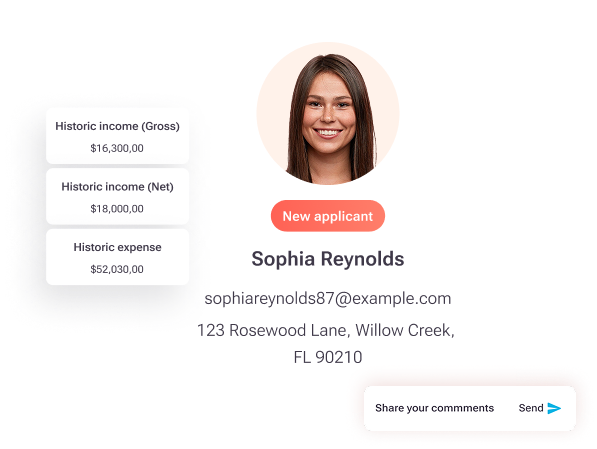
A recommended documentation practice is to maintain a decision log recording the date, applicant ID, outcome, reason category, and supporting documents received. TenantEvaluation’s QuickApprove board-ready approval process gives board members direct, real-time access to application status, summarized reports, and a voting panel and replaces email chains with a connected, auditable approval workflow inside one platform.
Inconsistent application of any single criterion is the primary source of fair housing exposure for Florida associations. As one Florida broker-owner put it, “One inconsistency in how you applied your screening criteria is all a plaintiff’s attorney needs. Document every decision, approvals and denials. The paper trail is the policy.” TenantEvaluation delivers a uniform workflow, FCRA-compliant adverse action automation, and audit-ready records that Florida CAMs and boards can rely on. The platform is built specifically for community associations rather than generic rentals and processes over 100,000 applications annually across more than 5,000 communities.
Frequently Asked Questions
Can a Florida HOA or condo association deny a rental applicant for any reason it chooses?
Florida associations cannot deny applicants for any reason they choose. They must base denials on objective, written criteria that are applied identically to every applicant. Denials rooted in a protected class under the federal Fair Housing Act, including race, color, religion, national origin, sex, disability, or familial status, are prohibited under Fla. Stat. § 760.23. Florida’s 2023 preemption law under F.S. § 83.425 removed local government authority to add screening restrictions on top of state law, and federal Fair Housing Act and FCRA requirements remain fully in force. Any criterion that is not written, consistently applied, and tied to the applicant’s ability to meet lease obligations creates legal exposure.
What is the difference between a pre-adverse action notice and a final adverse action notice in Florida rental screening?
In employment screening, the FCRA requires a two-step process with a pre-adverse action notice followed by a waiting period before the final notice. For housing and rental decisions, the FCRA does not require a pre-adverse action notice or a waiting period. Florida associations must issue a final adverse action notice that identifies the consumer reporting agency by name, address, and phone number, states that the agency did not make the decision, and informs the applicant of the right to obtain a free copy of the report and dispute inaccuracies within 60 days. The notice should be sent within a reasonable timeframe, commonly seven to ten days after the denial decision. If a credit score was used, the notice must also include the score and the principal reasons it was not higher.
How long must a Florida community association retain denied rental application files?
Florida landlords and associations should retain credit reports for at least two years, application fee records for at least one year, and applicant notifications for at least one year. Because fair housing complaints can be filed up to two years after the alleged violation and litigation timelines can extend further, retaining complete denial files, including the application, screening reports, decision records, and adverse action notices, for three to five years is the recommended best practice. A legal hold must be applied immediately if a complaint, audit, or litigation threat arises and suspends any standard destruction schedule until the matter is fully resolved.
Can a Florida association deny an applicant based on criminal history?
Florida associations may deny applicants based on criminal history only through an individualized, case-by-case assessment. Florida has no statewide ban-the-box law, and HUD’s 2016 guidance requires associations to consider the nature of the offense, its severity, the time elapsed since the conviction, and its relevance to resident, neighbor, or property safety. Blanket exclusions of entire offense categories, other than drug manufacturing convictions or registered sex offender status, carry Fair Housing Act risk. Arrest records alone never provide a valid denial basis, and only convictions count. The individualized assessment must be documented in writing and applied consistently to every applicant.
How does TenantEvaluation help Florida CAMs apply screening criteria consistently across all applicants?
TenantEvaluation encodes each community’s specific screening criteria, including income thresholds, credit bands, occupancy rules, required documents, and criminal history standards, directly into the application workflow during a custom setup process. Every applicant for the same unit type moves through the identical criteria sequence, and every action is timestamped and stored in a built-in audit trail. The platform’s QuickApprove board-ready approval process gives board members a dedicated voting panel with summarized applicant reports and replaces email chains and spreadsheets. Automated adverse action workflows generate compliant notices without manual drafting. The result is a single, auditable workflow that documents every approval and denial decision with the same objective criteria and reduces fair housing and FCRA exposure across the entire portfolio.
