Written by: Luis Teran, Co-founder, CEO, TenantEvaluation | Last updated: August 9, 2026
Key Takeaways for Florida CAMs and Boards
- Florida condo and HOA resident screening is a governance function governed by FCRA and Chapter 760 fair housing rules, requiring documented consent, permissible purpose, and adverse action notices.
- Traditional manual screening workflows create multi-day delays, incomplete applications, and fragmented lease records that increase risk and cost associations qualified applicants.
- Modern platforms replace legacy agencies with biometric identity verification, board dashboards, automated lease tracking, and applicant-paid revenue-share models that eliminate upfront costs.
- 2026 best practices for Florida associations include standardized digital workflows, liveness-checked biometrics, centralized lease visibility, and audit-ready board voting panels that reduce approval times by up to 70%.
- Associations ready to modernize their screening process can explore TenantEvaluation’s FCRA-compliant platform built specifically for Florida condos and HOAs at TenantEvaluation.
The 2026 Landscape for Florida Screening: Fraud, Instant Platforms, and Statutes
Florida now leads the United States in pre-tour biometric identity verification adoption, while many states still rely on basic document checks. This shift reflects rising fraud risk and tighter expectations around identity proofing.

At the application stage, identity verification typically includes biometric matching, a live selfie compared to a photo ID, paired with SSN verification or identity-record matching to detect synthetic or stolen identities. At the same time, Florida’s Chapter 760 fair housing obligations remain fully in effect. Following HUD’s January 2026 proposal to eliminate federal disparate-impact regulations under 24 CFR § 100.500, Florida’s Fair Housing Act and the Florida Commission on Human Relations enforcement framework remained unchanged, so Florida associations must continue complying with both federal and state fair housing requirements regardless of federal regulatory shifts.
CAMs now face pressure to cut administrative work while keeping audit-ready records for every application. The result is a rapid move from legacy agencies to applicant-paid digital platforms. NARPM’s 2025 technology adoption survey found that property managers using automated screening workflows process applications in 2.1 hours versus 2.3 days for manual processes, which sets a new expectation for Florida boards and applicants.
See how TenantEvaluation handles Florida’s 2026 compliance requirements with FCRA-first design built for community associations.
Daily Pain Points in Traditional Florida Association Screening
Traditional screening workflows in Florida community associations share a recognizable set of operational problems that cascade through the approval process. Applications arrive incomplete, which forces managers to follow up by phone and email with applicants, realtors, and owners, and this manual chase slows every file.
Lease copies then sit across folders and inboxes with no centralized visibility, so managers cannot quickly confirm whether a unit already has an active lease. Board members receive application packets through email chains and respond inconsistently, which creates approval bottlenecks and confusion about final decisions. Payment confirmations are chased separately from the application itself, adding another layer of manual coordination. Each friction point compounds the others and turns approvals into a process measured in days instead of hours.
Manual or thorough tenant screening typically takes 1 to 7 business days, and many qualified applicants accept another property if they do not receive a timely decision.
Compliance, Privacy, Audit Trails, and Board Oversight Responsibilities
Florida associations carry dual compliance obligations that shape how screening must work in 2026. FCRA rules govern consumer report usage, and Florida’s Chapter 760 fair housing framework adds state-level enforcement on top of federal FHA requirements. As noted earlier, Florida’s Chapter 760 obligations continue independently of federal regulatory changes.
FCRA compliance requires a clear separation between data providers and decision-makers. The association makes the decision, and the screening platform supplies data without dictating outcomes. Audit trails must document every step, including application receipt, consent, report pull, board vote, and final outcome.
Florida rental owners and property managers should retain copies of screening criteria, applications, consent forms, consumer reports, communications, and decision notes because good documentation is invaluable if an applicant later disputes the decision. Modern platforms that centralize this history give boards stronger protection than scattered email threads and paper files.
Common Failure Points in Legacy Screening Workflows
Legacy screening workflows in Florida associations fail at predictable points, and each failure creates downstream risk. Incomplete applications pass initial intake because there is no automated logic to reject missing documents, which forces managers to chase information after the fact.
This inconsistency extends to age-restricted community documentation, which different staff members handle in different ways and which creates audit exposure when regulators review approval records. Lease copies are often missing or outdated because no system connects the application to the active lease record, leaving managers unsure about occupancy status during approval. Identity verification relies on document uploads alone, with no biometric confirmation of physical presence, which becomes the weakest link in fraud prevention.
Manual screening can also introduce human bias in decisions, while automation applies criteria uniformly. Buildium’s 2025 property management performance benchmarks across 12,000 managed properties found that the average cost of a bad tenant placement is $3,500–$7,800 including turnover, lost rent, and legal fees.
Emerging Best Practices for 2026: Digital Workflows and Fraud Prevention
These recurring failure points have pushed Florida associations toward a new operational standard that addresses each gap with connected digital tools. The 2026 standard for Florida community associations combines several capabilities that legacy agencies do not offer as one integrated system.
- Standardized digital application workflows with intelligent form logic that rejects incomplete submissions automatically
- Biometric liveness checks that confirm physical presence before screening authorization
- Centralized lease visibility connecting onboarding, approvals, and active lease records in real time
- Configurable payment collection embedded within the onboarding workflow
- Revenue-share models that turn application processing into a compliant income stream for associations
- Board-ready dashboards with voting panels and timestamped audit trails
Property managers who automate screening report fewer Fair Housing complaints because consistent, documented criteria strengthen their defense against discrimination claims.
Decision Framework: Seven Dimensions for Comparing Modern Screening Platforms
Florida CAMs and boards evaluating modern alternatives to traditional tenant background screening companies can use seven clear dimensions to compare platforms.
- Compliance readiness: FCRA-first design, direct credit bureau reseller relationships, and automated adverse action workflows
- Operational efficiency: Application-to-decision time, staff hours saved, and manual follow-up reduction
- Board transparency: Dedicated voting dashboards, real-time application status, and timestamped audit records
- Scalability: Capacity to handle high-volume seasons without adding headcount
- Applicant and realtor experience: Mobile access, multilingual support, and clear payment instructions
- Auditability: Searchable digital records from application through occupancy
- Risk controls: Biometric identity verification, PCI Level 1 data security, and auto-redaction of sensitive information
Property-Type Decision Table for Florida Associations
Different property types in Florida face distinct screening challenges that shape which platform capabilities matter most. The following table maps each property type to its primary screening need, typical board involvement level, and specialized requirements, which helps CAMs decide which features to prioritize when they evaluate platforms.
| Property Type | Key Screening Need | Board Involvement | Specialized Requirement |
|---|---|---|---|
| Single-Family HOA | Credit, criminal, income verification | Moderate — approval by vote | Pet and vehicle policy documentation |
| Multi-Unit Condo | Full background, biometric ID, lease tracking | High — board dashboard required | Centralized lease visibility across units |
| 55+ Age-Restricted Community | Age documentation, income, background | High — audit-ready records essential | Standardized 55+ documentation workflow |
| Mixed-Use HOA Portfolio | Configurable criteria per property | Variable — portfolio-level visibility | Revenue-share payment model, scalable onboarding |
Five Integrated Screening Capabilities Compared to Traditional Agencies
Modern platforms address legacy workflow failures through five connected capabilities that work together rather than as isolated tools. Each capability replaces a specific friction point in traditional agency workflows.
- Biometric identity verification: Legacy agencies rely on document uploads, which cannot confirm presence or detect many synthetic identities. Modern platforms like TenantEvaluation embed IDVerify directly into the workflow, combining government ID validation, AI-powered liveness detection, and biometric selfie-to-ID comparison without redirecting applicants to external portals.
- Board dashboards: Biometric identity verification then feeds into board review. Traditional agencies deliver reports by email or PDF, while TenantEvaluation’s QuickApprove provides a dedicated board voting panel with real-time application tracking, AI-generated applicant summaries, and timestamped decisions inside one connected platform.
- 55+ community handling: Age-restricted communities require consistent documentation. Generic tools offer no structured workflow for age-restricted documentation, while TenantEvaluation’s 55+ Communities Verification standardizes application handling across Florida condos and HOAs and improves documentation consistency.
- Lease tracking: After approval, lease records must stay connected to the unit. Legacy workflows leave lease records in folders and spreadsheets, but TenantEvaluation’s Lease Tracking delivers centralized, real-time lease status visibility, including active, pending, expired, or missing, connected directly to the onboarding lifecycle.
- Connected payments: Payment collection completes the workflow. Traditional agencies separate payment collection from screening, while TEpayments by Zinc collects application fees and deposits within the onboarding workflow, with payments going directly from the applicant to the Association’s designated account, and TenantEvaluation never holds the funds.
Explore how these five capabilities work together inside one FCRA-compliant platform built for Florida associations.
Florida-Specific Compliance Considerations for 2026
Florida community associations operate under Florida Statutes Chapter 718 for condominiums and Chapter 720 for HOAs, which govern approval rights, application timelines, and record retention. Florida’s Fair Housing Act under Chapter 760 runs in parallel with federal FHA obligations and keeps state-level exposure high.
Florida Administrative Code Chapter 60Y-6, which implements the Florida Fair Housing Act, contains no regulations comparable to HUD’s disparate impact framework under 24 CFR § 100.500, so there was no state-level rule for FCHR to remove or amend in response to the federal proposal. Florida associations therefore cannot rely on federal regulatory rollbacks to reduce their state-level fair housing exposure.
Florida condo associations and HOAs may impose separate application processes, parking rules, pet rules, or occupancy requirements that must be disclosed early in screening so the tenant approval timeline does not break down after initial approval. Platforms built specifically for Florida associations, rather than adapted from generic rental tools, encode these requirements into the application workflow from the start.
Biometric Verification vs. Document Uploads in Florida Communities
Application-stage identity verification pass rates can look similar for operators using pre-tour checks and those that do not, so the real value of biometric verification lies in fraud detection quality rather than volume filtering. Document uploads alone cannot confirm physical presence or reliably detect synthetic identities.
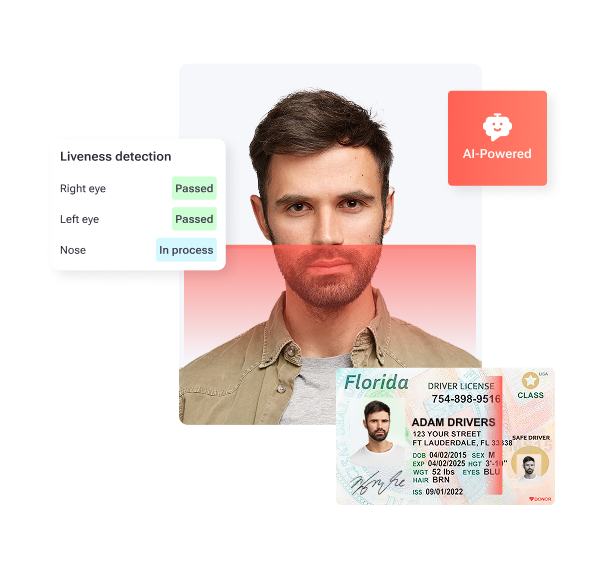
TenantEvaluation’s IDVerify combines government ID authentication, AI-powered liveness detection, and facial landmark biometric mapping and runs natively inside TenantEvaluation with no external portal redirect. IDVerify can be configured per community and per portfolio, which allows each association to match screening strength to its risk profile.
Board Dashboards and Faster Approval Workflows
TenantEvaluation’s QuickApprove accelerates resident approvals for CAMs, boards, and property management teams inside one connected platform. It replaces email chains and spreadsheets with real-time application tracking, automated communication support, customized approval letters, and a personalized welcome package while preserving board oversight and compliance review.
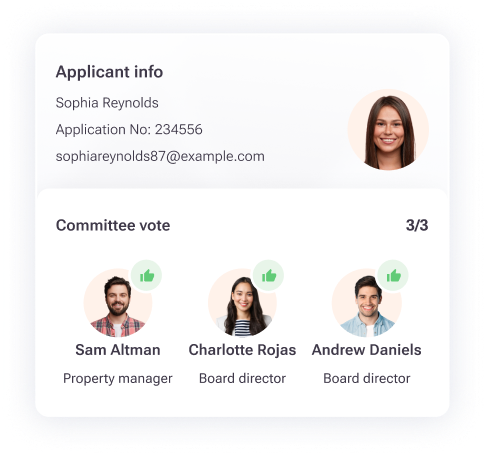
Automated screening workflows compress the screening timeline by running checks in parallel instead of sequentially, which creates a measurable time advantage over manual review. Manual processes typically take 1 to 7 business days, while TenantEvaluation’s platform reduces approval times by up to 70% for participating communities.
Handling 55+ Communities in Florida Condos and HOAs
Age-restricted communities in Florida face a documentation consistency problem that generic screening tools do not solve. Many boards manage eligibility documentation through emails, PDFs, and ad hoc follow-ups, which produces uneven records and extra work.

TenantEvaluation’s 55+ Communities Verification standardizes how age-restricted requirements are handled across applications, reduces manual work, improves documentation consistency, and strengthens internal operational control for CAMs and boards. This capability is built for Florida condos and HOAs that manage 55+ application requirements at scale and supports documentation and consistency without replacing legal guidance.
Cost and Revenue-Share Comparisons for Florida Associations
Manual screening increases staff labor costs per applicant and treats screening as a pure expense. TenantEvaluation’s applicant-paid model removes upfront costs for associations because the platform deducts its service fee from the collected application fee and rebates the remainder to the association or management company.
TenantEvaluation has already generated $150 million for communities across its platform, which shows how meaningful this revenue stream can become at scale. The revenue-share model turns application processing into a compliant, controlled income source instead of an operational cost center.
City Notes: Miami, Tampa, Orlando, and Jacksonville
Florida’s major metros share the same legal framework but present different operational realities for screening. Miami’s high-density condo market and multilingual applicant pool make 24/7 AI chat support in 11 languages and biometric verification especially useful for keeping applications moving.
Tampa and St. Petersburg’s growing HOA communities face high application volumes during seasonal peaks, where QuickApprove’s accelerated workflow reduces bottlenecks and keeps move-in dates on track. Orlando’s mix of residential and short-term rental properties requires configurable screening criteria for each community profile rather than one policy for the entire portfolio.
Jacksonville’s expanding suburban HOA market benefits from centralized lease tracking across geographically distributed portfolios, which gives management teams a single view of occupancy and lease status. TenantEvaluation serves all Florida regions with Florida-specific configuration built into the platform from the start, so CAMs can apply one system across diverse markets.
Frequently Asked Questions
What makes an applicant-paid screening model different from a traditional background check agency for Florida HOAs?
In an applicant-paid model, the prospective resident pays the screening fee directly as part of the application process, which removes upfront costs for the association. Traditional agencies typically invoice the association or management company separately and create a disconnected billing workflow.
TenantEvaluation’s applicant-paid model integrates fee collection into the onboarding process through TEpayments by Zinc, with payments going directly from the applicant to the Association’s designated account, and TenantEvaluation never holds the funds. The association also receives a revenue share from application fees, which converts a cost center into an income stream and has generated $150 million for communities on the platform.
How does FCRA compliance work specifically for Florida condo and HOA boards?
FCRA compliance for Florida community associations requires a permissible purpose before pulling any consumer report, a clear separation between the data provider and the decision-maker, and an automated adverse action notice when a report contributes to a denial. The board makes the decision, and the screening platform provides the data without recommending outcomes.
TenantEvaluation is a direct reseller of TransUnion and Equifax data, not a third-party scraper, and uses strict permissible purpose controls, automated adverse action workflows, and built-in audit trails for every application. Florida’s Chapter 760 fair housing obligations apply independently of FCRA and remain fully in effect in 2026 regardless of federal regulatory changes.
What is 55+ Communities Verification and why does it matter for Florida age-restricted condos?
55+ Communities Verification is a built-in capability within TenantEvaluation that standardizes how age-restricted application requirements are handled across Florida condos and HOAs. Many age-restricted communities manage eligibility documentation through fragmented manual processes, which produces inconsistent records and additional administrative burden.
TenantEvaluation’s 55+ Communities Verification reduces manual work, improves documentation consistency, and strengthens internal operational control for CAMs and boards managing these communities at scale. It is designed for Florida condos and HOAs and supports documentation and consistency without replacing legal guidance.
How does biometric identity verification reduce fraud risk in Florida community associations?
Biometric identity verification reduces fraud risk by confirming that the person applying is physically present and matches the ID provided. Traditional screening that relies on document uploads alone cannot reliably stop synthetic identities or impersonation attempts.
TenantEvaluation’s IDVerify+ builds on the core IDVerify capability by combining government ID authentication, AI-powered liveness detection, and biometric selfie-to-ID facial comparison, all running natively inside TenantEvaluation without redirecting applicants to external portals. IDVerify+ can be enabled per community and configured per portfolio to match each association’s risk profile.
What is Lease Tracking and how does it replace spreadsheets in community association management?
Lease Tracking is a centralized operational capability built directly into TenantEvaluation that connects resident onboarding, unit data, approvals, and lease documentation into one real-time workflow. CAMs and boards gain real-time lease status visibility, including active, pending, expired, or missing, with automated lease document collection during onboarding and unit-level tracking tied to occupancy records.
This capability replaces the combination of folders, inboxes, and spreadsheets that most community associations currently use to manage lease records. Every lease stays connected, searchable, trackable, and audit-ready from application to occupancy inside one platform.
Conclusion: Why Modern Screening Matters for Florida Associations
Modern screening matters because traditional tenant background screening companies were not built for the governance requirements, compliance obligations, or operational complexity of Florida community associations. Manual workflows introduce delays that cost qualified applicants and associations and keep occupancy below potential.
Properties with automated screening achieve higher occupancy rates because faster application-to-lease conversion keeps units from sitting vacant. Reducing screening time across portfolios can recover meaningful revenue each year through accelerated lease starts and fewer failed placements.
TenantEvaluation is built specifically for community associations and management companies, with FCRA compliance as the foundation rather than an add-on. Serving more than 5,000 communities and processing approximately 100,000 applications per year, TenantEvaluation delivers biometric identity verification through IDVerify, accelerated board approvals through QuickApprove, standardized 55+ documentation handling, centralized lease lifecycle visibility, and connected payment collection through TEpayments by Zinc, all inside one platform purpose-built for Florida HOAs and condos.
Join Florida’s leading management companies — including FirstService Residential, Campbell Property Management, and Associa — who trust TenantEvaluation as their resident screening and onboarding platform.
