Written by: Luis Teran, Co-founder, CEO, TenantEvaluation | Last updated: September 16, 2026
Key Takeaways
- Generic KYC tools like iDenfy are designed for financial compliance, not HOA governance or Florida Statute 720.317 voting authentication requirements.
- HOAs need separate verification workflows for board elections, resident screening under FCRA, and vendor access. Generic KYC tools cannot fully support these jobs.
- TenantEvaluation’s IDVerify+ embeds biometric verification directly inside resident onboarding so applicants stay in one workflow.
- TenantEvaluation provides FCRA-compliant adverse action workflows, a dedicated board voting dashboard, and direct credit bureau reseller status.
- For Florida HOAs seeking the right identity verification solution, see how TenantEvaluation handles all three verification contexts inside one purpose-built platform.
1. Idenfy Is A Generic KYC Tool, Not An HOA Governance Platform
iDenfy is a RegTech SaaS platform for identity verification, fraud prevention, and compliance (KYC, KYB, AML). It supports financial onboarding use cases such as customer identification, AML compliance queues, and sanctions screening against global lists, watchlists, and PEPs. It also offers API-based integration into fintech products and serves regulated sectors like crypto, iGaming, and e-commerce. Generic KYC systems are designed to trigger enhanced due diligence workflows involving compliance officers when positive matches occur, which fits banks and fintechs more than Florida community associations.
When a CAM in Miami or Tampa evaluates iDenfy, they are looking at a tool optimized for a $61 billion financial crime compliance industry. The LexisNexis True Cost of Financial Crime Compliance Study found that total financial crime compliance costs in the US and Canada reached $61 billion in 2024. That market operates under different regulatory drivers than Florida HOA governance. Because iDenfy’s model produces a verification result and routes it to a compliance queue, its output does not map to a board approval workflow or a resident screening report. It has no board voting dashboard, no FCRA adverse action workflows, and no resident onboarding context.
2. Florida Statute 720.317 Sets HOA-Specific Online Voting Authentication Rules
Florida Statute 720.317 requires an HOA to authenticate a member’s identity before granting ballot access and to permanently separate that authentication information from the ballot itself when the bylaws provide for secret ballots for director elections. This requirement addresses HOA governance rather than financial KYC checks.
Under Florida Statute 720.317(1)(a), the association must provide each member a method to authenticate their identity to the online voting system, a method to confirm at least 14 days before the voting deadline that the member’s electronic device can successfully communicate with the online voting system, and a method consistent with the election and voting procedures in the association’s bylaws. The statute also requires the online voting system to transmit a receipt to each member who casts an electronic vote and to store electronic ballots accessible to election officials for recount, inspection, and review.
Florida maintains two separate statutes for electronic association voting: section 720.317 for homeowners associations and section 718.128 for condominiums, and the two differ in ways that matter operationally. Neither statute contemplates a generic KYC tool as the authentication mechanism. The authentication requirement under 720.317 must connect member identity, eligibility, and vote access inside the election workflow. It cannot route the member through a financial compliance queue.
This is not legal advice. CAMs and boards should consult a licensed Florida community association attorney before implementing any online voting system. The statutory context here illustrates why generic KYC tools are architecturally mismatched with Florida HOA voting requirements.
3. HOAs Have Three Verification Jobs, And One Generic Tool Cannot Do All Three
Florida community associations face three distinct identity verification contexts. Each context requires a different workflow, a different legal framework, and different output. A single generic KYC tool cannot serve all three well.
Board Elections And Owner Authentication
Member authentication for online voting under Florida Statute 720.317 is a governance function. A legitimate HOA electronic voting platform must satisfy three security requirements: identity verification confirming each vote comes from an eligible member, vote confidentiality consistent with secret ballot requirements, and a tamper-evident audit trail. The verification step must connect member identity, eligibility, and vote access inside the election workflow. A KYC clearance report for a compliance officer does not satisfy that need.
Resident Screening For Renters And Buyers
Screening rental applicants and buyers is an FCRA-governed housing decision. Residential tenant screening is explicitly covered by the FCRA because it is a housing decision, and full FCRA disclosure, authorization, and adverse action requirements apply. When a Florida CAM denies an applicant based on a consumer report, the FCRA requires a written adverse action notice identifying the reporting agency and the applicant’s dispute rights. Generic KYC tools are built around AML compliance and sanctions screening, which follow a different regulatory architecture than FCRA housing decisions.
Vendor And Contractor Access Verification
Site-access control for vendors and contractors forms a third distinct context. It is neither a governance authentication nor an FCRA-governed housing decision. This context requires fast, configurable verification that fits community operations without triggering financial compliance escalation workflows. Generic KYC tools apply the same friction model to every verification regardless of context. That approach creates operational delays that do not serve community association workflows.
See how TenantEvaluation supports all three verification jobs inside one platform.
4. IDVerify+ Embeds Biometric Verification Inside The Resident Onboarding Workflow
TenantEvaluation addresses these verification contexts through tools built for community associations. The first, IDVerify+, is TenantEvaluation’s biometric identity verification layer embedded directly inside the resident screening workflow. It combines government-issued ID validation, AI-powered liveness detection, facial landmark recognition, and biometric selfie-to-ID comparison. All of it runs natively inside TenantEvaluation, so applicants stay in the same workflow and avoid extra logins.
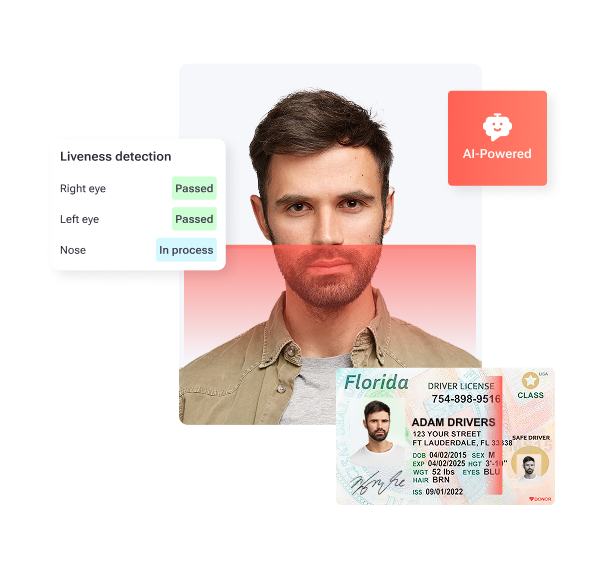
When an applicant completes the IDVerify+ step, the CAM sees verification results embedded directly within the screening report: ID authenticity confirmation, liveness verification status, biometric match result, and a redacted ID copy for compliance documentation. This shift moves communities from document-based review to biometric-confirmed identity verification. That distinction matters as Gartner predicts that by 2026, AI-generated deepfakes will lead 30% of enterprises to stop trusting identity verification and authentication tools in isolation.
QuickApprove complements IDVerify+ for board voting and approval workflows. It gives boards a dedicated review and voting dashboard with real-time application tracking, automated communication support, customized approval letters, and a personalized welcome package. Boards move applications from submission to decision faster while maintaining control, compliance, and visibility.

IDVerify+ can be enabled per condo or HOA, configured per property portfolio, and adapted to each community’s risk profile. iDenfy does not offer equivalent configuration for community association governance contexts.
5. Idenfy, TenantEvaluation, And Generic KYC Vendors Compared For HOA Use Cases
The capability differences between iDenfy, TenantEvaluation, and generic KYC vendors reflect different product architectures and regulatory assumptions. Florida HOAs should compare how each option handles core requirements.
Native workflow integration: iDenfy delivers identity verification results (such as APPROVED, DENIED, or SUSPECTED) to a developer’s configured endpoint via HTTP POST webhook callbacks, which the developer must then integrate into their own workflow. TenantEvaluation’s IDVerify+ runs inside the existing resident onboarding workflow with no external portal redirect. For a CAM managing 50 applications a month, an embedded result functions as a daily tool instead of an IT project.
FCRA compliance: Generic KYC tools are built for AML and financial crime compliance frameworks such as FATF Recommendations, FinCEN CDD rules, and sanctions screening. They are not built around FCRA adverse action workflows or permissible purpose controls. Nor do they provide the audit trail requirements that apply when a Florida community association denies a rental applicant. TenantEvaluation is built specifically for community associations with FCRA compliance as the foundation and operates as a direct reseller of TransUnion and Equifax data under strict bureau rules.
Board dashboard: iDenfy and generic KYC vendors do not treat a board of directors as a distinct user role. TenantEvaluation’s QuickApprove includes a dedicated board review and voting panel with AI-generated applicant summaries, real-time application status, and a voting workflow. Generic KYC products do not provide this capability.
Florida-specific configuration: TenantEvaluation is built for Florida regulations and workflows, with custom setup for each community’s governing documents, screening criteria, and association processes. Generic KYC vendors apply the same verification model regardless of jurisdiction or community type.
Direct credit bureau reseller status: TenantEvaluation is a legitimate reseller of TransUnion and Equifax data accessed under strict bureau rules, with regular compliance reviews and audits. iDenfy is a KYC/KYB vendor that also provides credit bureau data. It offers a Credit Bureau API for retrieving reports and financial data, and users can order reports from bureau providers through its dashboard. However, it does not provide the community-association-specific credit and background screening workflows that Florida associations need for resident screening decisions.
6. Florida CAMs Should Ask These Questions Before Choosing A Platform
Before selecting any identity verification platform for a Florida community association, CAMs and board members should work through focused questions that reflect HOA realities.
- Does the platform authenticate members for online voting under Florida Statute 720.317, including permanent separation of authentication information from the ballot for secret-ballot elections?
- Does identity verification run inside the screening workflow, or does the system redirect applicants to an external portal?
- Is the platform FCRA-compliant, with adverse action workflows, permissible purpose controls, and built-in audit trails for every application?
- Does the system give the board a dedicated review and voting dashboard with real-time application visibility?
- Is the configuration tailored to Florida regulations, including differences between Chapter 720 HOA requirements and Chapter 718 condominium requirements?
- Does the vendor hold direct credit bureau reseller status, or does it rely on third-party data aggregators?
Generic KYC vendors, including iDenfy, are not purpose-built for these community association requirements. TenantEvaluation is built to satisfy all six.
7. Why “Best Idenfy Alternative” Framing Misses The Point For HOAs
The search for an iDenfy alternative often assumes that another generic KYC vendor with better pricing or a cleaner API will solve the problem. For Florida community associations, that assumption hides the real issue. The key decision concerns product category fit, not minor differences between similar KYC tools.
TenantEvaluation was founded in 2007 by property managers, board members, and software engineers with over 50 years of combined experience in Florida community association management. It is built specifically for community associations, unlike generic rental, fintech onboarding, or financial crime compliance platforms. It serves 5,000+ communities, processes approximately 100,000 applications per year, and has generated $150 million for communities. Its Google rating is 4.8/5.
The platform covers the full resident onboarding lifecycle: application intake, document collection, biometric identity verification via IDVerify+, FCRA-compliant background and credit screening, board review and voting via QuickApprove, lease tracking, and connected payment collection via TEpayments by Zinc. Generic KYC vendors do not provide this scope. iDenfy covers one layer of the stack, identity verification, without the governance context, FCRA compliance foundation, or board workflow integration that Florida community associations require.
Explore the purpose-built platform for Florida HOAs.
Frequently Asked Questions About HOA Identity Verification Platforms
Does Idenfy Work For Florida HOA Board Elections?
iDenfy is a generic KYC tool built for financial onboarding and AML compliance. It does not include the governance-specific features that Florida Statute 720.317 requires for online HOA voting, such as a method to authenticate member identity within the voting system, permanent separation of authentication information from the ballot for secret-ballot elections, electronic receipt transmission to each voter, and ballot storage accessible for recount and inspection. iDenfy produces a KYC verification result but does not operate as an HOA online voting authentication system. TenantEvaluation’s IDVerify+ and QuickApprove are built for community association workflows rather than financial compliance queues.
Can One Tool Handle Both HOA Board Voting And Resident Screening?
A single generic KYC tool cannot handle both well because the two jobs operate under different legal frameworks and require different workflows. Board member authentication for online voting under Florida Statute 720.317 is a governance function requiring ballot secrecy, electronic receipts, and audit-ready records. Resident screening for renters and buyers is an FCRA-governed housing decision requiring adverse action workflows, permissible purpose controls, and direct credit bureau data. TenantEvaluation is purpose-built to serve both contexts inside one platform. IDVerify+ handles biometric identity verification embedded in the screening workflow, while QuickApprove provides the board review and voting dashboard for approval decisions.
What Should A Florida CAM Look For In An Identity Verification Platform?
A Florida CAM should look for a platform built specifically for community associations rather than adapted from a generic KYC or tenant screening product. The platform should embed identity verification inside the resident onboarding workflow without redirecting applicants to external portals. It should maintain FCRA compliance as the foundation with built-in adverse action workflows and audit trails. It should provide a board-ready review and voting dashboard, support Florida-specific regulations under Chapters 718 and 720, and source credit and background data through direct credit bureau reseller relationships instead of third-party aggregators. TenantEvaluation meets these criteria.
Conclusion: The Recommended Idenfy Alternative For HOA Identity Verification In Florida
Florida CAMs, LCAMs, and HOA board members across the state face a verification problem that generic KYC vendors like iDenfy are not designed to solve. HOA identity verification requires statutory awareness of Florida Statute 720.317, FCRA compliance as the foundation for resident screening decisions, biometric verification embedded inside the onboarding workflow, and a board dashboard that gives directors real-time visibility and voting capability.
TenantEvaluation is the purpose-built platform for Florida community associations. As noted earlier, it has served Florida communities since 2007 and now supports thousands of associations and tens of thousands of applications each year. It belongs to a different product category than generic KYC tools and is built for the specific job of HOA governance and resident onboarding.
Start your Florida HOA verification setup and see how TenantEvaluation serves community associations from application to approval.
