Written by: Luis Teran, Co-founder, CEO, TenantEvaluation | Last updated: July 21, 2026
Key Takeaways for Florida Condo Boards and CAMs
- Florida-compliant HOA onboarding software digitizes screening, document collection, identity verification, board approvals, and lease tracking while embedding Chapter 718 and FCRA requirements.
- HB 1021, effective January 1, 2026, expands digital document access requirements to all associations with 25+ units, which makes paper-based workflows non-compliant for most Florida condos.
- TenantEvaluation uses a pay-per-application revenue-sharing model with no upfront fees, plus biometric IDVerify, a QuickApprove board dashboard, and automated FCRA adverse action workflows.
- Subscription platforms such as AppFolio and Buildium charge fixed monthly costs ($60–$1,200 per month) without revenue sharing or Florida-specific onboarding features.
- Associations can streamline compliance and generate revenue by adopting TenantEvaluation’s purpose-built platform—explore the revenue-sharing model.
HB 1021 Requirements and Their Impact on Onboarding
Beginning January 1, 2026, HB 1021 requires Florida condo associations with 25 or more units to provide online access to association documents through a website or application. The prior threshold applied only to associations with 150 or more units. This change directly affects onboarding operations.
Application forms, governing documents, screening criteria, and approval records must now be accessible through a digital channel. Paper-based or email-driven workflows become structurally non-compliant for most Florida condo associations under this standard.
HB 1021 intersects with Chapter 718 of the Florida Statutes, which governs condominium associations, and with HB 1203, which introduced additional transparency and governance requirements for community associations in the 2025–2026 legislative cycle. Together, these statutes create a compliance environment where onboarding documentation, approval records, and resident data must stay organized, accessible, and audit-ready.
HB 1021 Onboarding Compliance: 7-Step Checklist
- Confirm your association meets the 25-unit threshold that triggers the HB 1021 website or portal requirement effective January 1, 2026.
- Publish governing documents, screening criteria, and application requirements through a compliant digital channel that applicants and owners can access.
- Obtain standalone written FCRA disclosure and written authorization before ordering any consumer report. The notice cannot be embedded in the application itself.
- Execute the two-step adverse action process for any denial. Issue a pre-adverse action notice with a copy of the report and the CFPB Summary of Rights, then issue a final adverse action notice after a minimum 5-day consideration period.
- Apply screening criteria consistently across all applicants to avoid Fair Housing liability. Sixty-eight percent of Fair Housing complaints originate from the screening process.
- Maintain a complete, timestamped audit trail for every application, approval, and denial decision.
- Store and securely dispose of consumer reports in accordance with the FCRA Disposal Rule, using shredding or irretrievable deletion for electronic files.
Compliance, Risk, and Governance Considerations for Screening
Willful FCRA violations carry statutory damages of $100 to $1,000 per violation (as an alternative to actual damages), with additional exposure from class action settlements and Fair Housing claims. There is no statutory minimum civil penalty for a first-offense Fair Housing violation; the maximum penalty is $26,262.
Florida’s 67 counties maintain independent court systems, and screening accuracy and processing timelines vary significantly for applicants with multi-county history. TenantEvaluation addresses these risks as a direct reseller of TransUnion and Equifax data, not a third-party scraper. Automated adverse action workflows and built-in audit trails support consistent handling of every application.
This article does not constitute legal advice. Associations should consult qualified legal counsel for statute-specific guidance.
How Much Does HOA Onboarding Software Cost in Florida?
Once an association understands its compliance obligations under HB 1021 and the FCRA, cost becomes the next concern. The goal is to meet these requirements without adding unsustainable fixed overhead.
TenantEvaluation uses a pay-per-application, revenue-sharing model. The platform deducts its service fee from the collected application fee and rebates the remainder to the association or management company. This structure converts onboarding from a cost center into a revenue stream with no upfront subscription fees. TenantEvaluation has already generated $150 million for communities across its portfolio of more than 5,000 associations.
Subscription-based alternatives create predictable monthly costs but no revenue-sharing offset. AppFolio charges a $280–$400 per month minimum plus per-unit fees, for a total of $880–$1,200 per month for a 100-unit community. Buildium ranges from $62 to more than $400 per month depending on tier and ePay fees. A 100-unit community can expect to pay $60–$250 per month for a full-featured community association management platform in 2026, with setup fees, training costs, and per-transaction payment processing added on top.
Operational savings also affect total cost. TenantEvaluation’s automated workflows can free up to 50 hours of staff time per day and reduce application cycle times by up to 70 percent. A Florida-based management company that switched to TenantEvaluation saved $240,000 annually. Processing time dropped by 50 percent, delivering $10 in savings per hour per property, while also reducing liability exposure from manual handling of sensitive resident data.
Model revenue impact and time savings for your specific community size.
Use Cases for Self-Managed, Managed, and 55+ Florida Communities
The right configuration of HOA onboarding software depends on whether the association is self-managed, operates under a professional management company, or runs as a 55+ age-restricted community. Each structure faces different operational pressures and risk profiles.
Self-managed condo association (board-run operations)
Self-managed associations rely on volunteer board members, so reducing manual application review and approval coordination becomes the primary need. The platform should cut board workload at every stage of the process.
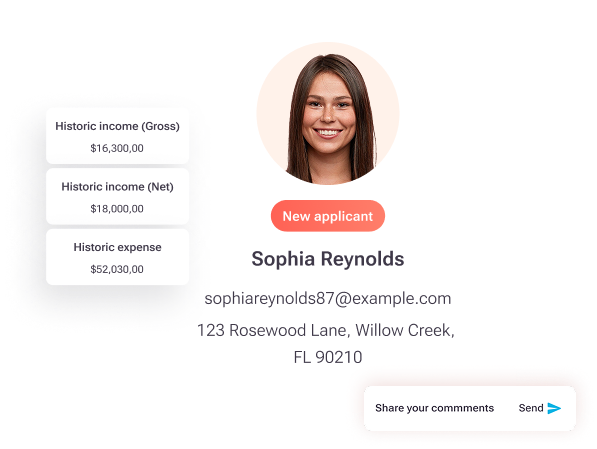
- QuickApprove provides a board voting panel for direct application review, which replaces email chains and spreadsheet tracking.
- IDVerify adds biometric verification to reduce fraud exposure without requiring dedicated screening staff or in-house expertise.
- Lease Tracking replaces spreadsheets with centralized, real-time lease visibility and lifecycle control so the board can see active, pending, and expired leases in one place.
- The pay-per-application revenue-sharing model sends income directly to the association, which suits communities that do not use a management company intermediary.
Professional management company (CAM-led portfolio)
Management companies need to standardize onboarding across multiple communities, reduce per-community administrative burden, and maintain portfolio-wide compliance. A single workflow that scales across properties becomes essential.
- End-to-end automated workflows run across all communities so CAMs avoid rebuilding processes for each property.
- QuickApprove supports high-volume application seasons by giving managers and boards a shared approval workspace.
- IDVerify can be configured per community risk profile, which allows stricter controls for higher-risk properties.
- 55+ Communities Verification supports age-restricted properties in the portfolio with consistent documentation and workflows.
- Lease Tracking connects onboarding, unit data, approvals, and lease documentation into one audit-ready workflow for the entire portfolio.
- The revenue-sharing model aligns TenantEvaluation’s incentives with management company performance, instead of adding a fixed subscription cost that does not adjust with volume.
55+ age-restricted communities (self-managed or managed)
Age-restricted communities must standardize age-related application handling and maintain consistent documentation. Manual follow-up across applicants creates delays and increases the chance of errors.

- 55+ Communities Verification supports Florida condos and HOAs with workflows tailored to age-restriction rules. The feature reduces manual work, supports documentation consistency, and strengthens internal operational control while still leaving room for legal guidance from counsel.
These use cases show how the same platform can support different governance structures while keeping compliance and documentation consistent.
Key Evaluation Criteria for Florida Condo Associations
Florida CAMs and board presidents should treat the following criteria as a decision framework rather than a simple feature checklist. Foundational items cover compliance and data integrity, while operational items focus on daily workflows and board visibility.
- Florida-specific compliance architecture: The platform must support FCRA standalone disclosure, automated adverse action workflows, and Chapter 718 and HB 1021 documentation requirements natively, not through manual workarounds.
- Credit bureau data sourcing: Direct reseller relationships with TransUnion and Equifax, as TenantEvaluation holds, provide data integrity and protect associations from liability tied to gray-market or offshore data sources.
- Biometric identity verification: IDVerify moves communities from document-based review to biometric-confirmed identity. Government ID validation, AI liveness detection, and facial biometric matching all run inside the TenantEvaluation workflow without external portal redirects.
- Board approval workflow: QuickApprove accelerates resident approvals inside one connected platform. A board-ready voting panel, real-time application tracking, automated communication support, and customized approval letters preserve control, compliance, and visibility.
- Lease tracking integration: Lease management should connect directly to the onboarding workflow. Centralized, real-time lease visibility, automated document collection, unit-level tracking, and audit-ready digital records replace spreadsheets and scattered email chains.
- Revenue model alignment: Pay-per-application revenue sharing turns onboarding into a revenue stream, while subscription models add fixed overhead regardless of application volume.
- Audit trail completeness: Every application action should be timestamped and retrievable for compliance defense, board reporting, and dispute resolution.
- Security standards: PCI Level 1 compliance, end-to-end encryption, and automatic redaction of sensitive PII form the baseline for platforms that handle consumer report data.
Frequently Asked Questions
What does HB 1021 require Florida condo associations to do differently in 2026?
Effective January 1, 2026, HB 1021 expands the digital document access requirement to all Florida condo associations with 25 or more units, down from the prior 150-unit threshold. Associations must provide online access to governing documents, meeting minutes, and association records through a website or application.
For onboarding, application forms, screening criteria, and approval documentation must be accessible through a compliant digital channel. Associations that still rely on paper applications or email-based workflows face structural non-compliance under this standard. HB 1203 introduced additional governance transparency requirements in the same legislative cycle.
Associations should consult qualified legal counsel for guidance specific to their governing documents and operational structure.
What FCRA obligations apply when a Florida condo association screens applicants?
Any Florida condo association or management company that orders a consumer report as part of resident screening is a “user” under the Fair Credit Reporting Act and must meet several obligations. Before ordering any background or credit check, the association must provide a standalone written disclosure, separate from the application, and obtain written authorization from the applicant.
If the report contributes to an adverse decision such as a denial, higher deposit, or co-signer requirement, the association must issue a pre-adverse action notice that includes a copy of the report and the CFPB Summary of Rights. The association then waits a minimum of five business days before issuing the final adverse action notice.
The final notice must identify the consumer reporting agency, state that the agency did not make the decision, and inform the applicant of their right to dispute the report and obtain a free copy within 60 days. As noted earlier, willful FCRA violations carry statutory damages of $100 to $1,000 per violation, with additional exposure from class action settlements.
TenantEvaluation automates the adverse action workflow and maintains built-in audit trails for every application, but this does not constitute legal advice. Associations should work with legal counsel to confirm their specific compliance posture.
How does a pay-per-application model differ from a subscription for a Florida condo association?
Subscription-based HOA software charges a fixed monthly fee regardless of application volume, typically $60 to $400 per month for a 100-unit community depending on the platform and features selected. A pay-per-application model such as TenantEvaluation’s charges only when an application is processed.
The revenue-sharing structure rebates the remainder of the collected application fee back to the association or management company after the platform’s service fee is deducted. This approach converts onboarding from a fixed operating cost into a revenue stream. For associations with seasonal application peaks or lower annual turnover, the pay-per-application model removes the overhead of paying for unused capacity.
What is the difference between IDVerify and standard document-based screening?
Standard document-based screening requires applicants to upload a copy of their government-issued ID, which staff then review manually or through basic optical character recognition. This approach cannot confirm that the person submitting the document is the person pictured on it, which leaves communities exposed to impersonation attempts, stolen IDs, and synthetic identity fraud.

IDVerify adds a biometric layer directly inside the TenantEvaluation workflow. Applicants complete a guided selfie verification, and the platform runs automated government ID authenticity validation, AI-powered liveness detection to confirm physical presence, and facial landmark biometric matching between the selfie and the ID.
Results, including ID authenticity confirmation, liveness status, and biometric match result, appear embedded in the screening report for the CAM, with a redacted ID copy retained for compliance documentation. No external portal redirect is required. IDVerify can be enabled per community and configured per portfolio to match each association’s risk profile.
Summary of Evaluation Criteria and Next Steps
Florida condo associations and management companies evaluating HOA onboarding software in 2026 should assess platforms across eight dimensions: Florida-specific compliance architecture, credit bureau data sourcing integrity, biometric identity verification capability, board approval workflow design, lease tracking integration with the onboarding lifecycle, revenue model alignment, audit trail completeness, and security standards.
TenantEvaluation is purpose-built to address all eight dimensions, with FCRA compliance as the foundation, a pay-per-application revenue-sharing model, the QuickApprove board dashboard, IDVerify biometric verification, centralized Lease Tracking, and 55+ Communities Verification. The platform serves more than 5,000 communities and processes over 100,000 applications annually across Florida.
Associations that currently use manual processes, spreadsheets, or generic property management software should evaluate whether their current workflow meets the HB 1021 digital access requirement, supports automated FCRA adverse action, and provides the board visibility and lease lifecycle control that modern community operations require.
