Written by: Luis Teran, Co-founder, CEO, TenantEvaluation | Last updated: June 16, 2026
Key Takeaways for Florida CAMs and Boards
- Florida community associations must follow strict statutes (Chapters 720 and 718) that govern recordkeeping, screening, lease tracking, and board governance.
- By 2026, many Florida HOAs and condos must maintain official websites or portals, which accelerates the move to digital platforms.
- Generic property management tools often lack FCRA compliance, biometric verification, and Florida-specific workflows that CAMs and boards need.
- TenantEvaluation provides end-to-end onboarding, board voting dashboards, lease tracking, and 55+ community verification in one connected platform.
- Learn more about streamlining screening, approvals, and lease tracking for your Florida association.
Why TenantEvaluation Matters in Florida’s Regulatory Environment
Florida community associations operate in one of the most demanding regulatory environments in the United States. Community Association Managers (CAMs) and board presidents must manage resident onboarding, approval workflows, lease records, and board governance while staying current with legislation that expanded transparency and accountability requirements effective January 1, 2026. Generic property management platforms were not designed for this environment. Fragmented workflows, compliance exposure, and heavy administrative work follow when associations rely on tools that are not built for them.
TenantEvaluation is built specifically for community associations and management companies, with FCRA compliance as the foundation, not an add-on. The platform serves more than 5,000 communities and processes about 100,000 applications each year. Within this comparison set, it is the only platform designed exclusively for the community association context.
Key Concepts Florida Associations Rely On
FCRA Compliance: The Fair Credit Reporting Act governs how consumer data is collected, used, and disclosed during screening. Florida landlords and property managers must obtain written consent before running background or credit checks and must document reasons for approval or denial. FCRA compliance functions as a core requirement, not a nice-to-have feature.
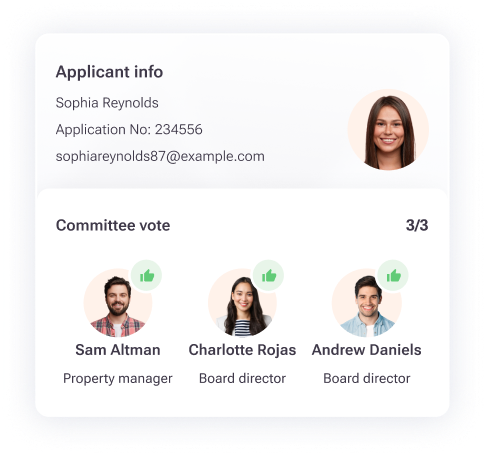
Board Voting Dashboard: A dedicated interface gives board members direct access to application summaries, voting panels, and real-time approval status. This replaces email chains and spreadsheets with a connected, auditable approval process.
Lease Tracking: Centralized, real-time lease visibility and lifecycle control connects resident onboarding, unit data, approvals, and lease documentation from application to occupancy inside one platform.
55+ Communities Verification: A built-in capability helps Florida condos and HOAs standardize how age-restricted requirements are handled across applications. It reduces manual work and improves documentation consistency.

Florida Market Shifts Toward Digital, Integrated Platforms
Effective January 1, 2026, condominium associations with 25 or more units must operate an official website or secure member portal that provides access to governing documents, budgets, financial reports, meeting notices, and reserve studies. HOAs with 100 or more parcels face the same requirement effective January 1, 2025. These mandates push associations away from spreadsheets and paper records toward centralized digital platforms.
The dominant trend in 2026 HOA management software is consolidation, with accounting, resident communication, violation tracking, and board document storage increasingly combined in single platforms. A May 2025 survey found that more than 70% of community managers, business partners, homeowner leaders, and company executives reported using AI. These industry-wide trends create specific operational pressures for individual CAMs.
Identity fraud now represents a growing concern for associations. Traditional screening methods that rely only on document uploads no longer provide enough protection for modern communities. As digital reliance grows, cybersecurity, data privacy, and role-based access controls are becoming more critical, especially where approvals and compliance intersect.
How Florida CAMs Use TenantEvaluation Day to Day
A typical Florida CAM managing a mid-size condominium portfolio handles application intake, document collection, background screening, board review, approval letters, and lease record management across multiple tools. Each handoff introduces delay and compliance risk.
TenantEvaluation addresses this through four integrated capabilities that work together to eliminate handoffs. QuickApprove accelerates resident approvals with real-time application tracking, automated communication support, customized approval letters, and a board-ready approval process. It is built for CAMs, boards, and property management teams inside one connected platform, while preserving control, compliance, and visibility.

Because identity fraud is a growing concern in digital workflows, IDVerify embeds biometric identity verification directly into the screening workflow using government ID validation, AI-powered liveness detection, and facial biometric matching. For associations managing age restrictions, 55+ Communities Verification standardizes age-restricted application handling, reduces manual work, and improves documentation consistency for Florida condos and HOAs.

Finally, Lease Tracking delivers centralized, real-time lease visibility and lifecycle control. It connects resident onboarding, unit data, approvals, and lease documentation into one audit-ready workflow that replaces spreadsheets and scattered email chains.
Compliance Risk and Governance Pressures in Florida
Florida HOAs must maintain specific official records for at least seven years, and Florida HOAs with annual revenue exceeding $500,000 must have audited financial statements. Failure to comply with Chapter 720 can result in criminal charges for board members, including charges tied to ballot forgery, vote tampering, or destruction of records.
Florida law requires landlords to choose tenant screening services that comply with both state regulations and the FCRA. TenantEvaluation operates as a legitimate reseller of TransUnion and Equifax data, with strict permissible purpose controls, automated adverse action workflows, and built-in audit trails for every application. This structure creates a clear separation between decision-making by the association and data provision by TenantEvaluation.
Where Florida Associations Commonly Struggle
Association management often involves juggling multiple apps, spreadsheets, social media platforms, and manual processes just to answer basic homeowner questions, reconcile bank statements, and manage compliance requirements. Many associations still rely on legacy accounting methods such as paper checks and spreadsheets, along with generic tools like QuickBooks and Excel that were not designed for community associations.
For CAMs, fragmented lease management creates operational blind spots. These include missing or outdated lease copies, manual expiration tracking, no centralized visibility, and no direct connection between applications and active leases. Identity fraud exposure compounds the risk when screening relies only on document uploads without biometric confirmation.
Operational Practices Leading Florida Associations Adopt
Leading Florida associations in 2026 are standardizing around four operational practices. They use biometric identity verification at the point of application, centralized lease lifecycle management from onboarding to occupancy, board-ready approval dashboards that replace email-based voting, and audit-ready digital records that satisfy Florida’s seven-year retention requirements.
Boards are increasingly evaluating management partners and tools based on measurable outcomes such as collection effectiveness, compliance execution, and audit-ready records. Workflow standardization, especially for 55+ communities and lease approvals, reduces fragmentation across emails, PDFs, and manual follow-ups.
Decision Framework for Evaluating HOA Software
Florida CAMs and board presidents evaluating HOA manager software can assess platforms across six dimensions. Compliance readiness covers FCRA foundation, adverse action workflows, and bureau reseller status. Operational efficiency includes application processing time and onboarding automation. Transparency focuses on board voting dashboards and real-time application tracking.
Scalability includes volume capacity and 55+ community support. Auditability covers searchable digital records, lease history, and document trails. Risk controls include biometric identity verification, PCI Level 1 security, and auto-redaction.
HOA Manager Software Comparison for Florida Associations (2026)
| Platform | Application Processing Time | Onboarding Automation | Florida Statute Compliance Matrix | Tenant Screening & FCRA Controls | Board Voting Dashboard | Lease Tracking & Real-Time Visibility | 55+ Community Support | Pricing & Revenue Model | Integration Notes |
|---|---|---|---|---|---|---|---|---|---|
| TenantEvaluation | 5–10 minutes (vs. industry average of 5–10 days) | End-to-end: document collection, ID verification, background checks, approval letters, welcome package | Built for Florida CAMs; Ch. 720 & 718 workflows; 7-year record retention support; adverse action automation | FCRA-first design; direct TransUnion & Equifax reseller; permissible purpose controls; biometric KYC via IDVerify | Dedicated board panel with AI-summarized applicant reports, voting workflow, and timestamped audit trail via QuickApprove | Centralized, real-time lease status (active, pending, expired, missing); unit-level tracking; audit-ready digital records | Built-in 55+ Communities Verification; standardizes documentation; reduces manual work | Pay-per-application; revenue-sharing model; no upfront fees | All-in-one native platform; no external portals required; PCI Level 1; end-to-end encryption |
| AppFolio | Variable, with multi-step manual handoffs reported | Broad property management automation; not association-specific | General landlord compliance; not Florida association-specific | Screening available; not FCRA-first by design; no biometric layer | No dedicated board voting panel | Lease storage available; not connected to onboarding lifecycle | Not purpose-built for 55+ HOA/COA workflows | Monthly subscription | Broad PM integrations; not association-native |
| Buildium | Variable, with screening via third-party integrations | Onboarding features present; screening not primary focus | General compliance tools; Florida-specific workflows limited | Third-party screening integrations; FCRA controls not foundational | No dedicated board voting dashboard | Lease management present; not real-time lifecycle tracking | No built-in 55+ verification workflow | Monthly subscription tiers | Integrates with third-party screening vendors |
| Vantaca | Variable, depending on workflow | Association management focus; screening not primary | Association governance tools; Florida-specific depth varies | Screening not a core module; FCRA controls not foundational | Board communication tools; dedicated voting panel not confirmed | Lease tracking not a core feature | No built-in 55+ verification workflow | Subscription-based | Association management integrations |
| Verify Screening Solutions | Background check turnaround; not full onboarding | Background checks only; no end-to-end onboarding | General FCRA screening; not Florida association-specific | TazWorks-based background checks; no biometric layer; no applicant interaction automation | No board dashboard | No lease tracking | No 55+ workflow | Per-report pricing | White-labeled TazWorks; not association-native |
| ApplyCheck | Background check turnaround; not full onboarding | Background checks only; no end-to-end onboarding | General FCRA screening; not Florida association-specific | TazWorks-based; no biometric layer; limited applicant interaction | No board dashboard | No lease tracking | No 55+ workflow | Per-report pricing | White-labeled TazWorks; not association-native |
| RealPage | Variable, with enterprise-scale workflows | Broad property management automation; multifamily focus | General compliance; not Florida association-specific | Screening available; enterprise-oriented; not association-native | No dedicated board voting panel | Lease management present; not association lifecycle-connected | No built-in 55+ verification workflow | Enterprise subscription | Large-scale PM integrations; not HOA/COA-native |
| RentSpree | Application and screening focused; faster than manual | Screening and application services; limited onboarding depth | General FCRA screening; not Florida association-specific | Screening available; simpler than association-specific platforms | No board dashboard | No lease tracking module | No 55+ workflow | Per-application or subscription | Integrates with listing platforms; not association-native |
Note: Competitor data reflects publicly available product information as of June 2026. Feature availability may vary by plan or configuration. Unlike the general property management platforms listed above, TenantEvaluation was designed exclusively for the community association context.
Frequently Asked Questions
What is the new HOA law in Florida in 2026?
Several significant changes took effect in Florida in 2025 and 2026. As discussed earlier, the 2025–2026 legislative changes introduced mandatory website requirements for larger associations, expanded electronic voting procedures under HB 913, and updated CAM licensing. Florida CS/CS/CS/HB 657 (2026) died in the Senate and never became law, so it imposes no requirements on new HOAs or COAs. These changes collectively increase the need for platforms that support digital recordkeeping, audit trails, and compliant approval workflows.
What is the 5-year rule for HOA in Florida?
The “5-year rule” most commonly referenced in Florida HOA contexts relates to the Housing for Older Persons Act (HOPA), which governs 55+ age-restricted communities. Under HOPA, a community qualifies for the 55+ exemption if at least 80% of occupied units have at least one resident who is 55 years of age or older, the community publishes and adheres to policies demonstrating intent to be housing for persons 55 and older, and the community conducts age verification surveys at least every two years. The five-year reference sometimes appears in discussions of how frequently communities must re-survey and document their resident age composition to maintain their 55+ status. TenantEvaluation’s 55+ Communities Verification capability helps Florida condos and HOAs standardize how age-restricted requirements are handled across applications, reducing manual work and improving documentation consistency, while not replacing legal guidance from qualified counsel.
How do Florida associations handle 55+ verification?
Florida condos and HOAs managing age-restricted communities must document that at least 80% of occupied units have at least one resident aged 55 or older and must maintain policies and procedures demonstrating intent to operate as 55+ housing. In practice, many associations handle this through fragmented manual processes such as emails, PDFs, and follow-up calls, which creates inconsistent documentation and administrative burden. TenantEvaluation’s 55+ Communities Verification is a built-in capability that standardizes how age-restricted requirements are handled across applications. It reduces manual work, improves documentation consistency, strengthens internal operational controls, and creates a more structured process for CAMs and boards managing 55+ community requirements. It is a documentation-first workflow standardization tool designed for Florida condos and HOAs, not a legal verification system and not a replacement for qualified legal counsel.
What does FCRA compliance mean for Florida community associations?
The Fair Credit Reporting Act (FCRA) governs how consumer reports, including credit, background, and eviction history, are obtained and used in screening decisions. For Florida community associations, FCRA compliance means obtaining written consent from applicants before running any consumer report, using the data only for permissible purposes, providing adverse action notices when a screening result contributes to a denial, and retaining records for the required periods. Associations that use non-compliant screening vendors or handle data improperly face legal exposure. TenantEvaluation is built with FCRA compliance as the foundation. It is a direct reseller of TransUnion and Equifax data, maintains strict permissible purpose controls, automates adverse action workflows, and provides built-in audit trails for every application, which keeps the association protected and the process defensible.
Why is lease tracking important for Florida community associations?
Lease tracking matters because lease data directly affects occupancy accuracy, compliance readiness, and operational efficiency. Many Florida associations manage lease records across disconnected spreadsheets, email inboxes, and paper files, which creates blind spots around lease expirations, missing documents, and unverified occupancy. This fragmentation increases the risk of disputes, compliance gaps, and administrative delays. TenantEvaluation’s Lease Tracking capability delivers centralized, real-time lease visibility and lifecycle control. It connects resident onboarding, unit data, approvals, and lease documentation into one audit-ready workflow. CAMs and boards gain real-time lease status visibility (active, pending, expired, or missing), automated lease document collection during onboarding, unit-level tracking, and a searchable digital history that replaces spreadsheets and scattered email chains from application to occupancy.
Conclusion and Next Steps for Florida Associations
Florida community associations in 2026 face a convergence of regulatory mandates, identity fraud risk, and operational complexity that generic property management tools do not address well. The comparison chart above highlights a structural gap. Most platforms in the market were built for multifamily rentals or broad property management, not for the specific governance, screening, and compliance workflows that Florida CAMs and boards require.
TenantEvaluation is the only platform in this comparison built specifically for community associations, integrating compliance, identity verification, board governance, and lease lifecycle management into a single connected workflow. This approach eliminates the fragmentation that creates risk and delay in generic property management tools.
CAMs and board presidents evaluating software can use the decision framework in this guide to assess their current processes against the six criteria: compliance readiness, operational efficiency, transparency, scalability, auditability, and risk controls.
