Written by: Luis Teran, Co-founder, CEO, TenantEvaluation
Key Takeaways for Florida HOA Lease Approvals
- HOA lease approval timelines in Florida typically range from 2 to 6 weeks, shaped by board meeting schedules, application completeness, and manual review.
- Common delay factors include incomplete applications, manual document reviews, monthly board meetings, fragmented tracking, and missing flood disclosures required under 2025 Florida statutes.
- Standardized pre-approval checklists with required documents like leases, IDs, income proof, and flood disclosures reduce processing times significantly.
- Automated workflows like TenantEvaluation’s QuickApprove and Lease Tracking can cut approval times by up to 70% while preserving compliance and board oversight.
- Ready to streamline your HOA lease approvals? Get started with TenantEvaluation today.
Florida HOA Lease Timelines and How Board Meetings Shape Them
Tenant approval in Florida often takes 2 to 6 weeks from complete submission. Communities move faster when boards meet more frequently and when applications arrive complete. Three distinct scenarios describe most Florida HOA approval cycles.
| Scenario | Typical Timeline | Key Conditions |
|---|---|---|
| Fast-Tracked | A few days | Complete application, delegated manager authority |
| Standard | 2–6 weeks | Board meeting cadence, manual document review, complete submission |
| Delayed | Longer than 6 weeks | Incomplete application, missed board meeting cycle, fragmented tracking |
Board meeting cadence often becomes a structural bottleneck. Communities that hold monthly meetings and require full board votes for every lease approval add extra time to the cycle. Approval speed depends directly on the board’s meeting schedule and whether the application packet is complete. Communities that delegate routine approvals to a manager or committee, within the limits of their governing documents, consistently achieve faster turnaround.
These structural choices set the best-case timeline. Most communities still face delays, which usually come from a predictable set of causes.
Ready to see how faster approvals work in practice? Schedule a demo today.
Primary Causes of Delays in HOA Lease Approvals
Most approval delays trace back to a small set of recurring causes. The matrix below highlights the most common delay factors, their operational impact, and the workflow layer where they originate.
| Delay Cause | Operational Impact | Workflow Layer |
|---|---|---|
| Incomplete applications | Triggers re-submission cycles, stalls background checks | Application intake |
| Manual document review | Consumes staff hours, introduces human error | Manager review |
| Monthly board meeting cadence | Can add weeks when full vote is required | Board decision |
| Fragmented lease tracking | No centralized status visibility, follow-ups multiply | Post-submission tracking |
| Missing flood disclosures | Delays lease execution under 2025 Florida statute updates | Compliance documentation |
Under Florida’s updated flood disclosure statutes effective October 1, 2025, residential landlords including condominium unit owners acting as landlords must provide specific flood disclosures before or at the time of lease execution. These disclosures cover whether the property has experienced flooding, whether flood insurance claims were filed, and whether federal or state assistance was received. Missing this documentation at submission adds another delay layer that many communities have not yet built into their intake checklists.
Pre-Approval Checklist Florida CAMs Can Use Today
CAMs and boards can shorten approval cycles by standardizing what is required before an application enters review. The checklist below reflects document requirements that appear across many Florida HOA and condo communities.
- Fully executed lease agreement (signed by all parties)
- Government-issued photo ID for all adult occupants
- Completed association application form with all fields populated
- Proof of income or financial qualification (per community criteria)
- Background check authorization and consent forms
- Florida flood disclosure acknowledgment (effective October 1, 2025)
- Pet registration documentation (if applicable per community rules)
- Vehicle registration and parking information
- Application fee payment confirmation
- Any community-specific addenda required by governing documents
Clear, document-based leasing criteria and attorney-reviewed amendments help Florida HOAs and condominium associations avoid arbitrary approval decisions that lead to enforcement disputes or delays. By implementing the checklist above as a mandatory intake standard, communities can remove the most controllable variable in the approval timeline: incomplete submissions that trigger re-work cycles.
Risks When Residents Move In Before HOA Approval
Occupancy before written board approval creates measurable legal and financial exposure for Florida community associations. Governing documents in most Florida HOAs and condominiums require written approval before occupancy. Residents who move in before that approval may face fines, lease nullification, or removal proceedings, which all create administrative burden and potential litigation.
Florida HOA governing documents amended after July 1, 2021 may impose minimum lease terms of at least six months enforceable against all parcel owners, but requirements for association approval of rentals generally apply only to new owners or those who consent. Boards that lack real-time visibility into application status encounter unauthorized occupancy more often. Centralized tracking reduces that risk by making pending and unapproved applications easy to monitor.
Do not let approval gaps create compliance exposure. Schedule a demo today.
How QuickApprove and Lease Tracking Speed Up Approvals
TenantEvaluation’s QuickApprove is an accelerated approval workflow built for CAMs, boards, and property management teams. It moves resident applications from submission to decision faster, inside one connected platform, with real-time application tracking, automated communication support, customized approval letters, a personalized welcome package, and a board-ready voting dashboard. QuickApprove replaces email chains and disconnected spreadsheets with a single workflow that keeps applications moving during peak seasons and in communities with complex onboarding requirements, while preserving control, compliance, and visibility.

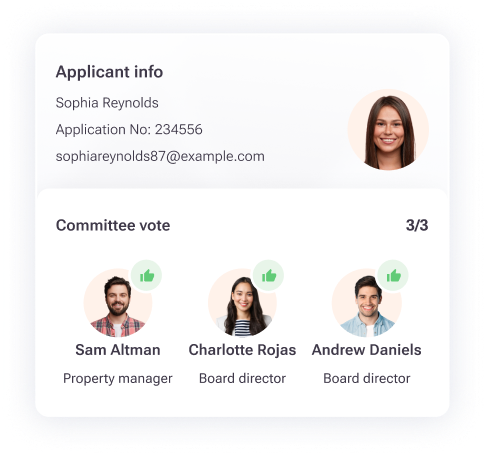
For boards specifically, QuickApprove provides a dedicated review and voting panel with AI-generated applicant summaries, timestamped actions, and a clear audit trail. Board members can review and decide without waiting for a scheduled meeting to receive paper packets. This structure directly addresses the monthly meeting bottleneck that often pushes standard approvals past 14 days.
Once an application is approved, Lease Tracking connects resident onboarding, unit data, approvals, and lease documentation in one centralized, real-time workflow. CAMs gain real-time lease status visibility, including active, pending, expired, or missing, alongside automated lease document collection, unit-level tracking, and searchable digital history. This setup removes the spreadsheets and scattered email chains that create operational blind spots after approval and supports audit-ready records from application to occupancy.
Together, QuickApprove and Lease Tracking create a connected approval-to-occupancy lifecycle inside TenantEvaluation. The platform is built specifically for Florida community associations with FCRA compliance as the foundation, not an afterthought. With 5,000+ communities and approximately 100,000 applications processed annually, TenantEvaluation has demonstrated up to 70% reduction in approval processing time for Florida CAMs and management companies.
FAQ: Florida HOA Lease Approval Timelines and Tools
How long does HOA approval take in Florida?
HOA approval timelines in Florida typically range from 2 to 6 weeks. As noted earlier, most approvals fall within that window, although fast-tracked applications with complete documentation and delegated authority can be resolved in a few days. Delayed approvals caused by incomplete documentation, missed meeting cycles, or fragmented tracking often extend beyond six weeks. The most reliable way to shorten timelines is to standardize intake requirements and use a connected approval workflow that gives boards real-time access to applications without waiting for a scheduled meeting.
What are the main reasons HOA lease approvals are delayed?
The most common delay causes include incomplete applications that trigger re-submission cycles, manual document review that consumes staff hours, and monthly board meeting schedules that add time when a full vote is required. Fragmented lease tracking that provides no centralized visibility into application status also slows decisions. Florida-specific compliance requirements, including flood disclosure documentation effective October 1, 2025, add another layer when communities have not updated their intake checklists. Addressing these causes through standardized checklists and automated workflows provides the most direct path to shorter approval cycles.
Can boards approve leases outside of scheduled meetings?
Whether a Florida HOA or condo board can approve leases outside a scheduled meeting depends on the community’s governing documents and applicable Florida statutes. Some communities authorize a manager or approval committee to handle routine lease approvals within defined criteria, which removes the board meeting bottleneck for standard applications. Others require a full board vote, which may occur through written consent or electronic means if the governing documents permit. CAMs should review their community’s bylaws and consult association counsel to determine what approval authority can be delegated and under what conditions.
How does Lease Tracking improve visibility after approval?
Lease Tracking inside TenantEvaluation connects the approved application directly to an active lease record, giving CAMs and boards real-time lease status visibility from a single centralized platform. Status categories include active, pending, expired, or missing. The system automates lease document collection during onboarding, maintains unit-level tracking tied to occupancy records, and provides a searchable digital history of lease activity and document trails. This structure replaces the spreadsheets and scattered email chains that typically follow approval and creates audit-ready records that support compliance readiness and reduce risk tied to incomplete or disconnected lease documentation.
Conclusion: Turn Weeks of Waiting into Days of Processing
Florida HOA lease approval timelines are shaped by factors that sit largely within a community’s control, including intake standardization, board review workflows, and lease lifecycle visibility. Communities that address all three with a connected platform, rather than disconnected tools, consistently move from submission to decision faster while preserving full board oversight and compliance. TenantEvaluation’s QuickApprove and Lease Tracking deliver that connected approach, built specifically for Florida CAMs, boards, and management companies, with FCRA compliance as the foundation. Schedule a demo today and see how your community can move from weeks to days.
