Written by: Luis Teran, Co-founder, CEO, TenantEvaluation | Last updated: September 11, 2026
Key Takeaways
- Most HOA approval failures come from missing authority checks and incomplete decision records rather than flawed criteria.
- The five-phase workflow of Intake, Verification, Review, Decision and Voting, and Archiving requires documented authority confirmation before any review begins.
- Defensible minutes capture exact motion language, mover and seconder, vote tally with names, conditions, effective date, and retention period.
- Conditional approvals and denials need written, criteria-tied notices. Vague or selective enforcement exposes associations to legal challenges.
- TenantEvaluation’s QuickApprove platform replaces email chains with a connected, board-ready approval workflow that automatically captures every required record element.
Five Phases in the HOA Approval Process
The HOA approval process follows five sequential phases. Each phase has a defined owner, a defined output, and a defined record requirement.
- Application Intake. The applicant submits a complete request through the designated channel. The receiving party confirms completeness before the file advances.
- Administrative Verification. The CAM or manager verifies documents, eligibility, and required attachments against the community’s written criteria.
- Committee or Board Review. The appropriate body reviews the application and produces a recommendation or preliminary finding.
- Formal Decision and Voting. The body holding decision rights takes a noticed, quorate vote and records the outcome.
- Notification and Record Archiving. The applicant receives written notice of the outcome. The complete record is archived with a defined retention period.
See how the five-phase workflow runs inside one platform.

Phase 1: Application Intake and Completeness Checks
The intake phase sets the tone for the entire approval. The applicant or owner submits the required materials, such as the application form, supporting documents, plans, and fees, through the community’s designated submission channel.
The receiving party, typically the CAM or management office, confirms that every required element is present before the file moves forward. Incomplete submissions are the most common cause of approval delay, which is why the correct response is rejection at intake with a written notice identifying the missing items. Advancing an incomplete file, even with a note to follow up later, creates downstream confusion about what was actually reviewed and approved.
Phase 2: Administrative Verification Against Written Criteria
The CAM or manager verifies that the submitted documents are current, that the applicant meets eligibility criteria, and that all required attachments are present and legible. Verification uses the community’s written criteria, applied the same way to every applicant.
Consistency at this phase is a governance requirement. Courts in multiple states have found selective enforcement to be a valid defense against HOA action, and inconsistent application of written criteria at the verification stage is one of the most common triggers for that defense. The verification record, including what was checked, against what standard, and on what date, becomes part of the file.
Authority Check: Who Can Approve This HOA Request
Before the reviewing body examines the application, one more check has to happen, and many guides skip it. Confirming which body holds decision rights for this specific type of request is what makes the eventual decision defensible.
There are three possible decision-rights holders:
- The board of directors, acting at a properly noticed, quorate board meeting.
- A committee, such as an Architectural Review Committee or finance committee, acting with authority expressly delegated by the governing documents.
- The ownership at large, voting at a properly noticed membership meeting when the governing documents or applicable statute require a member vote for the specific action.
The source of authority is always the recorded governing documents, including the declaration, bylaws, and any duly adopted rules, read alongside the applicable state statute. Florida requires architectural review authority to be specifically stated or reasonably inferred in the declaration. Florida Statutes §720.3035(1)(a) ties that authority to the declaration or authorized guidelines. Texas requires associations over 40 lots to establish a separate review authority. Texas Property Code §209.00505 makes decision rights document- and size-dependent. Hawaii leaves timing and decision mechanics to the recorded documents, and its governing statutes are silent on architectural-review timing and mechanics.
Quorum and voting thresholds default to state statute unless the governing documents specify otherwise. Most HOA bylaws set board quorum at a majority of the board, and this majority-of-the-board rule is also the default under many state nonprofit corporation laws. Under Florida Statutes §720.306(1)(a), the default quorum for a Florida HOA members’ meeting is 30 percent of the total voting interests unless the bylaws lawfully provide a lower number.
When a board approves something outside its authority, the decision is vulnerable to challenge. Courts may deem the action unenforceable when a board exceeds its authority or ignores required procedures. The remedy is ratification or reversal through the correct channel, either by the body that actually holds decision rights or by a membership vote if the governing documents require one. Documenting the authority check in the workflow record protects the board from this outcome before it occurs.
Phase 3: Committee or Board Review and Recommendation
Once authority is confirmed, the appropriate reviewing body examines the application. In many communities, this is an Architectural Review Committee or a finance committee. The HOA architectural review committee process functions as review and recommendation unless the governing documents expressly delegate final decision authority to the committee.
Florida HOA law requires committee meetings to be open and noticed when the committee will make a final decision on expenditures or when it is a body with architectural-approval power over a specific parcel, and committee members may not vote by proxy or secret ballot in those settings. Transparent recording of committee recommendations is essential regardless of whether the committee holds final authority.
The committee’s recommendation is documented separately from the board’s decision. The recommendation record states what was reviewed, what criteria were applied, and what the committee recommends, including approval, conditional approval, or denial, with the reasoning tied to the written standards. That recommendation then feeds the board’s formal decision process as a documented input, while the board’s vote remains the final decision unless authority is delegated otherwise.
Phase 4: Formal Decision and HOA Board Voting Process
The HOA board voting process follows a defined sequence at a properly noticed, quorate meeting. HOA meeting requirements derive from state statute, the association’s governing documents, and often Robert’s Rules of Order as parliamentary authority.
The sequence is:
- Agenda placement. The item appears on the posted agenda with enough detail to inform members of what will be decided.
- Notice. The meeting is noticed in compliance with the governing documents and applicable statute. Florida HOA board meetings require notice posted in a conspicuous place in the community at least 48 hours in advance, and the notice must specifically identify all agenda items per FS 720.303(2)(c).
- Quorum. The board secretary confirms quorum is established and records it. Without quorum, an HOA board cannot make or vote on motions, and any votes taken would be invalid.
- Motion. A board member states the motion in specific, complete language.
- Second. Another board member seconds the motion, signaling it is ready for discussion.
- Discussion. The board deliberates. The board president manages debate, and the board secretary records that discussion occurred without transcribing it verbatim.
- Vote. The board president calls the vote, and the board secretary records the tally.
The board president runs the meeting, the board secretary records the proceedings, and the CAM supports documentation. The most common procedural failure on HOA boards is treating consensus as a vote, because any board action requires an actual vote and a recorded count.
How to Record an HOA Board Approval Decision in the Minutes
The decision record makes an approval defensible in an audit or dispute. A vague record such as “the board approved the request” is insufficient. Florida Statute 720.303 requires each director’s vote or abstention to be recorded on every matter before the HOA board, which makes individual vote tallies a statutory requirement in that state.
A defensible minutes entry for an approval decision contains:
- Exact motion text. Use the precise wording as stated by the maker of the motion, not a paraphrase. Example: “Motion to approve the architectural modification request submitted by [Owner Name] for [specific improvement] at [unit address], as described in the application dated [date], subject to the conditions stated below.”
- Mover and seconder. Example: “Motion by Director [Name], seconded by Director [Name].”
- Vote tally. Record the count for, against, and abstaining, with individual names for roll call votes. Example: “Vote: 4-1, Director [Name] opposed.”
- Dissents and abstentions. Record these with the reason when disclosed. Abstentions count as neither yes nor no, but they can affect whether a motion passes if governing documents require a majority of the full board.
- Conditions attached to approval. Include any conditions in the motion language with specific deadlines and assigned responsibility. Example: “Approval is conditioned upon submission of a licensed contractor’s permit within 30 days of this decision.”
- Effective date. State the date the approval takes effect.
- Retention period. Note that the record is retained in accordance with the association’s retention schedule and applicable statute.
Conditional approvals are tracked as action items until each condition is verified complete. The conditions documented in the motion language become the tracking standard. Conditional approvals should be written so the authorization is explicitly limited and auditable, such as “contingent on execution of the standard contract,” “subject to review of insurance certificates,” or “not to exceed $X without additional board approval”.
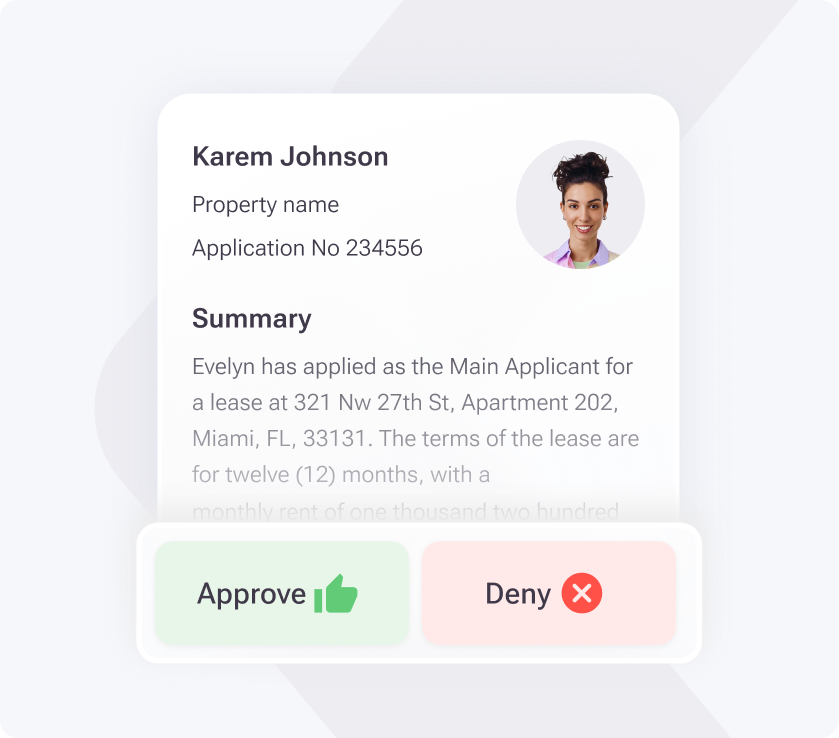
See how automatic audit trails capture every decision element.
Phase 5: Applicant Notification and Record Archiving
Every approval decision produces one of three outcomes: approval, conditional approval, or denial. Each outcome requires written notification to the applicant.
An approval notice states the decision, the effective date, and any conditions. A conditional approval notice states the decision, each condition with its deadline and the party responsible for satisfying it, and the consequence of non-compliance. A denial notice states the specific basis for denial tied to the written criteria. Under Florida Statutes §720.3035(4)(a), as amended by Florida HB 1203 effective July 1, 2024, an HOA denial of a request to construct a structure or improvement must be in writing and must state with specificity both the rule or covenant relied on and the specific aspect of the proposal that does not conform.
The complete record, including the application, supporting documents, verification checklist, committee recommendation, meeting notice, quorum confirmation, minutes with motion and vote, notification letter, and any condition-tracking documentation, is archived with a defined retention period. Many states set a minimum retention period of about seven years for HOA official records, and best practice is to retain meeting minutes for at least ten years. Many practitioners recommend retaining approval records permanently for decisions involving structural modifications, significant expenditures, or contested matters.
Workflow Versus Approval Process in HOA Governance
An approval process is the decision itself, including who decides, on what criteria, and with what authority. A workflow is the sequence of steps, roles, and records that carries a request to that decision.
The approval process answers who decides and how. The workflow answers how the request gets there and what is recorded along the way. Many HOA governance failures occur because the workflow that delivers requests to the decision-maker is undefined, inconsistent, or undocumented, even when the criteria are sound.
Manual Versus Digital Board Approval Workflows
Most communities that handle more than a handful of applications per year now rely on a digital board approval workflow. Paper-and-email workflows remain as a legacy fallback and often create preventable risk.
The table below maps four core capabilities in an approval workflow against how manual and digital approaches handle them, so you can see where manual processes tend to break down.
| Capability | Manual Workflow | Digital Workflow (TenantEvaluation) |
|---|---|---|
| Application tracking | Email chains and spreadsheets | Real-time application tracking |
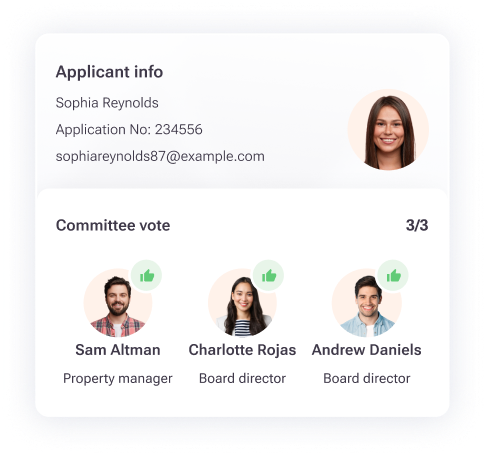
| Board voting | In-person or email polls | Board-ready voting panel with timestamped audit trail |
| Document collection | Scattered folders and inboxes | Centralized document collection |
| Approval letters | Manually drafted | Automated, customized approval letters |
Manual processes fail at predictable points. Email chains lose documents and spreadsheets go out of sync. There is no real-time status visibility and no timestamped audit trail. Repeated status requests from applicants and realtors consume staff hours that should be spent on higher-value work. Paper or email-based approvals have no memory, while a digital workflow records every action with a timestamp, sends reminders, escalates when someone is slow, and leaves a clean audit trail.
TenantEvaluation is built specifically for community associations and management companies, with FCRA compliance as the foundation. Its QuickApprove module carries the five-phase workflow described above inside one platform. The surrounding modules, including IDVerify+ for biometric identity confirmation, Lease Tracking for lifecycle visibility, and TEpayments for fee collection, plug into that same record so nothing falls back into email.

Explore the full TenantEvaluation platform in action.
HOA Approval Workflow Checklist by Phase
Use this checklist to confirm every required step is complete before a decision is recorded and communicated.
- Phase 1: Intake. Verify application completeness at intake and reject incomplete submissions before review begins.
- Phase 2: Verification. Apply written criteria consistently and document what was checked, against what standard, and on what date.
- Authority Gate. Confirm authority in the governing documents and identify which body holds decision rights for this request type.
- Phase 3: Review. Capture the committee or board recommendation, including criteria used and the reasoning for approval, conditional approval, or denial.
- Phase 4: Agenda and Notice. Place the item on the agenda with proper notice and confirm the notice period and method required by the governing documents and statute.
- Phase 4: Quorum and Motion. Confirm quorum at the meeting, record the count, and record the motion in exact language with mover and seconder.
- Phase 4: Discussion and Vote. Note that discussion occurred and record the vote tally for, against, and abstaining, with names for roll call votes.
- Phase 4: Conditions. Document any conditions in the motion language with deadlines and assigned responsibility.
- Phase 5: Written Notice. Notify the applicant in writing and state the outcome, effective date, and any conditions.
- Phase 5: Archiving. Archive the complete record as a single file with a defined retention period.
Frequently Asked Questions
Who Has Authority to Approve a Request in an HOA?
The board of directors, a committee with delegated authority, or the ownership at large may hold decision rights, depending on the declaration and bylaws. Budget approvals usually sit with the board. Architectural modifications may be delegated to an ARC. Amendments to the declaration typically require a membership vote. The governing documents control, and state statute sets the floor where the documents are silent. Confirm authority before review begins so the decision rests with the correct body.
What Must HOA Board Meeting Minutes Contain to Make an Approval Defensible?
Defensible minutes include exact motion text, the names of the mover and seconder, the vote tally with counts for, against, and abstaining, and individual names if a roll call vote occurred. They also include any conditions with deadlines and assigned responsibility, the effective date, and confirmation that quorum was established. A brief note that discussion occurred completes the record. This level of detail supports the decision in any audit or dispute.
How Are Conditional Approvals Tracked to Closure?
Conditions appear in the motion language with specific deadlines and a named responsible party for each condition. Once the motion passes, each condition becomes a tracked action item. The CAM or board secretary monitors conditions against their deadlines and documents verification of completion in the association’s records. This approach keeps the approval complete and enforceable.
How Long Should HOA Approval Records Be Retained?
Retention periods come from state statute and the association’s governing documents. As noted in Phase 5, most states require a minimum of seven years for official HOA records, with ten years as a common best practice. Many practitioners recommend permanent retention for approvals involving structural changes, major expenditures, or contested matters, and they keep the complete approval record together as a single file.
What Happens When a Board Approves Outside Its Authority?
The decision becomes vulnerable to challenge and may be deemed unenforceable. Owners can seek declaratory relief, injunctive relief, and in some jurisdictions attorney’s fees. The proper remedy is ratification or reversal through the body that actually holds decision rights, whether that is the board acting within its authority, a committee with delegated authority, or the membership at large. Addressing the defect promptly and documenting the corrective action in the minutes helps restore procedural integrity.
Conclusion: Building a Defensible HOA Board Approval Workflow
A reliable board approval workflow gives HOA teams a repeatable path from application to defensible decision. Authority checks built into the workflow and detailed decision records in the minutes separate approvals that withstand scrutiny from those that fail.
Next steps include reviewing your governing documents, confirming which body holds decision rights for each request type, and standardizing the record you keep for every decision. A clear, consistent, well-documented board approval workflow protects the board, protects the community, and supports decisions in any audit or dispute.
TenantEvaluation’s QuickApprove delivers this governance-first workflow inside one connected platform, built specifically for community associations and management companies with FCRA compliance at its core.
See how TenantEvaluation replaces email chains and spreadsheets with a connected approval workflow.
