Written by: Luis Teran, Co-founder, CEO, TenantEvaluation | Last updated: August 11, 2026
Key Takeaways for Florida CAMs
- HOA application automation replaces fragmented email chains and spreadsheets with a single digital workflow that covers intake, screening, board voting, and lease tracking.
- Manual workflows expose Florida CAMs to compliance gaps, identity fraud, and lost audit trails, while automation delivers up to 70% faster processing and 50 hours of daily staff time savings.
- Built-in biometric verification, FCRA-compliant screening, and a dedicated board voting dashboard remove the most common sources of delay and risk in community association management.
- Florida-specific features such as 55+ age-restricted verification and pay-per-application revenue sharing give CAMs a platform tailored to local governing documents and association economics.
- Streamline your entire HOA application process with TenantEvaluation’s FCRA-first platform, and see how it works for your community.
Why Manual HOA Application Workflows Hurt Florida CAMs
Manual application processing in community associations typically involves at least five disconnected steps. CAMs receive applications by email, request missing documents through follow-up, and manually review IDs and leases. They then route packages to board members through separate email threads and track decisions in spreadsheets. Each handoff introduces delay and creates a gap in the audit trail.
Buildium’s 2026 State of the Industry Report, surveying more than 3,200 respondents, found that AI adoption in property management jumped from 20% to 58% in a single year. That gap between awareness and execution is where Florida CAMs continue to absorb the cost of manual processing.
Common Causes of Processing Delays and Compliance Risk
Manual HOA application workflows in Florida communities tend to break down in predictable ways.
- Fragmented intake: Applications arrive through email, portals, and physical drop-offs with no standardized format. CAMs must sort and organize each submission before review can begin.
- Manual document review: CAMs verify IDs, leases, and income documents by hand. This process is prone to error and the risk compounds across hundreds of applications per year.
- Identity fraud exposure: Seventy percent of property managers reported an increase in fraudulent applications in the past year, and 46% of property managers conduct tenant verifications manually. That combination creates significant fraud exposure.
- Missing audit trails: Email-based approval flows leave no reliable record. Common problems with email-based approval flows include the loss of any trace if an approver deletes the email and the impossibility of generating reports on the process.
- Board voting bottlenecks: Board members receive application packages through email with no structured voting mechanism. These gaps create delays that extend processing from days into weeks.
These challenges create a clear case for automation. The next section explains how an end-to-end platform addresses each pain point while improving outcomes for CAMs, boards, and applicants.
Key Benefits of Automation for CAMs, Boards, and Applicants
Replacing manual workflows with HOA application processing automation produces measurable outcomes across all three stakeholder groups. TenantEvaluation’s platform, serving more than 5,000 communities and processing over 100,000 applications annually, delivers the following results.
- Time and cost savings: Customers report up to a 70% reduction in processing time and as much as 50 hours of staff time recovered per day. These outcomes are not theoretical. A Florida-based management company documented $240,000 in annual savings after switching to TenantEvaluation.
- Real-time visibility: CAMs, boards, and applicants work from a single connected platform, which removes status-check emails. Organizations that implement real-time workflow visibility report that teams work collaboratively instead of waiting for emails.
- FCRA compliance by design: TenantEvaluation operates as a direct reseller of TransUnion and Equifax data with strict permissible purpose controls. Automated adverse action workflows and built-in audit trails support consistent, defensible screening decisions.
- Biometric fraud prevention: IDVerify moves communities from document-based review to biometric-confirmed identity verification. AI-powered liveness detection and selfie-to-ID comparison help reduce identity fraud risk.
- Revenue share: A pay-per-application model turns application processing into a compliant income stream for associations and management companies, instead of a pure cost center.
The Six-Step Automated Workflow from Intake to Lease Tracking
TenantEvaluation’s end-to-end workflow covers every stage of the resident onboarding lifecycle.
- Intake: Applicants complete 100% online applications via web or mobile. Intelligent form logic adjusts required fields based on applicant type, such as tenant, purchaser, or adult occupant, and on community rules. Incomplete submissions are rejected automatically before they reach the CAM’s queue.
- IDVerify biometric verification: IDVerify validates government-issued ID authenticity, runs AI-powered liveness detection, and performs biometric selfie-to-ID comparison. All steps occur natively inside TenantEvaluation with no external portal redirect, reflecting the growing use of biometrics for fraud prevention in regulated digital processes.
- Screening: Background checks, credit reports through direct TransUnion and Equifax reseller access, income verification, and reference checks run within the same workflow. The platform does not rely on gray-market or offshore data sources.
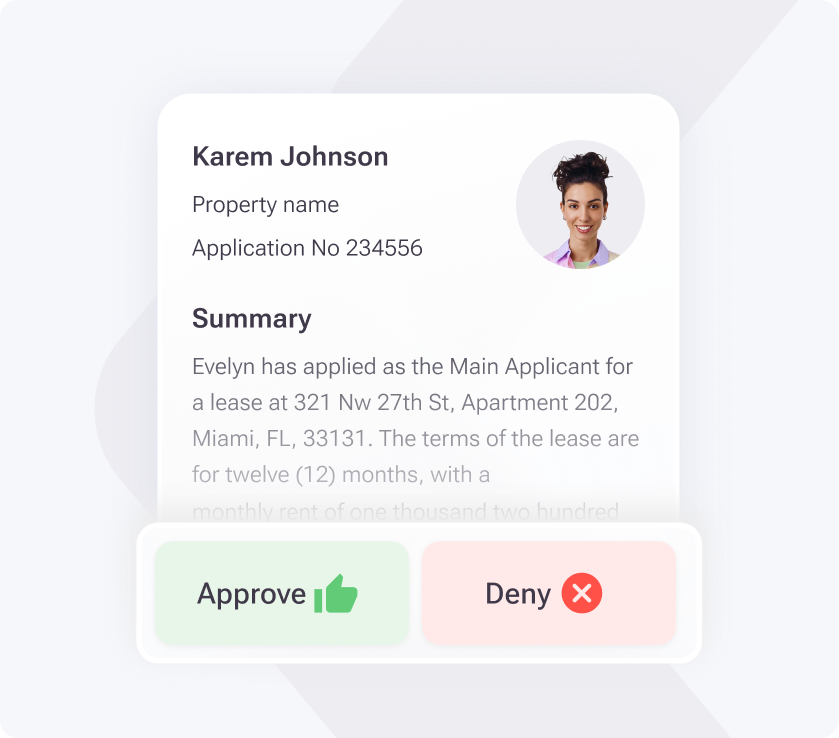
- QuickApprove board dashboard: QuickApprove routes completed applications to a board-ready review and voting dashboard. Board members see AI-generated applicant summaries, real-time application tracking, and a structured voting panel. This setup replaces email chains and spreadsheets with a connected approval process inside TenantEvaluation while preserving board oversight and compliance review.
- Approval: Customized approval letters and personalized welcome packages generate automatically. Automated communication support reduces manual follow-ups for CAMs during peak application seasons and in communities with complex onboarding requirements.
- Lease Tracking and TEpayments by Zinc: Lease Tracking connects resident onboarding, unit data, approvals, and lease documentation into one centralized, real-time, audit-ready workflow. This structure replaces spreadsheets and scattered email chains from application to occupancy. TEpayments by Zinc collects application fees, deposits, and other required resident payments within the onboarding process. Payments go directly from the applicant to the association’s designated account, and TenantEvaluation never holds the funds.
This six-step workflow runs on PCI Level 1 compliance and end-to-end encryption. Sensitive personal information is automatically redacted at every stage.
Florida-Specific Features Including 55+ Communities Verification
Florida condos and HOAs operate under governing documents and community standards that generic property management platforms rarely handle well. TenantEvaluation is built for Florida-specific workflows, including age-restricted communities.
55+ Communities Verification is a built-in capability that helps Florida condos and HOAs standardize how age-restricted requirements are handled across applications. It reduces manual work, supports documentation consistency, and improves operational efficiency and internal controls for CAMs and boards managing age-restricted communities. This capability supports documentation and workflow standardization and does not replace legal guidance.
Florida CAMs who manage portfolios across multiple community types gain a direct operational advantage when they configure community-specific rules, document requirements, and screening criteria inside one platform instead of maintaining separate processes per community.
How Florida CAMs Should Evaluate Automation Platforms
Florida CAMs comparing HOA application processing automation platforms can use the following criteria as a checklist.
- FCRA compliance architecture: Compliance should sit in the platform’s foundation, not as an add-on feature. TenantEvaluation operates as a direct reseller of TransUnion and Equifax data with strict permissible purpose controls and automated adverse action workflows.
- Board dashboard: A dedicated board review and voting panel keeps board involvement inside the platform instead of in email. The QuickApprove board dashboard, described earlier, delivers the structured voting and real-time tracking that email-based workflows cannot provide.
- Biometric fraud prevention: Generic tools rely only on document uploads. IDVerify provides biometric fraud prevention as described in the workflow above, which goes beyond basic document checks.
- Revenue share model: Platforms like AppFolio and RealPage charge monthly subscriptions. TenantEvaluation uses a pay-per-application model with a revenue-sharing structure that aligns platform success with association outcomes.
- Lease visibility: Many platforms do not connect lease documentation to the onboarding workflow. TenantEvaluation’s Lease Tracking delivers real-time lease status, including active, pending, expired, or missing, with unit-level tracking and searchable digital history.
Platforms such as Vantaca and PayHOA offer property management features but are not positioned as FCRA-first, board-ready screening platforms built specifically for community associations. ApplyCheck and Verify Screening Solutions focus on background checks without the end-to-end onboarding, board dashboard, biometric verification, or lease tracking capabilities that Florida CAMs require.
Before and After ROI for HOA Application Automation
| Metric | Manual Workflow | TenantEvaluation Automated Workflow |
|---|---|---|
| Application processing time | 5–10 business days | 5–10 minutes to submission, hours to decision |
| Staff time consumed | High, with manual follow-ups, document review, and board routing | Up to 50 hours per day recovered across the team |
| Approval cycle time reduction | Baseline | Up to 70% reduction |
| Audit trail completeness | Incomplete, because email deletions create gaps | Full timestamped audit trail on every application |
| Identity fraud exposure | High, with document-based review only | Reduced, with biometric verification via IDVerify |
| Annual cost impact | High operational cost with no revenue offset | Documented six-figure annual savings for Florida customers |
Automated approval workflows in multi-stakeholder environments can achieve up to 82% reductions in approval cycle time, turning days into hours while maintaining complete audit trails. For community associations processing hundreds of applications per year, that cycle-time compression translates directly into staff capacity and association revenue.
Review the full ROI breakdown for your portfolio size and community type.
Frequently Asked Questions
How does TenantEvaluation route applications to the board for voting?
QuickApprove routes completed, screened applications directly to a board-ready dashboard inside TenantEvaluation. Board members access AI-generated applicant summaries and cast votes through a structured voting panel, with no email chains and no spreadsheets. The entire process remains timestamped and audit-ready while preserving board oversight and compliance visibility.
Does TenantEvaluation support 55+ age-restricted communities in Florida?
Yes. 55+ Communities Verification is a built-in capability within TenantEvaluation that helps Florida condos and HOAs standardize how age-restricted application requirements are handled. It reduces manual work, improves documentation consistency, and strengthens operational efficiency and internal controls for CAMs and boards. This feature supports documentation and workflow standardization and does not replace legal guidance.
How does TenantEvaluation maintain FCRA compliance throughout the screening process?
TenantEvaluation is built with FCRA compliance as the foundation. The platform operates as a direct reseller of TransUnion and Equifax data, not as a third-party scraper. Strict permissible purpose controls, automated adverse action workflows, and built-in audit trails apply to every application. IDVerify+ strengthens permissible-purpose validation by confirming applicant identity before screening authorization proceeds.
What happens to application fees and deposits collected through the platform?
TEpayments by Zinc is a connected payment workflow integrated into TenantEvaluation’s onboarding process. Payments go directly from the applicant to the association’s designated account. TenantEvaluation organizes the workflow but never holds the funds. Each association defines what is collected and at which stage, and the capability adapts to the property’s process rather than forcing a universal sequence.
How does Lease Tracking work after an application is approved?
Lease Tracking connects resident onboarding, unit data, approvals, and lease documentation into one centralized, real-time workflow inside TenantEvaluation. After approval, lease documents are collected automatically during onboarding and stored with real-time status visibility, including active, pending, expired, or missing. CAMs, property managers, and boards can confirm occupancy status, track lease expirations, and access searchable digital lease history without searching across folders, inboxes, or spreadsheets.
Conclusion: A Single FCRA-First, Board-Ready Platform for Florida CAMs
Florida CAMs who manage HOA application processing through email chains, PDF uploads, and spreadsheets absorb preventable costs in staff time, compliance exposure, and fraud risk. TenantEvaluation replaces those disconnected steps with a single FCRA-first platform, with the compliance architecture detailed above, that covers intake, biometric verification, screening, board voting, lease tracking, and connected payments. Customers see up to 70% time reduction and documented annual savings for community associations.
No other platform in the market combines this FCRA-first foundation with a dedicated board voting dashboard, biometric identity verification, 55+ community support, and real-time lease lifecycle control in one system built exclusively for Florida community associations. See the complete workflow in action and discover how it is built specifically for your communities.