Written by: Luis Teran, Co-founder, CEO, TenantEvaluation
Key Takeaways
- Identity fraud, including stolen IDs, synthetic identities, and AI-generated documents, is rising sharply in Florida HOA and condo communities, with baseline application fraud rates between 5% and 7%.
- Document-only screening fails to confirm that the applicant is the rightful owner of submitted IDs and income documents, which leaves boards exposed to costly evictions and legal disputes.
- Modern fraud-prevention screening combines biometric identity verification, including government ID validation, liveness detection, and facial matching, with FCRA-compliant background and credit checks inside a single platform.
- TenantEvaluation’s IDVerify and QuickApprove modules deliver native biometric verification, board-ready approval workflows, and complete audit trails tailored for Florida CAMs and associations.
- Get started with TenantEvaluation to protect your community from identity fraud before it enters the building.
The Growing Threat: Common Fraud Types in Florida Communities
Florida’s high-volume rental and condo markets attract a concentrated range of fraud patterns that now appear in everyday applications. CAMs and boards most often see the following tactics.
- Stolen IDs: 70.7% of rental housing providers reported an increase in fraudulent applications and payments, using fraudulent documentation, financial statements, and even identities, in NMHC’s Pulse Survey. A real person’s identity is used without their knowledge.
- Synthetic identities: A legitimate Social Security number is paired with a fabricated name, date of birth, or address. These identities appear clean in database checks because they have no prior housing fraud history.
- Fake pay stubs and bank statements: 84.3% of rental housing operators have seen falsified or fabricated income documentation. Sumsub reported a 311% increase in synthetic identity document fraud in North America between Q1 2024 and Q1 2025.
- Deepfake selfies: Digital injection attacks feed AI-generated media directly into biometric verification systems, bypassing the camera entirely. Standard selfie uploads without liveness detection cannot catch these attempts.
- Borrowed identities: Applicants use identities borrowed from acquaintances with strong credit histories, which pass document review while misrepresenting who will actually occupy the unit.
Why Document-Only Screening Fails Against Modern Fraud
Manual review of income documents such as pay stubs or bank statements is increasingly vulnerable to sophisticated AI-generated forgeries. Purpose-built PDF creators generate fake bank statements with subtle font and alignment tweaks that are nearly invisible to the human eye.
Document-only screening fails because it treats documents as proof of identity instead of proof of possession. Uploaded files confirm that a document exists, not that the person submitting it is the document’s rightful owner. This gap widens as online pay stub generators make falsified income documents easier to produce, with inconsistencies often too subtle for manual review to catch.
Even when documents are authentic, income verification methods that rely only on applicant-provided paperwork cannot directly prove that the applicant is the person named in those documents. Synthetic identities exploit this weakness by passing database checks, since they appear clean when they have no prior housing fraud history. At the same time, fraud is becoming more automated and technically advanced, increasing the risk that single-method checks can be bypassed by generative AI tools.
Red-flag checklist for document-only screening gaps:
- No biometric confirmation that the applicant matches their submitted ID
- No liveness detection to rule out deepfake selfies or video replays
- No automated tampering analysis on uploaded pay stubs or bank statements
- No audit trail linking identity confirmation to the screening record
- No separation between document receipt and identity authentication
Why Current Screening Vendors Leave Fraud Gaps
Many screening vendors still rely on document uploads and basic background checks, which leaves structural blind spots. These blind spots show up as missing biometric checks, weak FCRA controls, and limited visibility for boards that must approve applicants.
When CAMs and boards use tools that lack biometric verification, they cannot reliably confirm that the applicant is present and matches their ID. When those tools also lack board dashboards, automated adverse action notices, or Florida-specific workflows, communities face both fraud risk and compliance risk in the same process.
The Solution: Modern Fraud-Prevention Tenant Screening
Modern fraud-prevention tenant screening layers biometric identity verification directly on top of FCRA-compliant background and credit checks. This approach confirms that the person submitting an application is physically present, matches their government-issued ID, and has not fabricated their identity before any approval decision is made.
TenantEvaluation is built specifically for community associations and management companies, with FCRA compliance as the foundation, not an afterthought. Founded in 2007 and serving more than 5,000 communities with approximately 100,000 applications processed annually, TenantEvaluation delivers an all-in-one resident screening and onboarding platform that fits the workflows of Florida CAMs and HOA and condo boards.
Two integrated capabilities anchor its fraud-prevention layer: IDVerify, a biometric identity verification module embedded natively in the screening workflow, and QuickApprove, an accelerated board-ready approval workflow that replaces email chains and spreadsheets with a connected, auditable process.

See how IDVerify stops identity fraud in your screening workflow.
How Biometric Verification Works Inside One Platform
IDVerify introduces automated KYC verification directly inside the TenantEvaluation screening workflow, with no external portals, redirects, or workflow disruption. The process runs three layers at the same time.
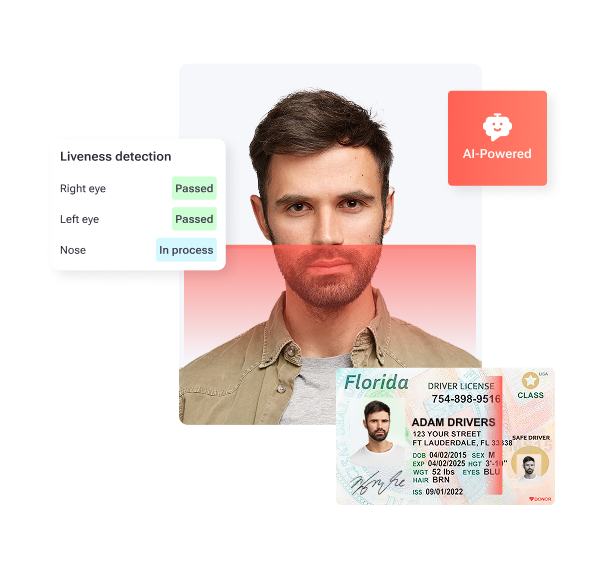
- Government ID validation: OCR technology extracts data from the ID and detects tampering signals such as font inconsistencies or pixel-level edits.
- AI-powered liveness detection: Liveness detection confirms the user is physically present by analyzing cues including blinking, slight head movements, and skin texture, which prevents fraud attempts that use photos, videos, or deepfakes.
- Biometric facial matching: A 1:1 face match compares the live selfie against the photo extracted from the identity document, which confirms that the applicant is the document’s rightful owner.
CAMs see verification results, including ID authenticity confirmation, liveness status, biometric match result, and a redacted ID copy, embedded directly within the screening report. IDVerify can be enabled per condo or HOA and configured per property portfolio, which supports different community risk profiles without a one-size-fits-all approach.
These biometric layers close the gaps created by document-only screening and directly target stolen IDs, synthetic identities, and AI-generated documents before they reach the board for approval.
FCRA Compliance Guardrails and Audit Trails
This FCRA-first design, introduced earlier, structures every element of the screening workflow around four core requirements. These requirements protect applicants’ rights while also protecting associations from regulatory and legal exposure.
- Permissible purpose: The FCRA requires that reporting agencies verify the requester and their legitimate purpose before releasing any consumer data. TenantEvaluation enforces strict permissible purpose controls at the point of data access.
- Written consent: Consumers must give written consent before anyone requests a consumer report. TenantEvaluation captures this consent digitally within the application workflow.
- Adverse action: Any person who takes adverse action based on a consumer report must provide the consumer with appropriate disclosures. TenantEvaluation automates adverse action workflows so that notices are delivered accurately.
- Audit trails: Every application generates a timestamped, auditable record. TenantEvaluation is a legitimate reseller of TransUnion and Equifax data, accessed under strict bureau rules with no gray-market or offshore data sources, which protects associations from liability exposure.
IDVerify+ further strengthens permissible-purpose validation by ensuring identity confirmation occurs prior to screening authorization, which reinforces FCRA-aligned workflows and audit defensibility. Biometric verification alone creates limited value if the screening process violates FCRA requirements, so these guardrails keep fraud prevention and compliance aligned.
Board-Ready Approval Workflows with QuickApprove
QuickApprove is TenantEvaluation’s accelerated approval workflow built for CAMs, boards, and property management teams inside one connected platform. It replaces email chains, spreadsheets, and disconnected follow-ups with a structured, board-ready process that accelerates resident approvals while maintaining control, compliance, and visibility.

Key capabilities include real-time application tracking, automated communication support, customized approval letters, a personalized welcome package, and a dedicated board review and voting dashboard. Board members access summarized applicant reports and cast votes directly inside TenantEvaluation, which removes the back-and-forth that stalls approvals during peak seasons or in communities with complex onboarding requirements.
The result is faster, clearer, and more consistent approvals for CAMs, a more organized decision process for boards, and a smoother onboarding experience for applicants, all within a single auditable workflow.
Watch QuickApprove and IDVerify work together in a live demo.
Red Flags in Vendors and What to Look for Instead
CAMs and boards can use red-flag checklists to assess current vendors, then apply clear criteria when evaluating alternatives. The first list below highlights warning signs in an existing screening provider. The second list shows the capabilities that support stronger fraud prevention and board visibility.
Red flags in your current screening vendor:
- No biometric identity verification layer inside the platform
- Redirects applicants to external portals for ID checks
- No board-facing dashboard or voting workflow
- No automated adverse action notices
- Not a direct credit bureau reseller, such as TransUnion or Equifax
- No Florida-specific configuration for HOA and condo workflows or 55+ communities
- No built-in audit trail per application
Vendor evaluation criteria for fraud-prevention tenant screening:
- Biometric verification, including liveness detection and facial matching, runs natively inside the platform
- FCRA-first design with direct bureau reseller relationships
- Automated adverse action and permissible purpose controls
- Board-ready dashboard with real-time application visibility
- Florida-specific workflow configuration
- End-to-end audit trail from application intake to final decision
The following comparison illustrates the capability gap between document-only screening and biometric-backed verification. It shows how fraud detection strength, audit completeness, and board visibility all improve when communities move beyond uploaded documents alone.
| Screening Method | Fraud Detection Strength | FCRA Audit Trail | Board Visibility |
|---|---|---|---|
| Document-Only Screening | Low, 5–7% baseline fraud rate passes through, and AI-generated documents bypass manual review | Incomplete, no biometric confirmation linked to screening record | None, approvals managed via email chains and spreadsheets |
| Biometric-Backed TenantEvaluation (IDVerify+ + FCRA Checks) | Multi-layer, government ID validation, liveness detection, and 1:1 facial biometric matching combined | Complete, timestamped audit trail per application with direct TransUnion and Equifax reseller relationships | Full, real-time board dashboard with voting panel via QuickApprove |
Frequently Asked Questions
How long does a TenantEvaluation application take to process?
TenantEvaluation processes applications in 5 to 10 minutes, compared to the 5 to 10 days typical of manual or less automated screening workflows. The platform automates document collection, identity verification via IDVerify, background and credit checks, and board notification in a single connected workflow, which removes the manual handoffs that create delays.
What does fraud-prevention tenant screening cost per application?
TenantEvaluation operates on a pay-per-application model with no upfront fees or monthly subscriptions. The platform’s revenue-sharing model deducts the service fee from the collected application fee and rebates the remainder to the association or management company, which makes it cost-neutral or revenue-generating for many communities. TenantEvaluation has already generated $150 million for the communities it serves.
Does adding biometric verification create FCRA compliance issues?
No. IDVerify is designed to strengthen FCRA compliance, not complicate it. Identity confirmation via IDVerify occurs prior to screening authorization, which reinforces permissible-purpose validation and audit defensibility. TenantEvaluation is a direct reseller of TransUnion and Equifax data, operates under strict bureau rules, and automates adverse action workflows, so every step of the process meets FCRA requirements. The platform maintains a complete, timestamped audit trail for every application.
How does TenantEvaluation handle 55+ community age-restricted applications?
55+ Communities Verification is a built-in capability within TenantEvaluation that helps Florida condos and HOAs standardize how age-restricted requirements are handled across applications. It reduces manual work, improves documentation consistency, and strengthens operational efficiency and internal controls for CAMs and boards managing age-restricted communities. This capability is designed for Florida-specific association workflows and supports documentation and consistency without replacing legal guidance.

Can TenantEvaluation be configured for different communities within the same management portfolio?
Yes. TenantEvaluation is configurable per community, per portfolio, and per risk profile. IDVerify can be enabled or adjusted per condo or HOA. Screening criteria, including credit score thresholds, income verification requirements, and document checklists, are customized to each community’s governing documents and Florida-specific regulations. This supports management companies that operate across multiple communities with different standards without requiring separate platforms or manual workarounds.
Conclusion: Move from Documents to Verified Identities
Document-only tenant screening no longer provides adequate protection against stolen IDs, synthetic identities, or AI-generated documents. Fraud is becoming more automated and technically advanced in 2025, and Florida HOA and condo communities face direct liability when fraudulent applicants pass through inadequate screening processes.
The shift from document-based validation to biometric-confirmed identity verification, layered on FCRA-compliant background checks inside a board-ready platform built for Florida community associations, now defines how CAMs and boards manage this risk. TenantEvaluation delivers that upgrade through IDVerify+, QuickApprove, and 55+ Communities Verification inside one platform, with FCRA compliance as the foundation.
