Written by: Luis Teran, Co-founder, CEO, TenantEvaluation | Last updated: August 6, 2026
Key Takeaways for Florida Condo Screening in 2026
- Florida condo associations may only screen residents when their governing documents explicitly authorize it under Chapter 718.
- Application fees are capped at $100 per applicant, and identity fraud risks now call for biometric verification beyond document review.
- FCRA compliance requires consent language, objective criteria, and timely adverse-action notices whenever consumer reports influence decisions.
- Consistent application of written screening criteria helps protect associations from Fair Housing Act liability and selective-enforcement claims.
- TenantEvaluation streamlines Florida condo screening workflows from application intake through occupancy records. See how TenantEvaluation automates compliance.
Current Landscape: 2026 Statute Updates, Identity Fraud, and Fee Caps
Under Section 718.112, Florida Statutes, application or transfer fees for screening are capped at $100 per applicant, with spouses or a parent and dependent children treated as a single applicant. Because the Florida Department of Business and Professional Regulation periodically adjusts this cap, boards must verify the current limit before setting fees. Boards collecting fees above the statutory cap, or imposing fees without governing-document authorization, face enforcement exposure.
Associations also risk legal challenges when they implement screening requirements or fees without clear authority in their declarations, articles, or bylaws. Every new policy should trace back to a specific provision in the governing documents.
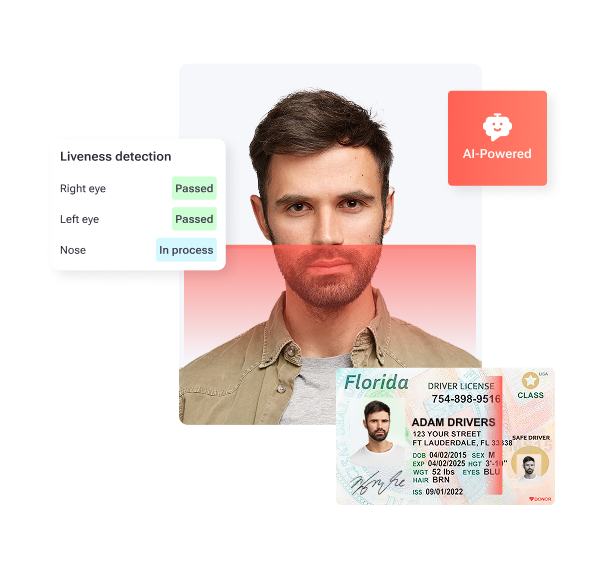
Beyond fee compliance, identity fraud compounds the operational challenge. Traditional document-based screening, which relies on uploaded ID copies, cannot reliably detect synthetic identities or impersonation attempts. The industry is shifting toward biometric verification that uses AI-powered liveness detection, government ID authentication, and selfie-to-ID facial comparison. Boards that have not updated their verification workflows now carry growing fraud exposure that document review alone cannot address.
Compliance, Risk, and Governance Requirements
When a consumer report influences a screening decision, the FCRA requires the association to provide an adverse-action notice identifying the consumer reporting agency, stating that the agency did not make the decision, and informing the applicant of the right to dispute the report and obtain a free copy within the statutory window. Missing this notice remains one of the most common and costly board mistakes in Florida condo screening.
The Fair Housing Act applies to condominium associations, covering property owners, housing managers, and homeowners and condominium associations. Screening policies must apply written criteria in the same order and under identical standards to every applicant. Inconsistent enforcement is treated as evidence of discrimination.
This principle extends beyond substantive rules to approval procedures themselves. No Florida DBPR arbitration decision matching Lovett v. Golden Lakes Village (2021) or the described selective-enforcement ruling on rental applicants exists in the evidence. The case confirms that selective enforcement applies to approval procedures, not just substantive rules.
Record retention functions as the audit backstop. Every consent form, screening report, board vote, and adverse-action notice must be stored in a retrievable format. Associations that rely on email chains and shared folders cannot easily demonstrate a consistent process when regulators, courts, or owners request proof.
Best Practices for Board-Ready Screening Workflows
A compliant screening workflow follows a documented sequence that creates a clear audit trail. The checklist below maps the process from application intake through final decision and shows how each stage supports FCRA compliance, Fair Housing consistency, and DBPR defensibility.
- Confirm governing-document authority for screening before accepting any application or fee.
- Collect FCRA-compliant consent language from every applicant before ordering any consumer report.
- Verify applicant identity using biometric confirmation, including government ID validation, liveness detection, and facial biometric comparison, before the application proceeds to board review.
- Apply objective, pre-established criteria such as credit threshold, income ratio, rental history, and criminal history review consistently to every applicant in the same sequence.
- Route completed applications to a board-ready dashboard with summarized reports and a documented voting record.
- Issue adverse-action notices within the FCRA-required window for any denial influenced by a consumer report.
- Collect the application fee within the $100 statutory cap through a traceable, documented payment workflow.
- Store all documents, including application, consent, screening report, board vote, approval or denial letter, and lease, in a centralized, searchable, audit-ready system.
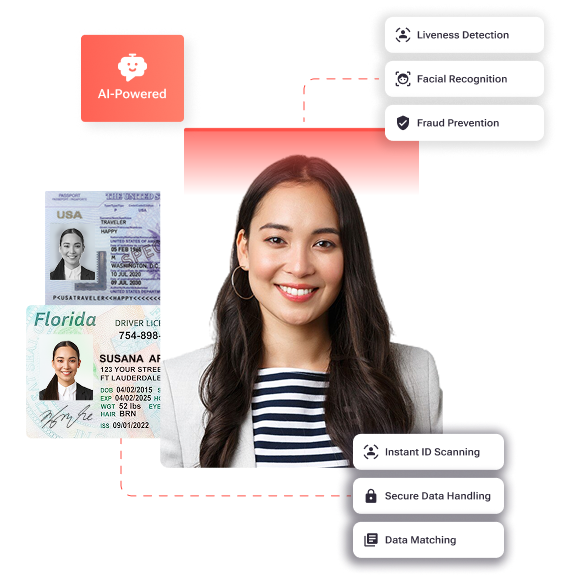
Biometric identity confirmation, specifically IDVerify, closes the gap between document submission and verified physical identity described in step three. AI-powered liveness detection and selfie-to-ID biometric comparison confirm that the applicant is present and matches the submitted identification before the board reviews the file, which strengthens both fraud prevention and audit readiness.
How TenantEvaluation Supports Florida-Specific Screening and Onboarding
TenantEvaluation is built specifically for community associations and management companies, with FCRA compliance as the foundation, not an afterthought. The platform serves more than 5,000 communities and processes approximately 100,000 applications annually across Florida.
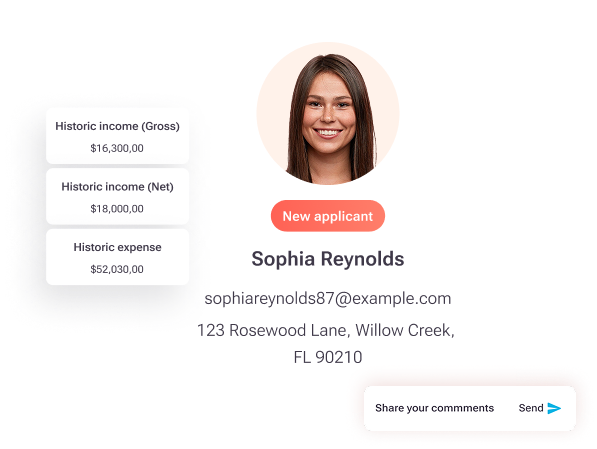
The platform’s capabilities align directly with the compliance requirements described in this guide.
- QuickApprove: An accelerated approval workflow built for CAMs, boards, and property management teams inside one connected platform. It delivers real-time application tracking, automated communication support, customized approval letters, a personalized welcome package, and a board-ready approval process, which reduces manual follow-ups while preserving control, compliance, and visibility.
- IDVerify: Biometric identity verification embedded directly in the screening workflow. Government ID validation, AI-powered liveness detection, and biometric facial matching run natively inside TenantEvaluation, so teams avoid external portals and workflow disruption.
- 55+ Communities Verification: A built-in capability that helps Florida condos and HOAs standardize age-restricted application handling, reduce manual work, and support documentation consistency across applications.
- Lease Tracking: Centralized, real-time lease visibility and lifecycle control that connects resident onboarding, unit data, approvals, and lease documentation into one audit-ready workflow. This replaces spreadsheets and scattered email chains from application to occupancy.
- TEpayments by Zinc: A connected payment workflow inside TenantEvaluation that collects application fees and deposits during resident onboarding. Payments go directly to the association’s designated account, and TenantEvaluation never holds the funds.
TenantEvaluation is a legitimate reseller of TransUnion and Equifax data, accessed under strict bureau rules with regular compliance reviews. Automated adverse-action workflows and built-in audit trails for every application help keep associations protected from liability exposure.
See the platform in action, from FCRA consent through lease tracking.
Evaluation Framework: Comparing Screening Platforms and Processes
CAMs and boards evaluating screening platforms against manual processes or generic property-management tools can use a six-dimension framework that mirrors the compliance and risk themes in this guide. Each dimension reflects a pressure point discussed earlier, from FCRA notices to identity fraud and record retention.
- Compliance readiness: Determine whether the platform embeds FCRA consent, adverse-action workflows, and permissible-purpose controls, or leaves the association to manage these separately.
- Operational efficiency: Assess whether the platform shortens application cycles and reduces manual follow-up, or simply recreates existing bottlenecks in a digital format.
- Transparency: Confirm that boards have a dedicated review and voting dashboard with real-time application visibility, instead of decisions flowing through email chains.
- Scalability: Check whether the platform can absorb higher onboarding volume during peak seasons without adding headcount.
- Auditability: Verify that all documents, votes, notices, and lease records are stored in a searchable, audit-ready format that staff can access without manual reconstruction.
- Risk controls: Ensure that the platform includes biometric identity verification, auto-redaction of sensitive PII, PCI Level 1 compliance, and end-to-end encryption.
Generic tenant screening tools and broader property-management platforms typically address one or two of these dimensions. Florida-specific end-to-end compliance, including governing-document configuration, FCRA-aligned workflows, biometric verification, board voting dashboards, centralized lease tracking, and connected fee collection, requires a platform built for community associations, not adapted from generic rental tools.
Frequently Asked Questions
What background-check standards apply to Florida condo associations?
Florida condo associations may conduct background checks only when the governing documents, such as the declaration, articles, or bylaws, explicitly authorize screening. When authorized, the association must establish objective, written criteria applied consistently to every applicant. Criteria commonly include credit score thresholds, income-to-rent ratios, rental history, eviction records, and criminal history review.
Criminal history must be evaluated individually, considering the nature of the offense, time elapsed, and relevance to resident or property safety. Blanket bans on applicants with any criminal record create Fair Housing Act exposure. All background checks must be conducted through a consumer reporting agency operating under FCRA rules, and any denial influenced by a consumer report requires a written adverse-action notice delivered to the applicant within the statutory timeframe.
Does Florida law impose a 5-year look-back rule for criminal records?
Florida statutes do not impose a universal 5-year look-back limitation on criminal records for condo association screening. The association’s governing documents and its adopted screening criteria determine the look-back period applied. However, sealed or expunged records cannot be used in screening decisions, and non-serious juvenile records meeting specific qualifications (no forcible felony charges after 18, no serious or habitual classification, and no commitment to a juvenile correctional facility) are automatically expunged two years after the minor’s 19th birthday.
HUD guidance discourages rigid time-based cutoffs applied without individual assessment and recommends that associations evaluate each conviction based on its nature, severity, and timing relative to the application. Associations should document the rationale for any criminal-history decision to support audit defensibility.
What does Section 718.3026 require for screening approvals?
Section 718.3026 of the Florida Condominium Act addresses contracts and financial obligations of associations but is frequently cited in the context of board governance and approval authority. Screening approvals under Chapter 718 more directly implicate Section 718.112, which governs bylaws, meeting procedures, and the application fee cap discussed earlier. The governing documents must authorize screening before any approval process is implemented.
Board approval decisions must follow the procedures established in the bylaws, including quorum requirements, voting thresholds, and notice obligations. Associations implementing or updating screening policies should confirm that the policy is grounded in declaration authority and that the board’s approval workflow is documented and consistently applied.
How do 55+ communities verify age-restricted requirements?
Florida condos and HOAs operating as age-restricted communities under the Housing for Older Persons Act (HOPA) must maintain documentation demonstrating that at least 80% of occupied units have at least one resident aged 55 or older, and must publish and follow policies demonstrating intent to be age-restricted housing. Verification typically involves collecting age documentation, such as government-issued ID, birth certificates, or similar records, from qualifying residents during the application process.
TenantEvaluation’s 55+ Communities Verification capability helps Florida condos and HOAs standardize how age-restricted application requirements are handled across applications, reducing manual work and supporting documentation consistency. This is a workflow standardization and documentation tool and does not replace legal guidance on HOPA compliance.

Conclusion: Benchmark Your Screening Processes
Florida condo association resident screening now operates at the intersection of Chapter 718 governing-document authority, FCRA consumer-report obligations, and Fair Housing Act consistency requirements. The $100 fee cap, the 2026 DBPR adjustment cycle, rising identity fraud, and selective-enforcement case law collectively raise the compliance floor for every board implementing or updating a screening policy in 2026.
The checklist in this guide, from governing-document confirmation through audit-ready lease recordkeeping, provides a benchmark for evaluating current processes. Associations that rely on manual workflows, disconnected spreadsheets, or generic screening tools should measure each stage against the compliance, efficiency, transparency, scalability, auditability, and risk-control framework outlined above.
TenantEvaluation connects every compliance stage described in this guide, from FCRA consent and biometric verification through board approvals, lease tracking, and fee collection, in a single platform purpose-built for association compliance requirements.
Benchmark your screening process against 2026 requirements in a live demo.
