Written by: Luis Teran, Co-founder, CEO, TenantEvaluation | Last updated: September 16, 2026
Key Takeaways
- Age verification in Florida 55+ condos confirms at least one occupant is 55 or older and documents it for fair-housing compliance under HOPA and Florida law.
- The federal 80/20 rule requires at least 80 percent of occupied units to have one resident aged 55+, with biennial re-surveys required to maintain the exemption.
- A structured workflow assigns clear roles to applicants, CAMs, and boards, and separates FCRA disclosures from age documentation collection to avoid common compliance errors.
- Non-qualifying household scenarios such as under-55 spouses, adult children, or caregivers require documented decision-tree routing and board review to stay compliant.
- TenantEvaluation streamlines the entire age-verification process for Florida condos and HOAs—see how the 55+ verification workflow works.
Florida 55+ Condo Age Verification Workflow: Step By Step
This workflow walks through each step in order. Every step explains who owns the action, when it happens, and what record it creates. Responsibilities sit with four roles: the applicant, the Community Association Manager (CAM) or front desk, the board, and any third-party screening provider. The process covers both individual household verification and the community-wide 80/20 occupancy calculation as two related but separate tracks.
See the 55+ onboarding workflow in action to watch TenantEvaluation handle intake, disclosure, and age documentation in one place.
Step 1: Intake And FCRA Disclosure Timing
Who: Applicant completes intake; CAM owns the intake configuration.
When: At application submission, before any consumer report is procured.
Artifact: Completed application record; standalone FCRA disclosure document; signed written authorization.
Before any background or credit report is ordered, 15 U.S.C. § 1681b(b)(2)(A) requires a clear and conspicuous written disclosure to the applicant in a document that consists solely of the disclosure. The disclosure cannot be embedded in the application form, a liability waiver, or any other document. Written authorization must be obtained before the report is procured.
FCRA compliance practitioners treat the disclosure and authorization as a four-step sequence. First, provide a standalone written disclosure. Second, obtain written authorization. Third, certify permissible purpose to the screening provider. Fourth, follow a two-step adverse action process if the report leads to a negative decision. The FCRA sets no numeric waiting period between consent and ordering the report; it requires only that disclosure and authorization occur before the report is procured.
Age documentation collection and FCRA disclosure happen at the same time during intake, but they answer different legal questions. The FCRA disclosure governs the consumer report, while age documentation governs HOPA eligibility. Because eligibility determination depends on both, neither can be skipped or deferred.
Review TenantEvaluation’s FCRA-first intake flow to see how disclosure and consent sequencing work inside a single connected workflow.
Step 2: Age Documentation Collection
Who: Applicant submits; CAM or front desk verifies completeness.
When: Concurrent with intake, before eligibility determination.
Artifact: Government-issued photo ID, birth certificate, passport, immigration card, military ID, or signed self-certification affidavit.
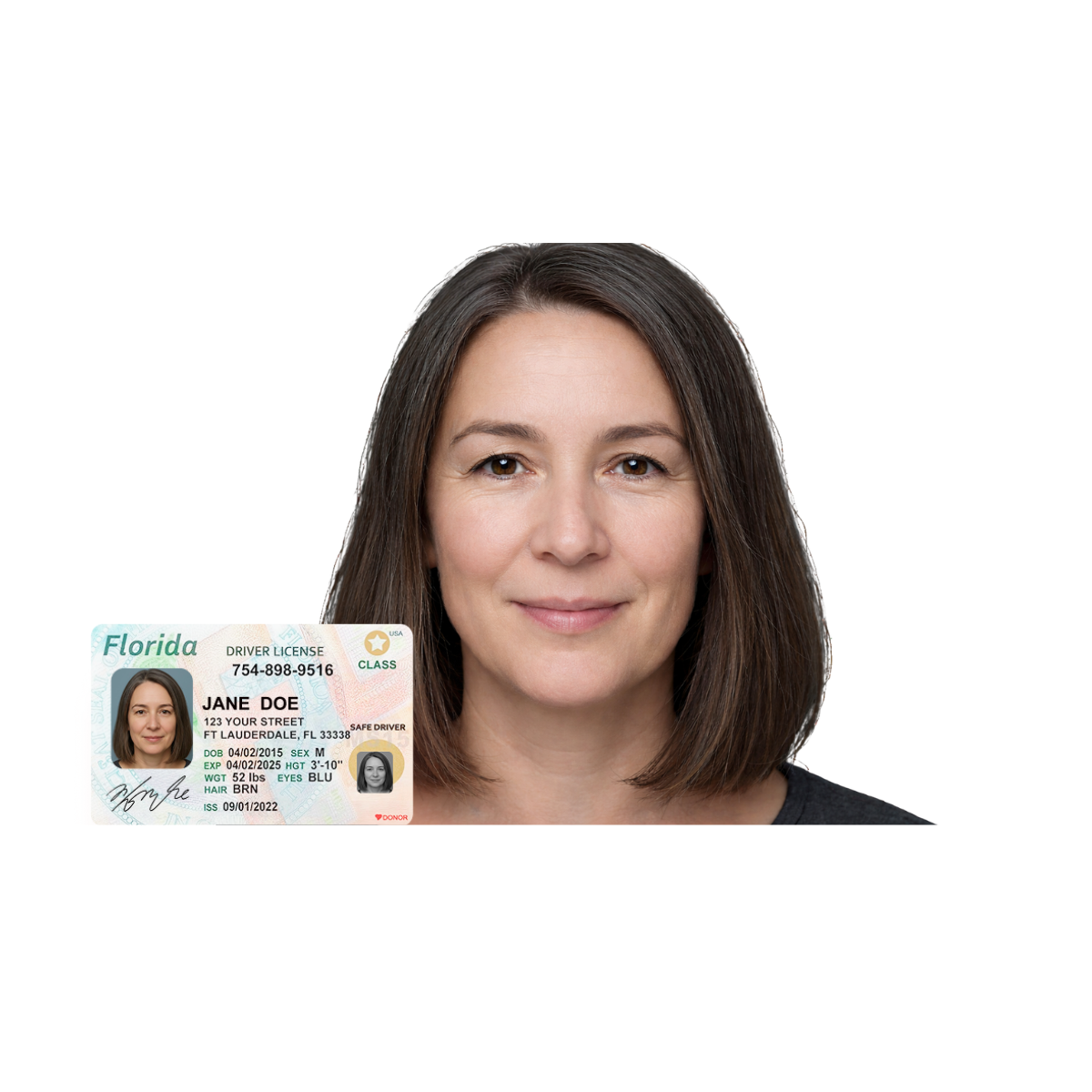
Under 24 CFR 100.307, acceptable proof of age includes a driver’s license, birth certificate, passport, immigration card, military ID, or any other government-issued document showing a birth date. A signed statement from any household member aged 18 or older asserting that at least one person in the unit is 55 or older also satisfies the requirement.
A self-certification affidavit suffices when the applicant can attest under penalty of perjury that at least one occupant meets the age threshold. Documentary proof is warranted when the affidavit alone would leave the file insufficiently supported for a fair-housing challenge. That often occurs when the qualifying occupant’s age is close to the threshold or when the household composition is complex. A community that demands multiple documents or rejects a valid document goes beyond what federal law allows.
If occupants refuse to cooperate, 24 CFR § 100.307 permits the community to rely on alternative evidence such as government records, prior applications, or a sworn statement from someone with personal knowledge of the occupants’ ages.
Step 3: Eligibility Determination And Decision Paths For Non-Qualifying Households
Who: CAM performs initial determination; board reviews escalated cases.
When: After documentation is collected, before board approval.
Artifact: Eligibility determination record with supporting documentation.
Most age-verification workflows stop at document collection. The real operational risk appears when a household does not present a straightforward qualifying occupant. The decision paths below cover four common escalation scenarios and keep outcomes consistent.
Decision Tree: Non-Qualifying Household Scenarios
- If no proposed occupant is 55 or older: Route the file for board review instead of treating the application as automatically ineligible. The community’s governing documents may address hardship provisions, and the 20 percent buffer may accommodate the household depending on the current occupancy census. The CAM documents the routing decision and the census position at the time of review.
- If the household includes an under-55 spouse: Verify that the qualifying 55+ occupant is present and document the relationship. Under HOPA, only one occupant in a qualifying unit must be 55 or older, so a 58-year-old living with a 50-year-old spouse forms a qualifying unit. Some governing documents impose a minimum age for the younger spouse, commonly 40 to 45. The CAM checks the declaration before making a determination. When the qualifying 55+ resident dies or permanently moves away, the CAM escalates to the board, and the outcome follows the governing documents.
- If the household includes an adult child: Check the community’s governing documents for age minimums and guest-duration limits. Community governing documents typically address whether children may live in the home permanently, stay during school breaks, or visit for a set number of days. Most Florida 55+ communities cap guest visits at 15 or 30 consecutive days with an annual total. A permanent adult-child occupant who does not meet the community’s minimum age for all residents requires board review and a census check before approval.
- If the household includes a live-in caregiver: Evaluate the request as a reasonable accommodation tied to a resident’s disability. Under 24 CFR § 100.305(e)(4), under-55 persons necessary to provide a reasonable accommodation to disabled residents are excused from the age restriction, and a caregiver request tied to a resident’s disability generally cannot be refused merely because the caregiver is under 55. The CAM documents the request, the disability nexus, and the board’s determination. The caregiver unit does not count against the 80 percent ratio.
Each branch of this decision tree produces a documented artifact. That artifact may be the routing decision, the census position at the time of review, the relationship verification, or the reasonable accommodation determination. These records form the core of the audit file.
Step 4: The 80/20 Calculation As An Ongoing Obligation
Who: CAM maintains the occupancy census; board reviews at re-survey.
When: Ongoing, recalculated at least every two years.
Artifact: Occupancy survey summary available for inspection upon reasonable notice.
Once individual households are verified, the community still has to prove it meets the federal floor. At least 80 percent of occupied units must have at least one resident who is 55 or older, under 24 CFR 100.305. A household can pass individual eligibility review and still affect the community’s overall ratio.
The denominator is occupied units, not total units. A temporarily vacant unit whose primary occupant intends to return still counts as occupied and as 55+ occupied if the primary occupant lived there during the past year and was 55 or older. A truly empty unit is excluded from the calculation. When the math produces a fraction, the fraction rounds up into the 55+ pool.
Under 24 CFR § 100.305, a community cannot evict families with children or refuse to renew leases to prop up its 80 percent ratio. If the ratio slips, future leasing decisions must restore it. The CAM maintains a running occupancy census and flags any application that would push the community below the threshold for board review before approval.
Under 24 CFR § 100.307, a summary of the occupancy survey must be available for inspection upon reasonable notice and request by any person. That summary does not need to expose residents’ private identification documents.
Step 5: Board Approval And Record Retention
Who: Board reviews and votes; CAM retains the file.
When: After eligibility determination, before occupancy.
Artifact: Board approval record; complete audit file.

The board’s role at this step is to review the CAM’s eligibility determination, vote on the application, and produce a timestamped approval record. Under Florida Statutes § 718.111(1)(b), each board member’s vote or abstention must be recorded in the minutes. Board members present at a meeting are presumed to have assented to action taken unless they vote against it or abstain.
The CAM retains the complete audit file after approval. Florida Statutes § 718.111(12)(b) requires condominium associations to retain most official records at least seven years, with foundational records such as the declaration, articles, bylaws, rules, and member roster kept permanently and bids retained at least one year. The audit file must contain seven items: the completed application, the FCRA disclosure and signed authorization, the age documentation or affidavit, the eligibility determination record, any decision-tree routing documentation, the census position at the time of approval, and the board approval record.
The good-faith defense under 42 U.S.C. § 3607(b)(5) and Florida Statutes § 760.29(4)(d) protects a director, agent, or manager from monetary liability for relying on the community’s 55+ status only if they had no actual knowledge the community was ineligible and the community had formally certified its compliance in writing under oath in advance. Without that written certification, individual board members, managers, and leasing agents face personal exposure.
Step 6: Biennial Re-Survey Mechanics And Audit File Standards
Who: CAM conducts the survey; board reviews results.
When: At least once every two years.
Artifact: Updated occupancy survey; summary available for inspection.
The biennial re-survey functions as a full occupancy census that re-establishes the community’s qualification for the HOPA exemption. Community-association law firm Becker warns that an association without a current census may be unable to enforce its 55-and-older provision at all until a proper survey is completed, and cannot substitute stale affidavits from an old file.
The audit file at re-survey must contain the following elements for each occupied unit:
- The name and age of the qualifying 55+ occupant, supported by a current document or affidavit
- The names of all other occupants and their relationship to the qualifying resident
- The date the age documentation was collected or last updated
- Any decision-tree routing records for non-qualifying household scenarios
- The census calculation showing the community’s 80/20 ratio at the time of the survey
- A summary available for inspection upon reasonable notice, without exposing residents’ private identification documents
Record integrity sets the standard. A file that contains a signed affidavit, a routing decision, and a census position is more defensible than a file that contains a photocopy of a driver’s license with no eligibility determination attached to it.
Data Minimization In Age Verification Intake
Who: CAM and board set collection policy.
When: At intake design.
Artifact: Documented collection policy.
Age assurance often works without an exact date of birth. A simple age threshold or age range usually suffices to make the eligibility decision without retaining unnecessary identity detail. Under 24 CFR 100.307, the legal standard asks whether at least one occupant is 55 or older, not the precise birth date of every household member.
Fields that do not change the decision path are candidates for removal, truncation, or short-lived handling. A common design mistake treats more proof as automatically better verification. In practice, it often increases liability without improving the defensibility of the file.
The following fields warrant review at intake design:
- Full date of birth for every household member when only the qualifying occupant’s age threshold matters for HOPA purposes
- Social Security numbers collected for age verification rather than for background screening, since these serve different permissible purposes and should be handled under separate FCRA controls
- Copies of identity documents retained beyond the verification event, when the eligibility determination record may suffice without the source document image
- Fields collected from prior intake forms that no longer map to a current decision path
Raw identity evidence should be kept outside the main application layer where feasible, so the platform does not become a long-term repository of identity data it does not need. Retention periods should follow the verification purpose and the association’s legal obligations.
Manual Checklist Versus Automated Age Verification Workflow
The table below compares how each major workflow dimension behaves under a manual checklist versus an automated workflow. This view highlights where operational risk concentrates and where automation reduces re-survey and fair-housing exposure.
| Process Dimension | Manual Checklist Approach | Automated Workflow Approach | Operational Impact |
|---|---|---|---|
| Role ownership | Undefined, steps live in email threads and PDFs | Each step assigned to CAM, board, or applicant with a timestamped record | Reduces escalation gaps and missed steps at re-survey |
| FCRA disclosure timing | Often embedded in application or sent after intake begins | Standalone disclosure and authorization collected before any consumer report is procured, per 15 U.S.C. § 1681b(b)(2)(A) | Eliminates the most common FCRA technical violation in community association screening |
| Decision tree for non-qualifying households | No documented routing, CAM makes ad hoc decisions | Conditional logic routes under-55 spouses, adult children, and caregiver requests to defined escalation paths with documented artifacts | Produces a defensible record for fair-housing challenges and board review |
| Biennial re-survey readiness | Stale affidavits in scattered files, census not maintained between surveys | Running occupancy census updated at each application event, audit file contains current documentation per 24 CFR § 100.307 | Community can produce verification on reasonable notice without reconstructing records from email |
Common Challenges In 55+ Onboarding And How To Address Them
Florida CAMs managing 55+ condominium onboarding encounter a consistent set of operational problems that map directly to the workflow steps above. Each challenge has a clear best-practice response.
Incomplete submissions: Applicants submit age documentation that is expired, illegible, or does not show a birth date. The intake configuration should reject incomplete submissions before they enter the review queue, with automated notification to the applicant identifying the specific deficiency.
Delays in eligibility determination: Files sit between intake and board review without a defined handoff. Assigning a named owner to each step, CAM for initial determination and board for escalated cases, with a defined timeline removes the most common bottleneck.
Communication gaps with applicants and realtors: Applicants and their realtors do not know where the application stands. Real-time status tracking and automated notifications at each workflow stage reduce inbound follow-up calls without adding staff time.
Manual review burden at re-survey: CAMs reconstruct the occupancy census from scattered files every two years. A running census maintained at each application event turns the re-survey into a verification exercise instead of a reconstruction project.
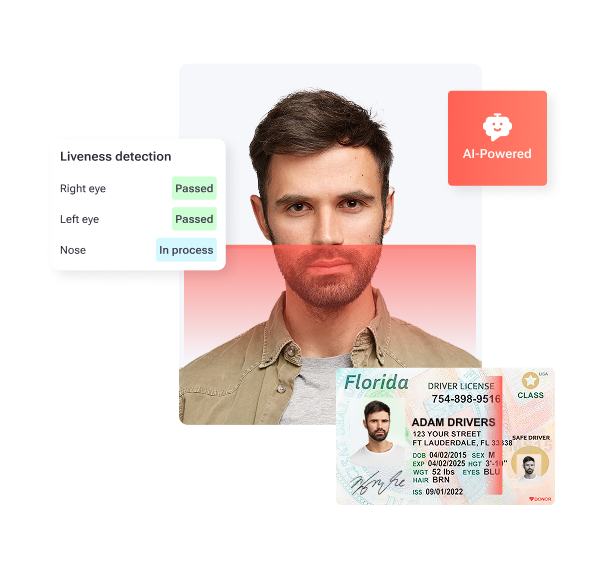
Fraud risk: Traditional document-based review cannot reliably prevent impersonation or synthetic identity fraud. Biometric identity verification that combines government ID validation, AI-powered liveness detection, and facial matching confirms that the person submitting the application is the person named in the age documentation.
Inconsistent decision-making across applications: Without a documented decision tree, similarly situated households receive different outcomes depending on who reviews the file. A written routing policy applied consistently is the primary defense against selective-enforcement claims under Florida fair-housing precedent.
Best Practices For Implementing A 55+ Age Verification Workflow
The practices below help individual communities and management company portfolios turn the legal framework into a repeatable process.
- Document the workflow before configuring the intake form. The intake form should reflect the workflow. Assign named owners to each step, define the artifacts each step produces, and identify escalation triggers before any form is built or modified.
- Separate the FCRA disclosure from age documentation collection in the applicant-facing interface. Both occur at intake, yet they serve different legal purposes and must appear as distinct steps with distinct artifacts.
- Maintain the occupancy census as a live document. Update the census at every application event, including new occupants, departures, deaths, and reasonable accommodation determinations. This approach turns the biennial re-survey into a check of a current record.
- Apply the decision tree consistently across all applications. Document the routing decision and the census position for every non-standard household. Inconsistent application of age restrictions can undermine enforcement under White Egret Condominium v. Franklin.
- Review governing documents before making eligibility determinations for edge cases. Federal law sets the floor, and the declaration and bylaws may impose stricter requirements, such as a minimum age for all permanent residents or a minimum age for a younger spouse. The CAM checks the governing documents, not just the HOPA standard.
- Define data retention periods at intake design. Retention periods should be defined around the verification purpose and the association’s legal obligations, with clear rules for when to delete raw identity data.
- Confirm the written good-faith certification described in Step 5 is current. Without that certification, individual board members and managers face personal exposure if the community’s 55+ status is later challenged.
How TenantEvaluation Supports The Florida 55+ Condo Age Verification Workflow
TenantEvaluation is an all-in-one resident screening and onboarding platform built specifically for community associations and management companies, with FCRA compliance as the foundation. Founded in 2007, TenantEvaluation serves 5,000+ communities, processes approximately 100,000 applications per year, has generated $150M for communities, and holds a Google rating of 4.8/5.
55+ Communities Verification is a built-in capability that helps Florida condos and HOAs standardize how age-restricted requirements are handled across applications. It reduces manual work, improves documentation consistency, and strengthens operational control. It replaces fragmented manual processes that rely on emails, PDFs, and follow-ups with a structured workflow designed for the real operating environment of Florida community associations. It does not replace legal advice; it standardizes workflow and documentation for CAMs and boards.
IDVerify+ introduces biometric identity verification directly inside the TenantEvaluation workflow. Government ID validation, AI-powered liveness detection, and biometric facial matching confirm identity before screening authorization. This alignment supports FCRA-compliant workflows, strengthens audit defensibility, and moves communities from document-based review to biometric-confirmed identity verification. IDVerify+ can be enabled per condo or HOA and configured per property portfolio.
QuickApprove is TenantEvaluation’s accelerated approval workflow built for CAMs, boards, and property management teams inside one connected platform. It delivers real-time application tracking, automated communication support, reduced manual follow-ups, customized approval letters, a personalized welcome package, and a board-ready approval process. It is designed for high-volume seasons and communities with complex onboarding requirements.
Additional proof points that distinguish TenantEvaluation from generic screening vendors include the following:
- Direct credit bureau reseller relationships with TransUnion and Equifax, with data accessed under strict bureau rules and no gray-market or offshore data sources
- Built-in audit trails for every application, with timestamped board voting records
- PCI Level 1 compliance and end-to-end encryption with automatic redaction of sensitive information
- Automated adverse action workflows built into the platform
- Clear separation between decision-making by the association and data provision by TenantEvaluation
- Processing time reduced from days to hours, with up to 70 percent time savings on approval cycles
Explore a live demo of the 55+ workflow to see how 55+ Communities Verification, IDVerify+, and QuickApprove work together in a single connected platform.
Frequently Asked Questions
Can A 53 Year Old Live In A 55+ Community?
Not as the qualifying occupant. Under HOPA, at least one occupant in a qualifying unit must be 55 or older, so a 53-year-old cannot serve as the qualifying resident. However, a 53-year-old may be able to live in the community as a non-qualifying occupant in a unit where another resident is 55 or older, for example as a spouse or partner, depending on the community’s governing documents. Some declarations impose a minimum age for all permanent residents, commonly 18 or 19, while others set a minimum age for younger spouses, often in the 40 to 45 range. The CAM must check the declaration before making a determination. A 53-year-old who inherits a unit or purchases one as an investment may own the property but cannot occupy it as the sole resident without the community falling out of HOPA compliance for that unit.
Can You Live In A 55+ Community If Your Spouse Is Under 55?
Yes, in most cases. Under HOPA, only one occupant in a qualifying unit must be 55 or older, so a 58-year-old living with a 50-year-old spouse is a qualifying unit for the 80 percent calculation. However, the community’s governing documents may impose a minimum age for the younger spouse, commonly 40 to 45, and the CAM must verify the declaration before approving the application. When the qualifying 55+ resident dies or permanently moves away, the outcome for the surviving younger spouse depends entirely on the governing documents. Some declarations include a survivorship or hardship provision; others require the younger spouse to reach a specified age or sell the unit within a stated period. This scenario requires the CAM to review the declaration and route the file to the board before making any occupancy determination.
