Written by: Luis Teran, Co-founder, CEO, TenantEvaluation
Key Takeaways
- Florida 55+ condos must verify ages using government-issued IDs such as driver’s licenses, passports, or birth certificates to comply with HOPA’s 80/20 rule.
- The verification process includes five steps: requesting documents, reviewing authenticity, obtaining affidavits if needed, board approval, and record-keeping for bi-annual surveys.
- HOPA requires at least 80% of units to have one 55+ resident, with periodic age verification surveys and written policies to maintain exemptions.
- Adult children can live in 55+ condos within the 20% allowance but cannot jeopardize the 80% threshold, so consistent enforcement prevents HOPA violations.
- Streamline your Florida 55+ age verification with TenantEvaluation’s purpose-built compliance tools for HOPA-compliant application processing.
Step-by-Step Age Verification Process in Florida 55+ Condo Applications
Florida 55+ condominiums follow a structured process to verify applicant ages and protect their HOPA exemption. The verification process involves five critical steps that create clear documentation and legal protection.
- Request Required Documents on Application: Collect government-issued identification such as driver’s licenses, passports, or birth certificates from all residents aged 55 and older.
- Review Age Proof Documentation: Validate the authenticity and accuracy of submitted identification documents, confirming they clearly display birth dates and remain current.
- Obtain Affidavits When Necessary: Secure sworn statement affidavits for age verification when primary documentation is unavailable or insufficient, particularly for spouses or family members.
- Board Review and Approval: Present compiled age verification materials to the board of directors through a centralized dashboard for final approval decisions.
- Record for Census Compliance: Maintain organized records of all age verification documentation to support bi-annual HOPA census requirements and regulatory audits.
This process must treat primary residents, spouses, and adult children differently because HOPA allows residents under 55 in most cases, provided the community maintains at least 80% of households with one resident aged 55 or older. TenantEvaluation’s 55+ Communities Verification automates this differentiation, which reduces manual work and standardizes application handling across all resident types.
Required Documents for 55+ Age Proof in Florida Communities
Florida 55+ communities rely on specific document types to prove age and stay compliant. The following documents serve as acceptable proof of age for HOPA requirements.
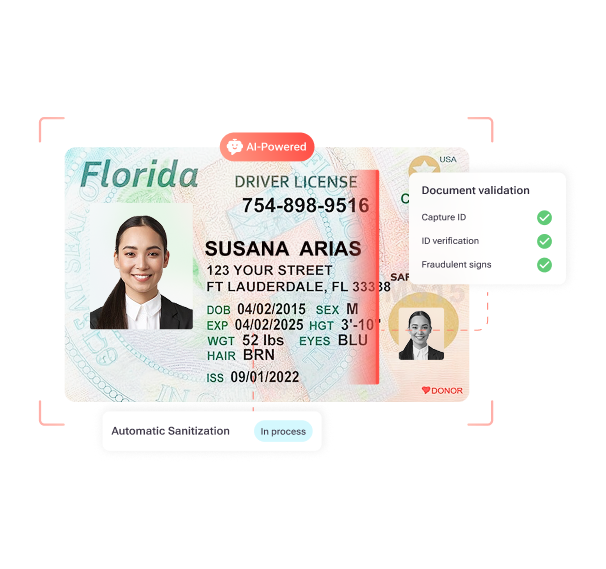
- Driver’s License or State-Issued ID: Primary identification showing current photo and birth date.
- U.S. Passport or Passport Card: Federal identification acceptable for all residents.
- Certified Birth Certificate: Official government record when other ID is unavailable.
- Immigration Documentation: Green cards or naturalization certificates with birth date information.
- Sworn Affidavits: Notarized statements for age verification when primary documents cannot be obtained.
The table below compares documentation expectations for primary residents and other household members so managers can see which verification methods apply to each applicant type.
| Document Type | Primary Resident (55+) | Adult Child/Guest | Compliance Notes |
|---|---|---|---|
| Driver’s License | Required | Optional | Most common verification method |
| Passport | Acceptable Alternative | Acceptable Alternative | Federal standard accepted nationwide |
| Birth Certificate | Backup Option | Backup Option | Used when photo ID is unavailable |
| Affidavit | Last Resort | Not Applicable | Alternative when applicants decline to share ID |
Legal experts emphasize that communities must maintain consistent documentation standards while still addressing legitimate privacy concerns through alternative verification methods such as affidavits.
HOPA 80/20 Rule and Bi-Annual Census Requirements
The Housing for Older Persons Act (HOPA) 80/20 Rule requires that at least 80% of occupied units in 55+ communities have at least one resident who is 55 years or older, with the remaining 20% reserved for younger residents such as spouses, caregivers, or family members. This structure preserves the age-restricted character of the community while allowing limited flexibility.
HOPA-qualified 55+ communities must also keep written policies that show intent to provide housing for older persons and verify occupant ages through written surveys. Outdated or incomplete survey documentation creates significant regulatory risk.
The following compliance checkpoints outline what communities must track, how often, and what has changed in 2026 so managers can maintain audit-ready records.
| Compliance Checkpoint | Requirement | Frequency | 2026 Update Notes |
|---|---|---|---|
| Age Verification Survey | 80% household compliance | Periodic | Digital records now preferred |
| Written Policy Review | Intent documentation | Annual | No major regulatory changes |
| Occupancy Calculation | 80/20 ratio maintenance | Ongoing | Audit-ready records essential |
| Documentation Retention | Complete verification files | Permanent | Enhanced security standards |
Adult Children Living in Florida 55+ Condos
Adult children can live in Florida 55+ condos only under narrow conditions, so managers must handle these cases carefully. Each exception must fit within HOPA rules and the community’s governing documents.
A family member or adult child who only helps around the house often does not qualify for caregiver exemptions under HOPA’s strict definition. Even when adult children qualify to live in the community, they must fall within the 20% allowance for households without a 55+ resident. Managers therefore need to track how many under-55 households exist at any time, because one additional adult child household can push the community below the required 80% threshold and threaten its HOPA exemption.
How Strict Florida 55+ Communities Enforce Age Rules
Florida 55+ communities vary in strictness based on HOA policies and enforcement practices. Some communities apply rigid age verification standards, while others accept a wider range of documentation. Every HOPA-compliant community still must enforce the 80/20 rule consistently to preserve its age-restricted status.
Common enforcement challenges include inheritance situations where properties transfer to younger family members, privacy refusals from applicants who decline to provide age documentation, and temporary housing arrangements that change occupancy counts. Communities falling below the 80/20 threshold due to inherited properties, vacancies, or rule enforcement failures lose their HOPA exemption and can no longer exclude buyers under 55. Loss of exemption can reduce property values and disrupt resident lifestyle expectations.
Best Practices and Digital Tools for Reliable Florida 55+ Age Verification
Successful age verification depends on standardized processes, clear audit trails, and efficient document management. Community Association Managers should implement verification checklists so no step is missed during application review. These checklists work best when paired with centralized records that create a single source of truth for all verification files. Clear communication protocols with applicants and boards then ensure everyone understands what is required and when, which reduces delays and confusion.

TenantEvaluation’s 55+ Communities Verification provides a comprehensive solution for Florida condos and HOAs that manage age-restricted applications. This capability builds on the automated differentiation mentioned earlier by also supporting documentation consistency and improving operational efficiency for Community Association Managers. Instead of fragmented manual processes that rely on emails and PDFs, TenantEvaluation uses automated workflows designed specifically for Florida condos and HOAs.
The platform integrates with IDVerify for biometric identity verification and QuickApprove for board dashboard management. With FCRA compliance as the foundation, TenantEvaluation processes over 100,000 applications annually across 5,000+ communities, maintains a 4.8/5 Google rating, and has generated $150 million in revenue for client communities.

Compared to competitors such as ApplyCheck or Verify Screening Solutions, TenantEvaluation offers end-to-end automation instead of manual steps, comprehensive board dashboards instead of fragmented systems, and Florida-specific compliance features that generic screening tools do not provide.
Effective age verification protects communities from HOPA violations and also streamlines approvals for qualified applicants. The five-step verification process, combined with clear documentation standards and bi-annual census compliance, helps communities preserve their age-restricted status and avoid costly legal disputes. See how TenantEvaluation eliminates manual verification work and maintains audit-ready records for your 55+ community.
FAQ
What documents are required to prove age in Florida 55+ condo applications?
Florida 55+ condos typically require government-issued photo identification such as driver’s licenses, state IDs, or passports that clearly display birth dates. Alternative documentation includes certified birth certificates, immigration cards with birth date information, or notarized affidavits when primary identification is unavailable. Communities must maintain consistent documentation standards while accommodating legitimate privacy concerns through sworn statements when necessary.
Can adult children live in Florida 55+ condos permanently?
Adult children can live in Florida 55+ condos only within the 20% allowance for households without a 55+ resident, and their presence cannot cause the community to fall below the required 80% threshold of households with at least one resident aged 55 or older. Certain caregiver situations may not qualify under HOPA if they involve only general household assistance or companionship.
How often must Florida 55+ communities conduct age verification surveys?
HOPA requires Florida 55+ communities to conduct age verification surveys to maintain their exemption status. These surveys must document that at least 80% of occupied units have one resident aged 55 or older, and communities must maintain written policies demonstrating their intent to provide housing for older persons throughout the compliance period.
What happens if applicants refuse to provide age verification documents?
When applicants refuse to provide standard age verification documents due to privacy concerns, communities can accept notarized affidavits as alternative proof of age. However, communities cannot compromise their HOPA compliance requirements and may need to deny applications that lack sufficient age verification. Consistent enforcement of documentation standards protects the community’s legal exemption status while accommodating reasonable privacy requests.
What digital tools can streamline Florida 55+ age verification processes?
TenantEvaluation’s 55+ Communities Verification offers a comprehensive digital solution for Florida condos and HOAs, reducing manual work while standardizing application handling and supporting documentation consistency. The platform automates verification workflows, provides board dashboard access, maintains audit-ready records, and integrates biometric identity verification to strengthen the entire age verification process from application through approval.
