Written by: Luis Teran, Co-founder, CEO, TenantEvaluation
Key Takeaways for Florida CAMs and Boards
- Florida CAMs and HOA and condo boards can cut approval cycles to 48 hours using automated pre-qualification, biometric verification, and a board-ready voting workflow while staying FCRA compliant.
- QuickApprove replaces email chains and spreadsheets with a seven-step pipeline that includes digital intake, automated checks, IDVerify biometrics, and real-time board voting.
- Biometric identity verification through IDVerify stops identity fraud by validating government IDs, confirming liveness, and matching selfies to documents, far beyond traditional paper checks.
- 55+ Communities Verification and revenue-sharing models standardize age-restricted documentation and turn screening fees into a cost-neutral income stream for associations.
- Get started with TenantEvaluation to implement the 48-hour approval workflow and fill Florida condo and HOA properties faster.
The 48-Hour QuickApprove Workflow for Faster Move-Ins
QuickApprove is TenantEvaluation’s accelerated approval workflow built for CAMs, boards, and property management teams inside one connected platform. The seven-step pipeline below is structured for quick reference and immediate operational use.

- Digital application intake: The applicant receives a Property Code, creates a TenantEvaluation account, and completes a 100% online application. Intelligent form logic rejects incomplete submissions automatically so CAMs do not chase missing documents.
- Automated pre-qualification: The platform checks credit score thresholds, income ratios, and required documents against the community’s governing criteria before the file advances.
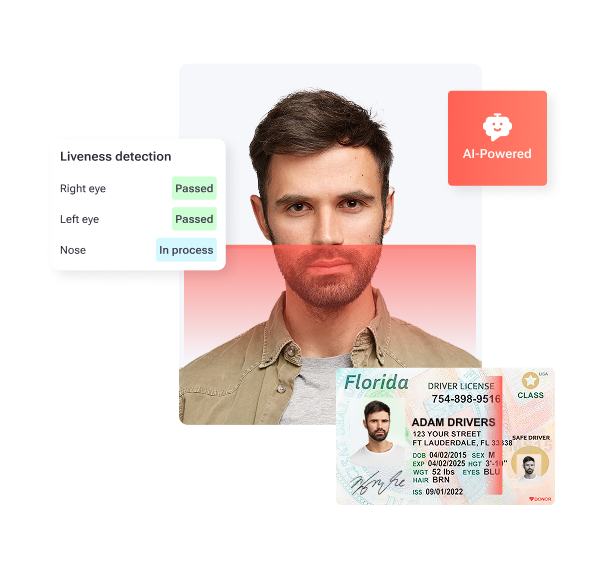
- Biometric identity verification: IDVerify validates the government-issued ID, runs AI-powered liveness detection, and performs a biometric selfie-to-ID comparison, all natively inside TenantEvaluation.
- Comprehensive background screening: Criminal, eviction, credit, and income reports run simultaneously through TenantEvaluation’s direct TransUnion and Equifax reseller relationships.
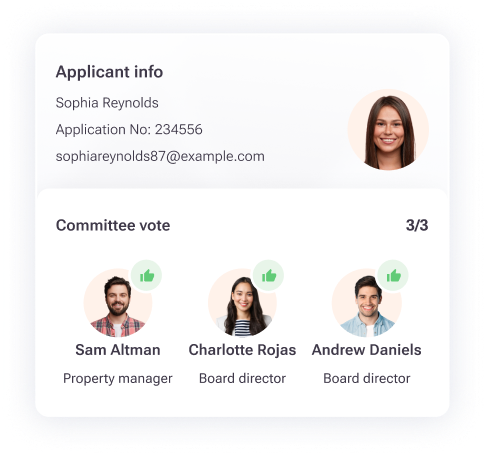
- Board-ready dashboard delivery: Summarized applicant reports and a voting panel appear in the board dashboard with real-time tracking, which replaces email chains and spreadsheets.
- Board vote and decision: Board members review, vote, and record decisions inside the platform with a full timestamped audit trail.
- Automated approval letter and welcome package: Customized approval letters and a personalized welcome package trigger automatically after the decision, which completes onboarding without extra manual work.
Board-Voting Bottlenecks That Slow Florida Approvals
Florida HOA and condominium approval processes often run 2 to 8 weeks, and many communities advise applicants to plan for 30 to 60 days when board votes are required. Board meeting frequency, usually monthly or quarterly, is the most common structural bottleneck. Applications sit until the next meeting regardless of how quickly the CAM completes their review. Incomplete applications are the most common cause of workflow delays, which compounds the meeting-schedule problem.
QuickApprove’s board-ready dashboard removes both bottlenecks. Board members access summarized applicant reports and a voting panel in real time, with no waiting for the next scheduled meeting, no email chains, and no spreadsheets. The result is a faster, clearer, and more consistent approval process that keeps board oversight, compliance review, and visibility intact.
Speed only matters when the applications are genuine, so the next challenge is identity verification inside this faster workflow.
Identity Fraud Risks and How IDVerify Closes the Gap
A 2024 National Multifamily Housing Council survey found that 93.3% of owners, managers, and developers experienced rental application fraud in the prior 12 months, including 70% who encountered fraudulent identity information. Nearly every step of traditional tenant screening can be faked with generative AI, so document-only review no longer provides a reliable fraud gate.
Selfie identity verification combines document authentication, biometric facial matching, and liveness detection to confirm that the legitimate owner is physically present. Fraudsters who pass basic document or photo-ID checks often fail once biometric confirmation and SSN validation are required at the application stage.
IDVerify integrates government ID validation, AI-powered liveness detection, facial landmark recognition, and biometric selfie-to-ID comparison directly inside TenantEvaluation. CAMs see verification results embedded in the screening report, including ID authenticity confirmation, liveness status, and biometric match result. IDVerify can be enabled per condo or HOA and configured per property portfolio, which supports different community risk profiles without a one-size-fits-all approach.
Standardizing 55+ Community Documentation in Florida
Florida condos and HOAs that manage age-restricted communities often rely on fragmented manual processes with emails, PDFs, and repeated follow-ups. These habits create inconsistent documentation and heavy administrative work for CAMs and boards.
55+ Communities Verification is a built-in capability within TenantEvaluation that standardizes how age-restricted requirements are handled across applications. It reduces manual work, supports documentation consistency, improves operational efficiency, and strengthens internal processes for CAMs and boards. This feature provides workflow standardization and operational control, not a replacement for legal guidance.

Turning Application Fees into a Cost-Neutral Revenue Stream
TenantEvaluation’s revenue-sharing model collects application fees from applicants during online submission, deducts its service fee, and rebates the remainder to the association or management company. This structure creates a pay-per-application model with no upfront fees, which turns the screening process into a compliant, controlled income stream instead of a cost center. TenantEvaluation has already generated $150 million for communities through this model.
QuickApprove as the Connected Workflow for CAMs and Boards
QuickApprove accelerates resident approvals inside one connected platform built for CAMs, boards, and property management teams while preserving control, compliance, and visibility. Real-time application tracking gives CAMs visibility into every submission as it happens, which enables automated communication that reduces manual follow-ups through status updates at each workflow stage.
Once the board approves an application, the platform automatically generates customized approval letters and a personalized welcome package. That automation completes onboarding without extra manual work and supports high-volume application seasons and communities with complex onboarding requirements.
Schedule a demo today and see QuickApprove’s board-ready workflow in action.
How TenantEvaluation Compares to Other Screening and PM Tools
| Feature | TenantEvaluation | Generic Screening Tools (e.g., ApplyCheck, Verify Screening Solutions) | Broad PM Platforms (e.g., AppFolio, Buildium) |
|---|---|---|---|
| End-to-end onboarding automation | Application intake through final decision and record retention | Background checks only, no full onboarding | Property management focus, screening is secondary |
| Board voting dashboard | Dedicated real-time board review and voting panel | Not available | Not available |
| FCRA compliance foundation | Direct TransUnion and Equifax reseller, built-in adverse action workflows, full audit trails | Varies, often third-party data resellers | Varies, not community-association-specific |
| Florida-specific features | 55+ Communities Verification, Florida statute-aligned workflows, QuickApprove, IDVerify | Not available | Not available |
Generic screening tools such as ApplyCheck and Verify Screening Solutions use the TazWorks platform and focus on background checks without applicant interaction, automated document review, or board dashboards. Broad property management platforms such as AppFolio and Buildium offer screening as a secondary feature and charge monthly subscriptions instead of TenantEvaluation’s pay-per-application revenue-sharing model.
Case Study: Florida Management Company Saves $240K Annually
A Florida-based management company switched from manual paper-based processes to TenantEvaluation and cut processing time by 50%, which generated $10 in savings per hour per property. That efficiency gain freed 50 staff hours daily for higher-value operations and resident service. Together, those improvements produced total annual savings of $240,000.
The switch also removed liability exposure from handling sensitive resident information on paper and replaced it with bank-level data encryption and automatic PII redaction.
Frequently Asked Questions
What is the typical board-approval timeline in Florida HOAs and condos?
As noted earlier, Florida HOA and condo approvals typically take 2 to 8 weeks because of board meeting schedules rather than screening time. TenantEvaluation’s QuickApprove workflow addresses this by rejecting incomplete submissions before they enter the pipeline and by allowing board members to review and vote in real time instead of waiting for the next scheduled meeting.
How does TenantEvaluation maintain FCRA compliance during accelerated approvals?
TenantEvaluation is built with FCRA compliance as the foundation, not an afterthought. The platform is a direct reseller of TransUnion and Equifax data, accessed under strict bureau rules with regular compliance reviews and audits. Written consent is collected from every applicant before any consumer report is generated.
Automated adverse action workflows trigger the required notices when an application is denied based on screening data. Built-in audit trails timestamp every action in the workflow, which creates a defensible record for associations. IDVerify+ strengthens permissible-purpose validation by confirming identity before screening authorization, which reinforces FCRA-aligned workflows. The clear separation between data provision by TenantEvaluation and decision-making by the association or board protects communities from liability exposure.
What is the difference between condo and HOA screening workflows in Florida?
Florida condominium associations operate under Chapter 718 of the Florida Statutes, while HOAs are governed by Chapter 720. Both allow associations to require tenant applications, background checks, and board approval before a lease begins, but the specific fee caps, transfer approval rules, and governing document requirements differ.
Condominium associations may charge a transfer or lease approval fee of up to $150 per applicant when authorized by governing documents and may collect a security deposit from prospective tenants capped at one month’s rent. HOA fee structures and approval requirements depend on the association’s governing documents and applicable Florida law. TenantEvaluation configures each community’s governing documents, screening criteria, and approval workflows into the platform so the process matches the association’s bylaws and applicable Florida statutes, whether the community is a condominium, HOA, or age-restricted 55+ community.
How does biometric verification reduce identity fraud compared with document uploads?
Traditional document-based screening requires applicants to upload a photo ID, which staff then review manually or through basic optical checks. This method cannot confirm that the person submitting the document is the same person pictured on it, so communities remain exposed to stolen IDs, impersonation attempts, and synthetic identities.
Biometric verification adds three additional security layers. Government ID authenticity validation confirms the document. AI-powered liveness detection confirms physical presence. Facial landmark biometric matching compares a live selfie to the ID photo. This multi-layer approach stops bad actors who can pass a document-only check but cannot replicate a live biometric match. IDVerify+ runs all three layers inside TenantEvaluation with no external portals and delivers results directly in the screening report for CAM review.
Conclusion: Faster Approvals, Stronger Screening, Lower Risk
Manual, paper-based approval processes cost Florida associations weeks of vacancy, increase exposure to identity fraud, and create unnecessary administrative burden for CAMs and boards. TenantEvaluation’s connected workflow combines QuickApprove’s board-ready pipeline, IDVerify+ biometric verification, 55+ Communities Verification, and FCRA-compliant background screening from direct bureau relationships. Together, these capabilities fill properties faster with better screening while keeping compliance and board control intact.
The 48-hour approval cycle reflects a practical outcome of replacing email chains and spreadsheets with a single connected platform built for Florida community associations. A bad tenant placement can cost between $3,500 and $10,000 when factoring in eviction expenses, lost rent, and property damage, and landlords who cut corners on screening face eviction rates up to 40% higher than those who properly vet applicants. The cost of a slow, manual process is measurable, and so is the return on a faster, more accurate one.
Compare your current approval timeline to the seven-step QuickApprove pipeline above and identify where delays occur. If your community still operates on a 2-to-8-week cycle, that gap marks the starting point for improving your workflow.
