Written by: Luis Teran, Co-founder, CEO, TenantEvaluation
Key Takeaways for Florida Associations
- FCRA consent relies on three separate elements: standalone disclosure, written authorization, and permissible purpose certification before any consumer report is ordered.
- Incomplete consent workflows expose Florida CAMs and boards to FCRA violations, Florida record-keeping penalties, and delays caused by scattered documents.
- An 8-step SOP covering disclosure, authorization, identity checks, blocking rules, adverse action, and retention creates a repeatable, audit-ready process.
- Electronic audit trails need automatic capture of timestamps, IP addresses, signatures, and document versions to remain defensible under Florida’s 7-year retention standard.
- TenantEvaluation embeds the full consent workflow into one platform; see how the platform supports end-to-end FCRA compliance in a personalized demo.
FCRA Consent Elements for Florida Tenant Screening
Under FCRA 15 U.S.C. §1681b(b)(2), any entity that procures a consumer report for tenant screening must first provide a clear and conspicuous written disclosure in a standalone document, separate from the rental application and separate from the authorization form. That disclosure must contain only the notice of the background check, use clear language, and avoid liability waivers or dense fine print.
Three distinct elements create valid FCRA consent:
- Standalone disclosure: A document that contains only the notice that a consumer report may be obtained, with no other content bundled in.
- Written authorization: Written authorization from the consumer is required before any consumer report is procured.
- Permissible purpose certification: The requesting entity must certify a permissible purpose. For community associations, this is housing-related screening.
The CFPB Summary of Consumer Rights is provided under FCRA requirements. Fla. Stat. §720.303 requires Florida HOAs to maintain official records for a set number of years and produce them within 10 business days of a written request. Condominiums are instead governed by §718.111. For 55+ Communities Verification, consistent documentation across age-restricted applications adds another layer of record-keeping discipline that connects directly to this retention obligation.

Despite these clear requirements, many associations struggle to keep consent documents consistent and accessible across every application.
The Risk: How Incomplete Consent Workflows Create Exposure
Running consumer reports without written consent is one of the most common FCRA violations in residential screening. For Florida associations, the consequences extend beyond federal exposure. Fragmented storage, such as consent forms in email, authorizations in a shared drive, and adverse action notices in a separate system, prevents fast production of a complete record when a dispute arises.
The fastest-growing compliance risk in FCRA processes stems from keeping disclosures, authorizations, adjudication criteria, and adverse-action notices in separate systems with inconsistent owners. This fragmentation creates two downstream problems. Manual follow-ups consume staff hours, and incomplete submissions push CAMs into reactive workarounds that compound the original gap.
TenantEvaluation’s all-in-one platform addresses these issues directly. SafeCheck+ enforces permissible-purpose validation before any report is ordered. IDVerify confirms biometric identity before authorization is captured. QuickApprove moves applications from submission to board decision faster, with real-time tracking and automated communication support, while preserving control, compliance, and visibility. Built-in audit trails connect every action to a timestamped, retrievable record.
8-Step FCRA Consent SOP for Florida CAMs
- Deliver standalone disclosure. Provide the applicant with the standalone FCRA disclosure described earlier, with no application content, waivers, or bundled language. SafeCheck+ enforces this separation at the point of delivery.
- Capture written authorization. Collect a separate written authorization signed by the applicant. Obtain this authorization through a separate or clearly distinct signature rather than bundling it with other onboarding documents.
- Certify permissible purpose. The association or management company certifies housing as the permissible purpose before any report is ordered. SafeCheck+ validates this certification inside the workflow.
- Capture electronic signature with audit fields. The applicant signs electronically. Electronic consent capture stores signatures, timestamps, IP addresses, and form versions for compliance documentation. TenantEvaluation’s audit trail records all of these fields automatically at the moment of signing.
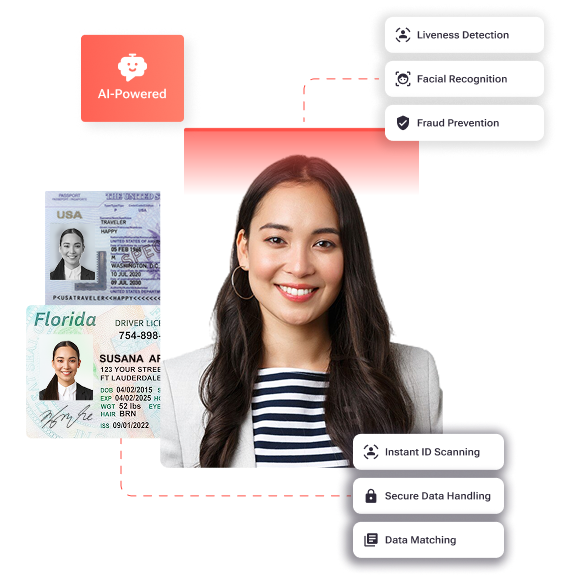
- Confirm identity with IDVerify before authorization proceeds. IDVerify validates government-issued ID, runs AI-powered liveness detection, and performs biometric selfie-to-ID comparison. This confirms that the person authorizing the report is the person present and strengthens permissible-purpose validation and audit defensibility.
- Apply automated blocking when consent is missing. No consumer report is ordered until all three consent elements, standalone disclosure, written authorization, and permissible purpose certification, are confirmed complete. The decision-gate matrix below defines the rules.
- Integrate adverse action workflow. When a report leads to denial, an adverse-action notice must be delivered under §1681m. TenantEvaluation’s automated adverse action workflow handles this within the same platform and maintains a connected record.
- Apply retention and disposal schedule. Store all consent records according to the schedule in the table below. Because retention requirements evolve and storage practices drift over time, set a recurring review schedule for record retention practices. When records reach the end of their retention period, securely dispose of consumer reports and derived materials by shredding paper copies and permanently deleting electronic copies.
FCRA Screening Sequence from Disclosure to Disposal
The full FCRA sequence for tenant screening runs from initial disclosure through final record disposal. Consent management functions as a connected workflow step that aligns with documented decision rules and Adverse Action Notice processes to maintain FCRA compliance.
The sequence follows this order:
- Standalone disclosure delivered to applicant
- Written authorization collected separately
- Permissible purpose certified by the requesting entity
- Consumer report ordered through a compliant channel
- Report reviewed and decision made by the association, not the platform
- Adverse action notice issued if applicable
- All records stored per retention schedule and disposed of securely at the end of the period
FCRA-compliant background check consent forms and reports must be stored separately from the general application file, with access restricted, because they contain Social Security numbers and address history. TenantEvaluation’s auto-redaction and PCI Level 1 encryption enforce this separation automatically.
Audit Trail Requirements for FCRA Consent Forms
A defensible audit trail for FCRA consent forms must capture specific fields at the moment each action occurs. Required elements include signatures, timestamps, IP addresses, and form versions. Drawing on electronic record standards as a high-bar model, audit trails for electronic consent records must be system-generated automatically in real time, remain uneditable by ordinary users or administrators, preserve prior values without obscuring them, and be retained for at least as long as the associated electronic records.
Required audit trail fields for FCRA tenant consent forms include:
- Exact date and time of each action, via automated time-stamping synchronized to a validated, secure time source
- IP address of the signing device
- Identity of the signer and the purpose for which the signature was applied
- Document version at time of signing
- Record of any prior values if the document was modified
- Role-based access log showing who viewed or retrieved the record
TenantEvaluation’s built-in audit trails capture all of these fields automatically for every application. Audit trail records remain available for inspection and export in both human-readable and electronic formats to support regulatory review or dispute resolution. TenantEvaluation’s export capability supports this standard.
Blocking Rules for Screening Without Valid Authorization
The decision to block a screening request is binary. Either all three consent elements are confirmed, or the screening does not proceed. The matrix below defines the blocking rules in a clear, repeatable format.
| Condition | Standalone Disclosure Delivered | Written Authorization Captured | Permissible Purpose Certified | Action |
|---|---|---|---|---|
| All elements complete | Yes | Yes | Yes | Proceed to screening |
| Disclosure missing | No | Yes | Yes | Block, running reports without proper disclosure is a common FCRA violation |
| Authorization missing | Yes | No | Yes | Block, Florida law mandates written consent before running background and credit checks |
| Permissible purpose not certified | Yes | Yes | No | Block, permissible purpose certification is required before report procurement |
TenantEvaluation’s SafeCheck+ enforces these blocking rules automatically. No report is ordered until the platform confirms all three conditions are satisfied. IDVerify adds a fourth gate, because biometric identity confirmation must complete before authorization is accepted as valid.
Watch the three-element blocking matrix enforce itself automatically by requesting your demo.
FCRA Record Retention Schedule for Consent Forms
Retention obligations for FCRA consent records come from federal requirements, Florida statutes, and internal risk policy. The table below presents the applicable periods by record type.
| Record Type | Federal Minimum | Florida Association Minimum | Recommended Practice |
|---|---|---|---|
| Signed authorization / consent form | The FCRA does not specify a retention period for signed authorization forms, while EEOC regulations require retention of hiring records for at least one year | Per Fla. Stat. §720.303 for HOAs; §718.111 for condos | 7 years minimum, consult legal counsel before destruction |
| Standalone disclosure document | Follow applicable federal and state requirements | Per Fla. Stat. §720.303 for HOAs; §718.111 for condos | Align to Florida association standard |
| Adverse action notice | The federal minimum retention period for adverse-action notices in consumer credit or housing decisions is 25 months under Regulation B | Per Fla. Stat. §720.303 for HOAs; §718.111 for condos | Align to Florida association standard |
| Consumer report (credit/background) | There is no federal 2-year minimum retention requirement for consumer credit or background reports. FCRA limits report content, such as adverse items after 7 years, while ECOA requires creditors to retain application records for 25 months | Per Fla. Stat. §720.303 for HOAs; §718.111 for condos | Align to Florida association standard and consult legal counsel before destroying any records related to the background-check process |
Federal rules require secure disposal of consumer reports and any derived materials by shredding paper copies and permanently deleting electronic copies instead of archiving them indefinitely. TenantEvaluation supports internal record-keeping processes with centralized, searchable digital records and access controls, giving CAMs and boards the infrastructure to apply and document their retention schedules consistently.
How TenantEvaluation Delivers the 8-Step Workflow
TenantEvaluation maps directly to each step of the 8-step SOP through four core capabilities that work together as a single workflow.

- SafeCheck+ enforces permissible-purpose validation before any consumer report is ordered. It blocks screening when consent elements are incomplete and maintains a connected record of every report request and its authorization basis, mirroring the SOP’s consent and blocking steps.
- IDVerify performs biometric identity confirmation, including government ID validation, AI-powered liveness detection, and facial biometric matching, before authorization is accepted. This supports the identity confirmation step and strengthens the audit trail for each consent record.
- QuickApprove accelerates resident approvals with real-time application tracking, a board-ready review and voting dashboard, automated communication support, customized approval letters, and a personalized welcome package. These features align with the decision and adverse action steps while keeping everything inside one connected platform.
- Built-in audit trails capture timestamps, IP addresses, signatures, form versions, and access logs for every application. These records remain searchable, exportable, and audit-ready under Florida’s 7-year retention requirement and support the retention and disposal steps of the SOP.
TenantEvaluation is a direct reseller of TransUnion and Equifax data, accessed under strict bureau rules with regular compliance reviews. This structure removes gray-market data exposure and keeps community associations protected from liability tied to data sourcing. The platform processes approximately 100,000 applications per year across more than 5,000 communities, with FCRA compliance as the foundation.
Frequently Asked Questions
What is the difference between the FCRA standalone disclosure and the written authorization?
The standalone disclosure is a document provided to the applicant that contains only the notice that a consumer report may be obtained. It cannot include application content, liability waivers, or any other material. The written authorization is a separate document, or a clearly distinct signature block, through which the applicant affirmatively consents to the report being pulled. Both are required under the FCRA and must exist as separate, retrievable records. Bundling them together or embedding either into a general application form creates a recognized source of FCRA violations.
How long must Florida community associations retain FCRA consent forms?
Retention periods are governed by Florida statutes and internal policy. See the retention schedule table above for specific requirements by record type. In general, HOAs follow Fla. Stat. §720.303 while condominiums follow §718.111, and both require production within 10 business days of a written request. Associations should consult legal counsel before destroying any records connected to the background-check process.
When should a Florida CAM block a screening request due to missing consent?
A screening request should be blocked any time one or more of the three required consent elements is absent, including standalone disclosure, written authorization, or permissible purpose certification. Proceeding without all three elements in place creates FCRA exposure regardless of whether the applicant verbally agreed or submitted other application materials. Florida law independently requires written consent before background and credit checks are run. A documented blocking rule, applied consistently and enforced at the platform level, provides the most defensible control a CAM can implement.
What fields must an electronic signature audit trail capture for FCRA consent forms?
A compliant electronic signature audit trail for FCRA consent forms must capture the exact date and time of signing, the IP address of the signing device, the identity of the signer, the purpose for which the signature was applied, and the version of the document at the time of signing. If the document was modified at any point, prior values must be preserved without being obscured. The audit trail must be system-generated automatically, remain uneditable by ordinary users or administrators, and be available for export in both human-readable and electronic formats for regulatory review or dispute resolution.
Is TenantEvaluation responsible for making FCRA compliance decisions on behalf of the association?
No. TenantEvaluation provides the platform infrastructure, data, and workflow controls that support an association’s internal compliance processes. It does not make compliance decisions on behalf of the association or replace legal guidance. The association or management company remains responsible for its own screening policies, adverse action decisions, and record retention practices. TenantEvaluation’s role is to provide a structured, audit-ready workflow that reduces manual error and supports the association’s ability to demonstrate that its processes were followed consistently. Associations should consult qualified legal counsel for guidance specific to their circumstances.
Conclusion: Turning FCRA Consent into a Repeatable Process
Incomplete FCRA consent management creates operational and legal exposure that grows over time. For Florida CAMs and boards, the combination of federal FCRA requirements and Florida’s 7-year association record retention standard establishes a clear compliance floor. The 8-step SOP in this guide offers a repeatable, defensible process that staff can follow immediately.
TenantEvaluation is built specifically for community associations and management companies, with FCRA compliance as the foundation. SafeCheck+, IDVerify, QuickApprove, and built-in audit trails implement every step of this workflow inside one connected, audit-ready platform. Florida associations gain a complete, consistent process for FCRA consent from disclosure through record retention.
Ready to implement the 8-step SOP in your association? Book your demo now.
