Written by: Luis Teran, Co-founder, CEO, TenantEvaluation | Last updated: July 4, 2026
Key Takeaways for Florida Condos and HOAs
- FCRA-compliant background screening requires written consent, permissible-purpose controls, accurate data, and a complete adverse-action workflow before any denial decision.
- Florida Condos and HOAs face heightened liability when they use non-compliant or generic screening tools, as FCRA lawsuits have doubled in the past decade.
- Providers are ranked by compliance maturity. TenantEvaluation leads with direct TransUnion and Equifax reseller status, automated adverse-action tools, and built-in audit trails.
- Key evaluation criteria for associations include direct bureau access, automated notices, audit-ready records, permissible-purpose enforcement, and HOA/condo specialization.
- Schedule a demo today to see how TenantEvaluation helps Florida community associations stay FCRA-compliant.
Compliance Maturity Ranking for Leading Screening Providers
The ranking below evaluates seven providers against five compliance criteria relevant to Florida community associations: direct credit bureau reseller status, automated adverse action workflows, built-in audit trails, permissible-purpose controls, and community-association specialization. Providers appear in order of compliance maturity for the HOA and condo use case.
- TenantEvaluation – Purpose-built for Florida Condos and HOAs. Direct TransUnion and Equifax reseller. Automated adverse action workflows, built-in audit trails, permissible-purpose controls, and IDVerify biometric identity confirmation embedded in the screening workflow. Serves 5,000+ communities and processes about 100,000 applications annually.
- Checkr – Strong FCRA infrastructure for employment screening, with limited community-association specialization and no HOA-specific adverse action tooling.
- Sterling – Enterprise-grade compliance features including PBSA accreditation, designed primarily for employment rather than residential community workflows.
- HireRight – Established CRA with documented dispute resolution processes, but no purpose-built HOA or condo onboarding layer.
- Verify Screening Solutions – Offers background checks through the white-labeled TazWorks platform and lacks native applicant interaction plus automated document review or redaction for community-association workflows.
- ApplyCheck – Also operates on the TazWorks platform and focuses on background checks without an end-to-end community onboarding workflow or board-facing approval dashboard.
- TransUnion SmartMove – Pulls credit data directly from TransUnion. TransUnion Rental Screening Solutions, Inc. (a TransUnion subsidiary providing tenant screening reports) was required by the FTC and CFPB to pay $15 million to settle charges that it failed to ensure the accuracy of those reports. The product offers no community-association specialization.
The table below consolidates these compliance differences across the three provider tiers, so you can see how TenantEvaluation’s direct bureau relationships and native automation compare to employment-focused platforms and white-label solutions.
| Compliance Criterion | TenantEvaluation | Checkr / Sterling / HireRight | Verify Screening / ApplyCheck |
|---|---|---|---|
| Direct credit bureau reseller (TransUnion & Equifax) | Yes, direct reseller relationships under strict bureau rules | Varies by provider, primarily employment-focused bureau access | No direct reseller status, white-label platform (TazWorks) |
| Automated adverse action workflow | Yes, built into every application workflow. Automated notice generation reduces statutory damage exposure of up to $1,000 per violation. | Partial, available for employment but not configured for HOA or condo adverse action sequences | Not natively automated for community-association adverse action |
| Built-in audit trails | Yes, timestamped, audit-ready records for every application | Yes for employment workflows, not mapped to HOA approval sequences | Limited, no dedicated community-association audit layer |
| Community-association specialization | Yes, designed exclusively for Florida Condos and HOAs, includes QuickApprove board dashboard and 55+ Communities Verification | No, employment-first design | No, generic background check platforms |

FCRA Background Checks for Community Associations
A background check governed by the Fair Credit Reporting Act is a consumer report compiled by a licensed Consumer Reporting Agency containing credit, criminal, or eviction data used for a housing or employment decision. For community associations, a compliant FCRA background check requires standalone written consent obtained before any report is pulled, a permissible purpose tied to a legitimate housing decision, accurate data sourced from a licensed CRA rather than a people-search database, and a complete adverse action sequence if the report contributes to a denial or adverse condition.
The FCRA requires CRAs to follow reasonable procedures to ensure maximum possible accuracy, including maintaining dispute resolution systems that investigate and correct inaccurate information within 30 days. Providers relying solely on instant database searches are more likely to surface stale or inaccurate records compared to those using direct court research and bureau-sourced data. For Florida associations, this difference directly affects liability exposure when they take adverse action.
Typical Timelines for FCRA Background Checks
Turnaround time for an FCRA-compliant background check in a community-association context depends on the data sources used and the degree of workflow automation. Providers using direct bureau relationships and automated consent workflows typically return credit and national criminal database results within minutes to hours. County-level criminal court research, required for maximum accuracy under FCRA Section 1681e(b), can add one to three business days depending on jurisdiction.
For Florida Condos and HOAs, the practical timeline from application submission to a compliant approval decision, including the mandatory pre-adverse action notice period, is a minimum of three to five business days when adverse action is anticipated. The compliant adverse action sequence requires a three-to-five business day dispute window after the pre-adverse notice is issued before a final denial can be communicated. Platforms with automated adverse action tooling compress the administrative steps within that window and reduce total cycle time without shortcutting required notice periods.
Common Red Flags on Background Checks
Common red flags in a community-association background check include recent felony convictions, active eviction judgments, significant derogatory credit history, OFAC or terrorist watchlist matches, and identity discrepancies between submitted documents and verified records. Florida community association rental approval packets commonly require criminal background checks, eviction history review, credit checks, and OFAC or terrorist and fugitive screening.
Compliant handling of red flags requires individualized assessment rather than blanket exclusion. HUD guidance explains that blanket criminal-record exclusions in tenant screening policies can create disparate impact fair-housing risk under the Fair Housing Act and recommends tailoring policies to legitimate safety interests. Most negative information, except certain convictions, cannot be reported after seven years under the FCRA, and a provider’s accuracy procedures should catch this automatically. Any adverse action taken on the basis of a red flag must follow the full FCRA adverse action sequence, including pre-adverse notice, dispute period, and final notice.
Five Criteria for Evaluating FCRA Compliance
A structured evaluation of a background screening provider’s FCRA maturity for community-association use should assess five criteria. First, direct credit bureau reseller status. Providers accessing TransUnion and Equifax data under direct reseller agreements operate under stricter bureau rules than those using third-party aggregators and reduce the risk of stale or inaccurate data. PBSA accreditation is a voluntary credential requiring screening companies to meet audited standards around compliance, data quality, and operational procedures.
Second, automated adverse action workflows. A legally compliant adverse action notice must include the name, address, and phone number of the CRA, a statement that the agency did not make the decision, the applicant’s right to a free copy of the report within 60 days, and the right to dispute inaccurate information. Providers that automate this notice generation reduce manual error risk.
Third, built-in audit trails. Every application action should be timestamped and retained. The FCRA requires that businesses retain background check documentation for at least five years if any adverse action was taken based on the report.
Fourth, permissible-purpose controls. The platform must enforce that reports are pulled only for verified housing decisions.
Fifth, community-association specialization. Generic rental or employment screening tools do not map to HOA and condo approval workflows, board voting requirements, or Florida-specific regulatory frameworks.
Why TenantEvaluation Leads for Florida Condos and HOAs
TenantEvaluation is built specifically for community associations and management companies, with FCRA compliance as the foundation rather than an add-on. As a direct reseller of both TransUnion and Equifax data, TenantEvaluation accesses bureau data under strict reseller rules with no gray-market or offshore data sources. This approach protects community associations from the liability exposure that accompanies third-party aggregated data.
Every application processed through TenantEvaluation generates a timestamped, audit-ready record. Automated adverse action workflows are embedded in the platform, so CAMs do not need to manually track notice delivery or dispute windows. Permissible-purpose controls are enforced at the platform level, with clear separation between the association’s decision-making role and TenantEvaluation’s data-provision role.
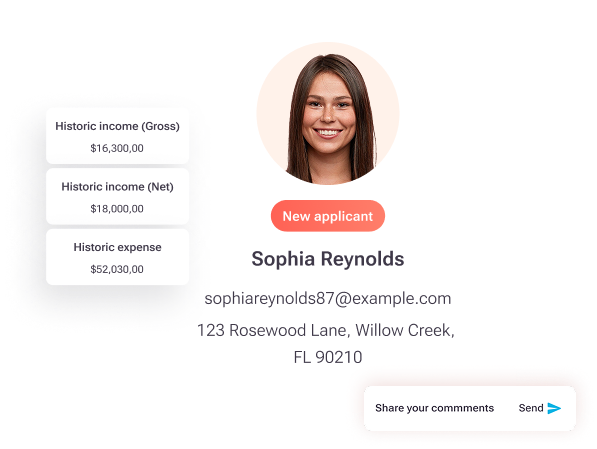
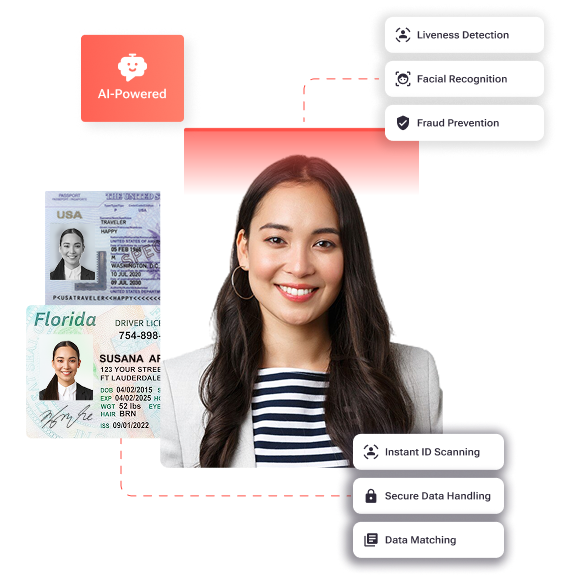
IDVerify adds a biometric identity verification layer directly inside the screening workflow. It uses government ID validation, AI-powered liveness detection, and biometric facial matching to confirm applicant identity before screening authorization proceeds. This structure reinforces FCRA-aligned permissible-purpose workflows and audit defensibility. Once identity is confirmed and screening is complete, QuickApprove accelerates the board approval step with real-time application tracking, a board-ready approval process, automated communication support, customized approval letters, and a personalized welcome package inside one connected platform. For communities with age restrictions, 55+ Communities Verification extends this workflow by standardizing application handling, reducing manual work, and supporting documentation consistency across age-restricted requirements.
TenantEvaluation has processed more than 100,000 applications annually across 5,000+ communities, generating $150 million for those communities, with a 4.8/5 Google rating. Trusted partners include FirstService Residential, Campbell Property Management, Associa, and Castle Group.
Summary: Applying a Compliance Scorecard to Providers
Florida CAMs, property managers, and boards should apply the five-criteria scorecard outlined above when they evaluate background screening providers with FCRA expertise. Generic employment or rental screening tools often miss the community-association specialization requirement and frequently lack direct bureau access or native adverse action automation. Providers using white-labeled platforms without built-in adverse action workflows introduce manual process risk that translates directly into FCRA liability exposure.
The providers that rank highest on this scorecard treat FCRA compliance as a design principle rather than a feature layer. For Florida Condos and HOAs, that standard means a platform built around the community-association approval lifecycle, not one adapted from an employment or multifamily rental context.
Frequently Asked Questions
What makes a background screening provider FCRA-compliant for community associations?
An FCRA-compliant background screening provider for community associations must operate as a licensed Consumer Reporting Agency and obtain standalone written consent before pulling any consumer report. The provider must enforce permissible-purpose controls so reports are accessed only for legitimate housing decisions and must deliver accurate data sourced from direct bureau relationships rather than third-party aggregators. A complete adverse action workflow also needs to be in place. For community associations specifically, the provider must support the HOA and condo approval lifecycle, including board review, timestamped audit trails, and documentation retention, instead of forcing generic rental or employment workflows into a community-association context.
What is the adverse action process under the FCRA for Florida HOAs and Condos?
When a Florida community association takes adverse action, such as denying an application, requiring a co-signer, or imposing a higher deposit, based in whole or in part on a consumer report, the FCRA requires a five-step sequence. First, the report must be pulled only after standalone written consent is obtained. Second, before any denial is communicated, a pre-adverse action notice must be issued to the applicant along with a copy of the report and the FTC Summary of Rights. Third, the applicant must be given a minimum of three to five business days to review and dispute the report. Fourth, if the association proceeds with the adverse action, a final adverse action notice must be issued identifying the Consumer Reporting Agency and the applicant’s dispute rights. Fifth, all documentation, including the signed consent, the report, and copies of all notices, must be retained for at least five years. Failure to complete this sequence exposes the association to FCRA statutory damages of up to $1,000 per violation plus attorney fees.
Why does direct credit bureau reseller status matter for community association screening?
Providers with direct reseller relationships with TransUnion and Equifax access consumer data under strict bureau rules, with regular compliance reviews and audits. This structure contrasts with providers that rely on third-party data aggregators or cached database compilations, which are more likely to surface stale, inaccurate, or legally unreportable records. Under FCRA Section 1681e(b), a Consumer Reporting Agency must follow reasonable procedures to ensure maximum possible accuracy. Stale compiled data from aggregators may not meet that standard and can create liability for both the provider and the community association that acts on the report. Direct bureau access also removes gray-market or offshore data sources and keeps the association’s liability exposure within a defined, auditable chain of data custody.
How does TenantEvaluation differ from generic background screening providers for HOAs?
TenantEvaluation is designed exclusively for community associations and management companies in Florida, while most background screening providers are built for employment or generic multifamily rental contexts. Practical differences include a board-facing approval dashboard with a voting workflow inside QuickApprove, biometric identity verification through IDVerify embedded in the screening workflow rather than redirecting to an external portal, and 55+ Communities Verification for age-restricted community documentation standardization. The platform also offers automated adverse action workflows configured for the HOA and condo approval lifecycle and direct TransUnion and Equifax reseller relationships. Generic providers require associations to manually map their workflows onto tools designed for different use cases, which introduces compliance gaps at every step where the workflow diverges from the provider’s design assumptions.
What documentation should a Florida community association retain for FCRA compliance?
Florida community associations using consumer reports for resident screening should retain several categories of documentation for a minimum of five years. These include the signed standalone written consent form obtained before the report was pulled, the consumer report itself, a copy of the pre-adverse action notice and proof of delivery, documentation of the dispute window provided to the applicant, and the final adverse action notice if adverse action was taken. Associations should also keep a log identifying the Consumer Reporting Agency, the date the report was pulled, and the date each notice was sent. Written screening criteria, including credit score thresholds, criminal history policies, and income requirements, must be documented before the first application is accepted and applied consistently to every applicant. Platforms with built-in audit trails that timestamp every application action and store all notices within the same workflow significantly reduce the administrative burden of maintaining this documentation.
