Written by: Luis Teran, Co-founder, CEO, TenantEvaluation | Last updated: June 21, 2026
Key Takeaways
- FCRA requires Florida HOAs and condos to deliver a compliant adverse action notice whenever a consumer report influences a housing decision, with statutory damages of $100–$1,000 per violation for missed notices.
- Adverse action sits inside the full resident-onboarding lifecycle, from application intake and screening through board review, notice delivery, and lease documentation.
- Automated adverse action letter software replaces manual templates with structured, audit-ready workflows that enforce permissible-purpose controls and maintain complete delivery records.
- Generic landlord tools often omit association-specific language, board dashboards, 55+ verification, and direct bureau reseller status, which creates compliance gaps for Florida community associations.
- TenantEvaluation delivers purpose-built FCRA compliance for associations by integrating adverse action automation, board governance, and lease tracking; learn more.
How Adverse Action Fits into Florida’s Resident-Onboarding Workflow
Adverse action touches every major step in the resident-onboarding process for Florida HOAs and condos. It connects application intake, consumer report authorization, board review, and record retention, and these steps must align for a defensible process.
The resident-onboarding lifecycle for a Florida HOA or condo typically moves through these stages: application submission and fee collection, identity verification and document review, consumer report authorization and screening, board review and voting, approval or denial decision, adverse action notice delivery when required, and lease documentation with occupancy tracking.
At each stage, CAMs and boards face daily operational touchpoints where FCRA obligations intersect with governance requirements. Under 15 U.S.C. § 1681m, an adverse action notice is required whenever a credit decision is based in whole or in part on a consumer report, and partial reliance on credit data does not create a safe harbor from the notice obligation. The adverse action workflow therefore must trigger consistently for every covered decision.
TenantEvaluation is built specifically for community associations and management companies, with FCRA compliance as the foundation, not an afterthought. The platform connects every stage of this lifecycle inside one system, from application intake through final decision and record retention.
Why FCRA Compliance Risk Is Rising for Florida Associations
Identity fraud is increasing across condo and HOA communities, which raises the stakes for accurate screening. Traditional screening methods that rely primarily on document uploads and database checks no longer provide enough protection. Tenant screening practices that lack consistency increase the risk of errors and can lead to enforcement actions.
Regulators now focus more closely on permissible-purpose controls as part of this broader risk landscape. Businesses must certify to the credit reporting agency that they will use consumer reports only for a permissible purpose and will comply with all FCRA obligations. Common violations include obtaining reports through bundled authorizations embedded in applications instead of standalone forms, delaying adverse-action notices, omitting the consumer-rights summary, and reusing a report for a different decision without fresh authorization.
The move from manual templates to automated, audit-ready workflows now functions as a core risk management requirement for associations that process applications at scale.
Core FCRA and Governance Requirements for Adverse Action
A compliant adverse action process for community associations depends on several structural elements that work together.
Mandated notice contents. Under FCRA Section 615, the adverse action notice must identify the consumer reporting agency that supplied the report, including name, address, and telephone number. The notice must also state the applicant’s right to obtain a free copy of the report within 60 days, the right to dispute the accuracy or completeness of the report, and either the specific reasons for the adverse action or notice of the applicant’s right to request those reasons. When a credit score contributed to the decision, the notice must also include the credit score.
Permissible-purpose validation. Lenders and housing providers must document a permissible purpose at the time of every consumer report access. TenantEvaluation enforces strict permissible-purpose controls natively. IDVerify strengthens this layer by confirming applicant identity before screening authorization proceeds.
Direct bureau reseller status. TenantEvaluation is a legitimate reseller of TransUnion and Equifax data, accessed under strict bureau rules with regular compliance reviews and audits. The platform does not rely on gray-market or offshore data sources. This structure gives associations a compliance advantage that generic landlord tools cannot match.
Audit trails. Businesses must maintain a complete audit trail of authorization forms, disclosure dates, and adverse-action notice delivery to defend against FCRA claims. TenantEvaluation builds this trail automatically for every application, which removes manual tracking gaps.
Separation of roles. TenantEvaluation maintains a clear separation between data provision by TenantEvaluation and decision-making by the association. This separation preserves the governance structure that community boards require.
Where Generic Landlord Tools Break for Florida Associations
Generic landlord and multifamily screening tools, including platforms designed for standard rental properties, create specific failure points when applied to community association workflows.
Templates that omit association-specific language. Standard rental adverse action templates rarely reflect HOA or condo governance structures, board voting requirements, or Florida-specific association bylaws. A recommended best practice for avoiding FCRA violations in HOA rental approvals is to standardize an adverse action workflow that includes a template notice plus a log of the report source and dates. Generic tools often fall short of this standard in association contexts.
Manual drafting inconsistencies. Failing to send required adverse action notices can result in penalties and legal fees. Manual processes introduce human error at the exact point where consistency is legally required.
Missing 55+ verification documentation. Florida age-restricted communities face additional documentation requirements that generic tools do not address. TenantEvaluation’s 55+ Communities Verification standardizes how age-restricted requirements are handled across applications. This structure reduces manual work and improves documentation consistency.

Fragmented lease records. Generic tools often disconnect the adverse action workflow from lease documentation and occupancy tracking. This fragmentation creates operational blind spots that increase compliance risk over time.
Best-Practice Principles for Florida CAMs and Boards
Florida CAMs and boards that process high application volumes benefit from four structural principles that support both compliance and efficiency.
Workflow standardization. Standardized application processes help associations apply the same screening criteria uniformly to every applicant. This consistency reduces discrimination risk and creates a defensible pattern across decisions.
Biometric identity confirmation. IDVerify introduces automated KYC verification through government ID validation, AI-powered liveness detection, and biometric facial matching. This shift moves communities from document-based review to verified physical identity confirmation before screening proceeds.

Real-time tracking with accelerated approvals. QuickApprove accelerates resident approvals by consolidating the entire approval workflow inside one connected platform. Real-time application tracking gives boards immediate visibility into pending decisions, and the board-ready approval process structures voting without email chains. Automated communication support keeps applicants informed at each stage, and customized approval letters maintain professional consistency while preserving board control, compliance oversight, and audit visibility.
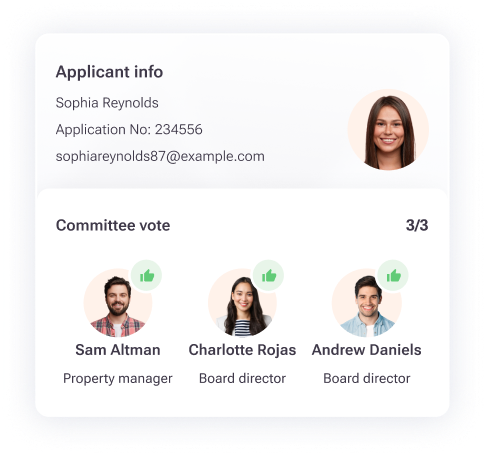
Centralized digital records. Lease Tracking connects resident onboarding, unit data, approvals, and lease documentation into one streamlined, audit-ready workflow. This structure replaces spreadsheets and scattered email chains with real-time lease status visibility from application to occupancy.
Schedule a demo today to see TenantEvaluation’s full compliance workflow in action.
Evaluation Framework: Comparing Association-Focused and Generic Tools
The table below compares key criteria for FCRA compliant adverse action letter software across association-focused automation and generic landlord tools. Every data point comes from publicly available platform documentation and the research cited throughout this article.
| Criteria | TenantEvaluation | Generic Landlord Tools (e.g., TurboTenant, Hemlane) | Notes |
|---|---|---|---|
| FCRA-first design | Built for community associations, with FCRA compliance as the foundation | Designed for standard rental properties, with FCRA features added later | Association governance structures require purpose-built workflows |
| Direct bureau integration | Direct TransUnion and Equifax reseller, with strict bureau rules | Typically third-party data aggregators, reseller status varies | Generic platforms vary in bureau access and compliance audit frequency |
| Board dashboard | Dedicated board voting panel with real-time application visibility via QuickApprove | Not available, board review handled through email or external tools | Board governance is a structural requirement for HOAs and condos |
| Automated adverse action letters with audit trails | Automated generation, delivery, and timestamped audit trail per application | Template-based, and one missed notice can cost $1,000 or more per instance | Audit trail automation eliminates manual tracking gaps |
| 55+ verification integration | Built-in 55+ Communities Verification for Florida age-restricted communities | Not available | Florida HOAs with age-restricted status require standardized documentation |
| Biometric identity verification | IDVerify with liveness detection and biometric facial matching | Document upload only, no biometric confirmation | Biometric verification strengthens permissible-purpose audit defensibility |
| Application processing time | 5–10 minutes, with end-to-end automation | 5–10 days, with manual back-and-forth | Based on TenantEvaluation platform documentation |
Frequently Asked Questions
What must an FCRA adverse action letter include?
An FCRA adverse action letter must include a statement that adverse action was taken and the name, address, and telephone number of the consumer reporting agency that supplied the report. The letter must also state the applicant’s right to obtain a free copy of the report within 60 days and the right to dispute the accuracy or completeness of the report. The notice must provide either the specific reasons for the adverse action or notice of the applicant’s right to request those reasons. When a credit score contributed to the decision, the letter must also include the credit score itself, the four key factors that most adversely impacted the score, and the name of the CRA that provided the score. Co-applicants whose reports contributed to the decision must each receive their own notice.
How do automated adverse action notices differ from templates?
A template is a static document that requires manual completion, delivery, and filing. Automated adverse action software generates the notice dynamically based on the specific consumer report data used in the decision and populates all required FCRA fields automatically. The system then delivers the notice through a documented channel and timestamps every action in an audit trail.
The practical difference is consistency and defensibility. Automated systems apply the same process to every denial, while manual templates introduce human error at the point where consistency is legally required. For associations that process 50–200 applications monthly, automation also removes the administrative burden of tracking which applicants received notices and when.
Do generic landlord tools suffice for HOAs and condos?
Generic landlord tools are designed for standard rental property workflows and typically lack the structural features that community association governance requires. These tools usually do not include board voting dashboards, association-specific adverse action language, 55+ community documentation workflows, or direct credit bureau reseller relationships.
They also tend to disconnect the adverse action process from lease documentation and occupancy tracking, which creates fragmented records that are difficult to audit. Florida HOAs and condos face governance obligations, including board approval requirements and Florida-specific bylaws, that generic tools are not configured to support. Purpose-built platforms like TenantEvaluation address these gaps by integrating FCRA compliance, board governance, and lease lifecycle management into one connected system.
How do boards maintain oversight while accelerating decisions?
Boards can maintain full oversight while accelerating decisions when the right workflow infrastructure supports both goals. TenantEvaluation’s QuickApprove provides boards with a dedicated review and voting panel that gives members direct, real-time access to application status, AI-generated applicant summaries, and a structured voting workflow inside the same platform used by CAMs.
This setup replaces email chains and spreadsheets with a connected approval process that keeps boards informed without creating bottlenecks. Boards retain full decision-making authority, and the platform accelerates the information flow and documentation that support those decisions without bypassing compliance review.
Conclusion: Reducing FCRA Risk with Association-Ready Automation
FCRA adverse action obligations are precise, non-negotiable, and apply to every denial decision based on a consumer report, whether the decision-maker is a landlord, a CAM, or a community association board. For Florida associations that process applications at volume, the gap between manual or generic-landlord processes and purpose-built automation represents a gap in legal exposure, administrative efficiency, and board governance.
The structural requirements are clear. Associations need automated notice generation with all mandated FCRA elements, direct credit bureau reseller relationships, strict permissible-purpose controls, biometric identity verification, board-ready dashboards, 55+ documentation workflows, and centralized lease records, all connected in one audit-ready platform.
TenantEvaluation is the only platform purpose-built for community associations that combines direct TransUnion and Equifax reseller relationships, automated adverse action workflows, board governance tools, and integrated features including IDVerify, QuickApprove, and 55+ Communities Verification, with FCRA compliance as the foundation rather than an add-on.
