How to Write an Adverse Action Notice for Condo Tenants
Written by: Luis Teran, Co-founder, CEO, TenantEvaluation | Last updated: July 11, 2026
Key Takeaways for Florida Condo and HOA Adverse Action Notices
An adverse action notice is required under the FCRA whenever a Florida condo or HOA denies a tenant application based in whole or in part on a consumer report.
The notice must include five specific elements: CRA contact details, a statement that the agency did not make the decision, the right to a free report copy within 60 days, the right to dispute inaccuracies, and credit score details when applicable.
Associations must deliver the notice within 30 days, send separate notices to co-applicants, and maintain complete documentation of delivery and content.
Common compliance risks include incomplete records, vague denial reasons, board delays, and missing co-applicant notices, all of which can lead to statutory penalties.
TenantEvaluation helps Florida community associations automate FCRA-compliant adverse action workflows and maintain audit-ready documentation; learn more.
The CAM Compliance Challenge with Adverse Action in Florida Communities
Florida Community Association Managers must issue a legally complete adverse action notice for every condo or HOA tenant denial that relies on a screening report. Under FCRA Section 615(a), any party taking adverse action based in whole or in part on a consumer report must provide the required notice to the applicant. This obligation applies to condominium associations governed by Florida Statutes Chapter 718 and HOAs under Chapter 720 whenever they use consumer reports for tenant screening, regardless of what the governing documents say about approval authority.
Given these compliance risks and the complexity of manual notice workflows, many Florida CAMs now rely on purpose-built platforms that automate FCRA obligations. TenantEvaluation is built specifically for community associations and management companies, with FCRA compliance as the foundation, not an afterthought. Its automated adverse action workflows and bureau-direct data access address this compliance gap and support consistent, documented decisions.
QuickApprove Plus
Five Required Elements in a Florida Condo or HOA Adverse Action Notice
The CFPB and FTC outline a five-element structure that every FCRA-compliant adverse action notice for a condo or HOA tenant denial must follow. The steps below apply that structure to Florida community associations.
Identify the consumer reporting agency. The notice must include the full name, mailing address, and toll-free telephone number of the CRA that provided the report. Contact information must be current and accurate, because outdated bureau addresses count as a documented compliance error.
State that the CRA did not make the decision. The notice must clearly state that the consumer reporting agency was not involved in the adverse action decision and cannot explain the specific reasons for it. The association, not TenantEvaluation and not the bureau, holds final decision authority.
Disclose the right to dispute inaccuracies. The notice must inform the applicant of the right to dispute the accuracy or completeness of the report directly with the CRA that furnished it.
Include credit score details when a score was used. When a credit score contributed to the decision, the notice must include the score and the related information required under the FCRA.
Timing creates a separate requirement. The FCRA expects a reasonable period between pre-adverse and final adverse action notices, and FTC guidance suggests a minimum of five business days. Both the primary applicant and any co-applicant whose consumer report contributed to the decision must receive a separate notice.
Documentation Standards for Florida CAMs and Boards
Writing an adverse action notice for a condo or HOA tenant denial covers only part of the obligation. Florida CAMs and boards must also keep documentation that shows the notice was sent, what it contained, when it was delivered, which address was used, and how delivery occurred.
The following ready-to-customize template block captures the required five elements for a Florida condo or HOA adverse action notice. Associations should have legal counsel review any template before use.
ADVERSE ACTION NOTICE — FCRA DISCLOSURE
Date: [DATE] Applicant Name: [FULL NAME] Unit Address: [UNIT / COMMUNITY ADDRESS]
Your application for tenancy at [COMMUNITY NAME] has been denied. This decision was based in whole or in part on information contained in a consumer report obtained from:
The consumer reporting agency listed above did not make this decision and cannot provide the specific reasons for it.
You have the right to obtain a free copy of your consumer report from the agency listed above within 60 days of receiving this notice. You also have the right to dispute the accuracy or completeness of any information in the report directly with the consumer reporting agency.
[IF CREDIT SCORE USED] The credit score used in this decision was: [SCORE]. Score range: [MIN–MAX]. Key factors that adversely affected your score: [FACTOR 1], [FACTOR 2], [FACTOR 3], [FACTOR 4]. Score date: [DATE]. Score provided by: [SCORING COMPANY].
This notice is provided pursuant to the Fair Credit Reporting Act, 15 U.S.C. § 1681m.
Common Adverse Action Pitfalls for Florida Condos and HOAs
Three recurring operational problems often undermine FCRA adverse action compliance in Florida condo and HOA settings.
Incomplete records.A frequent pitfall is failing to include required FCRA disclosures in the adverse action notice. The FCRA mandates five specific elements, including the statement that the decision was based on credit report information, the applicant’s right to a free credit report within 60 days, the CRA’s name, address, and toll-free number, and when applicable, the credit score plus reasons the score is not higher. Associations that rely on generic templates or verbal denials often omit one or more of these mandatory elements, which creates a compliance gap that can trigger statutory penalties.
Board delays and manual follow-ups. When board approval workflows live across email chains and spreadsheets, adverse action notices often go out late or not at all. The 30-day delivery standard becomes difficult to meet when no automated trigger connects the screening report, the board decision, and the notice generation step. CAMs then track notices manually, which creates audit gaps and exposes the association to liability.
These challenges intensify in large communities or during peak application seasons. The volume of applications quickly makes manual notice tracking unsustainable without a structured system.
Operational Best Practices for FCRA-Safe Tenant Denials
Florida CAMs and boards can reduce adverse action compliance risk by standardizing four operational practices.
Use a pre-denial checklist. Before issuing any denial based on a consumer report, confirm that all five FCRA notice elements are present, that the CRA contact information is current, and that credit score details appear when a score influenced the decision.
Maintain a complete audit trail. Every adverse action notice should be stored with a timestamp, the delivery method, the applicant address used, and the board decision record. This documentation becomes the primary defense in any FCRA dispute or regulatory review.
Automate the notice workflow. Manual processes introduce timing errors and omissions. Automated workflows that trigger notice generation at the point of board decision close the gap between denial and delivery.
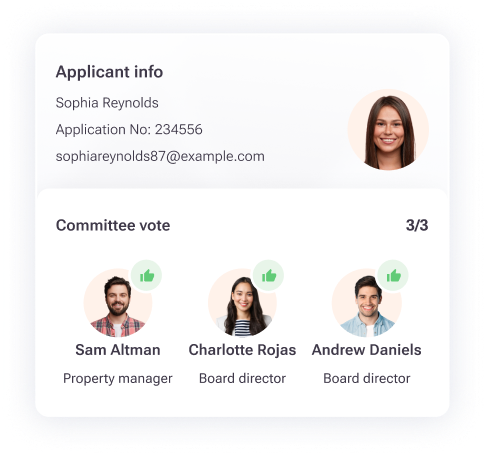
TenantEvaluation supports all four practices within a single platform. As a direct reseller of TransUnion and Equifax data, not a third-party scraper, TenantEvaluation accesses bureau data under strict bureau rules with regular compliance reviews and audits. Its automated adverse action workflows generate notices at the point of decision, and its built-in audit trails timestamp every application action. The QuickApprove accelerated approval workflow gives boards a dedicated review and voting dashboard that keeps the association in final decision authority while reducing manual follow-ups. The platform’s clear separation between data provision by TenantEvaluation and decision-making by the association functions as a structural compliance safeguard that generic rental screening tools typically lack.
QuickApprove: Fast, Informed Decisions at the Click of a Button
Communities that need centralized lease documentation connected to the onboarding record can use TenantEvaluation’s Lease Tracking capability. This feature connects resident onboarding, unit data, approvals, and lease documentation into one streamlined, audit-ready workflow. It replaces spreadsheets and scattered email chains with real-time lease status visibility from application to occupancy.
Creating an FCRA-compliant adverse action notice for a condo or HOA tenant denial in Florida requires five specific elements, delivery within 30 days, separate notices for co-applicants, and a documented audit trail. These steps must operate within a governance structure where the association retains final decision authority. Florida Statutes Chapters 718 and 720 define the board’s approval powers but do not replace or reduce the federal FCRA obligation when a consumer report drives the denial.
Manual workflows create timing gaps, omission errors, and incomplete records that expose associations to statutory penalties. Automated platforms purpose-built for community associations, with direct bureau reseller relationships, built-in adverse action workflows, and board-ready approval dashboards, address those gaps in a systematic way. TenantEvaluation processes over 100,000 applications annually across 5,000+ communities, and that scale supports mature, tested workflows with FCRA compliance built into every step.
Frequently Asked Questions
Does a Florida condo association always have to send an adverse action notice when denying a tenant?
A Florida condominium association must send an FCRA adverse action notice whenever a consumer report, including a credit report, background check, or tenant screening report, contributed in whole or in part to the denial decision. If the denial is based solely on factors unrelated to any consumer report, such as a governing document restriction on the number of rentals permitted, the FCRA notice obligation does not apply. When any part of the decision involves a consumer report, the notice is required regardless of what the governing documents say about board approval authority.
What happens if the condo board delays the denial decision past 30 days?
The 30-day delivery standard runs from the date of the adverse action, not from the date the application was submitted. If a board delays its decision, the clock on the adverse action notice does not start until the denial occurs. Prolonged delays in reaching a decision can still create separate compliance exposure under Florida’s fair housing obligations and the association’s own governing documents. Once the board issues a denial based on a consumer report, the adverse action notice should be sent promptly, and delivery within 30 days remains the accepted standard to avoid FCRA liability.
Can TenantEvaluation issue the adverse action notice on behalf of the association?
TenantEvaluation provides the workflow tools, data, and automated notice generation infrastructure, but the association retains final decision authority and remains the party legally responsible for issuing the adverse action notice. TenantEvaluation’s platform uses a clear separation between data provision and decision-making. TenantEvaluation supplies the consumer report as a direct reseller of TransUnion and Equifax data, and the association or its authorized CAM makes and communicates the denial decision. This structural separation functions as a core compliance safeguard within TenantEvaluation’s FCRA-first design.
Does the adverse action notice requirement apply to HOAs under Florida Statutes Chapter 720 as well as condos under Chapter 718?
The FCRA adverse action notice obligation is a federal requirement that applies to any entity taking adverse action based on a consumer report. This standard applies regardless of whether the community is organized as a condominium under Chapter 718 or a homeowners association under Chapter 720. Florida’s governing document statutes define the association’s approval powers and rental restrictions but do not override or replace federal FCRA obligations. Both condo associations and HOAs in Florida that use consumer reports in their tenant screening process must comply with FCRA adverse action notice requirements.
What records should a Florida CAM retain after issuing an adverse action notice?
A Florida CAM should retain several key records for each adverse action notice issued. These records include a copy of the notice itself with all five required FCRA elements, the applicant’s name and last known address used for delivery, the date the notice was sent and the delivery method, and the name and contact information of the consumer reporting agency identified in the notice. The CAM should also keep the board decision record or vote documentation and any proof of delivery, such as certified mail receipts or electronic delivery confirmation. TenantEvaluation’s built-in audit trails timestamp every application action and store these records in a searchable, audit-ready format, which replaces the manual folder and email chain approach that often creates compliance gaps during regulatory reviews or applicant disputes.