Written by: Luis Teran, Co-founder, CEO, TenantEvaluation
Key Takeaways for Florida Condo Boards and CAMs
- Florida condo associations face a predictable operational crunch every May through August when tenant application volume surges and manual workflows fail.
- State statutes cap approval fees at $150 and require specific documentation, consent, and audit records that generic landlord tools do not fully support.
- TenantEvaluation’s 7-step digital workflow with standardized intake, biometric IDVerify+, FCRA-compliant SafeCheck+, QuickApprove board voting, and 55+ verification cuts approval times by up to 70%.
- TenantEvaluation is built for Florida’s two-layer condo governance structure, with board dashboards, statutory fee handling, and complete audit trails.
- Schedule a demo today to keep your association compliant and profitable during peak season.
The Peak-Season Approval Problem for Florida Condos
Florida’s peak rental season creates a predictable operational crisis for condo associations. Application volume spikes sharply between May and August as seasonal residents, relocating professionals, and investors all compete for available units at the same time. Manual processes such as PDF applications, email document requests, and spreadsheet tracking cannot keep up with this volume.
Florida law adds a layer of regulatory precision that generic landlord tools are not designed to handle. Under Florida Statutes Section 718.112(2)(k), condominium associations may charge a maximum approval fee of $150 per applicant, with a husband and wife or parent and dependent child counted as one applicant. A separate security deposit from the tenant, capped at one month's rent, may also be collected when authorized by governing documents to protect common elements.
Under Florida Statutes Section 718.110(13), any association amendment that restricts rental duration or frequency applies only to owners who consented or who purchased after the amendment's effective date. CAMs must track each unit's amendment history so they can apply the correct screening rules to each application.
When these requirements are managed manually, boards become bottlenecks. Applications sit in email threads awaiting votes. Sensitive applicant data such as Social Security numbers and financial records circulates through unencrypted channels. Identity fraud exposure grows. Every day of delay represents lost rental income for unit owners and delayed fee revenue for the association.
How Application Volume and Bottlenecks Shift Through the Year
Peak season pressure does not appear overnight. It builds across the calendar as application volume rises and manual processes fall behind. The timeline below shows how volume, bottlenecks, and revenue impact change during a typical year.
| Period | Typical Application Volume | Primary Bottleneck | Revenue Impact |
|---|---|---|---|
| January–April | Moderate | Document completeness | Baseline fee collection |
| May–August (Peak) | High surge | Board review backlog, incomplete apps, identity fraud risk | Delayed approvals reduce rental starts and association fee revenue |
| September–October | Moderate decline | Audit trail gaps from peak season | Compliance exposure from rushed approvals |
| November–December | Low | Year-end reporting and record retention | Revenue reconciliation |
When HOA or condo association approval is required for a tenant, the submission and review process often takes several weeks before a target move-in date under manual workflows. That timeline becomes untenable when dozens of applications arrive at the same time during peak months.
The Digital Application Packet Florida Boards Actually Need
Most peak-season delays start with incomplete submissions and missing documentation. Associations that define a clear, digital “complete packet” standard prevent this bottleneck and protect compliance.

| Document / Verification | Required By | Florida Statute Reference | TenantEvaluation Feature |
|---|---|---|---|
| Completed application form | Governing documents | §718.112(2)(k) | Intelligent Form Logic |
| Government-issued photo ID | Association screening criteria | FCRA permissible purpose | IDVerify+ biometric validation |
| Executed lease agreement | Governing documents | §718.112(2)(k) | Smart document review |
| Background and credit check consent | FCRA | 15 U.S.C. §1681 et seq. | SafeCheck+ with FCRA audit trail |
| Income verification | Association screening criteria | Governing documents | IncomeEV report |
| Application fee payment | Governing documents | §718.112(2)(k), within fee cap | Automated fee collection |
| Age verification documentation (55+ communities) | HOPA / governing documents | 42 U.S.C. §3607 | 55+ Communities Verification |
7-Step TenantEvaluation Workflow for Faster Florida Approvals
This 7-step workflow reflects how Florida CAMs and condo boards use TenantEvaluation during high-volume months.
- Standardize the digital intake packet. Replace PDF emails and paper forms with a 100% online application configured to each community's governing documents. TenantEvaluation's Intelligent Form Logic dynamically adjusts required fields based on applicant type such as tenant, purchaser, or additional resident. The system blocks incomplete applications from moving forward, which removes the most common source of manual follow-up during peak season.
- Use two-layer vetting with document review and biometric IDVerify+. Traditional document-only screening cannot reliably prevent impersonation, synthetic identity fraud, or stolen ID use. IDVerify+ adds AI-powered liveness detection, government ID authentication, and biometric selfie-to-ID facial comparison inside TenantEvaluation without any external portal. CAMs receive verification results such as ID authenticity, liveness status, and biometric match inside the screening report, along with a redacted ID copy for compliance documentation.
- Automate red-flag screening and FCRA-compliant background checks. TenantEvaluation's SafeCheck+ runs nationwide and global criminal background checks, eviction history, and credit analysis as a direct reseller of TransUnion and Equifax data, not third-party scraping. Under the FCRA, written consent must be obtained before conducting background checks, and an Adverse Action Letter must be provided if an application is rejected based on the report. TenantEvaluation automates both requirements and maintains a complete audit trail for every application.
- Route applications through QuickApprove real-time tracking. QuickApprove replaces email chains and spreadsheets with a single connected workflow inside TenantEvaluation. Real-time application tracking, automated communication support, and reduced manual follow-ups keep applications moving during peak season without extra headcount. Applicants receive status updates automatically, which removes the repeat inquiry calls that consume staff hours during high-volume periods.
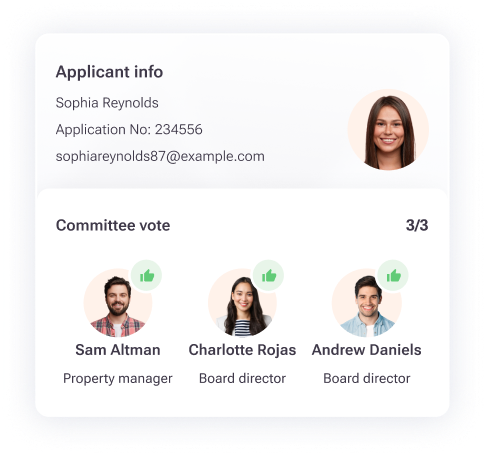
- Speed up board voting with a board-ready dashboard. QuickApprove includes a dedicated board review and voting panel that gives Board Members direct, real-time access to AI-generated applicant summaries, application status, and a structured voting workflow. Boards decide faster because the information they need is organized and accessible instead of buried in email threads. Customized approval letters and a personalized welcome package generate automatically after a decision.
- Apply 55+ Communities Verification for age-restricted properties. Florida condos and HOAs operating under HOPA age-restriction requirements need consistent age verification. 55+ Communities Verification standardizes how age-restricted application requirements are handled across applications. It reduces manual work, improves documentation consistency, and strengthens internal operational control by replacing fragmented email and PDF workflows with a structured, scalable process.
- Maintain complete audit trails and revenue-sharing reporting. Every action in TenantEvaluation is timestamped and auditable. The platform's revenue-sharing model deducts the service fee from the collected application fee, within the statutory fee cap, and rebates the remainder to the association or management company. Application processing becomes a controlled income stream with full reporting visibility.
Schedule a demo today to see this 7-step workflow in action for your community.
Why Generic Landlord Tools Cannot Support Florida Condo Governance
Platforms like Avail and RentSpree are designed for individual landlords who manage single-family rentals or small multifamily portfolios. They do not match the two-layer governance structure of Florida condo associations, where both the unit owner and the association board have defined roles in the approval process.
Generic landlord tools lack board voting dashboards, association-specific FCRA audit trails, Florida statutory fee handling, and the ability to configure screening criteria to individual community governing documents. They do not support 55+ Communities Verification workflows. They do not offer biometric identity verification inside the screening workflow. They also do not generate the adverse action documentation that Florida condo associations need to defend approval decisions.
Application fees for tenant processing in Florida HOAs vary based on governing documents, and associations using generic tools often lack automated fee collection and revenue-sharing infrastructure to manage this compliantly at scale. TenantEvaluation processes approximately 100,000 applications per year across 5,000+ communities, with FCRA compliance as the foundation and direct credit bureau reseller relationships with TransUnion and Equifax that generic platforms cannot match.
The distinction is structural. Community associations operate under Florida Statutes Chapter 718, with governing documents, board voting requirements, and audit obligations that require a platform built specifically for that environment.
Frequently Asked Questions
How long does a typical Florida condo tenant approval take during peak season?
Under manual workflows, the submission and review process for a Florida condo tenant application often takes several weeks before a target move-in date. During peak season from May through August, when application volume surges, that timeline often extends further because of board review backlogs, incomplete submissions, and manual follow-up cycles. TenantEvaluation's platform, including the QuickApprove accelerated approval workflow, reduces approval times by up to 70% by automating document collection, identity verification, background checks, and board voting inside a single connected platform. Applications that previously took weeks can move from submission to decision in days while preserving compliance, visibility, and board oversight.
What red flags should CAMs watch for in high-volume application periods?
During peak season, the most common red flags include incomplete application packets submitted to bypass review timelines and mismatched identity documents that suggest impersonation or synthetic identity fraud. CAMs should also watch for income documentation that does not align with credit report data, prior eviction history, and delinquent assessment records on the unit being rented. Under Florida Statute 718.116, delinquent assessments can be a valid reason for a condo association to disapprove a lease when the governing documents permit association approval.
TenantEvaluation's SafeCheck+ runs comprehensive background checks including eviction history and criminal records, while IDVerify+ adds biometric identity confirmation to catch impersonation attempts that document-only screening cannot detect. Automated red-flag logic identifies applications that do not meet preset criteria before they reach the board, which reduces the volume of problematic applications that require manual review.
How do 55+ community application requirements in Florida differ from standard rentals?
Age-restricted communities operating under the Housing for Older Persons Act (HOPA) must maintain specific documentation standards to preserve their exempt status. They must verify that at least 80% of occupied units have at least one resident aged 55 or older and that the community publishes and follows policies that show intent to be age-restricted housing. These requirements add a documentation layer that standard rental application workflows are not designed to handle.
Florida condo associations managing 55+ communities must collect, verify, and retain age-verification documentation consistently across every application. That process becomes fragile when handled through emails, PDFs, and manual follow-ups. TenantEvaluation's 55+ Communities Verification standardizes how these age-restricted requirements are handled across applications, reduces manual work, improves documentation consistency, and strengthens internal operational control. It provides workflow standardization and documentation consistency for Florida condos and HOAs but does not replace legal advice.

What are the board's legal responsibilities when approving tenant applications?
Florida condo association boards have several distinct legal responsibilities in the tenant approval process. The authority to screen and approve tenants must appear in the governing documents such as the declaration, articles, or bylaws before the association can require approval or charge a screening fee. Under Section 718.112(2)(k), Florida Statutes, approval fees are capped at $150 per applicant and must be used solely for screening and approval purposes.
Boards must apply screening criteria consistently across all applicants to avoid Fair Housing Act exposure. Any rejection based on a background check report triggers the adverse action notice requirements described earlier. All board votes and approval decisions must be documented with a complete audit trail. TenantEvaluation's platform automates adverse action workflows, maintains timestamped audit records for every application, and provides a board voting panel with AI-generated applicant summaries. Boards gain the structure they need to make defensible, compliant decisions without relying on email chains or manual documentation.
Conclusion: A Peak-Season Playbook Built for Florida Associations
Florida condo associations face a structurally difficult operational problem every peak season. Application volume surges precisely when manual processes are least equipped to handle it. Paper workflows, email chains, and generic landlord tools create compliance gaps, board bottlenecks, and fraud exposure that compound with every incomplete submission and delayed vote.

TenantEvaluation is an association-native platform that addresses this problem end-to-end by combining QuickApprove board-ready accelerated approval workflows, IDVerify+ biometric identity verification, and 55+ Communities Verification standardization inside a single FCRA-compliant platform built for Florida community associations. With the operational scale described earlier and $150M generated for communities, TenantEvaluation provides the infrastructure CAMs and boards need so peak season does not overwhelm their processes.
Schedule a demo today and see how TenantEvaluation can cut your association's approval time by up to 70% before peak season arrives.
