Written by: Luis Teran, Co-founder, CEO, TenantEvaluation
Key Takeaways for Florida Boards and CAMs
- Florida HOAs and CAMs lose hours weekly to email-based payment approvals and spreadsheet-driven board votes that lack built-in governance controls.
- Generic AP tools like ApprovalMax, BILL, and AvidXchange lack board voting dashboards, direct-to-association payment flows, and Florida-specific compliance features required under Chapters 718 and 720.
- TenantEvaluation’s QuickApprove and TEpayments by Zinc deliver multi-level authorization, immutable audit trails, and direct payments that move from applicant to association without third-party intermediaries.
- The platform’s board voting dashboard provides AI-generated summaries, timestamped votes, automated notifications, and full audit-ready records that replace email chains and spreadsheets.
- Associations seeking to eliminate manual reconciliation and ensure FCRA-compliant, audit-ready workflows can explore TenantEvaluation’s integrated solution at TenantEvaluation.
1. Multi-Level Authorization with Enforced Board Sign-Off
Generic accounts-payable tools route invoices through finance hierarchies built for corporate departments, not volunteer boards governed by Florida Statutes §§ 718 and 720. A delegation of authority matrix must encode approval limits as system rules, including amount-based routing that adds approvers as thresholds are crossed, authority limits that block completion unless someone with sufficient authority has signed, and role-based permissions that prevent unauthorized users from approving at all. Without those controls embedded in software, the matrix stays a document people try to remember instead of a control that automatically enforces policy.
CIC-SC identifies unauthorized expenditures as the most common loss event in community associations and recommends tiered spending thresholds with dual-signature requirements calibrated to roughly 1–2% of the annual budget. Without these written, system-enforced controls, boards face two risks. They cannot prove a manager exceeded authority when a loss occurs, and their fidelity insurer may dispute coverage because no documented policy existed to violate.
QuickApprove and the TEpayments by Zinc connected payment workflow close that gap with a single connected process. Board members access a dedicated voting panel inside TenantEvaluation, review AI-generated applicant summaries, and cast timestamped votes, all within the same platform that collects fees and deposits. The workflow removes external portals, eliminates scattered email threads, and prevents authority gaps that weaken governance.

2. Audit Trails That Stand Up to Florida Governance Reviews
Florida Statutes §§ 718.3027 and 720.3033 require conflict-of-interest screening before engaging vendors, and CIC-SC calls for monthly disbursement reviews by a director independent of the preparer, along with annual confirmation that bank signature cards match the adopted policy. Spreadsheets do not provide the identity, traceability, or integrity controls needed to satisfy these requirements.
A complete audit trail must capture more than timestamps and approver names. An effective audit trail must connect activity to identity, data access, decision logic, human approval scope, system actions with prior and new values, and outcomes including exceptions and evidence. Every compliant entry requires authenticated user identity, precise action taken, timezone-aware timestamp, before-and-after field-level data state, and cryptographic integrity proof that the record has not been altered.
TenantEvaluation delivers immutable, timestamped records for every application action, board vote, document upload, and payment event. Audit-ready workflows must enforce role-based routing tied to hierarchy data, centralized immutable event logging, rules-engine policy enforcement, automated segregation-of-duties checks, and mandatory reason codes for exceptions. TenantEvaluation’s built-in audit trails satisfy each of those requirements by embedding them directly into the platform’s core architecture, and they produce records queryable by user, date, document, or action. Regulatory responses shift from days of reconstruction to minutes of targeted reporting.
These audit capabilities become even more critical when combined with direct payment flows, where fraud prevention and traceability must work together.
3. Direct-to-Association Payment Collection for Fraud Reduction
The 2025 AFP Payments Fraud and Control Survey found 79% of organizations reported attempted or actual payments fraud activity in 2024, with business email compromise as the most frequently targeted method. Florida associations that still collect application fees and deposits by check or disconnected portal face that exposure with every transaction.
The TEpayments by Zinc connected payment workflow reduces that risk by design. Each association defines what is collected and at which stage of onboarding. Payments move directly from the applicant to the association’s designated account, and TenantEvaluation organizes the workflow but never holds the funds. Associations avoid third-party intermediaries holding their money, remove reconciliation delays, and give applicants clear instructions about what to pay, when to pay, and where to pay.
The contrast with generic AP tools is direct and measurable. One large management company with 200+ associations reduced payment processing costs and streamlined their AR team after adopting digital payment automation. TEpayments by Zinc delivers that same operational compression inside the resident onboarding workflow associations already use, so teams manage one workflow and stop chasing payments across multiple systems.
4. Board Voting Dashboard Walkthrough for Florida Associations
QuickApprove is TenantEvaluation’s accelerated approval workflow built for CAMs, boards, and property management teams inside one connected platform. The board-ready dashboard operates in six steps.
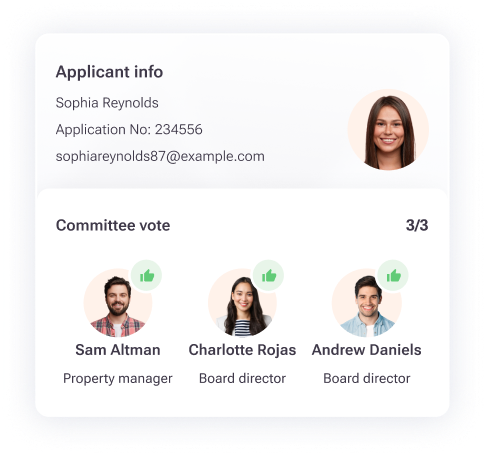
- Real-time application tracking: CAMs monitor every application’s status from submission through decision without opening an inbox.
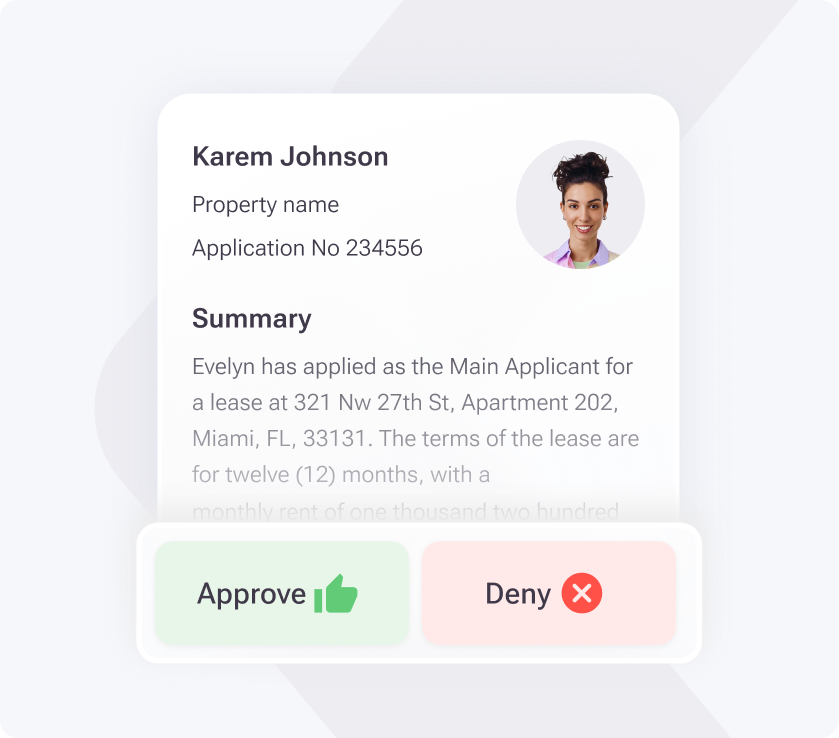
- AI-generated applicant summaries: Board members receive condensed reports on each applicant, which reduces the time spent reviewing raw documents.
- Voting panel: Each board member logs in to a dedicated panel, reviews the summary, and casts a timestamped vote, choosing approve, deny, or request more information.
- Automated notifications: The platform triggers communication to applicants, realtors, and managers at each status change, which reduces manual follow-ups.
- Customized approval letters and welcome packages: Approved applicants receive professionally formatted letters generated automatically inside the platform.
- Audit-ready decision record: Every vote, comment, and document action is logged with a timestamp and user identity, producing a complete governance record.
This structure replaces the email chains and spreadsheets that currently define board approval for most Florida associations. Boards keep full oversight, maintain screening rigor, and gain clearer compliance and visibility across every decision.
5. Accounting Integration with QuickBooks and Xero
TenantEvaluation connects to QuickBooks and Xero, posting approved payment records directly to the association’s accounting system without manual data entry. Every payment captured through the TEpayments by Zinc connected payment workflow carries a traceable record, including applicant identity, payment amount, stage of onboarding, and board approval status, and that context flows into the accounting ledger intact.
AI-enabled finance teams can spend less time on data processing when using automated systems. For community associations managing high onboarding volume across multiple properties, that time savings compounds quickly. Board-level approval and direct payment traceability remain intact through every accounting sync, so teams avoid manual reconciliation and eliminate disconnected records.
Beyond technical integration, Florida associations must also navigate state-specific governance requirements that generic tools were not designed to address.
6. Florida Governance Rules Built into the Workflow
Florida condominiums operate under updated electronic voting rules in Section 718.128, Florida Statutes, following 2025 legislative changes that removed the 14-day notice requirement for boards to adopt electronic voting. Associations that have not adopted electronic voting must designate an email address to receive emailed ballots, which creates additional compliance and recordkeeping burdens that a purpose-built platform can absorb.
The conflict-of-interest screening requirements discussed earlier (§§ 718.3027 and 720.3033) also apply to emergency expenditures, which require immediate board notification and ratification at the next meeting. TenantEvaluation is built for these requirements, not retrofitted from a generic AP tool. The platform’s configurable approval workflows, conflict-of-interest screening integration, and emergency ratification recordkeeping align with Florida condo and HOA governance requirements under Chapters 718 and 720, giving CAMs and board presidents a defensible, audit-ready process for every approval scenario.
Comparison: Generic AP Tools vs. TenantEvaluation for Community Associations
| Feature | Generic AP Tools | TenantEvaluation | For Community Associations |
|---|---|---|---|
| Board voting dashboard | No | Yes (QuickApprove) | Direct board sign-off inside the platform, with timestamped votes and AI-generated summaries |
| Direct-to-association payments | No | Yes (TEpayments by Zinc) | Funds move directly from applicant to association’s designated account, and TenantEvaluation never holds funds |
| Lease-connected records | No | Yes (Lease Tracking) | Audit-ready from application to occupancy, with real-time lease status across all units |
| Florida-specific compliance | No | Yes | Built for §§ 718/720, with conflict-of-interest screening, FCRA-first design, and adverse action workflows |
| Multi-level authorization | Partial (corporate hierarchy) | Yes | Configurable per association, with role-based permissions that enforce board-level authority limits |
| Immutable audit trail | Varies | Yes | Timestamped, user-attributed records for every vote, document, and payment event |
Six-Step Implementation Checklist for Florida Communities
- Map current approval touchpoints: Identify every stage where a CAM, manager, or board member currently approves an action by email or spreadsheet entry.
- Configure real-time tracking: Set up TenantEvaluation’s application tracking so every stakeholder sees live status without requesting updates.
- Activate automated communication: Enable automated notifications for applicants, realtors, and board members at each workflow stage to eliminate manual follow-ups.
- Define collection stages in TEpayments by Zinc: Specify which fees and deposits are collected and at which onboarding step, so the workflow matches the property’s existing process.
- Set up the QuickApprove board voting panel: Assign board member roles, configure authority thresholds, and test the voting workflow with a sample application before go-live.
- Map Florida compliance requirements: Confirm conflict-of-interest screening, emergency ratification recordkeeping, and §§ 718/720 documentation requirements appear in the configured workflow for each community.
Frequently Asked Questions
What is board approval payment workflow software, and why do Florida HOAs need a purpose-built version?
Board approval payment workflow software is a platform that routes financial transactions and resident application decisions through defined authorization levels, requiring sign-off from designated roles before funds move or approvals are issued. Generic AP tools are designed for corporate finance departments with fixed hierarchies. Florida HOAs and condominiums operate under Chapters 718 and 720 of the Florida Statutes, which impose specific requirements around conflict-of-interest screening, emergency ratification, and electronic voting. A purpose-built platform like TenantEvaluation embeds those requirements directly into the workflow rather than asking CAMs to manually enforce them alongside a generic tool. The result is a defensible, audit-ready process that reflects how Florida associations actually govern, not how a corporate AP department operates.
How does multi-level authorization work inside TenantEvaluation for community associations?
TenantEvaluation’s QuickApprove board voting dashboard assigns role-based permissions to CAMs, property managers, and board members. Each role operates within defined authority limits, so board members access a dedicated voting panel to review AI-generated applicant summaries and cast timestamped votes, while CAMs manage application tracking and communication workflows. The TEpayments by Zinc connected payment workflow adds a payment authorization layer, where each association configures which fees are collected at which onboarding stage, and payments move directly from the applicant to the association’s designated account only after the workflow conditions are met. TenantEvaluation never holds the funds. This structure converts multi-level authorization from a policy document into a system control that cannot be skipped and produces evidence that it operated correctly.
What does an audit-ready payment approval record look like in TenantEvaluation?
Every action inside TenantEvaluation, including application submission, document upload, board vote, payment event, and approval letter generation, is logged with an authenticated user identity, a timezone-aware timestamp, and a before-and-after record of any data change. Board votes include the exact evidence shown to the reviewer, the decision scope, and the authority under which the decision was made. Payment records capture the applicant identity, payment amount, onboarding stage, and direct-to-account routing confirmation. These records are immutable, queryable by user, date, document, or action type, and retained in a format that supports regulatory review. For Florida associations subject to §§ 718 and 720 audit requirements, every approval and payment event is traceable from application intake through occupancy without reconstructing information from email threads or spreadsheets.
Can TEpayments by Zinc be configured differently for each association in a management company’s portfolio?
TEpayments by Zinc supports configuration per association, so it adapts to each community’s process rather than imposing a universal sequence. A management company overseeing multiple Florida communities can configure different fee structures, collection stages, and payment triggers for each association independently. Each association defines what is collected and when, including application fees, deposits, or other required resident payments, and the workflow reflects that configuration inside the same TenantEvaluation platform the management company already uses for screening, approvals, and lease tracking. Payments in every configuration go directly from the applicant to the association’s designated account, and TenantEvaluation never holds the funds regardless of how the workflow is configured.
How does TenantEvaluation handle FCRA compliance within the board approval and payment workflow?
TenantEvaluation treats FCRA compliance as the foundation of the platform. As a direct reseller of TransUnion and Equifax data, TenantEvaluation accesses credit information under strict bureau rules with regular compliance reviews and no gray-market data sources. The platform enforces strict permissible purpose controls, automates adverse action workflows, and maintains a clear separation between decision-making authority, which belongs to the association, and data provision, which comes from TenantEvaluation. Every application carries a built-in audit trail that documents the screening basis, board vote, and payment record in a single connected workflow. IDVerify+ strengthens permissible-purpose validation by confirming applicant identity through biometric verification before screening authorization proceeds, which reinforces FCRA-aligned workflows and audit defensibility across the entire board approval and payment process.
Conclusion
Florida CAMs and board presidents face six compounding gaps when they rely on email chains, spreadsheets, and generic AP tools. They lack a dedicated board voting dashboard, a direct-to-association payment flow, Florida-specific governance controls, multi-level authorization built for community associations, an immutable audit trail, and lease-connected records. TenantEvaluation’s QuickApprove board voting dashboard and the TEpayments by Zinc connected payment workflow close all six in one FCRA-compliant platform, with payments flowing directly to the association’s account as described in the direct payment section, board votes logged with full audit context, and every record connected from application to occupancy.
TenantEvaluation has processed 100,000+ applications annually across 5,000+ communities and generated $150M for those communities. The platform is built specifically for Florida condos and HOAs, not retrofitted from a generic tool.
