Written by: Luis Teran, Co-founder, CEO, TenantEvaluation
Key Takeaways
- Manual board approval occupancy tracking creates delays, documentation gaps, and audit exposure for Florida HOAs and condos.
- Fragmented email chains and spreadsheets block CAMs and boards from seeing real-time applications, leases, and occupancy status.
- A connected digital workflow links application intake, board voting, lease documentation, and live occupancy updates in one searchable system.
- TenantEvaluation’s QuickApprove and Lease Tracking replace manual processes with automated document collection, structured voting, and real-time status tracking.
- See TenantEvaluation in action and move your Florida communities from email chains and spreadsheets to one connected workflow.
The Problem: Manual Tracking Creates Gaps, Delays, and Risk
Manual approval-to-occupancy workflows scatter critical information across inboxes, shared drives, and spreadsheets that no single stakeholder controls. A CAM tracking 30 active applications across multiple communities cannot reliably confirm which units are occupied, which leases are current, and which board votes are pending without manually assembling that picture from multiple sources.
Manual workflows commonly break in predictable ways. Incomplete applications pass initial review because no automated logic flags missing documents. Lease copies sit in email attachments that become inaccessible when staff changes. Board members receive application packages through email without a structured voting mechanism. Occupancy status gets updated manually, or not updated at all, after a resident moves in.
Each failure point compounds the next. A delayed board vote extends an applicant’s move-in timeline. A missing lease copy creates a gap in the occupancy record. An untracked lease expiration produces a compliance exposure that surfaces only during an audit or a dispute. For Florida CAMs managing communities with active turnover, these issues are recurring operational costs, not rare exceptions.
Centralized records prevent these failures by creating a single source of truth that connects application data, board decisions, lease documentation, and occupancy status in one searchable, audit-ready system.
Explore the connected workflow and see how TenantEvaluation replaces fragmented tracking with one continuous process.
The Solution: A Seven-Stage Digital Workflow From Application to Occupancy
A purpose-built platform links application intake, board voting, lease documentation, and real-time occupancy status inside one operational environment. The table below maps the seven critical handoff points where manual workflows often lose documentation or create delays, and it shows the specific action, responsible party, and required documentation that maintain an unbroken audit trail from application to confirmed occupancy.
| Stage | Action | Owner | Required Documentation |
|---|---|---|---|
| 1. Application Intake | Applicant submits online application with all required documents | Applicant / CAM | Completed application form, government-issued ID, executed lease |
| 2. Document Review | Platform validates completeness, and incomplete submissions are flagged or rejected | Platform / CAM | All community-required documents confirmed present |
| 3. Background Screening | FCRA-compliant background, credit, and identity checks run on the applicant | Platform | Screening report, identity verification result |
| 4. Board Review | Board members access summarized application package and cast votes via dashboard | Board of Directors | Applicant summary report, screening results, board voting record |
| 5. Approval Decision | Approval or denial is recorded, and approval letter and welcome package are issued | CAM / Platform | Timestamped approval or denial record, customized approval letter |
| 6. Lease Documentation | Executed lease is collected, linked to the unit record, and stored in the platform | CAM / Platform | Executed lease agreement tied to unit and resident profile |
| 7. Occupancy Confirmation | Unit occupancy status is updated to active, and lease expiration is tracked in real time | Platform / CAM | Active occupancy record, lease status (active, pending, expired, or missing) |
Boards need dashboard access that displays application status by unit, pending votes, approval history, and current occupancy status in one view. Approvals must connect directly to lease records so that occupancy status reflects the actual state of each unit rather than a manually updated spreadsheet entry.
Manual vs Connected: How Workflows Change in Practice
| Workflow Area | Manual Method | TenantEvaluation QuickApprove + Lease Tracking |
|---|---|---|
| Application tracking | Email threads and shared spreadsheets updated manually | Real-time application tracking inside one connected platform |
| Board voting | Email chains with no structured voting record | Dedicated board voting dashboard with timestamped decisions |
| Lease collection | Attachments stored across inboxes and folders | Automated lease document collection linked to unit and approval records |
| Occupancy status | Manually updated, frequently outdated or missing | Real-time lease status: active, pending, expired, or missing |
| Audit readiness | Records scattered, and reconstruction is time-intensive | Searchable digital history with built-in audit trail |
QuickApprove: Faster, Board-Ready Decisions in One Place
QuickApprove is TenantEvaluation’s accelerated approval workflow for CAMs, Boards, and property management teams. It moves resident applications from submission to decision faster inside one connected platform while preserving control, compliance, and visibility.

The board-ready approval process gives Board members direct access to summarized applicant reports and a structured voting panel, which replaces the email chains that currently carry approval decisions with no audit trail. Real-time application tracking keeps CAMs informed of where each application stands without manual follow-up. Automated communication support, customized approval letters, and a personalized welcome package reduce the manual work that follows a board decision.
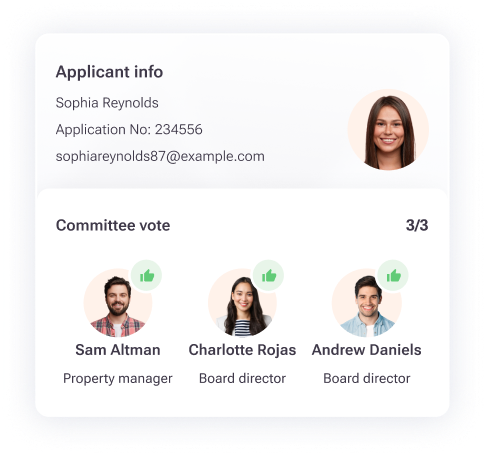
QuickApprove fits high-volume seasons and communities with complex onboarding requirements. These conditions are exactly where manual workflows create the most bottlenecks and the widest documentation gaps.
Watch a live QuickApprove walkthrough and see a full application cycle for your community.
Lease Tracking: Continuous Visibility Into Every Unit
Lease Tracking is the centralized operational capability inside TenantEvaluation that connects resident onboarding, unit data, approvals, and lease documentation into one streamlined, audit-ready workflow. It delivers centralized, real-time lease visibility and lifecycle control from application submission through occupancy.
Key capabilities include real-time lease status visibility at the unit level, with clear categories of active, pending, expired, or missing. Automated lease document collection occurs during onboarding. Unit-level tracking ties directly to occupancy records. A searchable digital history preserves lease records, resident activity, and document trails. Every lease stays connected, searchable, trackable, and audit-ready inside one platform, which replaces spreadsheets and scattered email chains.
Boards gain a clearer operational picture of occupancy and resident activity across communities. CAMs avoid the manual work of searching across folders and inboxes to confirm whether a unit is occupied and whether the lease on file is current.
Evaluation Checklist for CAMs and Boards
Florida CAMs and Board members evaluating board approval occupancy tracking systems can use the following criteria as a practical checklist.
FCRA-compliant data handling. The platform must handle applicant data under strict permissible purpose controls with built-in adverse action workflows and direct credit bureau reseller relationships, not third-party data scraping. This compliance foundation determines whether the platform can legally process applications at all.
Board voting access. Once compliance is in place, board voting access becomes the next critical requirement. Boards need a dedicated review and voting dashboard with timestamped, auditable decisions, not email chains that produce no structured record. Without structured voting, even compliant data collection produces no defensible approval trail.
Automated lease collection. That approval trail must connect directly to lease documentation. Lease documents should be collected automatically during onboarding and linked directly to unit and approval records, not stored separately.
Unit-level occupancy tracking. Occupancy status must reflect the actual state of each unit in real time. Lease status categories such as active, pending, expired, or missing should appear without manual updates.
Searchable audit history. Every application, board vote, lease document, and occupancy change must be searchable and retrievable for internal review or dispute resolution.
Frequently Asked Questions
Who is responsible for verifying occupancy at a Florida property?
In Florida HOAs and condominiums, the Community Association Manager (CAM) often plays a key operational role on behalf of the association. The Board of Directors holds governance responsibility for approving or denying resident applications, which directly determines authorized occupancy. In practice, both parties share accountability. The CAM manages the documentation and workflow, and the Board makes the approval decisions that authorize occupancy. A connected platform like TenantEvaluation links both functions so that board decisions automatically update occupancy information without a separate manual step.
What is a typical timeline for board approval occupancy tracking?
The timeline varies by community governing documents and application volume. The process generally spans from application submission through board vote to lease documentation and occupancy confirmation. In manual workflows, each handoff between stages introduces delays. Incomplete applications require follow-up, board votes wait on email coordination, and lease copies are collected separately from the approval process. A connected digital workflow compresses these handoffs by automating document collection, providing boards with immediate access to application packages, and linking approval decisions directly to lease and occupancy records. Communities using TenantEvaluation’s QuickApprove and Lease Tracking report significantly faster movement from submission to confirmed occupancy compared to manual processes.
Who maintains the official records for resident applications and leases?
Florida community associations are generally required to maintain official records accessible to authorized parties under the association’s governing documents and applicable Florida statutes. In practice, the CAM or management company maintains these records on behalf of the association. When records sit across email inboxes, shared folders, and spreadsheets, retrieval is slow and gaps are common. A centralized platform like TenantEvaluation stores all application records, board voting history, lease documents, and occupancy data in one searchable, audit-ready system. The association gains a complete, organized record set without manual assembly.
Conclusion: Connected Workflows Scale With Florida Communities
Fragmented email chains and spreadsheets create delays, blind spots, and audit risk in board approval occupancy tracking. Florida CAMs and Boards operating on manual workflows carry the operational cost of that fragmentation every time an application stalls, a lease goes missing, or an occupancy record falls out of date.
The connected system described above, which links intake, voting, documentation, and occupancy tracking, now manages 5,000+ communities and approximately 100,000 applications annually, with FCRA compliance as the foundation, not an afterthought. TenantEvaluation gives Florida CAMs and Boards a scalable way to manage board approval occupancy tracking with speed, transparency, and complete records.
Request a tailored demo and replace email chains and spreadsheets with one connected workflow built for Florida HOAs and condos.
