Written by: Luis Teran, Co-founder, CEO, TenantEvaluation | Last updated: July 4, 2026
Key Takeaways for Florida CAMs and Boards
- Accurate resident background checks are a core requirement for Florida condos and HOAs under the Fair Credit Reporting Act (FCRA), which imposes strict accuracy obligations on every Consumer Reporting Agency involved in housing decisions.
- Professional associations such as PBSA, NAA, and AAOA translate federal FCRA requirements into measurable benchmarks that screening providers can meet and prove through documentation.
- TenantEvaluation is built specifically for community associations and management companies, with FCRA compliance as the foundation and association standards embedded through biometric verification, board-ready workflows, and centralized lease lifecycle control.
- Aligning with professional association standards reduces operational and legal risks for Florida CAMs and boards while improving decision quality across resident screening processes.
- See TenantEvaluation in action and review how the platform supports association-backed accuracy standards.
Why Accurate Resident Background Checks Matter for Community Associations
The FCRA applies whenever landlords or organizations use a third-party CRA to compile background reports for eligibility decisions such as resident screening. For Florida CAMs and boards, inaccurate reports create two categories of risk: operational and legal. Operationally, a report containing stale, duplicated, or expunged records produces flawed approval decisions. Legally, every applicant must receive written authorization before a background check is run, the right to receive a copy of the report before adverse action, and the right to dispute inaccurate information with the CRA. Failures at any step expose the association to liability. Professional association standards help reduce both categories of risk while improving decision quality across the board.
FCRA Accuracy Requirements and the Role of Professional Associations
Under the FCRA, consumer reporting agencies must follow reasonable procedures to ensure the maximum possible accuracy of the data they provide for housing decisions. Four specific obligations define that standard in practice:
- Maximum possible accuracy: CRAs have a duty to ensure information in their reports is accurate and up to date, which requires solid processes for collecting information.
- Expungement and sealing: A 2024 CFPB advisory opinion reinforced that CRAs must prevent reporting of information that has been legally sealed or expunged and must not report duplicative records.
- Reporting time limits: Most negative information such as civil judgments and arrests without conviction cannot be reported after seven years, and bankruptcies can be reported for 10 years.
- Dispute resolution: If a tenant disputes inaccurate or incomplete information, the CRA is required to investigate, usually within 30 days, and correct any verified errors.
PBSA accreditation, NAA membership standards, and AAOA guidelines each create frameworks that push member organizations to demonstrate these obligations are met systematically, not case by case. The following comparison shows how each association’s standards translate into practical compliance proof points for community associations.
How PBSA, NAA, and AAOA Standards Compare for Florida Associations
The table below maps the three major professional associations against accuracy outcomes and FCRA compliance proof points relevant to community association screening decisions.
| Association | Accuracy Standard | FCRA Compliance Proof Points | Community Association Relevance |
|---|---|---|---|
| PBSA | Accreditation requires documented procedures for maximum possible accuracy and source verification | Audit-based accreditation covering permissible purpose, adverse action, and dispute handling | Highest structural rigor, which directly maps to HOA and condo board liability concerns |
| NAA | Member education on standalone disclosure requirements and adverse action workflows | Guidance on pre-adverse action notices and updated CFPB summary mandatory since March 20, 2024 | Relevant for management companies overseeing large residential portfolios |
| AAOA | Screening tools and landlord education focused on reporting time limits and criminal record accuracy | Resources on FCRA rights, dispute processes, and permissible purpose | Useful baseline for smaller self-managed communities, though less HOA specific than PBSA |
Florida CAMs evaluating screening providers should prioritize PBSA-accredited platforms, because accreditation requires documented, auditable accuracy procedures rather than self-reported compliance claims. See how TenantEvaluation’s PBSA-aligned accuracy procedures work in practice for Florida community associations.
Florida Community Association Needs: 55+ Rules, Board Dashboards, and Lease Tracking
Florida condos and HOAs carry screening obligations that generic landlord tools do not address. Some HOAs require pre-approval before any rental activity, impose registration fees, or mandate specific lease terms and tenant screening procedures as part of their CC&Rs. Age-restricted communities operating under the Housing for Older Persons Act (HOPA) require consistent documentation of age eligibility across every application. Manual processes handle that requirement inconsistently and leave gaps in records.
TenantEvaluation’s 55+ Communities Verification is a built-in capability that helps Florida condos and HOAs standardize how age-restricted requirements are handled across applications. This standardization reduces manual work, improves documentation consistency, and strengthens operational control. Board dashboards give directors real-time application visibility and a structured voting workflow, which replaces scattered email chains. Lease Tracking connects resident onboarding, unit data, approvals, and lease documentation into one centralized, real-time, audit-ready workflow and removes spreadsheets from application to occupancy.

Day-to-Day Challenges in Resident Screening for Florida CAMs
Florida CAMs managing community association screening without a purpose-built platform face four recurring operational problems that compound each other over time:
- Administrative bottlenecks: Manual follow-ups with applicants, realtors, and owners consume staff hours that could be redirected to higher-value tasks. These delays slow approvals and frustrate residents.
- Fragmented lease records: Missing or outdated lease copies, manual expiration tracking, and disconnected spreadsheets create occupancy blind spots and compliance exposure. These gaps increase the administrative burden created by the bottlenecks above.
- Identity fraud exposure: Traditional document-based screening cannot reliably detect stolen IDs, synthetic identities, or impersonation attempts entering communities. These weaknesses sit on top of fragmented records and raise both safety and liability concerns.
- Limited board visibility: Without a dedicated review dashboard, board members rely on email summaries that lack audit trails and slow approval decisions. This limited visibility makes every other challenge harder to manage and document.
New Accuracy Standards: Biometrics, Audit Trails, and Standardized Workflows
Three principle-based best practices define the 2026 accuracy standard for community association screening:
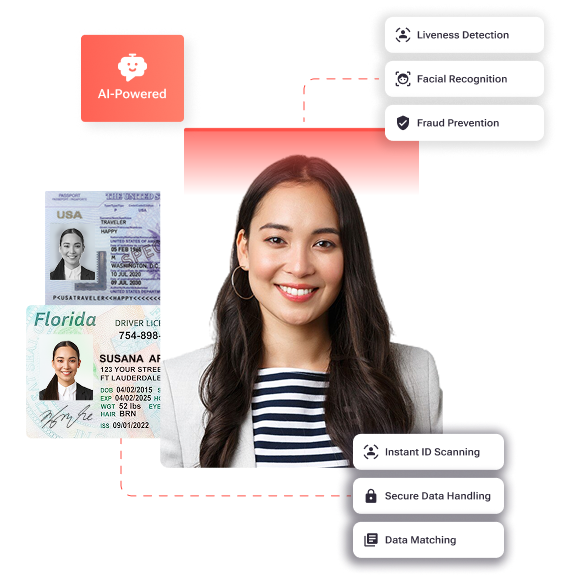
- Biometric identity verification: Communities are moving from document-based review to AI-powered liveness detection, government ID authentication, and biometric facial matching. This shift confirms that the applicant is physically present and matched to their identification before approval decisions.
- Immutable audit trails: Every application action, including document upload, board vote, and adverse action notice, should be timestamped and stored in a searchable, audit-ready format. This structure supports FCRA dispute resolution and board accountability.
- Workflow standardization: Consistent screening criteria applied uniformly across all applicants reduce fair housing exposure and produce comparable, defensible approval records. Standardization also simplifies training and oversight.
Evaluation Framework for Screening Providers Serving HOAs and Condos
Florida CAMs and boards evaluating screening providers can use five clear dimensions to structure their decisions:
- Compliance readiness: The provider should be a direct credit bureau reseller with documented permissible purpose controls and automated adverse action workflows.
- Operational efficiency: The platform should automate document collection, application intake, and board communication inside one connected workflow.
- Transparency: Boards should have real-time visibility into application status, screening results, and approval decisions.
- Scalability: The platform should handle high-volume application seasons without adding headcount or sacrificing response times.
- Auditability: All actions should be logged with timestamps, and lease records should be centralized and searchable for dispute resolution or regulatory review.
Frequently Asked Questions
What tenant screening tools do most landlords use?
Most individual landlords use general-purpose tools such as TransUnion SmartMove, RentPrep, or AAOA-affiliated services. These platforms are designed for single-family rentals and small landlords, not for community associations with board approval workflows, age-restricted documentation requirements, or centralized lease lifecycle management. Florida CAMs and HOA boards need a platform built specifically for community association workflows, including board dashboards, 55+ verification, biometric identity confirmation, and audit-ready lease tracking, which generic landlord screening tools do not provide as standard features.
Who provides the most accurate background checks?
Accuracy in background checks depends on the provider’s data sourcing practices, dispute resolution procedures, and adherence to FCRA maximum-possible-accuracy standards. Providers that are direct resellers of TransUnion and Equifax data, rather than third-party scrapers, access information under strict bureau rules with regular compliance audits. These controls reduce the risk of stale, duplicated, or improperly reported records. TenantEvaluation is a legitimate reseller of TransUnion and Equifax data, with no gray-market or offshore data sources, built-in adverse action workflows, and automated dispute handling. These structural safeguards position it among the most accurate options available to Florida community associations.
What are red flags on a background check for community associations?
For community association screening purposes, red flags typically include recent criminal convictions relevant to community safety, prior evictions within the reportable period, significant derogatory credit history, income-to-rent ratios that fall below community thresholds, and identity verification failures such as a mismatch between a submitted government ID and biometric selfie confirmation. Boards should evaluate red flags within the context of their community’s written screening criteria and applicable fair housing obligations. Boards should also rely on a platform that separates data provision from the approval decision, keeping the association in control of the final determination while the screening provider supplies accurate, FCRA-compliant information.
How does FCRA compliance differ for HOAs versus traditional landlords?
The core FCRA obligations, including permissible purpose, standalone disclosure, adverse action notice, and dispute rights, apply equally to HOAs and traditional landlords when a third-party CRA is used. HOAs, however, face additional operational complexity. Board approval workflows introduce multiple decision-makers who each need access to screening data. Age-restricted communities require consistent eligibility documentation. Lease lifecycle records must be maintained for occupancy verification and potential audits. A platform built for generic rentals does not address these structural differences. TenantEvaluation is designed exclusively for community associations and embeds FCRA-compliant workflows into board dashboards, 55+ documentation processes, and centralized lease tracking.
How TenantEvaluation Puts Association Standards into Daily Practice
TenantEvaluation serves more than 5,000 communities and processes approximately 100,000 applications annually. The platform is built exclusively for community associations and management companies, not generic rentals. Four capabilities directly operationalize the accuracy and compliance benchmarks described in this guide:

- QuickApprove: An accelerated approval workflow that moves applications from submission to decision faster, with real-time application tracking, automated communication support, customized approval letters, and a board-ready approval process inside one connected platform. Communities gain speed without losing control, compliance, or visibility.
- IDVerify+: A biometric identity verification layer embedded directly into the screening workflow that uses government ID validation, AI-powered liveness detection, and biometric facial matching. Communities move from document-based review to verified physical identity confirmation before approval.
- 55+ Communities Verification: The age-restricted documentation capability described earlier, embedded directly into the screening workflow so age eligibility is captured and stored consistently.
- Lease Tracking: Centralized, real-time lease visibility and lifecycle control that connects resident onboarding, unit data, approvals, and lease documentation into one streamlined, audit-ready workflow. This structure replaces spreadsheets and scattered email chains from application to occupancy.
As a direct reseller of TransUnion and Equifax data, TenantEvaluation accesses credit information under strict bureau rules with regular compliance audits, strong permissible purpose controls, automated adverse action workflows, and built-in audit trails for every application.
Conclusion: Applying Association Standards to Your Next Screening Decision
Florida CAMs, property management executives, and board members evaluating screening providers in 2026 can apply five criteria: FCRA-first design with direct bureau data sourcing, PBSA-aligned accuracy procedures, biometric identity verification, board-ready approval dashboards, and centralized lease lifecycle visibility. Generic landlord tools do not meet these criteria for community association workflows. TenantEvaluation meets all five and is built from the ground up for the operational and compliance realities of Florida condos and HOAs.
