Written by: Luis Teran, Co-founder, CEO, TenantEvaluation | Last updated: June 22, 2026
Key Takeaways
- Florida HOAs face identity fraud, slow board approvals, and fragmented lease records that generic screening tools cannot solve.
- Effective tenant screening requires FCRA compliance, biometric verification, and Florida-specific tools like 55+ documentation and centralized lease tracking.
- Leading platforms automate the full onboarding lifecycle from application intake through board approval, cutting processing time from days to minutes.
- Revenue-sharing models let associations earn income from application fees without upfront costs while staying fully compliant.
- Modernize your Florida HOA screening and lease tracking with TenantEvaluation at TenantEvaluation.
How Florida HOA Screening, Board Approval, and Lease Tracking Work
HOA tenant screening in Florida is the process where a community association reviews a prospective resident’s identity, background, credit, income, and documentation before granting occupancy approval. Board approval is the formal vote or sign-off by a community’s Board of Directors, which in many Florida condos and HOAs is a required step before a lease becomes effective. Lease tracking is the practice of keeping centralized, real-time records of all active, pending, expired, or missing leases across a community’s units. For age-restricted communities, 55+ verification is the structured process of collecting and maintaining age-certification documentation to support a community’s Housing for Older Persons Act (HOPA) fair-housing exemption.
Under federal law, a Florida 55+ community must maintain documented proof of HOPA compliance to preserve its fair-housing exemption. A deed restriction and gate sign alone are insufficient. Standard practices include confirming the 80% occupancy requirement, collecting age-certification paperwork, conducting resident surveys, and maintaining published policies and procedures. These compliance requirements exist within a rapidly changing operational environment for Florida HOAs.

Forces Reshaping Florida HOA Screening in 2026
In 2026, three forces are reshaping how Florida HOAs handle resident screening and onboarding. First, identity fraud is increasing across condo and HOA communities, with stolen IDs, synthetic identities, and impersonation attempts entering communities through traditional document-based screening. Second, Florida regulatory pressure around background check practices continues to evolve. FCRA compliance, permissible purpose controls, and adverse action workflows now function as non-negotiable elements of any legally defensible screening program in Florida. Third, the shift from manual to automated workflows is accelerating. Communities that still rely on paper applications, email chains, and disconnected spreadsheets absorb unnecessary cost and risk.
Daily Pain Points for Florida CAMs and Boards
These industry forces show up as concrete operational problems for managers and boards. Day-to-day pain points for Florida CAMs and boards include:
- Manual follow-ups with applicants, realtors, and owners due to incomplete submissions
- Board members waiting on emailed PDFs with no centralized review panel
- Missing or outdated lease copies stored across folders and inboxes
- No real-time visibility into which units have active, expired, or missing leases
- Inconsistent age-certification documentation across 55+ communities
- Applicants repeatedly asking for status updates with no automated communication
These bottlenecks create delayed revenue, compliance exposure, and operational inefficiency. Purpose-built platforms exist to remove these specific problems for Florida communities.
Compliance, Risk, and Governance for Florida HOAs
FCRA compliance is the baseline for any screening program in Florida. Key requirements include permissible purpose controls before pulling credit or background data, automated adverse action workflows when an application is denied, clear separation between the entity providing data (the screening platform) and the entity making the decision (the association), and built-in audit trails for every application. Meeting these requirements starts with how data is sourced. TenantEvaluation is a direct reseller of TransUnion and Equifax data, not a third-party scraper, which means data is accessed under strict bureau rules with regular compliance reviews and no gray-market sources. Age-verification records must also be collected, organized, and maintained in auditable condition so the association can demonstrate compliance on demand.
Common Challenges and Failure Points
Compliance requirements like FCRA controls and age-verification documentation only work when supported by reliable systems. When those systems break down, associations face both compliance exposure and workflow inefficiency. The most common failure points in Florida HOA screening workflows are:
- Manual bottlenecks: Applications processed over 5–10 days instead of minutes
- Incomplete applications: No smart form logic to reject submissions missing required documents
- Missing lease records: No centralized system connecting applications to active leases
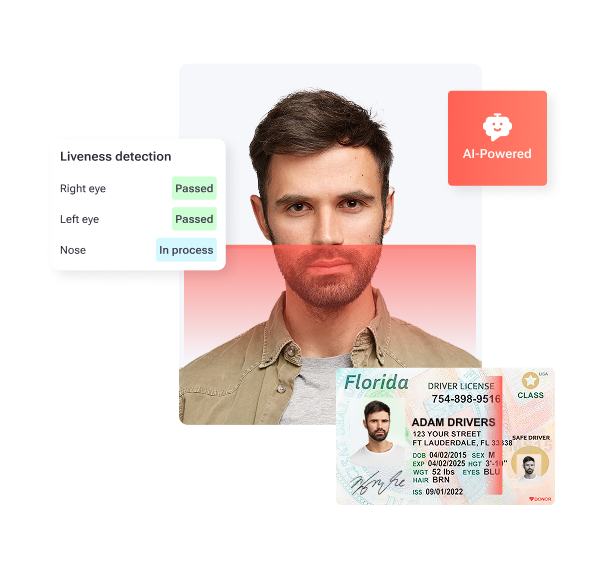
- Identity fraud: Document-only review with no biometric confirmation
- No board visibility: Boards reviewing applications through email with no dedicated dashboard
- Fragmented 55+ documentation: Inconsistent age-certification records across communities
Operational Standards Leading Florida Communities Now Use
Leading Florida community associations are adopting four operational standards in 2026. First, workflow standardization through digital application platforms removes manual bottlenecks and scattered email threads. Second, biometric identity verification moves beyond document-only review and confirms applicant identity with far greater certainty. Third, centralized lease records connect the onboarding lifecycle to ongoing compliance visibility at the unit level. Finally, revenue-sharing models turn application processing into a compliant income stream without upfront investment. TenantEvaluation has already generated $150M for communities through its revenue-sharing model, where application fees are collected, the platform’s service fee is deducted, and the remainder is rebated to the association with no upfront costs.
How to Evaluate Screening and Onboarding Platforms
These emerging standards provide a practical lens for evaluating platforms. Florida HOAs assessing screening and onboarding software should review six dimensions:
- Compliance readiness: FCRA-first design, direct bureau relationships, adverse action automation
- Operational efficiency: End-to-end automation from application intake to approval
- Board transparency: Dedicated board dashboard with real-time voting and application summaries
- Scalability: Ability to handle high-volume seasons without adding headcount
- Auditability: Searchable, timestamped digital records for every application and lease
- Florida-specific features: 55+ verification workflows, lease tracking, and board-ready approval processes built for community associations
Comparison Table and Platform Reviews
The table below shows how these six evaluation criteria appear in real platforms. It highlights the capability gaps between general background check tools and purpose-built HOA solutions.
| Feature | TenantEvaluation | ApplyCheck | Verify Screening Solutions |
|---|---|---|---|
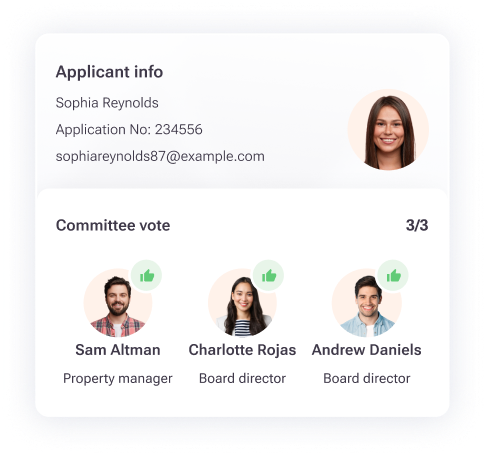
| Board voting dashboard | Yes, dedicated board panel with real-time voting and AI summaries | No | No |
| 55+ verification | Yes, built-in, standardized workflow for Florida HOAs and condos | No | No |
| Lease tracking | Yes, centralized, real-time lease visibility and lifecycle control | No | No |
| IDVerify+ biometric verification | Yes, AI liveness detection, government ID validation, biometric matching | No | No |
| QuickApprove workflow | Yes, accelerated approval with automated communication and welcome package | No | No |
| Revenue model | Revenue-sharing, no upfront fees | Fee-based screening | Fee-based screening |
| FCRA compliance | Foundation-level, direct bureau reseller, automated adverse action, full audit trails | Partial, TazWorks platform | Partial, TazWorks platform |
TenantEvaluation
Founded in 2007 and built exclusively for Florida community associations, TenantEvaluation is an all-in-one resident screening and onboarding platform that combines QuickApprove, IDVerify+, 55+ Communities Verification, and centralized Lease Tracking inside one connected system. It processes applications in 5–10 minutes versus the industry norm of 5–10 days. Communities see up to 70% faster approvals and can free as much as 50 hours of staff time per day. FCRA compliance is the foundation, not an afterthought, with the direct bureau relationships described earlier, automated adverse action workflows, and built-in audit trails for every application. The platform serves 5,000+ communities and has a Google rating of 4.8/5.
ApplyCheck
ApplyCheck offers background screening services using the TazWorks platform. It is not designed specifically for community associations, lacks a board voting dashboard, does not include biometric identity verification, and provides no native lease tracking or 55+ verification workflows. It functions as a background check tool rather than an end-to-end onboarding platform.
Verify Screening Solutions
Verify Screening Solutions also operates on the TazWorks platform with a white-label approach. Like ApplyCheck, it focuses on background checks without applicant interaction automation, board dashboards, biometric verification, or Florida-specific compliance workflows. It does not offer a revenue-sharing model or centralized lease management.
Frequently Asked Questions
What is HOA tenant screening in Florida?
HOA tenant screening in Florida is the process by which a homeowners association or condominium reviews a prospective resident’s identity, background, credit history, income, and required documentation before approving occupancy. Florida associations typically require board approval as a formal step in this process. Screening must follow FCRA guidelines, which govern how consumer data is collected, used, and disclosed. Purpose-built platforms like TenantEvaluation automate this entire workflow, from application intake through board approval and lease documentation, inside one connected system.
What is the Florida HOA 5-year rule for tenant screening?
Some Florida community associations include provisions in their governing documents that restrict how frequently a unit can be leased, sometimes referred to as lease frequency restrictions. These rules vary by community and are governed by the association’s declaration and bylaws rather than a single statewide statute. CAMs and boards should review their governing documents and consult legal counsel to confirm applicable restrictions. TenantEvaluation’s custom setup capability allows each community’s specific rules to be configured directly into the platform’s screening workflow. Applications are then evaluated against the correct criteria from the start.
How does QuickApprove compare to manual board review?
Manual board review typically involves emailing application documents to board members, waiting for individual responses, and manually compiling votes. That process can take days or weeks, especially during peak seasons. QuickApprove replaces that workflow with a board-ready approval panel inside TenantEvaluation, where board members access AI-generated application summaries, cast votes in real time, and receive automated communication support. This approach removes email chains and spreadsheets. The result is faster, clearer, and more consistent approvals without removing board oversight, compliance, or visibility.

What does 55+ verification require for Florida HOAs?
Florida 55+ communities must maintain documented proof of HOPA compliance to preserve their federal fair-housing exemption. This includes maintaining documented proof that the community meets the 80% age threshold and follows published occupancy policies, the specific requirements outlined earlier in this article. TenantEvaluation’s 55+ Communities Verification feature standardizes how these application requirements are handled across communities, reducing manual work and improving documentation consistency. It supports internal operational control and does not replace legal guidance.
Why does lease tracking matter for Florida community associations?
Lease management across many Florida HOAs is fragmented. Missing lease copies, manual expiration tracking, disconnected spreadsheets, and no direct connection between applications and active leases create operational blind spots and compliance risk. TenantEvaluation’s Lease Tracking delivers centralized, real-time lease visibility from application to occupancy, with automated lease document collection, unit-level tracking, real-time lease status (active, pending, expired, or missing), and searchable audit-ready digital records. All of this sits inside one connected platform alongside screening, approvals, and onboarding.
Conclusion and Next Steps for Florida HOAs
Florida HOAs and condos need more than a background check tool. They need a platform built for the full resident onboarding lifecycle that handles board approvals, biometric identity verification, 55+ documentation, lease tracking, and FCRA compliance inside a single connected workflow. Generic national tools do not offer board voting dashboards, Florida-specific 55+ standardization, real-time lease visibility, or revenue-sharing models. TenantEvaluation delivers these capabilities and has done so for Florida community associations since 2007.
The verdict is clear: for Florida HOAs and condos evaluating tenant screening and onboarding software in 2026, TenantEvaluation is the purpose-built platform that delivers faster approvals, stronger compliance, and measurable revenue without operational guesswork.
