Written by: Luis Teran, Co-founder, CEO, TenantEvaluation | Last updated: July 28, 2026
Key Takeaways for Florida Community Associations
- Florida community associations are moving from manual document collection to automated screening platforms, cutting leasing agent touchpoints and freeing up to 50 hours of staff time daily.
- Essential capabilities include FCRA-compliant screening, biometric identity verification, board voting dashboards, lease lifecycle visibility, and connected payment workflows aligned with CAM, board, and applicant needs.
- Manual screening costs $35–$65 per applicant in staff time alone, with each day of vacancy costing $62–$95 in lost rent, so automation directly affects association revenue.
- FCRA compliance requires permissible-purpose certification, standalone disclosure and authorization, a two-step adverse-action process, and built-in audit trails, which generic landlord tools do not provide for community association governance.
- TenantEvaluation is the only end-to-end, FCRA-first platform purpose-built for Florida community associations, combining automated document collection, IDVerify biometric verification, QuickApprove board dashboard, Lease Tracking, and TEpayments by Zinc in one solution.
Why Florida Associations Are Shifting to Automated Document Collection
Florida’s community association landscape in 2026 faces converging pressures that make manual screening operationally untenable. Identity fraud is rising across condo and HOA communities, with synthetic identities and impersonation attempts entering communities through traditional document-based screening. Regulatory oversight increased in 2025 around building safety, reserve funding, and homeowner protections in Florida, making compliance continuous and demanding reliable records and clear documentation. Florida HB 1203 requires HOAs with 100 or more parcels to maintain a members-only website or mobile-app portal containing specified governing and financial documents by January 1, 2025.

Florida’s 55+ community segment adds a distinct layer of complexity. Age-restricted communities must document eligibility consistently for every application. Manual email-and-PDF workflows handle this requirement inconsistently, which produces fragmented records and creates audit exposure.
These manual processes carry significant direct costs, as noted above, and each day of delay translates to $62–$95 in lost rent. These delays have a compounding effect, because slow communication is frequently cited as a reason that renters withdraw an application and choose a competing property. For Florida associations competing for qualified residents, this makes approval speed a direct revenue variable.
Many associations continue to rely on outdated systems even as many HOAs plan to deploy new technology. That gap between intent and execution is where manual workflows continue to generate delays, inconsistent documents, and compliance exposure. The compliance dimension of this exposure deserves particular attention, because FCRA violations carry significant legal and financial risk.
Compliance, Risk, and Governance Considerations for Florida Communities
FCRA compliance in resident screening rests on several non-negotiable operational requirements. Housing providers in Florida must have a permissible purpose before obtaining a consumer report and must certify to the screening company that the report will be used only for the housing application. The FCRA requires a standalone written disclosure and written authorization before running a background check through a third-party Consumer Reporting Agency.
The FCRA two-step adverse action process for employment decisions requires a Pre-Adverse Action Notice, including a copy of the report and the FCRA Summary of Rights, followed by a reasonable waiting period, with FTC guidance treating five business days as the minimum before issuing the Final Adverse Action Notice. Failure to provide a required adverse action notice can expose the landlord or screening provider to damages and attorney’s fees.
Common operational failure points in manual workflows include missing adverse-action documentation, incomplete lease records that surface during audits, and disconnected payment tracking that leaves boards without traceable records. These failures are often discovered only during audits or disputes, which is why screening records must be retained in accordance with regulatory and legal requirements, with records subject to active disputes held under a legal hold.
Broadly accepted best practices include workflow standardization with written screening criteria applied consistently to every applicant, biometric identity layers that confirm physical presence before approval, centralized digital lease records, and integrated payment workflows that produce traceable audit trails. Automation of screening workflows enforces written criteria uniformly for every applicant, providing the documented consistency required for a defensible fair-housing-compliant program.
Evaluation Framework: How Florida CAMs and Boards Should Assess Platforms
Florida CAMs and boards evaluating resident screening platforms should assess candidates against the following criteria:
- Automation depth: The platform should automate document collection, identity verification, background checks, and adverse-action notices natively, without relying on manual steps or external portals.
- FCRA reseller status: The platform should act as a direct reseller of TransUnion and Equifax data under strict bureau rules, not as an aggregator of gray-market sources.
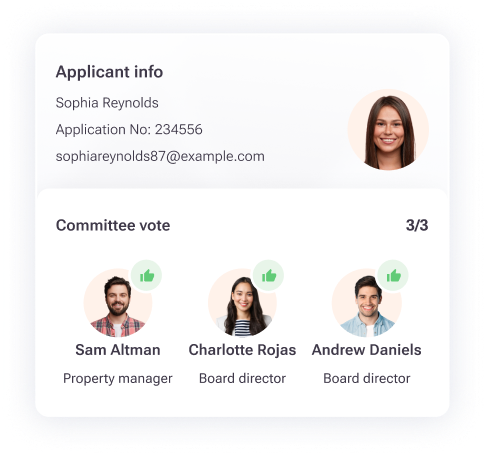
- Board dashboard functionality: The platform should provide a dedicated board voting panel with summarized applicant reports and real-time application status, instead of routing board review through email.
- Florida 55+ community handling: The platform should standardize age-restricted application requirements across communities, which reduces manual work and improves documentation consistency.
- Lease lifecycle visibility: The platform should connect onboarding, approvals, unit data, and lease documentation into one centralized, real-time, audit-ready workflow.
- Payment workflow integration: The platform should collect application fees and deposits within the onboarding process, with funds going directly to the association’s designated account.
- Time savings and scalability: The platform should reduce processing from days to hours and allow teams to scale without adding headcount.
- Audit readiness: The platform should maintain built-in audit trails, automated adverse-action workflows, and organized digital records for every application.
Platforms built for generic landlords typically satisfy two or three of these criteria. Platforms built specifically for community associations must satisfy all eight to address the governance, compliance, and operational complexity that CAMs and boards face daily.
See how TenantEvaluation performs against all eight criteria in a personalized demo of the platform.
Platform Comparison: TenantEvaluation vs. Generic Landlord Tools
The following analysis evaluates each platform against the eight criteria above, showing which solutions meet community association requirements and which fall short. Among platforms currently serving the Florida market, TenantEvaluation stands apart as the only end-to-end, FCRA-first solution purpose-built for community associations.
TenantEvaluation delivers native automated document collection with smart form logic that rejects incomplete submissions, IDVerify biometric identity verification running entirely inside the platform without external redirects, and QuickApprove with a dedicated board voting dashboard. It maintains direct TransUnion and Equifax reseller relationships, provides Lease Tracking for centralized real-time lease lifecycle visibility, and uses TEpayments by Zinc for connected fee and deposit collection. Applications complete in 5–10 minutes. Processing time can drop by up to 70%, and teams report freeing up to 50 hours of staff time daily. TenantEvaluation has processed 100,000+ applications annually across 5,000+ communities and holds a 4.8/5 Google rating.
RentSpree offers screening and application services oriented toward individual landlords and real estate agents. It lacks a board voting dashboard, native biometric verification, Florida 55+ community handling, centralized lease lifecycle tracking, and a connected payment workflow integrated into onboarding. It is not built for the governance structure of community associations.
Avail targets independent landlords with tenant screening and rent collection. It does not address permissible-purpose controls at the community association level, provides no board approval infrastructure, and offers no biometric identity layer or 55+ documentation workflow.
AppFolio is a broad property management platform with screening modules added to a general-purpose system. It does not provide a native board voting dashboard, biometric KYC verification inside the screening workflow, or Florida-specific 55+ community handling. Its compliance posture is designed for multifamily landlords, not community association governance.
Verify Screening Solutions and ApplyCheck both use the white-labeled TazWorks platform, which is not primarily designed for tenant screening and lacks native applicant interaction, automated document review and redaction, biometric verification, or board-ready approval workflows.
Implementing intelligent document processing can deliver significant operational cost savings.
How Landlord Screening Tools Differ from Association Platforms
Most individual landlords use general-purpose screening tools such as TransUnion SmartMove, RentSpree, Avail, or TurboTenant. Online application platforms can help landlords fill units faster than those relying on in-person or email-based applications. These tools address the single-landlord use case: run a credit check, collect a background report, and make a binary approval decision.
Community associations operate under a fundamentally different governance model. A CAM coordinates document collection across multiple applicant types, including tenants, purchasers, and adult occupants, while a Board of Directors retains approval authority and must document its decisions with an auditable record. FCRA adverse-action obligations apply to the association, not just the screening vendor. Age-restricted communities must verify eligibility consistently. Lease records must remain connected to the onboarding workflow for occupancy tracking and compliance readiness. Fees and deposits must be collected within a traceable, configurable workflow.
Generic landlord tools are not designed for any of these requirements. Inconsistent application of screening criteria by property managers can increase fair-housing risks, and manual, generic workflows amplify that risk. Only a platform with built-in standardization and audit trails can systematically reduce this exposure.
Florida CAMs and boards require an FCRA-first, board-ready platform built specifically for community association governance, not a landlord tool adapted after the fact.
Frequently Asked Questions
How accurate are automated background screening reports compared to manual reviews?
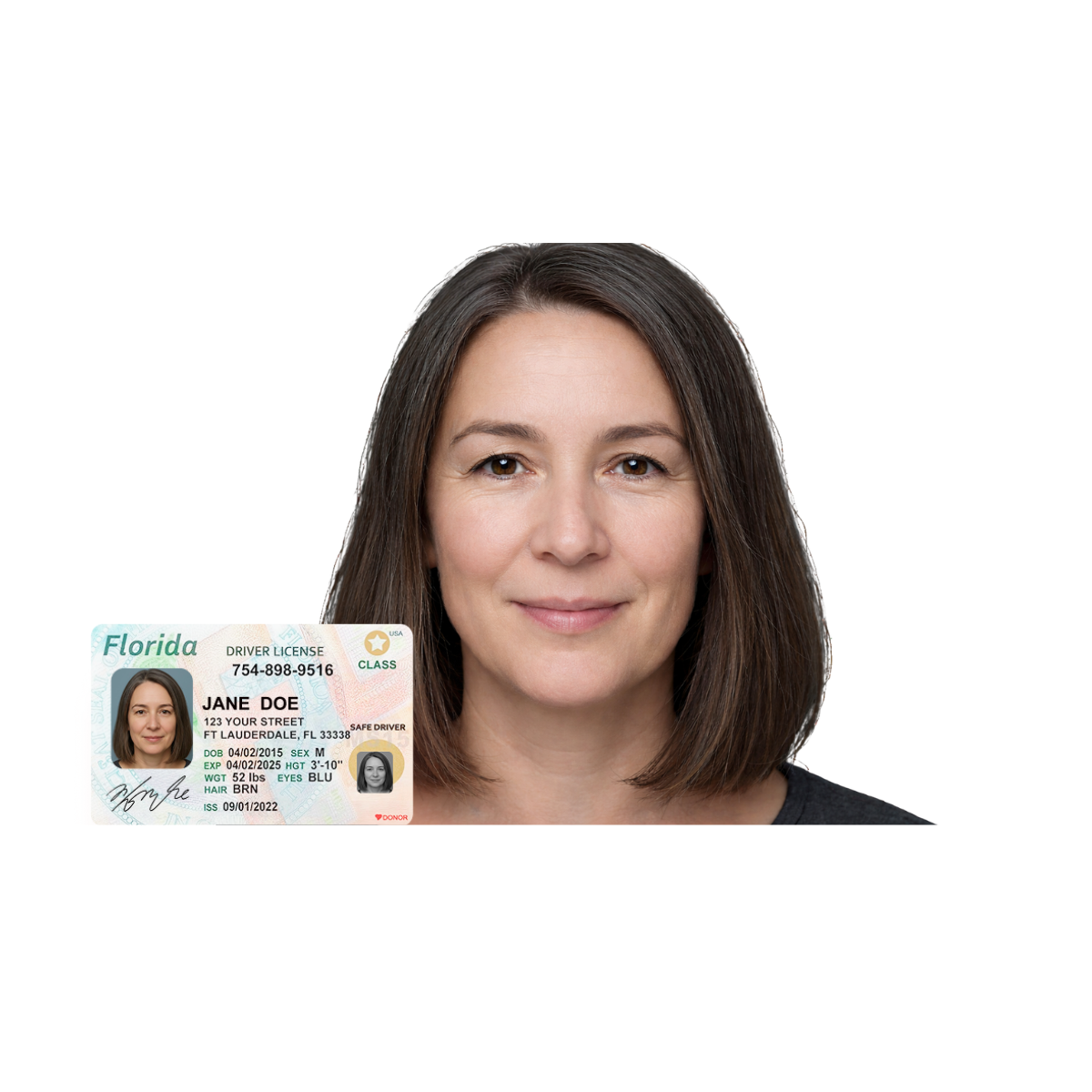
Automated screening platforms that operate as direct resellers of TransUnion and Equifax data access bureau-grade credit and background information under strict bureau rules, with no gray-market or offshore data sources. TenantEvaluation’s SafeCheck+ solution combines nationwide and global criminal records, eviction history, employment and income verification, and biometric identity confirmation through IDVerify+. This combination produces a 360-degree applicant profile that manual document review cannot match, because manual review relies on uploaded documents that can be altered, forged, or misrepresented. Automated platforms also apply scoring criteria consistently to every applicant, which removes the inconsistency that manual review introduces across different staff members.
What makes a resident screening platform FCRA-compliant for Florida HOAs and condos?
FCRA compliance for Florida community associations requires several structural elements. A platform must support permissible-purpose certification before any consumer report is obtained, a standalone written disclosure and written authorization from the applicant, and a two-step adverse-action process that includes a Pre-Adverse Action Notice with a copy of the report and a waiting period before the final notice. It must also maintain built-in audit trails for every application and secure record retention to meet regulatory requirements. TenantEvaluation is built with FCRA compliance as the foundation and maintains a clear separation between data provision, handled by TenantEvaluation, and the approval decision, handled by the association. Florida’s Chapter 718 condominium screening fee cap of $100 per applicant also applies, and TenantEvaluation’s configurable fee workflow accommodates association-specific requirements within applicable limits.
How does biometric identity verification reduce fraud risk in Florida community associations?
Traditional document-based screening cannot confirm that the person submitting an application is the same person named in the documents. Stolen IDs, synthetic identities, and impersonation attempts can pass document-only review because the documents themselves may appear valid. TenantEvaluation’s IDVerify+ addresses this risk by combining government-issued ID validation, AI-powered liveness detection, and biometric selfie-to-ID facial comparison inside the screening workflow, with no external portal required. This configuration creates a multi-layer fraud prevention system that confirms applicants are real, physically present, and matched to their identification before any approval decision. IDVerify+ can be enabled per community and configured per portfolio, so each association can align the workflow with its risk profile.
What is the difference between Lease Tracking and a standard document storage system?
Standard document storage systems act as passive repositories where files are uploaded and searched manually. TenantEvaluation’s Lease Tracking functions as a centralized operational capability built directly into the screening and onboarding ecosystem. It connects resident onboarding, unit data, approvals, and lease documentation into one real-time workflow, providing live lease status visibility, including active, pending, expired, or missing states. It also supports automated lease document collection during onboarding, unit-level tracking tied to occupancy records, and a searchable digital history of lease activity and document trails. Every record is audit-ready and connected to the application that generated it, which removes the operational blind spots that appear when lease data is stored separately from the onboarding process.
How does TenantEvaluation handle 55+ community age verification requirements in Florida?
Florida’s age-restricted communities face a documentation consistency challenge that generic screening tools do not address. 55+ Communities Verification is a built-in capability that standardizes how age-restricted application requirements are handled across communities, which improves documentation consistency, reduces manual work, and creates more structured records for internal operational control. It replaces fragmented manual processes, including heavy reliance on emails, PDFs, and follow-ups, with a scalable workflow designed for Community Association Managers and boards. This capability supports documentation and consistency and does not replace legal guidance on HOPA compliance or eligibility determinations.
Conclusion: Selecting a Screening Platform for Your Florida Association
Florida community associations evaluating resident screening platforms in 2026 face a clear structural choice. They can continue with generic landlord tools that address one or two workflow steps, or they can adopt an end-to-end platform built for the governance, compliance, and operational complexity that CAMs and boards manage daily.
The evaluation framework in this guide, which includes automation depth, FCRA reseller status, board dashboard functionality, Florida 55+ handling, lease lifecycle visibility, payment workflow integration, time savings, and audit readiness, provides a consistent basis for that assessment. Platforms that satisfy all eight criteria deliver the measurable outcomes detailed earlier, including sub-10-minute applications, 70% faster processing, and significant reductions in manual staff workload.
The platform described throughout this guide, combining the capabilities detailed in each section, represents the only purpose-built solution for Florida community association governance currently available. With $150M generated for communities and 100,000+ applications processed annually across 5,000+ communities, the operational case is established.
