Written by: Luis Teran, Co-founder, CEO, TenantEvaluation
Key Takeaways for CAMs and Boards
- Effective lease tracking for community associations requires real-time unit-level status, automated document collection, and board-ready dashboards that replace manual spreadsheets.
- Generic property management tools miss HOA needs because they lack governance workflows, board voting dashboards, and a direct link between screening and lease records.
- TenantEvaluation delivers centralized, real-time lease lifecycle control that connects applications, approvals, and executed leases in one platform built for Florida CAMs and boards.
- Florida’s 2025–2026 regulatory updates raise recordkeeping standards, so audit-ready digital lease records and searchable document trails now support compliance.
- Compare your current lease processes against these capabilities and schedule a demo at TenantEvaluation to evaluate a purpose-built solution for your association.
Lease Tracking Platforms Built for Community Associations
The strongest lease tracking software for community associations is built around HOA and condo governance workflows, not repurposed from commercial or single-family landlord tools. This decision framework evaluates platforms on four criteria: HOA and condo specialization, real-time lease visibility, board dashboard capability, and integration with resident screening and approvals.
TenantEvaluation ranks first under this framework. Its Lease Tracking capability delivers centralized, real-time lease visibility and lifecycle control from application through occupancy, all inside the same platform used for screening, QuickApprove accelerated approvals, and document collection. With 5,000+ communities and approximately 100,000 applications processed annually, TenantEvaluation is purpose-built for Florida CAMs, property managers, and boards, not retrofitted from a generic rental tool.

Schedule a demo today and see TenantEvaluation Lease Tracking in action.
Why Generic Lease Management Software Fails HOAs
Generic property management platforms focus on landlord-tenant relationships instead of community association governance. They rarely include board voting dashboards, HOA-specific document workflows, or a direct connection between a resident’s application and the lease record that follows approval. These gaps create operational blind spots such as missing lease copies across folders and inboxes, manual expiration tracking in disconnected spreadsheets, and no reliable way to confirm occupancy status at a specific moment.
HOA boards and property managers face significant administrative burden tracking rental percentages, maintaining waitlists, and verifying compliance consistently, tasks that generic tools were never designed to support at the association level. TenantEvaluation Lease Tracking reduces manual follow-ups, spreadsheets, and scattered email chains by connecting every step of the lease lifecycle inside one platform built exclusively for community associations.
Real-Time Lease Visibility for Every Unit
Real-time lease status visibility forms the operational foundation of effective community association management. Without this visibility, CAMs cannot confirm whether a unit is legally occupied, boards cannot enforce rental caps, and compliance reviews stay reactive instead of proactive.
TenantEvaluation Lease Tracking provides real-time lease status at the unit level, including active, pending, expired, or missing, so every stakeholder sees the same current picture. Without this visibility, enforcement of rental caps is complicated by informal or unreported rentals and short-term rental platforms, which create monitoring gaps that manual tracking cannot close. Real-time lease status closes these gaps, so follow-up is triggered by data instead of memory or manual calendar reminders.
Automated Lease Document Collection During Onboarding
Automated lease document collection removes one of the highest-friction steps in community association onboarding. When documents arrive through disconnected channels, associations face incomplete records, delayed move-ins, and compliance gaps that often surface during disputes.
Manual document collection is one of the most time-consuming steps in community association onboarding. Managers request executed leases by email, follow up repeatedly, and store received files across shared drives with inconsistent naming conventions. TenantEvaluation automates lease document collection as part of the resident onboarding workflow, requires submission before the application advances, validates document completeness through smart form logic, and stores the executed lease directly inside the unit’s digital record. The result is audit-ready digital lease records from day one, with no separate filing step required.
Board Dashboards and Audit Trails for Florida Governance
Florida law is raising the bar for association recordkeeping and owner access to records. Under Florida Statute 718.111(12)(g), condominium associations with 25 or more units must operate an official website or secure member portal effective January 1, 2026, providing owner access to governing documents, budgets, financial reports, meeting notices, agendas, at least 12 months of meeting minutes, active contracts, and more. Under Florida Statute 720.303(4), HOAs with 100 or more parcels face records requirements.
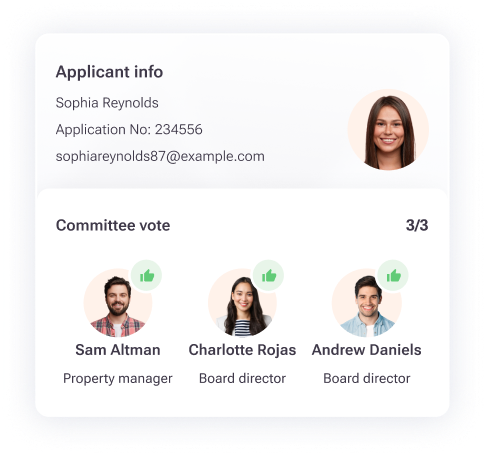
TenantEvaluation’s board-ready dashboards give board members direct visibility into lease status, occupancy records, and document trails without asking a CAM to assemble reports. Every action inside the platform is timestamped and auditable, which supports the organized digital records that association governance increasingly demands. This capability is built into the same workflow used for applications and approvals, not added later as a separate reporting tool.
Integration with Screening and Approvals
Workflow integration becomes critical when evaluating how lease tracking connects to the steps that precede it. The most significant gap in generic lease tracking tools is the absence of any connection between a resident’s application and the lease that follows.
TenantEvaluation closes that gap by connecting resident onboarding, unit data, approvals, and lease documentation into one streamlined workflow from application through occupancy. When an application is approved through QuickApprove, the lease record is initiated in the same platform. When IDVerify confirms applicant identity biometrically, that verification becomes part of the same audit trail as the executed lease. No data migration, no duplicate entry, and no disconnected systems.

Replacing Spreadsheets and Email Chains with a Single System
Replacing spreadsheets and email chains with a centralized system reduces operational risk for community associations. Spreadsheet-based tracking often leads to missed expiration dates, lost executed copies, and occupancy status that cannot be confirmed without manual cross-referencing.
Spreadsheets and email chains are the default lease management infrastructure for many community associations, and both create compounding operational risk. Lease expiration dates are missed, executed copies are lost in inboxes, and occupancy status remains uncertain until someone manually checks multiple sources. Florida Statute 720.3033 requires new HOA directors to complete education covering recordkeeping within 90 days of election, which spreadsheet-based systems cannot reliably support at scale.
By centralizing every lease record, status update, and document trail inside one searchable platform, TenantEvaluation eliminates the operational friction described earlier. One Florida-based management company that moved its onboarding workflows to TenantEvaluation freed up 50 hours of staff time per day and cut processing time by 50%.
Florida HOA and Condo Compliance Readiness
Florida’s 2025–2026 legislative updates materially increase documentation and recordkeeping obligations for community associations. Florida House Bill 913, effective July 1, 2025, updates requirements for community associations. Florida’s updated flood disclosure statutes, effective October 1, 2025, require residential landlords, including condominium unit owners acting as landlords, to provide specific flood risk disclosures before or at the time of lease execution.
TenantEvaluation’s audit-ready digital lease records and searchable document history support the organized, accessible recordkeeping that these requirements call for. TenantEvaluation does not provide legal advice and does not guarantee compliance outcomes. Associations should consult qualified legal counsel for guidance on specific statutory obligations.
How HOA Lease Tracking Differs from Landlord Tracking
HOA and condo lease tracking operates in a governance environment that differs from landlord portfolios. Landlord lease tracking centers on rent collection, maintenance scheduling, and tenant communication for properties the landlord owns directly.
In community associations, the association does not own the units, board approval is required before occupancy, rental caps and waitlists must be enforced, and lease records must be accessible to multiple stakeholders including boards, CAMs, and auditors. Professional community association management companies support boards by tracking owner-occupancy and lease status, maintaining compliant waiting lists, and ensuring fair uniform enforcement to reduce risk of disputes and compliance errors, a workflow that no landlord-focused tool is designed to support. TenantEvaluation is built for this governance model, not adapted from it.
Comparing TenantEvaluation with AppFolio, Buildium, and Yardi
| Capability | TenantEvaluation | AppFolio | Buildium | Yardi / Re-Leased |
|---|---|---|---|---|
| Built for HOA/condo governance | Yes, purpose-built for community associations | No, designed for landlord and rental portfolios | Partial, rental-first with some HOA features | No, commercial and multifamily focus |
| Real-time lease status (active/pending/expired/missing) | Yes, unit-level and real-time inside one platform | Lease tracking available, not HOA-governance-specific | Lease tracking available, limited HOA workflow integration | Lease tracking available, not designed for association governance |
| Board voting dashboard | Yes, dedicated board review and voting panel | Not available | Not available | Not available |
| Connected from application to active lease | Yes, screening, approval, and lease record in one workflow | Screening and leasing available, not HOA-connected | Screening and leasing available, limited HOA connection | Lease management available, no HOA onboarding connection |
| Florida-specific compliance workflows | Yes, built for Florida CAMs, condos, and HOAs | Not Florida-specific | Not Florida-specific | Not Florida-specific |
| Biometric identity verification | Yes, IDVerify+ native to platform | Not available natively | Not available natively | Not available natively |
| Revenue model | Pay-per-application, no upfront fees, revenue-sharing | Monthly subscription | Monthly subscription | Monthly subscription or enterprise pricing |
Platform capability descriptions for AppFolio, Buildium, Yardi, and Re-Leased are based on publicly available product documentation and are subject to change. TenantEvaluation’s capabilities reflect its current platform.
Key Takeaways for CAMs and Boards in 2026
The decision framework for lease tracking software in community associations centers on one structural question. Is the platform built for HOA and condo governance, or adapted from a landlord or commercial real estate tool? Generic platforms often recreate the same operational blind spots they are meant to solve, including disconnected records, manual expiration tracking, and no clear path from application to active lease.
TenantEvaluation delivers centralized, real-time lease visibility and lifecycle control across the entire process, from application through occupancy. It reduces manual follow-ups, spreadsheets, and scattered email chains while maintaining audit-ready digital lease records that support the recordkeeping standards Florida associations now face. For CAMs and boards managing Florida condos and HOAs in 2026, that level of control represents the operational baseline, not a premium feature.
How to Evaluate Your Current Lease Processes
Evaluate your current lease management workflow against the capability framework outlined above. If your team cannot confirm real-time lease status for every unit, retrieve an executed lease in under a minute, or show a board member an audit trail without assembling it manually, your current process carries measurable staff time costs, compliance exposure, and operational risk.
TenantEvaluation Lease Tracking is available for Florida community associations and management companies of all sizes, from self-managed communities to enterprise portfolios managing thousands of units across multiple properties.
Schedule a demo today and evaluate TenantEvaluation Lease Tracking against your current workflow.
Frequently Asked Questions
What makes lease tracking for community associations different from standard property management lease tracking?
Community association lease tracking operates within a governance structure that standard property management tools do not address. In an HOA or condo, the association does not own the units, enforces governing documents, approves tenants through a board process, and must maintain records accessible to CAMs, board members, and auditors. Lease tracking must therefore connect to approval workflows, board dashboards, rental cap enforcement, and occupancy verification in ways that landlord-focused platforms do not support. TenantEvaluation is built specifically for this governance model and connects resident onboarding, unit data, approvals, and lease documentation into one centralized, real-time workflow.
How does TenantEvaluation Lease Tracking connect to the resident screening and approval process?
TenantEvaluation Lease Tracking operates inside the same platform used for resident screening, identity verification through IDVerify+, and accelerated approvals through QuickApprove. When an application is submitted, document collection, including the executed lease, becomes part of the onboarding workflow. When the board approves an applicant, the lease record starts in the same system. No data migration, no duplicate entry, and no disconnected handoff between systems occur. Every step from application submission through occupancy remains tracked, searchable, and audit-ready inside one platform.
What Florida regulatory changes in 2025–2026 affect how community associations must manage lease records?
Several Florida statutory updates have raised the bar for association recordkeeping, as detailed in the compliance section above. These include the January 1, 2026 website and portal requirements for condos with 25 or more units, HOA records requirements for associations with 100 or more parcels, House Bill 913’s recordkeeping updates, and new flood disclosure obligations for landlords. TenantEvaluation’s audit-ready digital lease records and searchable document history support the organized recordkeeping these requirements call for. Associations should consult qualified legal counsel for guidance on their specific statutory obligations.
Can TenantEvaluation Lease Tracking support large management companies with multiple community portfolios?
Yes. TenantEvaluation currently serves 5,000+ communities and processes approximately 100,000 applications per year, supporting portfolios that range from self-managed communities to enterprise-level management companies. Lease Tracking is designed to scale without adding operational complexity. Centralized records, unit-level tracking, and searchable digital history mean that higher onboarding volume does not require additional headcount or additional systems. Management companies including RealManage, FirstService Residential, Castle Group, and Campbell Property Management use TenantEvaluation across their portfolios.
What is the difference between TenantEvaluation and platforms like AppFolio or Buildium for HOA lease management?
AppFolio and Buildium are designed primarily for landlord and rental portfolio management. They offer lease tracking and tenant screening features, but neither platform includes a dedicated board voting dashboard, Florida-specific HOA compliance workflows, or a direct connection between a resident’s application and the active lease record that follows approval. TenantEvaluation is purpose-built for community associations, and its Lease Tracking capability operates inside the same ecosystem as screening, biometric identity verification, board approvals, and document collection. For Florida CAMs and boards, that specialization creates a practical difference between a tool adapted for HOA use and one built for it from the ground up.
