Written by: Luis Teran, Co-founder, CEO, TenantEvaluation | Last updated: July 21, 2026
Key Takeaways for Florida Community Associations
- Florida HOAs and condos face rising synthetic-identity fraud and new state laws like HB 1293, so document-only screening no longer provides sufficient compliance or liability protection.
- Native KYC with biometric verification (ID validation, liveness detection, and facial matching) keeps applicants inside one workflow, preserves audit trails, and reduces drop-off compared to bolt-on tools.
- Traditional tenant screening covers credit and background checks, while KYC adds physical identity confirmation so the applicant is proven to be the person they claim to be.
- Only platforms purpose-built for Florida community associations combine native biometric KYC, board-ready approval workflows, integrated lease tracking, 55+ standardization, and direct FCRA reseller status in a single workflow.
- TenantEvaluation is the only platform that meets all five criteria for Florida HOAs and condos; schedule a demo today to modernize your screening process.
How the 4 Pillars of KYC Map to HOA and Condo Onboarding
KYC, or Know Your Customer, is a structured identity and risk verification framework originally developed for financial institutions under the Bank Secrecy Act and enforced by FinCEN. In condo and HOA resident onboarding, the four pillars translate into clear operational requirements.
- Customer Identification: The platform collects and verifies government-issued identification, date of birth, address, and a unique identifier such as a Social Security number. In community association onboarding, this occurs during application intake when ID documents and personal data are gathered from every adult occupant.
- Customer Due Diligence (CDD): The platform assesses the risk profile of each applicant through background checks, credit review, income verification, and sanctions screening. The CDD Rule also requires identifying beneficial ownership for entities owning 25% or more of a legal entity, which applies when a corporate entity holds a unit.
- Ongoing Monitoring: The association tracks changes in a resident’s risk profile over time. In a lease lifecycle context, this includes lease renewal reviews, occupancy changes, and re-verification triggers when material changes occur.
- Recordkeeping: The platform maintains auditable records of every verification step. U.S. BSA regulations generally require customer identification and transaction records to be retained for at least five years.
The most meaningful distinction for platform selection is whether KYC verification runs natively inside the screening workflow or forces applicants into a third-party portal. Native biometric verification preserves workflow continuity, reduces applicant drop-off, and keeps all verification results inside a single audit trail. Third-party bolt-ons fragment the record and create handoff points where fraud can slip through undetected.
Tenant Screening vs. KYC for Property Managers
Traditional tenant screening and KYC overlap but do not solve the same problem. Tenant screening typically covers credit history, criminal background, eviction records, and income verification. KYC adds the missing layer of confirming that the person submitting the application is physically the person they claim to be.
The gap between these approaches now carries real operational risk. A 2024 National Multifamily Housing Council Survey found that 93.3% of owners, managers, and developers had experienced rental application fraud in the last 12 months, including 70% who encountered fraudulent identity information.
Florida’s legislative response is direct. Florida HB 1293, effective October 1, 2026, creates the criminal offense of fraudulent entry of a residential dwelling unit, covering materially false identity statements, forged documents, impersonation, and use of synthetic or stolen identities. Lawmakers passed HB 1293 in response to rising fraud involving fake pay stubs, altered identification, and online document-forging services.
For CAMs and board members, document-only screening no longer provides adequate protection against liability or fraud. AI-assisted document forgery rose from 0% to 2% of detected fakes in one year, and sophisticated multi-step fraud attacks grew 180% year-over-year according to the Sumsub Identity Fraud Report 2025–2026. Visual inspection of uploaded documents no longer functions as a reliable fraud control. This gap between the fraud landscape and traditional screening methods has accelerated the move toward biometric identity verification as the next generation of resident onboarding technology.
Biometric Identity Verification Inside Property Management Software
Community association screening workflows often fail for structural reasons rather than procedural ones. Incomplete applications, missing lease copies, fragmented email chains, and lack of real-time visibility signal that the platform was not designed for the governance complexity of HOAs and condominiums.
Biometric identity verification closes the identity confirmation gap directly. Biometric 1:1 face matching verifies that the person presenting a selfie during onboarding is the same individual pictured on their government-issued ID, while document-only verification confirms only that the document itself is genuine without linking it to the presenter.
Liveness detection closes a second gap. A legitimate document can still be used fraudulently via someone else’s passport, a high-quality photograph held to a camera, or a deepfake video on a second screen, which can pass document verification but fail liveness detection.
Emerging best practices for 2026 combine several layers:
- Government ID authenticity validation using AI document authentication
- AI-powered liveness detection to confirm physical presence
- Biometric facial matching linking the applicant’s face to the ID photo
- Centralized lease lifecycle records connected to the approval workflow
- Standardized documentation handling for 55+ age-restricted communities
Physical biometrics reached 45% adoption among organizations in the 2026 ACFE/SAS Anti-Fraud Technology Benchmarking Report, up from 34% in 2022, making it the most widely adopted emerging anti-fraud technology. Platforms without native biometric verification now operate behind the current adoption curve.
Compliance Requirements for KYC in Florida Community Associations
Florida community associations operate in a layered compliance environment. Florida condominium associations are governed by Florida Statute Chapter 718, while HOAs are governed by Chapter 720. Both frameworks require documented application processes, identity verification, and background check authorization from every adult occupant.
The Fair Credit Reporting Act (FCRA) governs how consumer report data is collected, used, and disclosed. Key compliance requirements for any platform used in community association screening work together as a single compliance architecture. At the foundation, permissible purpose controls ensure that background checks run only with documented applicant consent and a permissible purpose, and the platform must enforce this at the workflow level rather than relying on manual steps.
When screening results contribute to a denial, adverse action workflows become critical. The association must follow FCRA-mandated adverse action procedures, including pre-adverse action notice and the applicant’s right to dispute. Throughout this process, separation of roles must remain clear. The FCRA draws a line between data providers and decision-makers, where the platform provides screening data and the association makes the approval decision, and platforms that blur this line create liability exposure.
Supporting these requirements, audit trails must capture every verification step, document submission, board vote, and communication with timestamps and retrievability. Florida HB 913 amends Fla. Stat. §718.128 to remove the prior 14-day written notice requirement for condominium associations adopting online voting procedures. Data retention then closes the loop. As noted in the KYC framework above, BSA regulations mandate minimum five-year retention of customer identification records so the entire compliance chain remains auditable over time.
Platforms that operate as legitimate resellers of TransUnion and Equifax data, rather than third-party scrapers, provide stronger compliance positioning because data is accessed under strict bureau rules with regular compliance reviews and audits.
Evaluation Framework for Florida-Focused Property Management Platforms
CAMs and board members benefit from a consistent evaluation framework instead of relying on feature lists alone. The following criteria reflect the operational and compliance requirements specific to Florida community associations:
- Native vs. integrated KYC: Biometric verification should run inside the platform instead of redirecting applicants to a third-party portal, which preserves audit continuity and reduces applicant drop-off.
- Board dashboard access: The platform should provide a dedicated review and voting panel for board members instead of relying on email chains for approvals.
- Florida-specific workflow support: The configuration should align with Chapter 718 and Chapter 720 requirements rather than adapting a generic rental tool for HOA use.
- Time-to-decision: The platform should measurably reduce approval cycles and provide real-time tracking for all parties.
- Auditability: All verification steps, board votes, and communications should be timestamped and exportable for compliance review.
- 55+ community standardization: The platform should include built-in handling for age-restricted application requirements instead of relying on manual processes.
- Lease lifecycle visibility: Applications, approvals, and lease documentation should connect into one centralized workflow rather than separating lease management.
- FCRA reseller status: The platform should act as a direct reseller of bureau data with documented permissible purpose controls and adverse action automation.
Top Property Management Platforms with Built-in KYC Screening
The table below scores five platforms against the evaluation criteria most relevant to Florida community associations. Scores reflect publicly available feature documentation and platform positioning as of July 2026.
| Platform | Native KYC Depth | Board-Ready Approval Workflow | Lease Tracking Integration | 55+ Community Standardization | FCRA Reseller Status |
|---|---|---|---|---|---|
| TenantEvaluation | Native biometric IDVerify+ with liveness detection, facial matching, and government ID validation inside one workflow | Dedicated board voting panel with real-time tracking and QuickApprove accelerated workflow | Centralized real-time lease lifecycle control from application to occupancy | Built-in 55+ Communities Verification with standardized documentation handling | Direct TransUnion and Equifax reseller with built-in adverse action automation |
| AppFolio | Third-party screening integrations, no native biometric verification layer | General approval workflows, no dedicated board voting panel | Lease management available, not natively connected to screening workflow | No built-in 55+ standardization capability | Screening via third-party providers |
| Buildium | Background screening available, no native KYC or biometric verification | No dedicated board review or voting panel | Lease tracking available, separate from onboarding workflow | No built-in 55+ standardization capability | Screening via third-party providers |
| ApplyCheck | Background checks via TazWorks platform, no native biometric KYC | No board-specific approval dashboard | No integrated lease lifecycle tracking | No built-in 55+ standardization capability | Not positioned as direct bureau reseller |
| Verify Screening Solutions | Background checks via TazWorks platform, no native biometric KYC | No board-specific approval dashboard | No integrated lease lifecycle tracking | No built-in 55+ standardization capability | Not positioned as direct bureau reseller |
Best for Florida Condos & HOAs filter: Only TenantEvaluation satisfies all five criteria simultaneously, including native biometric KYC, board-ready approval workflow, integrated lease tracking, 55+ community standardization, and direct FCRA reseller status, within a single platform purpose-built for community associations.
How TenantEvaluation’s IDVerify+ Delivers Native KYC
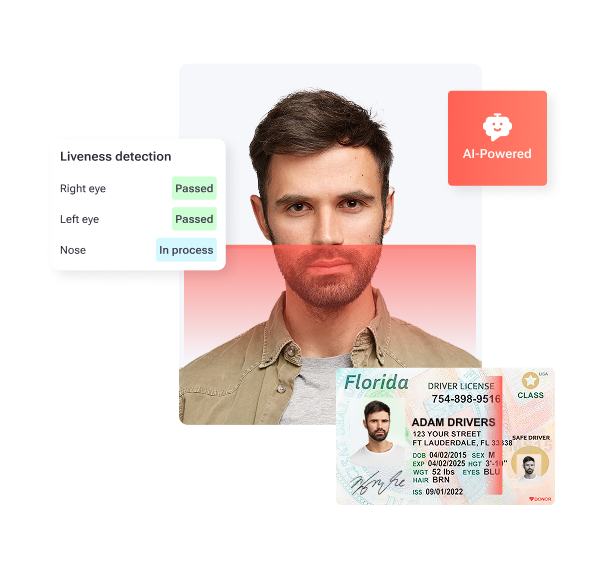
IDVerify+ is TenantEvaluation’s biometric identity verification layer, embedded directly into the resident screening workflow. It validates government-issued ID authenticity, confirms physical presence through AI-powered liveness detection, and performs biometric facial matching between the applicant’s selfie and their ID photo, all inside one platform without redirecting applicants to an external portal.
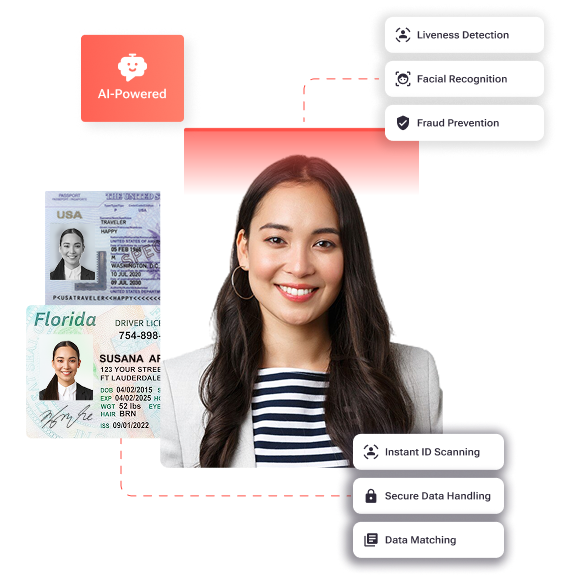
This architecture matters because effective PropTech implementations embed identity verification directly into the existing tenant application flow so applicants do not need to download a separate app or visit an office, and the verification result feeds directly into the approval workflow alongside credit and background check data.
CAMs see IDVerify+ results inside the screening report, including ID authenticity confirmation, liveness verification status, biometric match result, and a redacted ID copy for compliance documentation. IDVerify+ can be enabled per condo or HOA, configured per property portfolio, and adapted to each community’s risk profile. This shift moves communities from document-based review to biometric-confirmed identity verification, which document checks alone cannot achieve because they cannot reliably detect false documents or genuine IDs used by the wrong person.
Faster Board Decisions with QuickApprove
QuickApprove is TenantEvaluation’s accelerated approval workflow for CAMs, boards, and property management teams inside one connected platform. It replaces email chains, spreadsheets, and disconnected follow-ups with real-time application tracking, automated communication support, customized approval letters, a personalized welcome package, and a board-ready voting panel, while preserving control, compliance, and visibility.
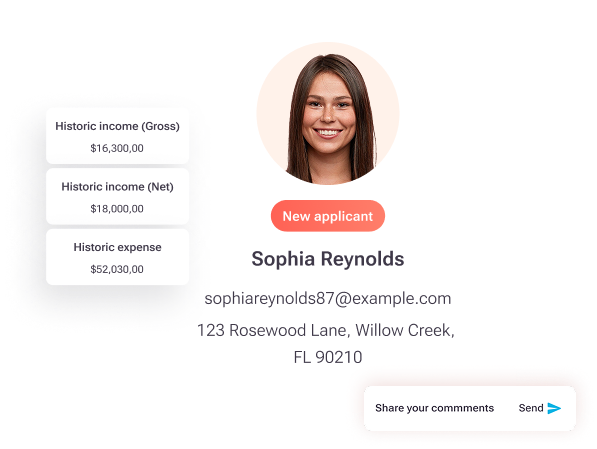
The board-ready approval process creates a clear differentiator. Board members access a dedicated panel with summarized applicant reports and a structured voting workflow. Managers track application progress in real time and trigger automated communications at each stage. This design proves especially helpful during high-volume application seasons and in communities with complex onboarding requirements, where manual processes create the most bottlenecks.
QuickApprove accelerates resident approvals while maintaining the full compliance and oversight structure that Florida community associations require. It keeps approvals faster, clearer, more consistent, and easier to manage, and it reduces manual follow-ups without removing board oversight or bypassing screening due diligence.
55+ Communities Verification and Centralized Lease Tracking
55+ Communities Verification is a built-in capability within TenantEvaluation that helps Florida condos and HOAs standardize how age-restricted requirements are handled across applications. It reduces manual work, supports documentation consistency, and improves operational efficiency for community operations teams managing age-restricted communities. Unlike generic tools, this capability aligns with the real workflows of Florida associations and supports Community Association Managers and boards that need a consistent and scalable way to handle 55+ application requirements without relying on fragmented emails, PDFs, and manual follow-ups.
Lease Tracking is TenantEvaluation’s centralized, real-time lease visibility and lifecycle control capability. It connects resident onboarding, unit data, approvals, and lease documentation into one audit-ready workflow from application submission through occupancy. CAMs, property management teams, boards, and community operations teams use Lease Tracking to:
- Access centralized lease records with real-time lease status (active, pending, expired, or missing)
- Automate lease document collection during onboarding
- Track leases at the unit level, connected to occupancy records
- Search a digital history of leases, resident activity, and document trails
- Maintain audit-ready digital lease records inside one connected platform
This structure replaces spreadsheets and scattered email chains, reduces manual follow-ups, and improves operational efficiency and compliance readiness across the full lease lifecycle.
Conclusion: How to Assess Your Current Screening Process
The evaluation framework in this guide gives you a structured way to compare your current screening process against the capabilities Florida community associations now require. Start by checking whether your current platform confirms biometric identity natively or relies on document uploads alone. Review how your board approves applications and whether members use a dedicated approval panel with real-time visibility or rely on email.
Next, look at your lease records and confirm whether they are centralized and connected to your onboarding workflow or scattered across folders and spreadsheets. Finally, review how your platform handles 55+ documentation and whether that process runs through standardized workflows or manual steps.
Platforms that address these needs with native capabilities, instead of third-party integrations or manual workarounds, reduce fraud risk, administrative burden, and board liability while accelerating approvals. TenantEvaluation is the only platform purpose-built for Florida community associations that combines all five criteria in one FCRA-compliant workflow.
Frequently Asked Questions
What is the difference between tenant screening and KYC for property managers?
Tenant screening typically covers credit history, criminal background, eviction records, and income verification. KYC adds identity confirmation by verifying that the person submitting the application is physically the person they claim to be, using government ID validation, biometric facial matching, and liveness detection. For Florida community associations, this distinction matters because document-only screening cannot reliably detect impersonation, synthetic identities, or AI-generated fraudulent documents. A platform with native KYC closes this gap by confirming identity before the screening report is generated, which also strengthens FCRA permissible-purpose documentation.
What are the 4 pillars of KYC and how do they apply to HOA and condo onboarding?
The four pillars of KYC, Customer Identification, Customer Due Diligence, Ongoing Monitoring, and Recordkeeping, are explained in detail earlier in this guide. For HOA and condo onboarding, the most operationally significant distinction is whether platforms handle all four pillars natively or fragment them across separate tools, which weakens the audit trail and overall compliance positioning.
Why is biometric identity verification more effective than document-only screening for community associations?
Document-only screening confirms that an uploaded ID appears genuine but cannot confirm that the person submitting it is the rightful owner. Biometric identity verification adds facial matching and liveness detection, which together confirm that a real, physically present person is completing the verification and that their face matches the ID photo. This closes the impersonation gap that document-only screening leaves open. For Florida community associations, this matters because AI-generated fraudulent documents have become increasingly difficult to detect through visual inspection alone, and Florida HB 1293, effective October 1, 2026, creates criminal liability for impersonation and synthetic identity fraud in residential applications. Biometric verification provides a defensible, audit-ready record that the association verified physical identity before approval.
How does TenantEvaluation support 55+ community compliance requirements in Florida?
TenantEvaluation’s 55+ Communities Verification is a built-in capability that standardizes how age-restricted application requirements are handled across applications for Florida condos and HOAs. It reduces manual work, improves documentation consistency, and strengthens internal operational controls for CAMs and boards managing age-restricted communities. The capability replaces fragmented manual processes, such as heavy reliance on emails, PDFs, and follow-ups, with a more structured and consistent workflow. It functions as a documentation-first onboarding solution and workflow standardization platform, not a legal verification system. TenantEvaluation recommends that communities continue to seek legal guidance on HOPA compliance requirements, while the platform supports the operational and documentation layer that surrounds those requirements.
What makes TenantEvaluation different from general property management software for Florida HOAs?
TenantEvaluation was built specifically for community associations and management companies in Florida, with FCRA compliance as the foundation rather than an afterthought. The platform combines native biometric identity verification through IDVerify+, an accelerated board-ready approval workflow through QuickApprove, built-in 55+ Communities Verification, and centralized real-time Lease Tracking, all inside one connected platform. It operates as a direct reseller of TransUnion and Equifax data, so screening data is accessed under strict bureau rules with regular compliance reviews and no gray-market sources. General property management platforms such as AppFolio, Buildium, ApplyCheck, and Verify Screening Solutions do not combine native KYC, a dedicated board voting panel, integrated lease lifecycle tracking, and 55+ standardization in a single FCRA-compliant workflow designed for Florida community associations. TenantEvaluation has processed over 100,000 applications annually across 5,000+ communities and has generated $150 million for those communities through its revenue-sharing model.
