Written by: Luis Teran, Co-founder, CEO, TenantEvaluation | Last updated: August 8, 2026
Key Takeaways for Florida CAMs
- Identity verification now sits at the center of Florida CAM operations because of rising synthetic-identity fraud and tighter FCRA rules.
- Generic KYC tools miss key needs such as FCRA workflows, board-ready dashboards, and Florida-specific association processes.
- Biometric verification with liveness detection and facial matching has become essential to confirm that applicants are who they claim to be.
- TenantEvaluation’s IDVerify combines native biometrics, automated adverse action workflows, and lease tracking in one association-focused platform.
- Learn more about streamlining community association screening and lease management at TenantEvaluation.
Key Identity and Compliance Terms for CAMs
Biometric verification confirms that the person presenting an identity document is its legitimate holder. It combines government-issued ID validation, AI-powered liveness detection, and facial biometric matching. This moves communities from document-only review to verified physical identity confirmation.
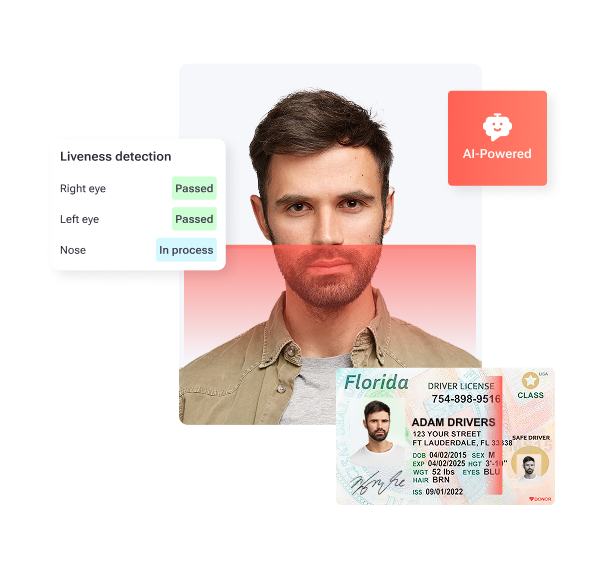
FCRA permissible purpose is the legal basis under the Fair Credit Reporting Act that authorizes a screening entity to obtain a consumer report. For community associations, this requires the applicant’s clear, written authorization before any credit, background, or eviction check is run.
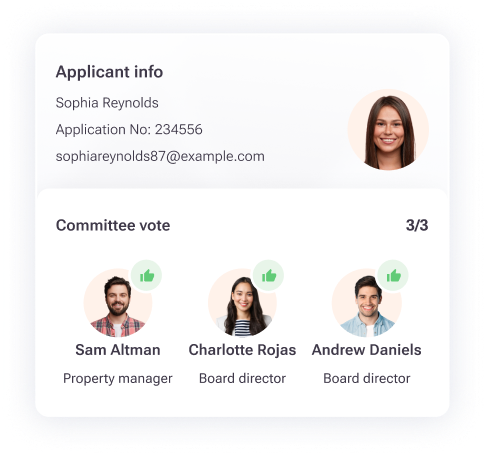
Board-ready dashboard refers to a dedicated review and voting panel that gives Board Members direct, real-time access to application status and summarized applicant reports. It also provides a structured approval workflow that replaces email chains and spreadsheets with a connected, auditable process inside a single platform.
Florida in 2026: Fraud Pressure and Board Liability
Synthetic identity fraud losses continue to grow, and regulators in the United States now expect stronger KYC controls than legacy manual and rules-based processes can deliver. Florida condominiums and HOAs face the same pressure. Fraudulent applicants using stolen or fabricated identities target communities through traditional document-based screening, which cannot reliably confirm that the person presenting an ID is its legitimate holder.
Board liability tracks directly with approval decisions. When an association approves a resident whose identity was never biometrically confirmed, the board accepts exposure that a proper verification layer could have reduced. Communities with higher risk profiles now treat the shift from document uploads to biometric confirmation as a required control, not a future upgrade.
Resident Onboarding Friction CAMs See Every Day
CAMs overseeing large portfolios encounter the same operational friction again and again:
- Manual ID review that relies on document image quality rather than biometric confirmation
- Email-chain approvals that create bottlenecks during peak application seasons
- Fragmented lease records stored across folders, inboxes, and disconnected spreadsheets
- Payment chasing through phone calls and emails when fees and deposits sit outside the onboarding workflow
- No centralized lease visibility, which makes occupancy confirmation slow and error-prone
- Incomplete applications that pass initial review because smart form logic is missing
These pain points extend approval cycles, increase administrative workload, and delay revenue from application fees. Beyond operational friction, they also create gaps that affect compliance and board oversight.
FCRA Rules Community Associations Must Follow
The CFPB’s FCRA compliance resource sets the federal rules that govern every consumer report used in housing decisions. For community associations, the core obligations include:
- Written applicant authorization, clear and conspicuous, and in some cases separate from the application itself, before any consumer report is obtained
- Permissible-purpose controls that restrict report access to authorized parties only
- Adverse action notices that identify the consumer reporting agency, state that the agency did not make the decision, and inform the applicant of their right to a free report copy within 60 days
- Audit trails documenting every step from consent through decision
- Data redaction and secure storage of sensitive personal identifiable information
Failure to send a compliant adverse action notice exposes associations to either actual damages or statutory damages of $100–$1,000 per incident, plus potential punitive damages and attorney fees, for willful noncompliance under the FCRA. TenantEvaluation acts as a direct reseller of TransUnion and Equifax data and uses automated adverse action workflows with built-in audit trails to help keep associations protected.
Structural Gaps That Slow Approvals and Add Risk
Three structural gaps account for most approval delays and compliance exposures in community association onboarding:
- Incomplete applications, where missing documents require manual follow-up and add days to the cycle
- Missing lease copies, which force managers to search across inboxes and folders to confirm occupancy status
- No real-time visibility, leaving boards and managers without a connected dashboard to highlight applications that need attention
Modern Identity Verification Standards for Associations
A strong automated KYC flow verifies document authenticity, human presence via liveness detection, face match between selfie and document portrait, and data consistency before routing to approval. These capabilities address fraud and efficiency gaps when they sit inside workflows that match how associations operate. For community associations, this now translates into four practical standards:
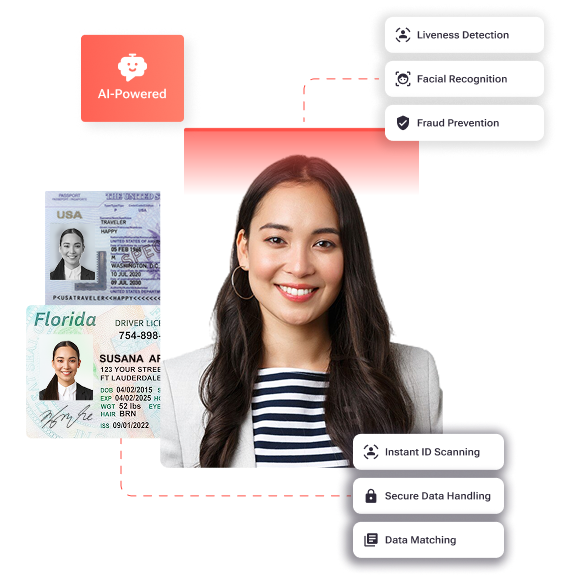
- Native biometric layers that run inside the screening workflow without redirecting applicants to external portals
- Board voting panels with timestamped, auditable decisions that replace email-based approvals
- Standardized 55+ documentation workflows that reduce manual handling of age-restricted application requirements
- Connected payment workflows that collect fees and deposits inside onboarding, with funds going directly to the association’s designated account
See these best practices in action during a TenantEvaluation demo and review how they work inside a single platform.
Six Criteria for Selecting an Identity Verification Platform
CAMs assessing identity verification platforms for large portfolios can use six clear criteria:
- Compliance readiness that includes FCRA permissible-purpose controls, automated adverse action workflows, and direct credit bureau reseller relationships
- Operational efficiency where biometric verification runs natively inside onboarding instead of redirecting applicants to external portals
- Board transparency through a dedicated board review and voting dashboard with real-time application visibility
- Scalability that supports high annual application volume without adding headcount
- Fraud prevention that layers government ID validation, liveness detection, and biometric facial matching
- Florida specificity with configuration for Florida condo and HOA governing documents, 55+ requirements, and state screening criteria
Comparing Association Platforms and General KYC Tools
| Capability | TenantEvaluation (IDVerify) | ApplyCheck / Verify Screening | Generic KYC (Onfido, Jumio) |
|---|---|---|---|
| FCRA compliance as foundation | Yes, direct bureau reseller and automated adverse action | Partial, TazWorks platform with limited automation | No, not designed for FCRA resident screening |
| Native biometric verification | Yes, IDVerify runs inside the platform | No, relies on document upload review | Yes, but no HOA or condo workflow integration |
| Board-ready dashboard | Yes, QuickApprove with voting panel | No | No |
| 55+ Communities Verification | Yes, built-in, standardized workflow | No | No |
| Lease Tracking | Yes, centralized, real-time, audit-ready | No | No |
| Connected payment workflow | Yes, TEpayments by Zinc, direct to association account | No | No |
Why TenantEvaluation IDVerify Fits Florida CAM Workflows
For Florida CAMs and LCAMs with large portfolios, TenantEvaluation’s IDVerify offers a tightly aligned mix of compliance, fraud control, and workflow design. It is the only biometric identity verification layer built natively inside a platform created specifically for community associations, with FCRA compliance as the starting point. Face verification APIs with liveness detection reduce synthetic identity fraud losses compared to document-only review, and IDVerify delivers this protection without redirecting applicants or disrupting screening.
Generic vendors such as Onfido and Jumio provide biometric capabilities but lack board dashboards, 55+ standardization, lease tracking, and FCRA-aligned resident onboarding architecture. TenantEvaluation closes those gaps inside one environment that matches how Florida associations actually operate.
Identity Verification Pricing for HOAs and Condos
Generic KYC platforms usually charge per-verification fees that sit on top of existing screening and property management subscriptions. TenantEvaluation instead uses a pay-per-application revenue-sharing model with no upfront fees. The platform deducts its service fee from the collected application fee, and the remainder goes back to the association or management company.
This structure turns application processing into a compliant, controlled income stream rather than a recurring cost. Communities across Florida have already converted significant application volume into new revenue under this model.
How TenantEvaluation Compares to Other Providers
The competitive landscape for community association identity verification falls into three groups:
- ApplyCheck and Verify Screening Solutions, which use the TazWorks platform and focus on background checks without native biometric verification, board dashboards, or automated FCRA workflows
- Generic KYC vendors (Onfido, Jumio, Veriff), which primarily target fintech, banking, and e-commerce sectors and do not offer community-association-specific process design or board approval integration
- Broader property management platforms (AppFolio, RealPage, Buildium), which provide general screening features but lack Florida-focused compliance architecture, a native biometric layer, and a board-ready approval workflow
None of these alternatives position a single all-in-one platform built specifically for CAMs with FCRA as the foundation and association workflows at the center.
Buyer Checklist to Cut Approval Time by Up to 70%
CAMs evaluating platforms can use this checklist before selecting a solution:

- Biometric verification runs natively inside the platform with no external portal redirects
- Government ID validation, liveness detection, and selfie-to-ID biometric matching are all included
- FCRA permissible-purpose controls and automated adverse action workflows are built in
- A board-ready dashboard with a voting panel is included, not sold as an add-on
- 55+ Communities Verification standardizes age-restricted documentation without manual follow-up
- Lease Tracking connects onboarding, unit data, approvals, and lease documentation in real time
- TEpayments by Zinc collects fees and deposits inside onboarding, with funds going directly to the association’s designated account
- The platform acts as a direct credit bureau reseller rather than a third-party scraper
- PCI Level 1 compliance and end-to-end encryption protect sensitive applicant data
- The revenue model uses pay-per-application pricing with no upfront subscription fees
Walk through this checklist with our team during a personalized TenantEvaluation demo.
Conclusion: A Single Platform for Florida Association Onboarding
Generic KYC tools push Florida CAMs into disconnected workflows that cannot meet modern compliance, operational, and board-transparency requirements. IDVerify, integrated with QuickApprove, 55+ Communities Verification, Lease Tracking, and TEpayments by Zinc, delivers a unified resident onboarding platform built for community associations with FCRA compliance at its core.
See the platform in action and review how an all-in-one resident onboarding solution can support Florida community associations.
Frequently Asked Questions
What makes biometric identity verification different from standard document upload for HOA and condo applications?
Standard document upload verification confirms that an image of a government-issued ID was submitted. It cannot confirm that the person submitting the application is the same person named on the document. Biometric identity verification adds a liveness detection step and a facial biometric comparison between the applicant’s selfie and the ID photograph. This confirms physical presence and identity authenticity before the application proceeds to review.
For community associations, this distinction matters because impersonation attempts and synthetic identities rarely appear in document images alone. TenantEvaluation’s IDVerify+ combines government ID validation, AI-powered liveness detection, and biometric facial matching natively inside the screening workflow. Applicants and managers avoid external portals, extra logins, and workflow disruption.
How does FCRA compliance apply specifically to community associations running identity verification during resident onboarding?
Community associations that use consumer reports, including credit checks, background checks, and eviction history, during resident screening fall under the Fair Credit Reporting Act. The association must obtain clear, written applicant authorization before pulling any report and maintain permissible-purpose controls that restrict access to authorized parties. It must also issue a compliant adverse action notice whenever a denial or less favorable decision relies in whole or in part on a consumer report.
The adverse action notice must identify the consumer reporting agency, state that the agency did not make the decision, and inform the applicant of their right to a free report copy within 60 days. Failure to comply can trigger actual damages or statutory damages of $100–$1,000 per incident, plus potential punitive damages and attorney fees, for willful noncompliance under the FCRA. TenantEvaluation, as a direct reseller of TransUnion and Equifax data, uses automated adverse action workflows and audit trails to help associations manage this risk.
Can TenantEvaluation handle both standard condo and HOA applications and 55+ age-restricted community requirements in the same platform?
Yes. TenantEvaluation includes 55+ Communities Verification as a built-in capability that helps Florida condos and HOAs standardize how age-restricted requirements are handled. It reduces manual work, improves documentation consistency, and creates more structured records for internal operational control while leaving legal guidance to association counsel.
CAMs with mixed portfolios that include both standard and age-restricted communities can configure each property’s requirements separately inside the same platform. This keeps processes consistent and scalable across the portfolio without switching systems or relying on manual email and PDF workflows.
How does TenantEvaluation’s Lease Tracking capability reduce compliance risk for community associations?
Lease Tracking is a centralized capability inside TenantEvaluation that connects resident onboarding, unit data, approvals, and lease documentation in one real-time workflow. It provides clear lease status visibility, including active, pending, expired, or missing, and automates lease document collection during onboarding. It also ties unit-level tracking to occupancy records and maintains a searchable digital history of lease records and document trails.
For community associations, this keeps every lease connected, searchable, trackable, and audit-ready from application through occupancy. Managers no longer search across folders and inboxes to confirm occupancy status, and boards gain a clearer picture of resident activity across communities.
What is TenantEvaluation’s pricing model, and how does it compare to generic KYC subscription tools?
TenantEvaluation uses a pay-per-application revenue-sharing model with no upfront subscription fees. The platform deducts its service fee from the collected application fee, and the remainder is rebated directly to the association or management company. This structure turns application processing into a compliant, controlled income stream instead of a fixed operating expense.
Generic KYC platforms and broader property management software typically charge monthly subscriptions, such as fixed pricing used by AppFolio and RealPage, plus per-verification fees that stack on top of existing tools. TenantEvaluation’s model aligns platform incentives with client results and has already produced meaningful revenue for communities across Florida.
