Written by: Luis Teran, Co-founder, CEO, TenantEvaluation | Last updated: July 19, 2026
Key Takeaways for Florida Associations
- Florida HOAs and condominiums can require FCRA-compliant background screening as a condition of residency approval when documents allow it.
- Association-ready screening platforms combine biometric identity checks, board voting dashboards, lease tracking, and adverse action workflows in one auditable system.
- Generic tenant screening tools lack board-level governance, biometric protection, and Florida-specific configuration that associations need for compliance and efficiency.
- TenantEvaluation stands out with direct TransUnion and Equifax reseller status, revenue sharing, and features like QuickApprove and IDVerify.
- Learn more about how TenantEvaluation can streamline your association’s screening process at TenantEvaluation.
Florida HOA Authority to Require Background Checks
Florida HOAs and condominium associations have broad authority under their governing documents to require background screening as a condition of residency approval. Florida HOA rental restriction frameworks permit associations to establish screening criteria, including criminal history, credit review, and identity verification, when those criteria are applied consistently and follow federal and state law.
The legal foundation for screening sits at the intersection of Florida statute, the Fair Credit Reporting Act, and each community’s recorded governing documents. Associations that screen without a documented, consistently applied policy face fair housing exposure. Associations that use a compliant, automated platform with clear policies reduce that exposure significantly.
FCRA Compliance Requirements for Florida Community Associations
The Fair Credit Reporting Act (15 U.S.C. § 1681 et seq.) applies whenever a community association obtains a consumer report, including credit, criminal, or eviction history, from a third-party Consumer Reporting Agency. Key obligations include:
- Standalone written disclosure and authorization: The disclosure must be clear, conspicuous, and separate from the application itself. Electronic signatures qualify as valid under federal law.
- Permissible purpose: The association must have a documented, lawful reason, typically a residency application, before pulling any consumer report.
- Pre-adverse action notice: Before denying or conditionally approving an application based on a consumer report, the association must send the applicant a copy of the report and the CFPB’s Summary of Rights. The association must then allow at least five to seven business days for the applicant to dispute inaccuracies.
- Final adverse action notice: If the association proceeds with denial, it must identify the CRA, state that the CRA did not make the decision, and inform the applicant of the right to a free report copy within 60 days.
- Secure data handling: The FTC’s Safeguards Rule requires encrypted storage and secure disposal of all consumer report data.
Failure to comply exposes associations to statutory damages of $100 to $1,000 per violation, punitive damages for willful violations, and attorney’s fees. Using a third-party screening vendor does not transfer these obligations, so the association remains responsible.
TenantEvaluation is built specifically for community associations and management companies, with FCRA compliance as the foundation, not an afterthought. As a direct reseller of TransUnion and Equifax data, TenantEvaluation accesses bureau data under strict permissible-purpose controls, with automated adverse action workflows and built-in audit trails for every application.
Red Flags on Background Checks and Florida Level 2 Standards
Florida’s Level 2 background check standard, used for certain licensed professionals and positions of trust, relies on FBI fingerprint-based screening through the Florida Department of Law Enforcement. This process differs from the commercial consumer reports used in HOA and condo resident screening. Private screening companies do not have access to FBI or NCIC databases. Commercial “national” criminal searches aggregate state repositories and county records but miss an estimated 30–40% of cases that exist only at the county court level.
Once an association has FCRA-compliant processes in place, it must decide which screening criteria to apply. Clear red flag definitions help boards make consistent, defensible decisions across applications.
For community association resident screening, common red flags include:
- Felony convictions, particularly violent offenses or crimes against persons
- Active sex offender registry listings
- Prior eviction judgments within the lookback period
- Credit scores below the community’s documented minimum threshold
- Income-to-rent ratios that fall outside the association’s stated criteria
- Identity mismatches between submitted documents and biometric verification results
Under FCRA §605, criminal convictions are reportable indefinitely on consumer reports used for resident screening, while non-conviction records such as arrests without conviction and dismissed charges are limited to seven years. HUD’s Fair Housing Act guidance also requires an individualized assessment before denying housing based on criminal history. That assessment works best when associations rely on documented, consistent criteria instead of ad hoc board decisions.
Typical Costs for Florida Background Checks
Resident screening pricing varies by package depth and vendor structure. Entry-level packages covering criminal history and identity verification typically cost $25–$45 per check. Mid-tier packages that add employment and income verification usually range from $50–$85. Comprehensive packages that include reference checks and specialized searches often cost $100–$150 or more.
Organizations using background screening services incur all-in costs that are typically 40–60% higher than vendor fees alone once internal processing time, adverse action administration, and integration maintenance are included. For community associations with high application volumes, those hidden labor costs add up quickly.
TenantEvaluation uses a pay-per-application model with no upfront subscription fees. Its revenue-sharing structure deducts the service fee from the collected application fee and rebates the remainder to the association. This approach turns the screening process into a compliant income stream instead of a cost center. Communities served by TenantEvaluation have collectively generated $150M through this model.
Florida HOA Law Changes in 2026 That Affect Screening
Florida’s 2026 condominium law updates and statutes effective July 1, 2026 continue a multi-year legislative trend toward greater transparency, financial accountability, and operational documentation requirements for Florida community associations. Several themes directly affect screening and onboarding.
- Strengthened record-keeping and audit-trail requirements for association decisions
- Expanded homeowner rights to access association records and financial documentation
- Continued enforcement of criminal penalty provisions introduced under House Bill 1203 for board member misconduct
- Increased scrutiny of management company practices and vendor relationships
These updates strengthen the case for a platform with built-in audit trails, documented approval workflows, and centralized lease records. TenantEvaluation includes these capabilities as standard features.
Why Generic Tenant Screening Fails Florida HOAs and Condos
Generic rental screening tools are designed for landlord-tenant relationships, not the governance structures of Florida community associations. The gaps are structural and compound each other.
- No board dashboard: Generic tools route decisions through manager email chains instead of a dedicated board voting panel with timestamped audit records. This governance gap creates the first layer of compliance exposure.
- No biometric verification: Florida has one of the highest rates of identity theft reports per capita. Document-only screening cannot confirm physical presence or detect synthetic identities, which adds fraud risk on top of governance risk.
- No lease lifecycle visibility: Spreadsheets and email folders are not audit-ready systems. Missing or expired lease records create additional exposure under Florida’s evolving documentation requirements.
- No 55+ community workflow: Age-restricted communities need standardized, documented eligibility handling. Generic tools do not provide that structure, so CAMs rely on manual workarounds.
- No revenue sharing: Generic platforms charge flat fees or subscriptions and keep all application fee revenue. Associations lose a potential income stream that could offset operating costs.
- No Florida-specific configuration: Governing document requirements, community-specific screening criteria, and CAM workflows require tailored configuration that off-the-shelf tools rarely deliver.
Vendor Comparison for Florida Association Screening Platforms
The table below compares key association-specific capabilities across platform categories. Verify Screening Solutions and ApplyCheck both use the TazWorks white-label platform, which is not purpose-built for community association workflows and lacks native applicant interaction, automated document redaction, or board-level dashboards.
| Feature | TenantEvaluation | Screening Link / Verify Screening Solutions / ApplyCheck | Generic Tenant Tools |
|---|---|---|---|
| Board dashboard with voting panel | Yes, dedicated board review and voting workflow with timestamped audit trail | No | No |
| Biometric ID verification | Yes, IDVerify with liveness detection, government ID validation, and facial biometric matching, native to the platform | No native biometric layer | No |
| Lease tracking | Yes, centralized, real-time lease visibility and lifecycle control from application to occupancy | No | No |
| QuickApprove accelerated workflow | Yes, QuickApprove moves applications from submission to decision inside one connected platform with automated communication and approval letters | No | No |
| Revenue sharing | Yes, application fee revenue rebated to the association after service fee deduction | No | No |
| FCRA reseller status | Yes, direct TransUnion and Equifax reseller with strict permissible-purpose controls and automated adverse action workflows | Third-party data access via TazWorks, not a direct bureau reseller | Varies, many use third-party aggregators |
How TenantEvaluation Speeds Approvals and Protects Associations
TenantEvaluation serves 5,000+ communities and processes approximately 100,000 applications annually across Florida. Its platform is built end-to-end for community associations, not adapted from a generic rental tool.
QuickApprove accelerates resident approvals inside one connected platform. It replaces email chains and spreadsheets with real-time application tracking, automated communication support, customized approval letters, a personalized welcome package, and a board-ready approval process. Communities use it during high-volume seasons and for complex onboarding requirements, and many see approval cycles shrink by up to 70%.

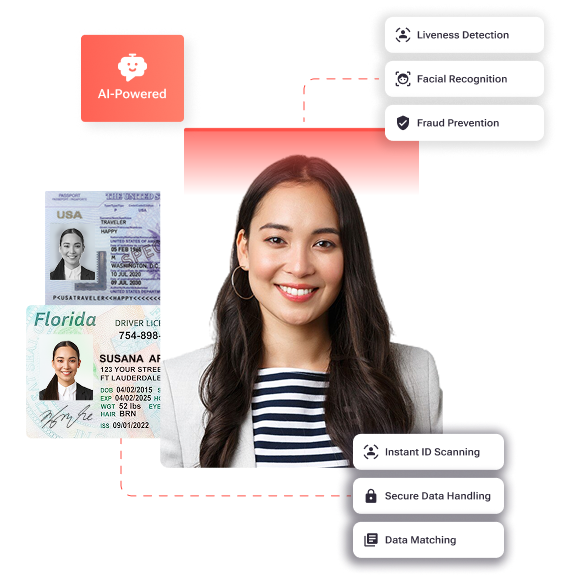
IDVerify adds biometric identity verification directly into the screening workflow. It combines government-issued ID validation, AI-powered liveness detection, and biometric selfie-to-ID facial matching inside TenantEvaluation without external portals. Verification results appear directly in the screening report, including ID authenticity confirmation, liveness status, and biometric match result. Associations can configure IDVerify per community or portfolio to match each risk profile.
55+ Communities Verification standardizes how age-restricted application requirements are handled across Florida condos and HOAs. It reduces manual work, supports documentation consistency, improves operational efficiency, and strengthens internal processes for Community Association Managers who oversee age-restricted communities.

Lease Tracking delivers centralized, real-time lease visibility and lifecycle control from application to occupancy. It connects resident onboarding, unit data, approvals, and lease documentation into one streamlined, audit-ready workflow. Associations replace spreadsheets, scattered email chains, and operational blind spots with real-time lease status, automated lease document collection, unit-level tracking, and searchable digital history.
Security infrastructure includes PCI Level 1 compliance, end-to-end encryption, and automatic redaction of sensitive personal information. Teams using TenantEvaluation have reported freeing up to 50 hours of staff time per day.
Frequently Asked Questions
What is the difference between a Level 2 background check and a standard HOA background check in Florida?
A Level 2 background check in Florida uses FBI fingerprint-based screening administered through the Florida Department of Law Enforcement and applies to specific licensed positions and roles involving vulnerable populations. Standard HOA and condo resident screening uses commercial consumer reports obtained from Consumer Reporting Agencies under the FCRA. These reports draw from state criminal repositories, county court records, sex offender registries, credit bureaus, and eviction databases, not FBI or NCIC systems, which remain restricted to law enforcement. For community association resident screening, the relevant standard is FCRA compliance, not Level 2 certification.
Is TenantEvaluation compliant with the Fair Credit Reporting Act?
TenantEvaluation is built with FCRA compliance as the foundation, not an afterthought. As a direct reseller of TransUnion and Equifax data, TenantEvaluation accesses consumer report data under strict bureau rules with documented permissible-purpose controls. The platform includes automated adverse action workflows, standalone disclosure and authorization collection, built-in audit trails for every application, and clear separation between the association’s decision-making role and TenantEvaluation’s data provision role. IDVerify+ also strengthens permissible-purpose validation by confirming applicant identity before screening authorization proceeds.
How does TenantEvaluation handle 55+ age-restricted community applications?
TenantEvaluation’s 55+ Communities Verification capability helps Florida condos and HOAs standardize how age-restricted requirements are handled across applications. It reduces manual work, supports documentation consistency, improves operational efficiency, and strengthens internal processes for Community Association Managers. The feature is designed for Florida’s specific association workflows and replaces fragmented manual processes such as emails, PDFs, and follow-ups with a more structured and scalable approach. It supports documentation and internal operational control and does not replace legal guidance on HOPA compliance.
What does TenantEvaluation’s revenue-sharing model mean for my community?
TenantEvaluation collects application fees from applicants during the online submission process, deducts its service fee, and rebates the remainder to the association or management company. This structure creates a pay-per-application model with no upfront subscription costs, and the association generates revenue from the screening process instead of absorbing it as an expense. Communities served by TenantEvaluation have collectively generated $150M through this model. The structure aligns TenantEvaluation’s incentives with the association’s operational success.
How does Lease Tracking work inside TenantEvaluation?
Lease Tracking operates as a centralized capability built directly into the TenantEvaluation platform. It connects resident onboarding, unit data, approvals, and lease documentation into one real-time workflow, giving CAMs, property managers, boards, and community operations teams full visibility over lease-related activity from application submission through occupancy. It provides real-time lease status, automated lease document collection during onboarding, unit-level tracking tied to occupancy records, and a searchable digital history of leases and resident activity. It replaces spreadsheets and scattered email chains with audit-ready digital records and does not replace legal lease review or interpretation.
Conclusion: Next Steps for Evaluating Your Screening Process
Florida community associations face a convergence of regulatory pressure, identity fraud risk, and operational complexity that generic screening tools do not address. The 2026 legislative environment, FCRA adverse action obligations, biometric fraud trends, and board governance requirements all point toward the same conclusion: association-ready screening requires a purpose-built platform.
The platform described above, which serves thousands of Florida communities with direct bureau relationships and comprehensive onboarding capabilities, represents a fundamentally different approach than generic screening tools. It aligns screening, governance, and documentation with the realities of Florida association management.
Associations currently using manual processes, generic rental tools, or white-label background check platforms should assess whether their current vendor provides board dashboards, biometric verification, lease lifecycle visibility, automated adverse action workflows, and direct bureau data access. When any of those elements are missing, the operational and compliance gap becomes measurable.
Evaluate TenantEvaluation against your current screening process by booking a comparison demo.
