Written by: Luis Teran, Co-founder, CEO, TenantEvaluation | Last updated: June 24, 2026
Key Takeaways for Florida CAMs in 2026
- A purpose-built tenant portal centralizes digital onboarding, lease tracking, and board oversight to meet Florida’s 2026 compliance demands.
- Biometric identity verification and automated PII redaction reduce fraud exposure and strengthen documentation for audits and disputes.
- Accelerated board approval workflows with QuickApprove cut onboarding delays while preserving full board control and timestamped records.
- Centralized lease lifecycle visibility and 55+ age-verification tools replace manual spreadsheets and fragmented records for CAMs.
- Compare these integrated capabilities and schedule a demo to see the platform in action for Florida condo and HOA operations.
1. End-to-End Digital Application and Document Collection
A fully digital application workflow removes paper submissions and cuts down on incomplete filings that delay board decisions.
- Applicants complete forms, upload documents, and pay fees through a single web or mobile interface, accessible 24/7.
- Intelligent form logic adjusts required fields based on applicant type, such as tenant, purchaser, or additional resident, so CAMs receive complete packages on first submission.
- In 2026, Florida associations managing multilingual resident populations benefit from platforms with support in multiple languages, and TenantEvaluation provides 24/7 AI-assisted support in 11 languages.
- AppFolio, Buildium, DoorLoop, and Condo Control offer online applications, but none provide community-association-specific form logic or automated document rejection for incomplete submissions that TenantEvaluation delivers natively.
2. Biometric Identity Verification for Safer Onboarding
Once an application is submitted digitally, the next operational risk point is confirming that the applicant is who they claim to be.
Identity fraud is an increasing exposure point for condo and HOA communities, and document-only screening no longer provides adequate protection.
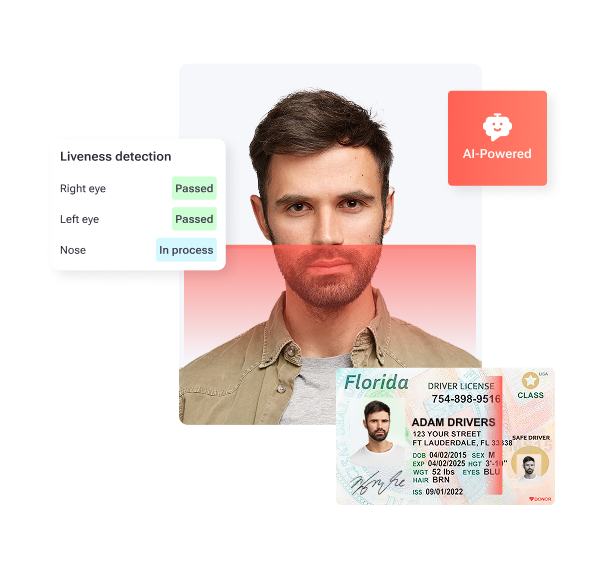
- IDVerify embeds government ID validation, AI-powered liveness detection, and biometric selfie-to-ID comparison directly inside the TenantEvaluation screening workflow, with no external portals or redirects.
- CAMs see verification results, including ID authenticity, liveness status, and biometric match, embedded within the screening report alongside a redacted ID copy for documentation.
- For 2026, communities facing rising synthetic identity attempts and impersonation risk gain a standardized fraud-prevention layer that strengthens approval confidence before a resident enters the property.
- AppFolio, Buildium, DoorLoop, and Condo Control do not offer native biometric liveness detection or selfie-to-ID facial matching integrated within a community-association onboarding workflow.
3. Accelerated Board Approval Workflow with QuickApprove
Board approval bottlenecks create some of the most common onboarding delays and applicant frustration in Florida condo communities.

- QuickApprove accelerates resident approvals inside one connected platform, giving boards a dedicated review and voting dashboard with AI-generated applicant summaries, real-time application tracking, and automated communication support.
- These capabilities translate into operational efficiency for CAMs, because automated communication support reduces manual follow-ups, AI-generated summaries enable customized approval letters, and the connected workflow supports personalized welcome packages while preserving control, compliance, and visibility.
- During Florida peak season application surges and in communities with complex onboarding requirements, QuickApprove supports high-volume periods and keeps applications moving without adding headcount.
- Generic platforms like DoorLoop and Condo Control lack a board-ready voting panel with timestamped, auditable decisions connected directly to the screening record.
See QuickApprove and the board dashboard in action during a live walkthrough.
4. Centralized Lease Tracking and Lifecycle Visibility
Centralized lease tracking builds on streamlined approvals by giving CAMs and boards clear visibility into every lease after approval.
Fragmented lease records scattered across folders, inboxes, and spreadsheets create operational blind spots and compliance gaps that boards must address.
- Lease Tracking links resident onboarding, unit data, approvals, and lease documentation into one centralized, real-time workflow from application submission through occupancy.
- Real-time lease status, automated lease document collection during onboarding, unit-level tracking, and a searchable digital history work together to replace manual expiration tracking and disconnected records.
- In 2026, digital lease records support associations during board reviews, owner disputes, and operational audits without requiring staff to reconstruct records from email chains.
- AppFolio and Buildium offer lease storage within broader property management suites, but neither integrates lease documentation with the approval lifecycle at the point of onboarding.
5. 55+ Community Age-Restricted Verification Workflow
Age-restricted communities in Florida reduce risk when they standardize how they collect and store eligibility documentation.

Florida age-restricted communities face documentation inconsistency and administrative burden when handling eligibility requirements through manual, email-driven processes.
- 55+ Communities Verification standardizes how age-restricted requirements are handled across applications, reducing manual work, improving documentation consistency, and strengthening internal operational controls for Florida condos and HOAs.
- CAMs and boards gain a more structured process for collecting and organizing age-verification documentation, replacing fragmented PDFs and follow-up emails with a consistent, scalable workflow.
- For 2026, Florida associations managing 55+ communities need documentation-first workflows that support internal compliance-related processes and reduce the risk exposure visible during audits or disputes.
- No named competitor, including AppFolio, Buildium, DoorLoop, or Condo Control, offers a built-in, Florida-focused 55+ documentation workflow designed for community association operational control at this level of standardization.
6. Automated Data Security, Redaction, and FCRA-Aligned Audit Trails
Secure handling of sensitive applicant data protects associations from breach liability and supports the audit trail boards rely on to justify decisions.
- TenantEvaluation automatically redacts personally identifiable information, including Social Security numbers and banking details, from uploaded documents, with PCI Level 1 compliance and end-to-end encryption applied throughout.
- Built-in audit trails timestamp every application action, board vote, and document exchange, creating a defensible, audit-ready record for FCRA-aligned workflows and adverse action processes.
- TenantEvaluation operates as a direct reseller of TransUnion and Equifax data, which means the platform receives credit information under strict bureau licensing rules rather than aggregating it from third-party scrapers.
- This direct relationship protects associations from the liability exposure tied to gray-market data sources that operate outside bureau oversight.
- Generic screening tools and broader platforms like RealPage and AppFolio do not offer the same combination of automatic PII redaction, community-association-specific audit trails, and direct bureau reseller status.
7. Community Analytics and Board-Level Reporting
Community analytics turn onboarding data into board-ready insights that support long-term planning and policy decisions.
Boards making strategic decisions about amenities, policies, and budgets require data on resident demographics and community trends, not just individual application records.
- TenantEvaluation advanced reporting generates insights on community demographics, median rent and purchase trends, pet ownership, EV usage, and resident profiles, giving boards the data layer needed for informed governance.
- CAMs can present board-ready reports without assembling data manually from disconnected systems.
- In 2026, associations evaluating capital improvements or policy changes, such as EV charger installation or updated pet policies, benefit from analytics drawn directly from verified onboarding data rather than self-reported surveys.
- Condo Control offers some reporting, but it lacks the connection to a verified screening and onboarding dataset that makes TenantEvaluation analytics operationally meaningful for Florida CAMs.
2026 Feature Comparison: TenantEvaluation vs. Leading Portals
The table below summarizes how TenantEvaluation integrated approach compares to the fragmented capabilities of generic property management platforms across the seven operational dimensions Florida CAMs need in 2026.
| Feature | TenantEvaluation | AppFolio / Buildium | DoorLoop / Condo Control |
|---|---|---|---|
| End-to-end digital onboarding with intelligent form logic | Yes, community-association-specific | Partial, generic rental focus | Partial, limited document logic |
| Biometric identity verification (liveness + facial match) | Yes, IDVerify+, native integration | No | No |
| Board voting dashboard with audit trail | Yes, QuickApprove board panel | No dedicated board voting panel | Limited, no timestamped voting record |
| Centralized lease lifecycle tracking | Yes, linked to onboarding workflow | Lease storage only, not onboarding-connected | Basic, not tied to screening lifecycle |
| 55+ community documentation workflow | Yes, built-in, Florida-specific | No | No |
| Automatic PII redaction + PCI Level 1 | Yes | Partial | No |
| Community analytics tied to verified screening data | Yes | Reporting available, not screening-connected | Limited reporting |
Frequently Asked Questions
Most important condo tenant portal feature for Florida property managers in 2026
The single most operationally impactful feature for Florida CAMs in 2026 is centralized lease lifecycle tracking connected directly to the onboarding workflow.
When lease records are disconnected from applications and approvals, associations face occupancy blind spots, manual expiration tracking, and audit readiness gaps.
A platform that links application submission, board approval, and active lease documentation in real time closes those gaps without adding administrative headcount.
How a condo association tenant portal supports 55+ community requirements
A purpose-built portal standardizes how age-restricted documentation is collected and stored across every application, replacing fragmented email-and-PDF workflows with a consistent, structured process.
This approach improves documentation consistency, reduces manual follow-up for CAMs, and creates more organized records for internal operational control.
It supports the association internal processes without replacing legal guidance or guaranteeing compliance with any specific statute.
What condo association lease tracking is and why it matters
Condo association lease tracking is a centralized capability that gives CAMs, boards, and property management teams real-time visibility over every lease status, including active, pending, expired, or missing, from application through occupancy.
It matters because manual lease management across spreadsheets and email chains creates operational blind spots, delays occupancy confirmation, and weakens the audit trail associations need during board reviews or owner disputes.
Connecting lease data to the onboarding workflow removes those disconnects and supports consistent oversight.
How biometric identity verification differs from standard ID document review
Standard document review confirms that an ID was uploaded, while biometric verification confirms that the person submitting the application physically matches that ID.
Biometric verification uses AI-powered liveness detection to confirm physical presence and facial landmark mapping to compare the applicant selfie against their government-issued ID.
This shift moves communities from document-based validation to verified physical identity confirmation, reducing exposure to stolen IDs, synthetic identities, and impersonation attempts that document review alone cannot catch.
Why a tenant portal does not replace the board role in approvals
A tenant portal functions as an operational tool that organizes information, automates document collection, and surfaces application data in a board-ready format.
The board retains full decision-making authority for every approval.
Platforms like TenantEvaluation provide a dedicated board voting dashboard with timestamped, auditable records, which accelerates the review process and improves visibility while keeping the board in control of each decision without removing oversight or bypassing due diligence.
Evaluating Your Current Portal Against the 2026 Framework
The seven features above, including digital onboarding, biometric verification, accelerated board approvals, centralized lease tracking, 55+ documentation workflows, automated data security, and community analytics, define the operational baseline Florida CAMs and boards need to manage condo associations efficiently with audit-ready records in 2026.
Generic portals address some of these needs in isolation, while TenantEvaluation connects all seven inside one platform built specifically for community associations, with FCRA compliance as the foundation rather than an afterthought.
Associations processing applications across 5,000 plus communities and more than 100,000 applications annually have validated that this integrated approach reduces approval times, eliminates spreadsheet-based lease management, and gives boards the visibility they need to govern confidently.
Schedule a demo today to evaluate TenantEvaluation against your current portal and see where the gaps are.
