Written by: Luis Teran, Co-founder, CEO, TenantEvaluation | Last updated: August 6, 2026
Key Takeaways for Florida Associations
- Florida community associations face rising rental application fraud, with 93.3% of owners reporting incidents and new felony penalties under HB 1293 effective October 2026.
- Biometric ID verification combines government ID validation, liveness detection, and facial matching to catch synthetic identities and deepfakes that traditional document checks miss.
- FCRA compliance requires documented consent, permissible purpose controls, and automated adverse action workflows, which platforms like TenantEvaluation provide.
- IDVerify+ runs natively inside TenantEvaluation, delivering board-ready reports, QuickApprove workflows, and 55+ community support without external portals or upfront costs.
- Evaluate biometric tools now to reduce fraud exposure and strengthen compliance; see how IDVerify+ addresses both requirements.
Why Biometric Verification Matters for Florida Community Associations
Florida’s House Bill 1293, signed by Governor Ron DeSantis on June 12, 2026 and effective October 1, 2026, creates a new third-degree felony for knowingly using false statements, forged documents, counterfeit records, or identity misrepresentation to obtain a residential rental unit. The bill passed the House 110–0, which reflects the severity of the problem across the state.
A fraudulent tenant who passes screening can generate substantial losses before eviction is complete. These losses include unpaid rent, property damage, legal costs, and vacancy. Snappt’s 2026 Multifamily Fraud Report found that roughly 5% of more than 1.4 million rental applications analyzed showed signs of fraud. Traditional document-only screening cannot reliably catch stolen IDs, synthetic identities, or AI-generated headshots that pass visual inspection.
Biometric verification closes this gap by confirming that the person submitting an application is physically present and matches the government-issued ID provided.
See how IDVerify+ stops identity fraud in your community.
How Biometric ID Verification and FCRA-Compliant Screening Work Together
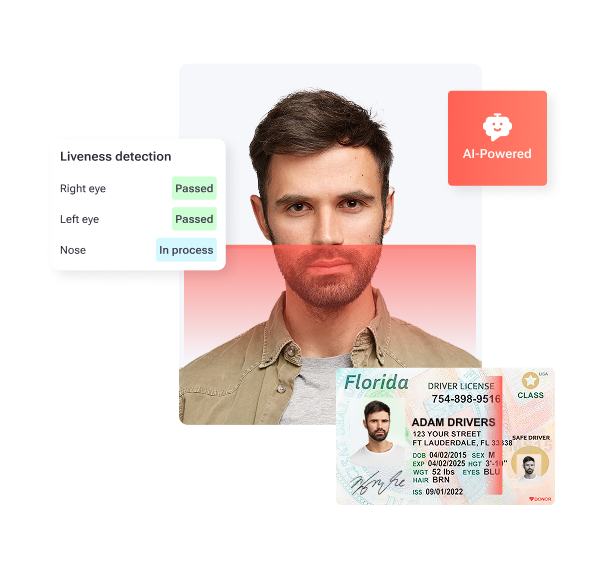
Biometric ID verification in rental screening combines three distinct technical layers.
- Government ID validation: Authenticates the document itself, checking for tampering, forgery, or counterfeit markers.
- Liveness detection: Confirms the applicant is physically present rather than submitting a photo, replay, or deepfake. This step directly counters synthetic identity fraud that visual ID checks cannot detect.
- Biometric facial matching: Compares a live selfie against the portrait on the submitted ID using facial landmark recognition.
FCRA compliance in this context requires that written consent is obtained before any consumer report is generated. Permissible purpose must be tied to a specific rental application. Adverse action notices must be issued when a report contributes to a denial.
For community associations, the verification platform therefore needs documented consent workflows, audit trails, and data handling practices aligned with FCRA obligations, not just accurate biometrics. Given these technical capabilities and compliance requirements, understanding Florida’s current fraud landscape helps explain why biometric verification has become essential for community associations.
2026 Florida HOA and Condo Fraud Landscape
Multifamily rental application fraud remains a challenge in Florida and reflects the state’s position as a high-target market. The Miami-Fort Lauderdale area specifically sees common fraud involving altered pay stubs, false employment records, synthetic identities, and counterfeit bank statements.
61% of property managers are not confident their current process can reliably prevent application fraud, even as fraud rates climb. The regulatory environment has shifted. HB 1293 now creates legal consequences for fraudulent applicants, and enforcement depends on associations having documentation that proves identity misrepresentation occurred. Biometric verification creates that documentation trail.
Pre-tour identity verification is gaining traction among operators, which shows that many are already moving toward earlier identity confirmation. That trend extends naturally into biometric application-stage verification for HOAs and condos.
How Biometric Verification Fits Daily CAM and Board Workflows
The value of biometric verification depends on how it fits into existing workflows. A tool that redirects applicants to an external portal, requires separate logins, or produces results outside the screening report adds friction without solving the operational problem.
Before IDVerify+:
- Applicants uploaded ID documents, and verification relied on document review alone.
- No biometric confirmation or liveness validation existed.
- Managers depended on manual oversight to catch fraud.
- Condo and HOA properties faced higher fraud exposure.
After IDVerify+:
- Automated ID authenticity validation runs natively inside TenantEvaluation, which removes the need for external portals.
- This triggers AI-based liveness detection to confirm physical presence during the application step and prevent photo or deepfake submissions.
- Once liveness is confirmed, facial landmark biometric mapping compares the live selfie against the ID photo automatically.
- All three verification layers, along with a redacted ID copy, appear together in a single screening report that CAMs can review without switching systems.
This workflow connects directly to QuickApprove, TenantEvaluation’s accelerated approval process. Boards access a dedicated review and voting panel with summarized applicant reports, real-time application tracking, and automated communication support. They avoid email chains and spreadsheets while gaining faster, clearer, and more consistent approvals with full control and visibility.

Compliance, Risk, and Governance for Biometric Screening
Every landlord or property manager who obtains a consumer report for a rental decision must have a permissible purpose tied to the specific rental application. For community associations, consent forms must be property-specific, not portfolio-wide, and must identify the reporting agency.
Florida HOA and condo boards should maintain a written Data Ethics and Privacy Charter that is reviewed before introducing biometric systems. This charter should cover data ownership, encryption standards, retention periods, and deletion rights. Biometric oversight should function as a continuous control rather than a one-time product sign-off, with documented approval for threshold changes and escalation paths for borderline cases.
TenantEvaluation is a direct reseller of TransUnion and Equifax data, not a third-party scraper. The platform enforces strict permissible purpose controls, automated adverse action workflows, and built-in audit trails for every application. IDVerify+ strengthens permissible-purpose validation by confirming identity before screening authorization, which reinforces FCRA-aligned workflows and audit defensibility. This information does not constitute legal advice, and associations should consult qualified counsel on their specific compliance obligations.
Operational Screening Challenges for Florida CAMs and Boards
Florida CAMs and boards consistently encounter the same operational friction points in applicant screening.
- Stolen-ID submissions: Identity fraud includes stolen Social Security numbers, manipulated driver’s licenses, and AI-generated headshots that pass visual inspection, which means the person on the lease is not who they claim to be.
- Manual bottlenecks: Document review, board follow-ups, and approval letters handled through email chains create delays and inconsistency.
- Inconsistent documentation: Applications missing required documents, unsigned leases, or unverified IDs reach board review without a standardized check layer.
- Lack of board visibility: Boards receive application summaries through email instead of a structured review panel, which reduces oversight and slows decisions.
Best Practices for Biometric Screening in 2026
Biometric identity verification with liveness detection is positioned as the single most critical layer in a five-layer fraud prevention framework for multifamily operators in 2026. For Florida community associations, several best practices now stand out.
- Multi-layer verification: Combine government ID validation, liveness detection, and biometric facial matching instead of relying on any single check.
- Application-stage confirmation: Application-stage identity verification typically includes biometric matching of a live selfie against the photo ID plus SSN verification to detect synthetic or stolen identities.
- Standardized 55+ community handling: 55+ Communities Verification reduces manual work, standardizes application handling, and supports documentation consistency for age-restricted Florida condos and HOAs.
- Connected approval workflows: Feed biometric results directly into board review panels and lease tracking to create an unbroken audit trail from application to occupancy.
Schedule a demo to see the complete platform in action.
Evaluation Framework for CAMs and Boards
CAMs and boards need a consistent framework when they compare biometric ID verification tools for a Florida community association. The criteria below work together to show both compliance strength and operational fit.
- FCRA compliance readiness: Confirm whether the platform operates as a direct credit bureau reseller and supports permissible purpose controls, written consent workflows, and automated adverse action notices.
- Native workflow integration: Check whether biometric verification runs inside the existing screening platform or redirects applicants to an external portal.
- Board dashboard access: Look for a dedicated board review and voting panel with real-time application visibility.
- Florida HOA and condo configuration: Verify that the tool can be enabled per community, configured per portfolio, and adapted to 55+ community requirements.
- Revenue model: Review whether the platform offers a revenue-sharing model with no upfront costs or requires monthly subscriptions.
- Audit trail completeness: Ensure that every verification step, including ID authenticity, liveness result, and biometric match, produces a timestamped, auditable record.
Biometric Tool Comparison for Florida Rental Applicants (2026)
The tools below represent the primary options available to Florida community associations that are evaluating biometric verification in 2026. IDVerify+ ranks first across criteria that matter most for HOA and condo screening workflows.
| Tool | FCRA Alignment | Florida HOA/Condo Fit | Board Dashboard & Workflow Integration |
|---|---|---|---|
| IDVerify+ (TenantEvaluation) | Direct TransUnion/Equifax reseller, permissible purpose controls, automated adverse action, built-in audit trails, FCRA-first design | Built exclusively for Florida condos and HOAs, configurable per community, 55+ community support, no upfront costs, revenue-sharing model | Native integration inside TenantEvaluation, board voting panel via QuickApprove, real-time application tracking, lease tracking connected |
| Snappt | Focuses on document fraud detection, FCRA applicability depends on use case and configuration | Multifamily-focused, 2026 Fraud Report covers multifamily broadly, no dedicated HOA or condo board workflow | No native board voting panel, requires integration with separate property management systems |
| Onfido | Global KYC and AML focus, FCRA compliance requires additional configuration for US rental use cases | Generic identity verification platform, not designed for Florida HOA or condo workflows or 55+ requirements | API-based, no native board dashboard, requires custom integration for community association workflows |
| ResMan ID FraudGuard (CLEAR) | Multifamily-oriented, FCRA alignment depends on deployment | Multifamily PMS integration, no dedicated Florida HOA or condo configuration or 55+ community support | Integrated within ResMan PMS, no standalone board voting panel for community association governance |
| Payscore Identity Verification | Application-stage verification focus, FCRA configuration required | Multifamily-oriented, no HOA or condo board workflow | No native board dashboard, requires external PMS integration for community association use |
IDVerify+ is the only tool in this comparison built natively inside a platform designed exclusively for Florida community associations. It combines a direct credit bureau reseller relationship, a board voting panel, and configurable 55+ community support, all without upfront costs.
Frequently Asked Questions
How liveness detection prevents synthetic identity fraud
Liveness detection requires the applicant to complete a guided real-time selfie capture during the application process. The system analyzes the capture to confirm that a live person is present, not a printed photo, a screen replay, or a deepfake image. The live selfie is then compared against the portrait on the submitted government-issued ID using facial landmark biometric matching.
Synthetic identities combine real and fabricated personal data with AI-generated or stolen photos. These identities cannot pass this layer because the biometric comparison requires a live, present individual whose face matches the ID. Traditional document-only screening has no mechanism to detect this category of fraud, which is why liveness detection now functions as the most critical single layer in modern rental fraud prevention frameworks.
What IDVerify+ FCRA reseller status means for associations
TenantEvaluation is a direct reseller of TransUnion and Equifax data, which means consumer report data is accessed under strict bureau rules with regular compliance reviews and audits, not sourced from gray-market or offshore providers. For community associations, FCRA liability exposure is significantly lower when the screening platform operates as a legitimate bureau reseller with documented permissible purpose controls, automated adverse action workflows, and built-in audit trails.
IDVerify+ reinforces this structure by confirming identity before screening authorization, which strengthens the permissible purpose record for each application. Associations should consult qualified legal counsel regarding their specific FCRA obligations. TenantEvaluation provides the compliance infrastructure, not legal advice.
How 55+ Communities Verification works with biometric screening
Florida condos and HOAs operating as age-restricted communities under federal housing law face documentation and consistency requirements that generic screening tools do not address. TenantEvaluation’s 55+ Communities Verification is a built-in capability that standardizes how age-restricted application requirements are handled across all applicants. This reduces manual work, improves documentation consistency, and strengthens internal operational control.

When combined with IDVerify+ biometric verification, associations gain both identity confirmation and standardized age-documentation handling within the same onboarding workflow. This creates a more structured process for age-restricted communities and supports internal compliance-related processes, though it does not replace legal guidance on HOPA requirements.
Typical implementation timeline for IDVerify+
IDVerify+ is embedded directly inside the TenantEvaluation platform, so there is no separate integration project, external portal setup, or applicant-facing login to configure. TenantEvaluation works with each community association or management company to configure the platform to their specific community profile, screening criteria, and portfolio requirements.
IDVerify+ can be enabled per condo or HOA and configured per property portfolio, which allows the deployment to match each community’s risk profile. For associations already using TenantEvaluation, enabling IDVerify+ is a configuration step rather than a new implementation. For new clients, TenantEvaluation’s onboarding process covers the full platform setup. Associations can contact TenantEvaluation directly for a timeline tailored to portfolio size and community requirements.
Conclusion: Why Florida Associations Should Move to Biometric Verification
Florida’s rental fraud environment in 2026 is defined by three converging pressures. More than 9 in 10 rental housing operators reported experiencing rental application fraud. HB 1293 created a new felony statute that requires documented identity misrepresentation to enforce. AI-powered fraud tools now make document-only screening unreliable.
Community associations that continue relying on manual document review face growing liability exposure, operational bottlenecks, and board governance gaps. Biometric verification directly addresses these risks.
IDVerify+ delivers government ID validation, AI-powered liveness detection, and biometric facial matching natively inside TenantEvaluation. The platform is built exclusively for Florida condos and HOAs and includes a direct credit bureau reseller relationship, a board voting panel through QuickApprove, 55+ Communities Verification, and a revenue-sharing model with no upfront costs. With 5,000+ communities and 100,000+ applications processed annually, TenantEvaluation brings proven scale to a Florida-specific problem that generic tools are not designed to solve.
