Written by: Luis Teran, Co-founder, CEO, TenantEvaluation | Last updated: June 22, 2026
Key Takeaways for Florida HOAs and Condos
- Florida HOA and condo operators experience gaps in AppFolio because it was built for rentals, not associations. Missing pieces include native eVoting, architectural review workflows, and advanced board governance tools.
- Post-Surfside legislation and new governance laws increased demand for platforms with audit-ready records, deeper screening, and clear board-level visibility.
- Critical evaluation criteria for alternatives include screening depth, biometric verification, board dashboards, lease tracking, and Florida-specific 55+ community support.
- TenantEvaluation stands out with native biometric ID verification, a dedicated board voting panel, centralized lease lifecycle tracking, and FCRA-first compliance designed for community associations.
- Boards and CAMs can streamline approvals and reduce manual work by adopting TenantEvaluation’s purpose-built platform; explore how the platform works for your community.
Core Screening and Governance Terms Explained
Resident screening refers to the structured process of evaluating prospective residents through background checks, credit reports, income verification, identity validation, and reference checks before an association approves occupancy.
Board voting dashboards are dedicated interfaces that give board members direct, real-time access to application summaries, voting panels, and approval status, replacing scattered emails and manual follow-ups with a connected governance workflow.
Biometric verification uses AI-powered liveness detection, government ID authentication, and facial biometric comparison to confirm that an applicant is physically present and matched to their submitted identification. This approach moves communities beyond document-upload-only screening.
Lease lifecycle tracking is a centralized operational capability that connects resident onboarding, unit data, approvals, and lease documentation into one real-time workflow. It provides visibility over lease status, including active, pending, expired, or missing, from application through occupancy.
2026 Platform Comparison for Florida Associations
The following comparison evaluates seven platforms across the criteria that matter most to Florida HOAs and condos: screening depth, board governance tools, identity verification capabilities, lease tracking, and Florida-specific 55+ support. Pay close attention to which platforms offer native capabilities versus third-party integrations, because that difference directly affects workflow speed and reliability.
| Platform | Screening Depth | Board Dashboard | Biometric Verification | Lease Tracking | Florida 55+ Support | FCRA Posture | Pricing Model | Implementation Notes |
|---|---|---|---|---|---|---|---|---|
| TenantEvaluation | Full FCRA stack: criminal, credit (TransUnion/Equifax direct reseller), income, biometric, references | Dedicated board voting panel with AI-generated summaries and real-time status | IDVerify: liveness detection, government ID validation, facial biometric match, native with no external portal | Centralized, real-time lease status, automated document collection, audit-ready records | Built-in 55+ Communities Verification workflow with standardized documentation | FCRA-first design, direct bureau reseller, automated adverse action, built-in audit trails | Pay-per-application, revenue-sharing model, no upfront fees | Purpose-built for Florida HOAs and condos, 5,000+ communities, 100k+ applications per year |
| AppFolio | Standard rental screening with limited HOA-specific depth | No dedicated board governance dashboard, limited enforcement workflow depth | No native biometric verification layer | Basic lease storage, not connected to onboarding lifecycle | No native 55+ workflow | Rental-oriented, FCRA coverage present but not HOA-first | Monthly subscription | Rental-origin architecture with HOA module added after launch |
| Buildium | Third-party screening integrations with moderate depth | No dedicated board voting panel | No native biometric layer | Basic lease management, manual tracking common | No native 55+ workflow | Standard FCRA coverage, not HOA-specialized | Monthly subscription tiers | Broad property management focus, not HOA-first |
| RealPage | Enterprise screening suite with rental focus | No dedicated HOA board dashboard | No native biometric layer | Lease management present with enterprise complexity | No native 55+ workflow | SOC 2 and fair housing compliance posture, enterprise-grade security protocols | Enterprise contract pricing | Large multifamily focus with high implementation overhead |
| Yardi | Broad screening with rental and commercial focus | No dedicated HOA board voting workflow | No native biometric layer | Lease management available with complex configuration | No native 55+ workflow | Enterprise compliance posture, not HOA-first | Enterprise contract pricing | Significant implementation timeline, not Florida HOA-specific |
| Vantaca | Limited screening focus with HOA operations emphasis | HOA governance features present, no dedicated screening-linked voting panel | No native biometric layer | Basic document management | No native 55+ workflow | HOA-oriented with limited screening depth | Subscription-based | HOA operations focus, screening requires third-party integration |
| ApplyCheck | Background check focus on TazWorks platform, limited applicant interaction | No board dashboard | No native biometric layer | No lease tracking capability | No native 55+ workflow | Background check posture, not end-to-end HOA compliance | Per-report pricing | Screening-only with no onboarding automation |
See how the full platform handles your specific screening and approval workflows
Choosing Platforms for Large Firms vs Self-Managed HOAs
Large management companies that operate portfolios across Miami, Fort Lauderdale, and Tampa need platforms that scale across hundreds of communities without adding headcount. TenantEvaluation processes more than 100,000 applications annually across over 5,000 communities, with enterprise partners including FirstService Residential, Associa, and Campbell Property Management. The pay-per-application revenue-sharing model removes upfront subscription costs and sends rebated income back to the association. AppFolio and RealPage charge monthly subscriptions regardless of application volume, which creates fixed overhead that fails to adjust to seasonal demand spikes.
Self-managed HOAs and condos face a different challenge, because they lack dedicated staff to manage manual follow-ups, long email chains, or spreadsheet-based lease tracking. Fragmented tools create manual handoffs that increase administrative burden for boards and managers. TenantEvaluation’s QuickApprove accelerated approval workflow and board voting dashboard give self-managed boards direct application visibility and a structured decision process without requiring a full-time CAM to coordinate approvals.
Biometric Identity Verification Built into Screening
Identity fraud is rising across Florida condo and HOA communities. Traditional screening methods that rely on document uploads and database checks cannot reliably prevent impersonation or synthetic identity fraud. IDVerify integrates automated KYC verification directly into the TenantEvaluation screening workflow using government-issued ID validation, AI-powered liveness detection, facial landmark recognition, and biometric selfie-to-ID comparison.
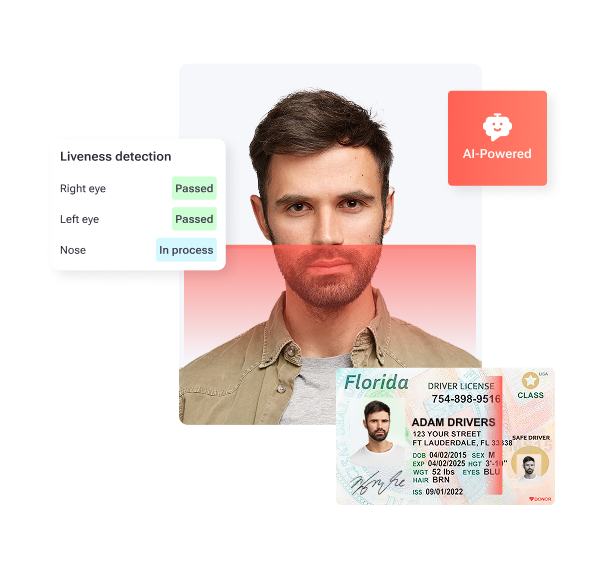
The critical operational distinction is straightforward. IDVerify runs natively inside TenantEvaluation, with no external portals, no workflow disruption, and no separate login for applicants or managers. CAMs see verification results embedded directly within the screening report, including ID authenticity confirmation, liveness verification status, and biometric match result. IDVerify can be enabled per community and configured per portfolio, which supports different risk profiles without a one-size-fits-all approach. None of the general-purpose platforms in the comparison table above offer this capability natively.
Approval Workflows That Speed Decisions and Keep Control
Approval delays in Florida HOAs and condos usually come from one structural problem. The approval process lives across email chains, spreadsheets, and manual follow-ups instead of inside a single connected workflow. QuickApprove is TenantEvaluation’s accelerated approval workflow for CAMs, boards, and property management teams inside one connected platform.
Board members access a dedicated review panel with AI-generated applicant summaries and a structured voting workflow. Managers track application progress in real time, trigger automated communication, and generate customized approval letters and personalized welcome packages. QuickApprove supports high-volume seasons and communities with complex onboarding requirements. It accelerates resident approvals while preserving control, compliance, and visibility. Florida and California have both formally authorized electronic voting for HOA elections, and communities deploying digital voting tools have generally seen improved participation rates. QuickApprove’s board dashboard aligns with this trend and supports higher engagement.
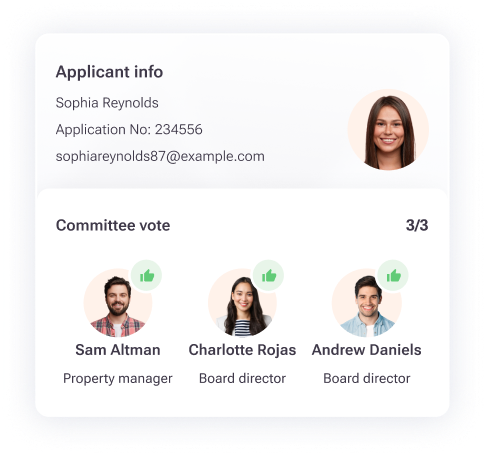
Replace scattered approvals with a structured board voting system and see the dashboard in action
Real-Time Lease Visibility from Application to Occupancy
Lease management across Florida community associations often remains fragmented, with missing or outdated lease copies, manual expiration tracking, disconnected spreadsheets, and no direct connection between applications and active leases. Lease Tracking inside TenantEvaluation connects resident onboarding, unit data, approvals, and lease documentation into one centralized, real-time workflow from application submission through occupancy.
CAMs gain real-time lease status visibility, including active, pending, expired, or missing leases, along with automated lease document collection during onboarding. They also see unit-level tracking tied to occupancy records and a searchable digital history of lease records and document trails. Boards receive a clearer operational picture of occupancy and resident activity across communities, with audit-ready digital lease records that support compliance readiness. The result is simple: no spreadsheets, no missing leases, and far less operational guesswork.
What Florida CAMs Are Saying About TenantEvaluation
“It’s fast, it’s easy, it makes every transaction seamless. Love it. I wish all Condominiums would have it, makes my job and the application easier.” — TenantEvaluation customer
CAMs evaluating AppFolio alternatives consistently report three friction points. They struggle with the learning curve of adapting a rental-origin platform to HOA governance workflows, limited visibility into where applications stand without manual follow-up, and the administrative fatigue of managing board approvals through fragmented manual coordination. These are structural gaps that general-purpose platforms have not resolved, because their product roadmaps prioritize multifamily rental use cases over community association governance.
Six-Point Framework to Score Any Platform
Florida CAMs and board presidents can apply the following framework to any platform under evaluation.
1. Compliance Readiness: Confirm whether the platform is a direct credit bureau reseller and whether it includes automated adverse action workflows and built-in FCRA audit trails, or whether it relies on third-party scraping and manual processes.
2. Operational Efficiency: Review how the platform handles document collection, application review, and communication. Identify whether it automates these steps or requires manual follow-up at each stage, then measure staff hours consumed per application cycle.
3. Transparency: Check whether boards have direct, real-time access to application status and a structured voting workflow, or whether they depend on CAM-forwarded email summaries.
4. Scalability: Assess whether the platform can absorb peak-season application volume without adding headcount and whether the pricing model scales with usage or imposes fixed monthly overhead.
5. Auditability: Confirm whether lease records, application histories, and approval decisions live in searchable, audit-ready digital records or remain scattered across folders, inboxes, and spreadsheets.
6. Risk Controls: Verify whether the platform includes biometric identity verification natively and whether it supports Florida-specific workflows, including 55+ Communities Verification for age-restricted communities.

Frequently Asked Questions
How does TenantEvaluation’s pricing model differ from AppFolio and other subscription-based platforms?
TenantEvaluation operates on a pay-per-application model with a revenue-sharing structure. The platform deducts its service fee from the collected application fee and rebates the remainder back to the association or management company. Communities can run the platform on cost-neutral or revenue-generating terms instead of paying monthly subscription fees regardless of application volume. AppFolio, Buildium, RealPage, and Yardi all use monthly subscription pricing, which creates fixed overhead that does not align with seasonal application patterns common in Florida communities.
How long does implementation typically take for a Florida HOA or condo switching to TenantEvaluation?
TenantEvaluation configures each community’s governing documents, screening criteria, and association workflows directly into the platform. The setup process reflects the community’s specific bylaws, credit score requirements, income verification thresholds, and document requirements. Because TenantEvaluation is purpose-built for Florida community associations, not adapted from a rental platform, the configuration process avoids extensive customization workarounds. Communities with complex onboarding requirements, including 55+ age-restricted workflows, receive dedicated setup aligned with real Florida association workflows.
What Florida 55+ community features does TenantEvaluation include that other platforms lack?
TenantEvaluation includes a built-in 55+ Communities Verification capability that helps Florida condos and HOAs standardize how age-restricted application requirements are handled across applications. It reduces manual work, improves documentation consistency, and strengthens internal operational control by replacing fragmented manual processes involving emails, PDFs, and follow-ups with a more structured and consistent workflow. This capability is designed specifically for Community Association Managers and boards managing age-restricted communities in Florida. Generic property management platforms and background screening tools do not offer this as a native, workflow-integrated feature. This capability supports documentation and consistency and does not replace legal guidance.
Can board members access TenantEvaluation’s dashboard without going through the CAM?
Yes. TenantEvaluation’s board voting dashboard gives board members direct, real-time access to application status, AI-generated applicant summaries, and a structured voting panel without requiring the CAM to forward information manually. Board members log in to their dedicated panel to review applications, cast votes, and track what needs attention. All actions are timestamped and auditable. This capability differs from what AppFolio and most general-purpose platforms provide, where board involvement typically requires CAM-mediated information forwarding or exported reports.
How does IDVerify protect communities from identity fraud without disrupting the applicant experience?
IDVerify runs natively inside TenantEvaluation, and applicants complete a guided identity verification step during the standard application process by uploading their government-issued ID and completing a selfie verification. The verification capabilities described earlier run automatically within the same workflow, with no external portals or separate logins required. CAMs see verification results, including ID authenticity confirmation, liveness status, and biometric match result, embedded directly within the screening report. IDVerify can be enabled per community and configured per portfolio, which supports different risk profiles across a management company’s full book of business.
Conclusion: Align Your Workflows with the Right Platform
AppFolio’s rental-origin architecture creates structural gaps in screening depth, board governance visibility, biometric fraud prevention, and lease lifecycle tracking that Florida CAMs and board presidents must navigate in 2026. General-purpose alternatives such as Buildium, RealPage, and Yardi address some operational needs but were not built for the governance workflows, Florida-specific regulatory pressures, or community association risk environments that define this market.
TenantEvaluation is built specifically for community associations and management companies, with FCRA compliance as the foundation rather than an afterthought. With the scale described earlier, direct TransUnion and Equifax reseller relationships, native biometric verification, a board-ready approval dashboard, centralized lease tracking, and built-in 55+ community workflows, it reflects the purpose-built alternative highlighted in the comparison table above.
Map your current workflows against the six evaluation criteria above. Identify where manual follow-up, visibility gaps, or fragmented lease records create operational drag. Then review how TenantEvaluation closes those gaps in a single connected platform.
See how TenantEvaluation connects application to occupancy for Florida HOAs and condos
