Written by: Luis Teran, Co-founder, CEO, TenantEvaluation | Last updated: June 18, 2026
Key Takeaways for Florida Condo Boards
- Florida condo associations with 25 or more units must maintain an online portal with official records starting January 1, 2026, which raises compliance and technology requirements.
- Traditional HOA platforms often require separate screening vendors, which creates hidden costs and compliance gaps for self-managed associations.
- TenantEvaluation offers a pay-per-application, revenue-sharing model with no upfront subscription fees, so screening can become a potential income stream instead of a cost center.
- FCRA-compliant screening with automated adverse-action workflows and audit trails is essential for Florida associations that want to avoid statutory violations and legal exposure.
- Associations can integrate TenantEvaluation’s screening and lease tracking capabilities with existing platforms; request a cost review demo to evaluate your total cost of ownership.
Florida Condo Law Changes for 2026: What Boards Must Handle
Florida’s legislative activity between 2025 and 2026 has materially increased the operational and technology requirements for condo associations. Florida condominium associations with 25 or more units (excluding timeshares) must maintain a website or application that makes specified official records available online, effective January 1, 2026. This requirement originated in 2024 legislation, while 2025 HB 913 added further compliance rules. House Bill 1021 (2024) lowered the prior threshold for official website or owner portal requirements from 150 units to 25 units, effective January 1, 2026.
The portal must contain the recorded declaration, bylaws, articles of incorporation, rules, annual budgets, financial reports, and at least 12 months of approved meeting minutes. Associations must upload these documents within 30 days of creation or receipt, which requires consistent digital workflows instead of ad hoc email chains.
HB 913 updates requirements for official records and meeting documentation. If a board or unit-owner meeting is conducted by video conference, the recording becomes an official record retained for at least one year and must be posted or hyperlinked on the association’s portal. Associations were also required to create and maintain an online account with the Florida DBPR by October 1, 2025, including building details, assessment data, and a link to the association website.
Structural Integrity Reserve Studies are required for applicable condominiums, with full funding of SIRS-designated reserves mandatory after January 1, 2025, although subsequent changes allow for pauses, loans, and owner-approved alternatives. These mandates push associations toward platforms that support document storage, portal access, audit trails, and verifiable lease documentation. Base HOA management platforms do not always include these capabilities out of the box.
Day-to-Day Pain Points for Boards and CAMs Under New Rules
These new compliance requirements compound the operational challenges that boards and CAMs already face in day-to-day management. For self-managed associations operating without specialized tools, the application and onboarding cycle remains heavily manual and error-prone.
Board members and CAMs typically spend time chasing incomplete applications, following up with applicants and realtors by phone and email, manually verifying uploaded documents, and tracking lease expirations across disconnected spreadsheets. This manual workload is particularly burdensome for volunteer board members, who already dedicate substantial time to financial reporting, vendor coordination, compliance issues, and resident communication.
The resulting friction, including missing lease copies, unsigned documents, and fragmented approval chains, delays move-ins and creates compliance gaps. These gaps become more serious under tightened record-retention requirements, because associations must now prove what was approved, when it was approved, and which documents supported each decision.
Compliance Requirements for Florida Condo Associations
The Fair Credit Reporting Act governs every background check run on a prospective resident. Associations must establish permissible purpose before ordering a report, provide pre-adverse and adverse-action notices when a screening result contributes to a denial, and maintain audit trails that show decisions were made by the association, not the screening vendor. Data security expectations have also risen. Sensitive applicant information, including Social Security numbers and financial data, must be stored and transmitted securely, with access controls and redaction practices in place.
Florida statute adds a fee-cap layer that directly affects how associations structure their screening workflows. Condominium association transfer and screening fees are capped at $150 per applicant, with a husband and wife or parent and dependent child treated as a single applicant. These fees must be used solely for screening and transfer-approval purposes and cannot be redirected as capital contributions. This means associations must show that collected fees fund actual screening and approval costs, not general operations.
Associations that collect screening fees through non-compliant workflows risk both statutory violations and FCRA exposure. TenantEvaluation is built specifically for community associations and management companies, with FCRA compliance as the foundation. As a direct reseller of TransUnion and Equifax data, TenantEvaluation accesses bureau data under strict rules, with automated adverse-action workflows and built-in audit trails for every application.
Least Expensive Property Management Software for Self-Managed Condos
Compliance requirements establish the baseline, but cost determines feasibility for budget-conscious boards. Evaluating affordability for a 25–100 unit Florida condo association requires examining five criteria: total cost of ownership (base fee plus add-ons), Florida statute alignment (portal mandates, record retention, fee caps), board transparency features (voting dashboards, audit trails), screening depth (FCRA compliance, identity verification, income verification), and scalability.
Base platform pricing is rarely the full picture, because the features associations actually need to meet Florida’s 2026 requirements are frequently sold as paid add-ons or handled through separate vendors. Screening, onboarding, document collection, lease tracking, and identity verification often sit outside the core subscription, and each vendor relationship carries its own cost and compliance exposure. Associations that evaluate only the monthly subscription fee routinely underestimate their actual annual spend by a significant margin.
HOA Software Cost Comparison for Florida Associations
The table below compares six platforms commonly evaluated by Florida condo associations. It highlights base pricing for a 50-unit association, notes whether screening and onboarding are included, and flags Florida-specific compliance considerations so boards can see where gaps are likely to appear.
| Platform | Base Monthly Cost (est. 50 units) | Screening / Onboarding Included? | Florida-Specific Compliance Notes |
|---|---|---|---|
| TenantEvaluation | $0 upfront; pay-per-application via revenue-sharing model | Yes, FCRA-first, IDVerify+, QuickApprove, Lease Tracking, 55+ Communities Verification | Built for Florida CAMs and condo associations, direct bureau reseller, audit-ready records |
| Buildium | Buildium uses fixed tiered base pricing starting at $62/month (Essential), $192/month (Growth), or $400/month (Premium) with no per-unit fees | Basic screening available, lease signing costs extra | General property management, not HOA-specific, add-on fees for e-signatures and inspections |
| AppFolio | $280–$400/mo minimum, about $6–$8 per unit per month effective cost at 50 units | Screening available, not HOA-board-specific | Broad property management platform, no dedicated board voting dashboard |
| PayHOA | PayHOA uses tiered pricing that starts at $49–$54/month for up to 25 units (annual billing) and scales by unit count rather than a flat rate | No native screening, third-party required | Dues, violations, and portal features, screening and onboarding require separate vendor |
| Condo Control | Pricing available by custom quote and varies by association size and selected features | No native FCRA-compliant screening | Communication and portal tools, screening compliance managed externally |
| EasyHOA | EasyHOA flat-rate entry plans start from $49/month | No screening included | Lightweight dues and communication tool, limited compliance infrastructure |
RealPage operates at enterprise scale with pricing structures designed for large portfolios, which makes it cost-prohibitive for most self-managed associations under 100 units. Generic background screening platforms such as ApplyCheck and Verify Screening Solutions provide background checks but lack applicant interaction, automated document review, board voting dashboards, and the Florida-specific onboarding workflows that community associations require.
Screening Add-On Costs That Exceed Base Platform Fees
The screening and onboarding layer often becomes the most significant hidden cost in HOA software total cost of ownership. Platforms like PayHOA and Condo Control do not include FCRA-compliant background checks, identity verification, income verification, or lease tracking. Associations using these platforms must contract separately with a screening vendor, a document collection tool, and potentially a lease management system. Each additional vendor introduces its own monthly or per-transaction fee, its own compliance exposure, and its own data security risk.
Buildium applies additional fees for premium features including electronic lease signing and property inspections even within its core subscription. For larger communities using platforms like Buildium or AppFolio, monthly costs can be substantial before boards even account for screening add-ons.
TenantEvaluation addresses this gap through its revenue-sharing approach, which removes the upfront cost barrier that prevents many small associations from accessing enterprise-grade screening. TenantEvaluation deducts its service fee from the collected application fee and rebates the remainder to the association, which can turn the onboarding process into a compliant, controlled income stream instead of a cost center.
Features including IDVerify biometric identity verification, QuickApprove accelerated approval workflow, Lease Tracking, and 55+ Communities Verification are built into the platform, not sold as separate add-ons.

Direct Recommendation by Association Size
Based on the cost structures and feature gaps identified above, the ideal platform combination changes as association size increases. The table below maps recommended base platforms and screening layers to three common size brackets and shows how boards can minimize total cost of ownership while maintaining full compliance coverage.
| Association Size | Recommended Base Platform | Recommended Screening & Onboarding Layer | Key Rationale |
|---|---|---|---|
| 25–50 units | PayHOA or EasyHOA (flat-rate, low overhead) | TenantEvaluation (pay-per-application, no upfront cost) | Base platform handles dues and portal, TenantEvaluation adds FCRA-compliant screening, IDVerify+, and Lease Tracking without a monthly subscription |
| 51–75 units | Condo Control or PayHOA | TenantEvaluation | Mid-size associations benefit from the QuickApprove board voting dashboard and automated document collection as application volume increases |
| 76–100 units | Buildium (if full accounting needed) or Condo Control | TenantEvaluation | Higher volume makes per-application revenue sharing more advantageous, while 55+ Communities Verification and centralized Lease Tracking reduce CAM workload at scale |
Frequently Asked Questions
How much does TenantEvaluation cost for a small Florida condo association?
TenantEvaluation operates on a pay-per-application, revenue-sharing model with no upfront subscription fee for the association. When an applicant submits an application and pays the application fee, TenantEvaluation deducts its service fee and rebates the remainder to the association or management company. This structure keeps the screening and onboarding layer cost-neutral or revenue-generating for the association, instead of adding another monthly expense on top of a base platform subscription.
Does TenantEvaluation support Florida’s 2026 website and record-retention requirements?
TenantEvaluation provides audit-ready digital records, centralized lease documentation, and a searchable history of applications, approvals, and resident activity. These capabilities support an association’s ability to meet Florida’s expanded record-retention and transparency mandates. TenantEvaluation does not replace legal counsel or guarantee compliance outcomes, but its built-in audit trails, document collection workflows, and Lease Tracking capability help associations maintain organized, accessible records consistent with the requirements introduced under HB 913 and related statutes.
Can TenantEvaluation integrate with platforms like PayHOA or Condo Control?
TenantEvaluation is designed to function as a screening and onboarding complement to lighter base platforms. Associations using PayHOA, Condo Control, or similar tools for dues collection, violation tracking, and owner communication can add TenantEvaluation as the FCRA-compliant screening, identity verification, document collection, and lease tracking layer. This approach avoids replacing the existing platform or committing to a full-stack migration and lets budget-conscious associations access enterprise-grade screening capabilities without enterprise-level costs.
What is the board voting dashboard in TenantEvaluation?
TenantEvaluation’s QuickApprove accelerated approval workflow includes a dedicated board-ready review and voting panel. Board members log in to access AI-generated application summaries, review screening results, and cast votes directly inside the platform. This process replaces email chains and spreadsheets with a connected, auditable approval workflow.
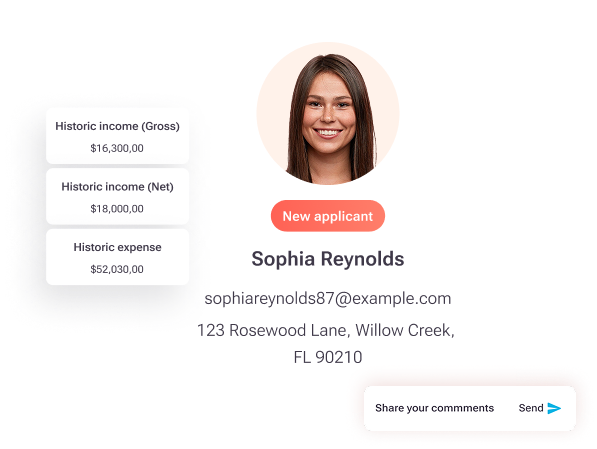
Real-time application tracking, automated communication support, customized approval letters, and a personalized welcome package are all part of the QuickApprove workflow. These tools support CAMs, boards, and property management teams that manage high-volume seasons or communities with complex onboarding requirements.
How does TenantEvaluation handle FCRA compliance for Florida condo associations?
TenantEvaluation is a direct reseller of TransUnion and Equifax data, accessing bureau information under strict bureau rules with regular compliance reviews and audits, not through gray-market or offshore data sources. The platform includes strict permissible-purpose controls, automated adverse-action workflows, clear separation between decision-making by the association and data provision by TenantEvaluation, and built-in audit trails for every application. IDVerify+ strengthens permissible-purpose validation by confirming applicant identity before screening authorization, which reinforces FCRA-aligned workflows and audit defensibility.

Conclusion: Balancing Cost, Compliance, and Workload
Affordable HOA management software for Florida condo associations involves more than a single line item. Base platform fees between $39 and $300 per month represent only a portion of what associations actually spend once screening, onboarding, identity verification, lease tracking, and compliance infrastructure are included. Florida’s 2026 mandates, including the 25-unit portal threshold, expanded record-retention requirements, and DBPR registration, have raised the operational floor for every association, regardless of size.
Boards and CAMs evaluating their current stack should calculate total cost of ownership across all vendors, confirm that their screening layer is genuinely FCRA-compliant with audit trails and adverse-action workflows, and verify that lease documentation is centralized and audit-ready. TenantEvaluation provides the screening, onboarding, identity verification, and lease tracking layer that many base platforms lack, through a pay-per-application model that requires no upfront investment and is built specifically for Florida community associations, with FCRA compliance as the foundation.
