Written by: Luis Teran, Co-founder, CEO, TenantEvaluation | Last updated: July 15, 2026
Key Takeaways for Florida Condo and HOA Screening
- Proptech tenant screening platforms for Florida condos and HOAs must deliver board-ready dashboards, biometric fraud prevention, and FCRA-compliant audit trails as standard operational requirements in 2026.
- Community associations face unique governance needs, including board voting workflows, adverse action automation, and 55+ documentation that generic rental screening tools were never designed to support.
- Fragmented manual processes create costly bottlenecks, compliance risks, and lost revenue. Automation reduces application cycles from days to minutes while improving decision consistency.
- Key evaluation criteria for boards include native biometric verification, real-time lease tracking, revenue-sharing models, Florida-specific configuration, and direct credit bureau reseller relationships.
- TenantEvaluation is purpose-built for community associations and connects every step of the resident onboarding lifecycle into one board-ready, audit-ready workflow. See how TenantEvaluation works for your community.
Community Association Screening Basics and Key Terms
Community Association Managers (CAMs) and Boards of Directors operate under a governance model that generic rental screening tools do not support. Unlike multifamily landlords, community associations require board-level approval workflows, documented voting records, FCRA-compliant adverse action notices, and audit-ready trails that can withstand regulatory scrutiny.
Key terms relevant to this evaluation include:
- FCRA (Fair Credit Reporting Act): Federal law governing how consumer reports are obtained, used, and disclosed. Violations create significant liability exposure for associations.
- Permissible purpose: The legal basis under which a screening platform may pull a consumer report. Platforms must enforce strict controls so only authorized parties initiate screening.
- Adverse action workflow: The required process for notifying applicants when a consumer report contributes to a denial or conditional approval decision.
- 55+ Housing for Older Persons Act (HOPA): Federal framework governing age-restricted communities. Florida condos and HOAs must maintain consistent documentation practices to support their age-restricted status.
- Lease lifecycle management: The operational process of tracking a lease from application submission through occupancy, renewal, and expiration.
Proptech Growth, Fraud Trends, and Florida Regulations
The global PropTech market is estimated to be valued at USD 51.70 billion in 2026 and is expected to reach USD 139.21 billion by 2033, growing at a 15.2% CAGR. Housing associations form a major end-user segment, driven by challenges in payment collection, maintenance, and tenant tracking. North America holds a 55.5% share of the global PropTech market in 2025, with the US market alone projected at $8.45 billion in 2026.
Fraud trends are accelerating the shift toward biometric verification. AI-powered tenant screening solutions reduce application fraud by up to 75% while cutting decision times from days to minutes. Enhanced biometric verification using facial recognition is predicted to become standard for identity verification in 2026, which makes it significantly harder for fraudulent applicants to use stolen identities. AI models are also improving fraud detection through broader and deeper data sources.

On the regulatory side, Florida’s 2023 amendment to FIPA broadened the definition of “personal information” to include biometric and geolocation data, so associations must protect this information collected during screening. Effective January 1, 2026, condominium associations with 25 or more units must maintain a digital records portal under Fla. Stat. §718.111(12)(g), which raises the compliance stakes for associations still relying on manual processes.
How Screening Workflows Play Out for CAMs
A CAM managing a 300-unit Florida condo touches many steps in a single application cycle. Each application requires identity verification, income confirmation, criminal background checks, board review, approval letter generation, and lease document collection. When these steps live across email chains, spreadsheets, and disconnected vendors, the operational cost compounds quickly.
Leasing teams spend substantial time per application on manual collection, follow-up, and decision communication. For a 300-unit portfolio, automated screening helps recover vacancy days and recapture rent revenue by shortening the decision window. Faster decisions keep qualified applicants engaged and reduce the risk of losing them to competing properties.
Board-level delays compound the problem. Owner and board approval creates delays when members are busy, traveling, or reviewing documents from multiple sources. Qualified applicants often accept an offer from another property if they have not received a decision within two days.
Explore how TenantEvaluation eliminates these bottlenecks in your workflow.
Compliance Risk and Governance for Florida Associations
Florida community associations face layered compliance obligations that generic screening platforms do not address well. Under FIPA, associations must notify affected individuals within 30 days of a data breach and notify the Florida Department of Legal Affairs if the breach affects 500 or more Florida residents. FIPA violations are treated as unfair or deceptive trade practices, exposing associations to civil penalties of up to $500,000 per breach.
Under FCRA, manually generated adverse action notices often contain errors that create compliance risk. Platforms that automate adverse action workflows and maintain built-in audit trails materially reduce this exposure. Associations should also verify that any screening vendor is a direct credit bureau reseller, not a third-party data aggregator, so permissible purpose controls are enforced at the source.
Typical Screening Gaps in Community Associations
The most common failure points in community association screening workflows include:
- Fragmented lease management: Missing or outdated lease copies, manual expiration tracking, and no centralized visibility create operational blind spots and compliance risk.
- Identity fraud exposure: Traditional document-based screening cannot reliably prevent impersonation, synthetic identities, or stolen ID fraud.
- Board approval bottlenecks: Applications stuck in email chains with no real-time status visibility slow decisions and frustrate applicants.
- Inconsistent 55+ documentation: Fragmented manual processes for age-restricted communities produce incomplete records that create risk exposure in audits or disputes.
- FCRA audit trail gaps: Generic platforms not designed for community associations often lack the structured adverse action workflows and timestamped audit records required for regulatory defensibility.
- Data security risks: Florida associations routinely collect driver’s license numbers, Social Security numbers, and government IDs, which creates high-value targets when handled through insecure manual processes.
Operational Standards Leading Associations Now Follow
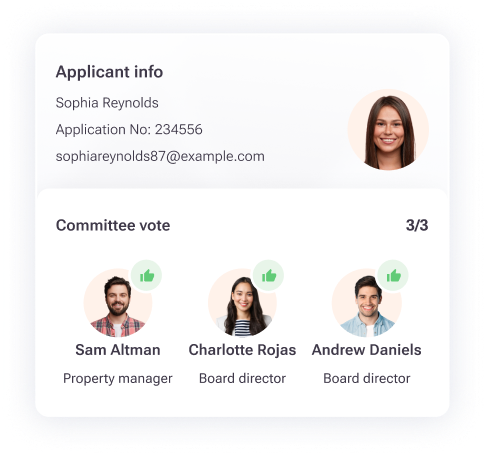
Leading community associations in 2026 are adopting operational standards that cover the full screening lifecycle. At the identity stage, they embed biometric verification directly into the workflow instead of redirecting applicants to external portals. After identity is confirmed, board-ready approval dashboards with timestamped voting records and AI-generated applicant summaries accelerate decisions.
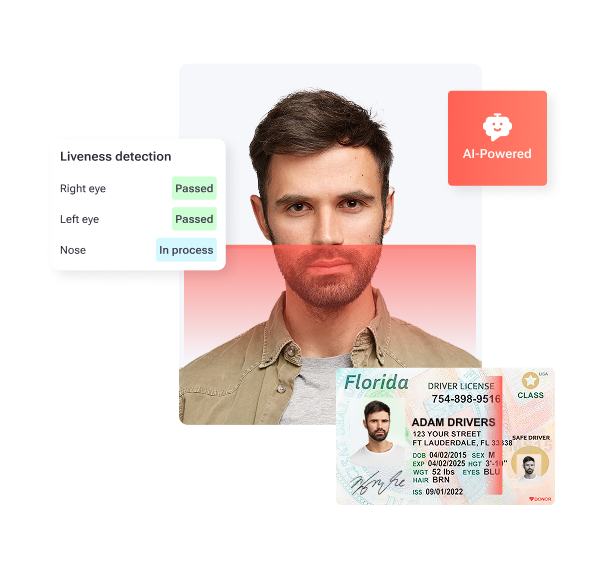
Once boards approve applicants, centralized real-time lease tracking connects the application through occupancy and renewal, replacing spreadsheets and scattered email chains. Standardized 55+ documentation workflows improve consistency and reduce manual handling for age-restricted communities. FCRA-compliant adverse action automation with built-in audit trails supports defensible decisions for every application.
Associations also prioritize direct credit bureau reseller relationships with TransUnion and Equifax instead of gray-market data sources. PCI Level 1 compliance and end-to-end encryption protect applicant data across the entire process. Association vendor contracts should require reasonable security measures, prompt breach notification, and indemnification provisions to manage risk from screening platform integrations.
Seven Criteria to Evaluate Screening Platforms
CAMs and boards evaluating proptech screening platforms in 2026 should assess each vendor against seven criteria that reflect community association needs.
- Board-ready dashboard and voting: The platform should provide a dedicated board review panel with real-time application status and a structured voting workflow.
- Biometric identity verification: Identity confirmation should occur natively inside the platform using liveness detection and biometric facial matching.
- 55+ Communities Verification: The platform should standardize age-restricted application handling with consistent documentation workflows.
- Real-time lease tracking: The platform should connect onboarding, approvals, unit data, and lease documentation into one centralized, audit-ready workflow.
- Revenue-sharing model: The platform should generate income for the association instead of relying only on fixed monthly subscription fees.
- FCRA audit trails: Adverse action workflows should be automated, with every application action timestamped and auditable.
- Florida-specific configuration: The platform should be built for Florida condo and HOA governing documents, bylaws, and regulatory requirements.
Ranked Comparison of TenantEvaluation, AppFolio, and Buildium
The table below evaluates platforms across the seven criteria most relevant to Florida condo and HOA managers. TenantEvaluation is the only platform built specifically for community associations with FCRA compliance as the foundation, serving 5,000+ communities and processing 100,000+ applications annually.
| Criteria | TenantEvaluation | AppFolio | Buildium |
|---|---|---|---|
| Board-Ready Dashboard & Voting | Dedicated board voting panel with AI-generated summaries, real-time status, and timestamped audit trail | General manager dashboard, no dedicated board voting workflow | General reporting tools, no board-specific voting panel |
| Biometric Identity Verification (IDVerify) | Native biometric verification with government ID validation, AI liveness detection, and facial biometric matching inside TenantEvaluation | No native biometric verification layer | No native biometric verification layer |
| 55+ Communities Verification | Built-in capability that standardizes age-restricted application handling for Florida condos and HOAs | Not available | Not available |
| Real-Time Lease Tracking | Centralized lease lifecycle control connecting onboarding, approvals, unit data, and lease documentation in one audit-ready workflow | Lease management available within broader property management suite | Lease tracking available but not connected directly to the screening workflow |
| Revenue-Sharing Model | Pay-per-application with revenue rebated to the association and no upfront fees | Monthly subscription model with no revenue sharing | Monthly subscription model with no revenue sharing |
| FCRA Audit Trails | Automated adverse action workflows, built-in audit trail for every application, and direct TransUnion and Equifax reseller status | FCRA-compliant screening available, audit trail depth varies by configuration | FCRA-compliant screening available, audit trail depth varies by configuration |
| Florida-Specific Configuration | Built exclusively for Florida condos and HOAs with custom setup for governing documents, bylaws, and state regulations | Configurable for Florida but not purpose-built for community associations | Configurable for Florida but not purpose-built for community associations |
ApplyCheck and Verify Screening Solutions both use the TazWorks platform and focus on background checks without applicant interaction, automated document review, or board-specific workflows. RentSpree, TurboTenant, and Avail serve multifamily rental markets and lack community association governance features such as board voting dashboards and 55+ documentation workflows. RealPage offers broad property management capabilities but is not purpose-built for condo and HOA board workflows and does not provide native biometric verification or Florida-focused governance tools.
Tenant Screening Built for 55+ Florida Communities
Age-restricted communities in Florida face a documentation challenge that generic screening tools cannot solve. Fragmented manual processes that rely on emails, PDFs, and repeated follow-ups produce inconsistent records and increase risk in audits or disputes. 55+ Communities Verification is a built-in capability within TenantEvaluation that helps Florida condos and HOAs standardize how age-restricted requirements are handled across applications.

This capability reduces manual work, supports documentation consistency, improves operational efficiency, and strengthens internal processes for CAMs and boards managing age-restricted communities at scale. No other platform in this comparison offers a purpose-built 55+ verification workflow designed for Florida community associations.
QuickApprove Compared to Manual Board Review
Manual board review processes create the largest single bottleneck in community association screening. Manager review and approval creates a 90-minute average bottleneck per application in manual workflows. Applications frequently stall while board members travel or review documents from multiple disconnected sources.

QuickApprove is TenantEvaluation’s accelerated approval workflow built for CAMs, boards, and property management teams inside one connected platform. It delivers real-time application tracking, automated communication support, a board-ready approval process with a dedicated voting panel, customized approval letters, and a personalized welcome package. Communities use QuickApprove during high-volume seasons and for complex onboarding requirements, replacing email chains and spreadsheets with a connected, auditable approval process while preserving control and compliance.
Lease Tracking Designed for Community Associations
Lease management across many community associations remains fragmented, with missing lease copies, manual expiration tracking, disconnected spreadsheets, and no direct connection between applications and active leases. This fragmentation creates operational blind spots, slows teams, and increases compliance risk tied to incomplete records.
TenantEvaluation’s Lease Tracking delivers centralized, real-time lease visibility and lifecycle control from application to occupancy in a fully connected workflow. Built for CAMs, boards, property management companies, and community operations teams, it connects resident onboarding, unit data, approvals, and lease documentation into one streamlined platform. Real-time lease status, automated lease document collection during onboarding, unit-level tracking, searchable digital history, and audit-ready digital lease records replace spreadsheets and scattered email chains.
Replace your spreadsheets with centralized lease visibility and request a personalized walkthrough.
AppFolio vs TenantEvaluation for HOA and Condo Governance
AppFolio is a broad property management platform serving multifamily, single-family, and commercial portfolios. It offers screening, leasing, and accounting tools within a subscription-based model. For HOA and condo managers, AppFolio provides general manager dashboards and configurable screening criteria, but it was not built for community association governance.
AppFolio lacks a dedicated board voting panel, native biometric identity verification, 55+ Communities Verification, and a revenue-sharing model that generates income for the association. TenantEvaluation is built specifically for community associations and management companies, with FCRA compliance as the foundation rather than an add-on. Its board-ready dashboard, QuickApprove accelerated workflow, IDVerify biometric verification, and pay-per-application revenue-sharing model are purpose-built capabilities that AppFolio does not offer for HOA and condo governance contexts.
Buildium Alternatives for Florida Condo Managers
Buildium is a property management platform with features covering leasing, accounting, and maintenance. It serves a broad range of property types but does not focus deeply on screening and does not offer board-specific voting workflows, native biometric verification, or 55+ age-restricted documentation capabilities. Buildium’s own 2024 Property Management Industry Report found that leasing teams spend an average of 4.2 hours per application on manual collection, follow-up, and decision communication. A purpose-built platform with end-to-end automation directly addresses this burden.
For condo managers evaluating Buildium alternatives, TenantEvaluation offers an end-to-end platform with automated document review, board-ready approval workflows, biometric fraud prevention, centralized lease tracking, and a revenue-sharing model. These capabilities are not available in Buildium’s standard feature set for community associations.
Frequently Asked Questions About HOA Screening Platforms
What platforms do property managers use for tenant screening in community associations?
Property managers in community associations use a range of platforms, from broad property management software like AppFolio and Buildium to background screening tools like ApplyCheck and Verify Screening Solutions. Most of these platforms were designed for multifamily or generic rental markets and lack board voting dashboards, biometric identity verification, 55+ documentation workflows, and FCRA audit trails that community associations require. TenantEvaluation is the only platform built specifically for Florida condos and HOAs, serving 5,000+ communities with 100,000+ applications processed annually.
How does AppFolio compare to TenantEvaluation for HOA screening?
AppFolio is a general property management platform with screening capabilities, but it was not purpose-built for HOA or condo governance. It operates on a monthly subscription model and does not offer a dedicated board voting panel, native biometric identity verification, 55+ Communities Verification, or a revenue-sharing model. TenantEvaluation is built exclusively for community associations, with FCRA compliance as the foundation, a board-ready approval workflow through QuickApprove, biometric fraud prevention through IDVerify, and a pay-per-application model that generates revenue for the association instead of charging fixed monthly fees.
What is the best tenant screening platform for 55+ communities in Florida?
TenantEvaluation is the only platform with a built-in 55+ Communities Verification capability designed specifically for Florida condos and HOAs. It standardizes how age-restricted application requirements are handled across applications, reduces manual work, supports documentation consistency, and improves operational efficiency for CAMs and boards. Generic screening platforms do not offer structured workflows for age-restricted documentation, which leaves associations to manage these requirements manually and increases inconsistency and operational risk.
What is QuickApprove and how does it differ from manual board review?
QuickApprove is TenantEvaluation’s accelerated approval workflow that moves resident applications from submission to decision faster inside one connected platform. Manual board review relies on email chains, spreadsheets, and disconnected follow-ups, which slows decisions and obscures status. QuickApprove gives CAMs and board members a single connected workflow with real-time application tracking, a board-ready voting panel with AI-generated applicant summaries, automated communication support, customized approval letters, and a personalized welcome package. It supports high-volume seasons and communities with complex onboarding requirements without removing board oversight or bypassing compliance review.
Why is FCRA compliance important for HOA and condo tenant screening?
FCRA governs how consumer reports are obtained, used, and disclosed in screening decisions. For community associations, FCRA compliance requires strict permissible purpose controls, automated adverse action notices when a consumer report contributes to a denial, and audit-ready records for every application. Platforms not designed for community associations often lack these controls and expose associations to legal liability. TenantEvaluation is a direct reseller of TransUnion and Equifax data, not a third-party aggregator, and provides automated adverse action workflows, built-in audit trails, and clear separation between data provision and association decision-making.
Conclusion: Choosing a Board-Ready Screening Platform
The 2026 operating environment for Florida condo and HOA managers demands more than generic tenant screening. Board voting dashboards, biometric fraud prevention, standardized 55+ documentation, centralized lease lifecycle visibility, and FCRA audit trails now function as baseline capabilities rather than optional extras. Platforms built for multifamily or broad property management markets cannot match the governance structure, compliance depth, or operational specificity that community associations require.
CAMs and boards evaluating their current workflows should measure each platform against the seven criteria outlined in this guide. These criteria include board-ready approval workflows, biometric identity verification, 55+ documentation standardization, real-time lease tracking, revenue-sharing alignment, FCRA audit trail depth, and Florida-specific configuration. The gap between purpose-built and generic platforms becomes most visible at the point of board review, fraud exposure, and compliance audit.
TenantEvaluation is built specifically for community associations and management companies, with FCRA compliance as the foundation rather than an afterthought. With 5,000+ communities served, 100,000+ applications processed annually, and $150M generated for communities, it is the only platform that connects every step of the resident onboarding lifecycle into one board-ready, audit-ready workflow.
Evaluate your current screening workflow against these criteria and schedule a demo today.
