Written by: Luis Teran, Co-founder, CEO, TenantEvaluation | Last updated: September 19, 2026
Key Takeaways For Florida HOA Boards
- Florida law lets small HOAs shift tenant screening costs to applicants under a $150 statutory cap, so a pay-per-application model usually delivers the lowest net cost.
- Three payment structures exist, and only a revenue-sharing model avoids upfront costs while creating potential income from application fees.
- Generic screening tools expose boards to FCRA compliance risk and lack association-specific features such as board voting dashboards and centralized lease tracking.
- Small Florida HOAs need five critical vendor capabilities: board voting tools, lease tracking, Florida-specific compliance, biometric identity verification, and revenue return.
- TenantEvaluation delivers these association-focused features through a compliant pay-per-application platform built for community boards.
See How TEpayments Handles Applicant Fees
Who Pays For Tenant Screening In A Florida HOA
The association’s screening policy determines who pays. Florida boards typically use one of three arrangements:
- The applicant pays the screening fee directly to the association or its designated platform, up to the $150 statutory cap.
- The association absorbs the cost and pays the screening vendor from operating funds.
- A pay-per-application platform collects the fee from the applicant, deducts the cost of the background check, and rebates the remainder to the association.
Option three costs the association nothing and can generate revenue. Under Florida Statute 718.112(2)(k), a condominium association may charge up to $150 per applicant when approval is required and the fee appears in the declaration, articles, or bylaws. Spouses, or a parent and dependent children, count as a single applicant, so a married couple applying together pays one $150 fee. The association may not charge a fee on a renewal with the same tenant in the same unit.
Florida Statute 83.425, enacted by HB 1417 and effective July 1, 2023, preempts local government regulation of residential tenancies to the state, including screening, application fees, and related matters under Chapter 83, Part II. Cities and counties such as Miami, Fort Lauderdale, Palm Beach, Tampa, St. Petersburg, Clearwater, Sarasota, Fort Myers, Orlando, and Jacksonville follow the same statewide rules. Boards work under one consistent framework across Florida.
What The Pay-Per-Application Model Costs A Small Florida HOA
A pay-per-application model ties costs and revenue directly to application volume. The applicant submits the application fee, up to the $150 statutory cap. The platform deducts the cost of the background check and related services. The association receives the remainder as revenue.
The association avoids upfront subscription costs and monthly minimums. Revenue rises with application volume, which fits a 60-to-200-unit community that processes 10 to 40 applications a year.
Monthly-subscription property management platforms such as AppFolio and Buildium follow a different logic. AppFolio is quote-based, with a 50-unit minimum and an undisclosed minimum monthly spend. Buildium publishes transparent monthly subscription tiers starting at $62/month (Essential), $192/month (Growth), and $400/month (Premium), with no minimum unit threshold. A small self-managed HOA that pays a monthly platform fee for software it uses a dozen times a year pays for capacity it does not use.
TenantEvaluation’s revenue-sharing model turns application processing into a compliant, controlled income stream. The association defines what to collect and at which stage. Payments flow directly from the applicant to the association’s designated account through TEpayments by Zinc, a connected payment workflow integrated into the platform. TenantEvaluation organizes the workflow and never holds the funds.
See How The Revenue-Share Model Works
Why Free And $25-Per-Screen Tools Often Cost A Board More
Generic applicant-paid screening tools work for individual landlords but create hidden costs for HOA boards. Boards face compliance exposure, weak audit trails, and workflows that ignore association approvals.
The Fair Credit Reporting Act (FCRA) requires a documented permissible purpose for every consumer report. For an HOA, that purpose is evaluating an applicant for a housing decision. When the board denies an application, it must send a pre-adverse action notice with a copy of the report and the FTC’s Summary of Consumer Rights. The board then waits at least five business days and sends a final adverse action notice that lists the reasons for denial. Failure to send adverse action notices is a common FCRA violation that leads to lawsuits, with statutory damages of $100 to $1,000 per willful violation. A free tool that saves $40 per screen can expose the association to thousands of dollars in a single challenged denial.
The table below highlights two capabilities that separate an association platform from landlord tools: a board voting panel and revenue returned to the association. None of the three generic tools provide either capability.
| Platform | Pricing Model | Who Pays | Board Voting Panel | Revenue Share To Association |
|---|---|---|---|---|
| TenantEvaluation | Pay-per-application, no upfront fees or monthly subscription | Applicant, remainder rebated to association after cost deduction | Yes, dedicated board review and voting dashboard included | Yes, revenue-sharing model built in |
| SmartMove By TransUnion | Pay-as-you-go, $25–$45 per applicant depending on tier | Applicant or landlord at submission | No | No |
| Zillow Rental Manager | Free for landlords, $35 applicant-paid screening fee | Applicant | No | No |
| Apartments.com | Free for landlords, $29 plus tax applicant-paid screening fee | Applicant | No | No |
These generic tools also miss key compliance and workflow features. Zillow Rental Manager does not automate FCRA adverse action notices. Apartments.com relies on a downloadable adverse action template instead of automation. Neither platform offers centralized lease tracking, Florida-specific compliance settings, biometric identity verification, or revenue share back to the association. SmartMove targets self-managing residential landlords under roughly 50 doors and lacks association-centered features such as centralized lease tracking and board-level workflow controls.
ApplyCheck and Verify Screening Solutions both rely on the TazWorks platform for background checks and focus on general tenant screening. They do not provide a board voting dashboard, Florida-specific compliance workflows, or a revenue-sharing model for associations.
The Five Capabilities A Small Florida HOA Needs From A Screening Vendor
A generic tenant screening tool answers a single question: does this applicant pass a background check. A community association needs a broader set of capabilities that support board decisions and long-term records.
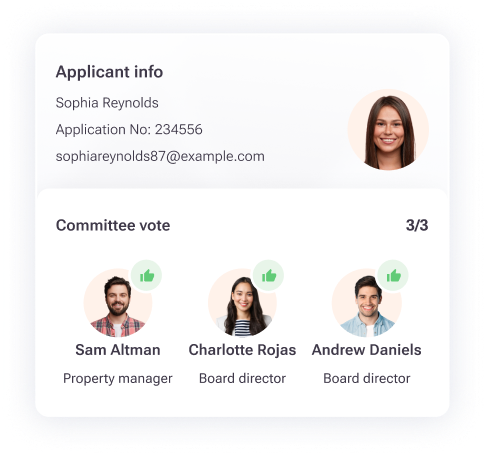
- Board Voting And Approval Dashboard. The board needs a way to review applications, cast votes, and produce a timestamped record of every decision inside the platform.
- Centralized Lease Tracking. The platform should show every active, pending, expired, or missing lease in real time. Each lease should connect to the application and approval record and remain audit-ready from onboarding through occupancy.
- Florida-Specific Compliance Configuration. The system must align with the association’s governing documents, screening criteria, and Florida statutory requirements, rather than a generic rental template.
- Biometric Identity Verification. IDVerify confirms applicant identity using AI-driven liveness detection, government ID authentication, and selfie-to-ID biometric comparison. This shifts communities from document-based review to verified physical identity confirmation.
- Revenue Return. The pay-per-application model should send the remainder to the association after the background check cost is deducted, with no upfront fees and no monthly subscription.
TenantEvaluation focuses on community associations and management companies and builds FCRA compliance into every step. The company launched in 2007 and now serves more than 5,000 communities. It processes about 100,000 applications each year.
TenantEvaluation holds direct reseller relationships with TransUnion and Equifax and includes built-in adverse action workflows and full audit trails for every application. The pay-per-application revenue-sharing model removes upfront fees. QuickApprove accelerates resident approvals inside one connected platform. It tracks applications in real time, gives the board a ready-made approval process, automates communication, and generates customized approval letters and a personalized welcome package.

Get A Board-Ready Screening Workflow
How To Set Up A Screening Policy The Board Can Defend
A board-defensible screening policy rests on four pillars:
- Objective written criteria
- Consistent application
- Confidential handling
- Attorney review
The board should establish objective written criteria before it reviews the first application. Criteria often include minimum credit score, income-to-rent ratio, eviction history threshold, and criminal history scope within the limits of HUD’s fair housing guidance on individualized criminal history assessment. The same criteria should apply in the same order to every applicant.
Best practice is to retain screening records and adverse action notices for at least two years after the application decision, even though the FCRA does not specify a mandatory retention period. This record set supports the board if a denial is challenged.
Florida Statute 83.425 preempts local screening regulation to the state, so the association’s policy operates under a single statewide framework. This applies whether the community is in Miami, Fort Lauderdale, Palm Beach, Tampa, St. Petersburg, Clearwater, Sarasota, Fort Myers, Orlando, or Jacksonville. Florida’s Fair Housing Act (Florida Statutes 760.20-760.37) prohibits housing discrimination based on race, color, national origin, sex, disability, familial status, and religion. The written screening policy should cite both statutes by number and receive review from a licensed Florida attorney before adoption.
A Worked Example For A 120-Unit Community Processing 25 Applications A Year
A 120-unit Florida HOA that processes 25 rental applications a year can run a straightforward pay-per-application model. Each applicant submits the application fee, up to the $150 statutory cap, through the platform at the time of application. The platform deducts the cost of the background check, credit report, and related services. TEpayments by Zinc then sends the remainder to the association’s designated account, with payments flowing directly from the applicant to the association. TenantEvaluation never holds the funds.
The board receives each completed application through the QuickApprove board dashboard. Board members review AI-generated applicant summaries, cast timestamped votes, and trigger automated approval or adverse action communications. Every step appears in a built-in audit trail, including application submission, document collection, identity verification through IDVerify, the board vote, and any adverse action notice. At year-end, the association has 25 processed applications, a complete audit record, and a revenue contribution from application fees, all with zero upfront platform cost.
Why Identity Fraud Makes Screening Choices Critical In 2026
The FBI’s Internet Crime Complaint Center logged more than 12,000 real estate fraud complaints in 2025, with reported losses above $275 million. Synthetic identities, which combine a real Social Security number with fabricated biographical data and an AI-generated portrait, then build a genuine credit file over time, accounted for 21% of first-party fraud detected in 2025. A clean credit pull no longer proves that an applicant is genuine.
Document-based review struggles to detect AI-generated fake IDs, fabricated pay stubs, and synthetic identities. More than 90% of property managers encountered rental application fraud in the prior twelve months, with double-digit year-over-year increases. Boards need biometric-backed identity confirmation before applications reach the voting stage.
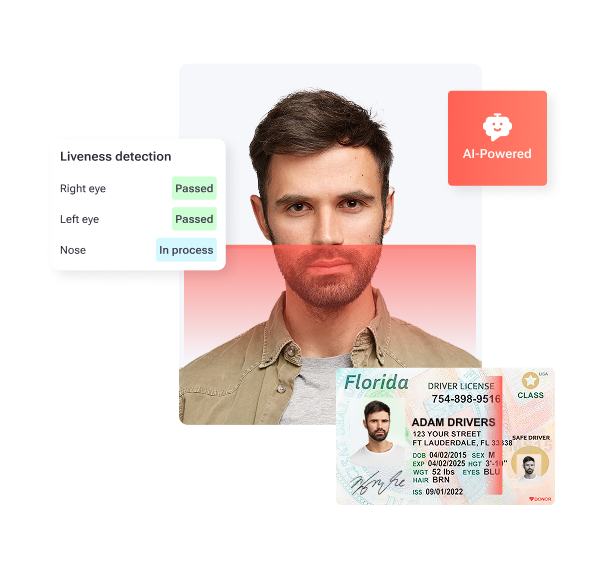
IDVerify brings biometric identity verification into the TenantEvaluation workflow. It validates government-issued ID authenticity, runs AI-powered liveness detection, and performs facial landmark biometric matching against the submitted ID. This shifts Florida HOA communities from document-based review to biometric-confirmed identity verification and strengthens approval confidence while reducing liability.

Conclusion And Next Steps For Florida HOA Boards
A small Florida HOA gains the most value from a screening model that costs the association nothing upfront, returns revenue to the community, and produces an audit trail the board can present if a denial is challenged. Applicant-paid screening under the $150 Florida statutory cap, with married couples counted as one applicant, achieves that outcome when it runs through an FCRA-focused platform built for community associations.
Generic tools such as SmartMove, Zillow Rental Manager, and Apartments.com serve individual landlords and lack a board voting dashboard, centralized lease tracking, Florida-specific compliance configuration, biometric identity verification, and revenue share back to the association. ApplyCheck and Verify Screening Solutions center on background checks through the TazWorks platform and do not address community association workflows.
TenantEvaluation focuses on community associations and management companies and treats FCRA compliance as a core design requirement. The platform serves more than 5,000 communities, processes about 100,000 applications each year, and connects directly to TransUnion and Equifax. Built-in adverse action workflows, full audit trails, and a pay-per-application revenue-sharing model with no upfront fees make it a practical, board-defensible screening solution for Florida HOAs.
Talk With TenantEvaluation About TEpayments
