Written by: Luis Teran, Co-founder, CEO, TenantEvaluation | Last updated: September 17, 2026
Key Takeaways
- Credit and criminal screening services combine credit reports, criminal record searches, eviction history, identity verification, and related checks to evaluate applicants before approval.
- FCRA compliance is mandatory when using a consumer reporting agency and requires written consent, permissible purpose documentation, and adverse action notices for any decision based on the report.
- Community associations reduce liability and Fair Housing Act exposure when they adopt written, objective screening criteria and apply them consistently to every applicant.
- Modern screening now uses biometric identity verification to combat synthetic identity fraud, which has grown significantly and does not surface through document review alone.
- TenantEvaluation provides FCRA-compliant screening built specifically for Florida condos and HOAs, with direct bureau relationships, automated workflows, and audit trails that generic rental platforms do not provide.
Talk With TenantEvaluation About Your Screening Workflow.
What Credit And Criminal Screening Services Include
Community associations rely on several core components when they screen an applicant.
- Credit report and rental-oriented credit scoring, including payment history, outstanding balances, and collections.
- Criminal database and county court record searches. National databases are incomplete on their own, and hits must be confirmed at the county level where records are most current.
- Sex offender registry checks.
- Eviction history searches. Many credit reports do not surface eviction court records, so a dedicated eviction search is worth ordering explicitly.
- Identity verification, including biometric confirmation where available.
- Employment or income verification beyond self-reported data.
TenantEvaluation’s Safecheck+ delivers FCRA-compliant background checks with built-in audit trails. Incomeev handles income verification that goes beyond what applicants self-report and contacts employers directly to confirm figures.
What Shows Up On A Credit And Background Check
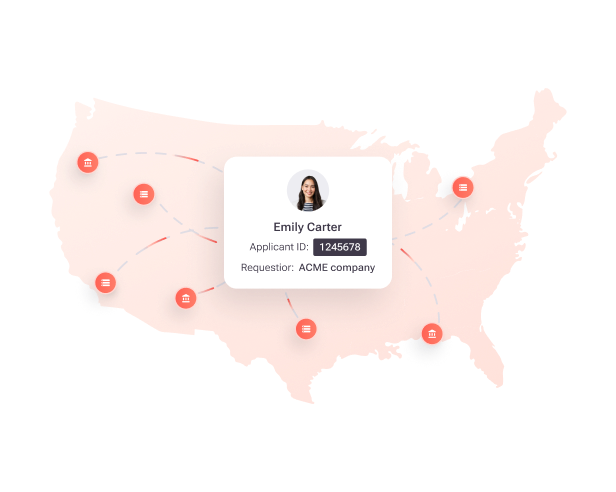
A combined credit and background report surfaces several distinct categories of information.
- Credit accounts and payment history, including late payments and current utilization.
- Collections, including unpaid rent or utility balances.
- Public records such as judgments and bankruptcies.
- Criminal offenses at the county, state, and national database level.
- Eviction filings, which differ from final judgments.
- Identity or address history discrepancies.
Credit reports should be read for patterns rather than a single score. High utilization combined with recent late payments signals cash-flow strain. An old collection with a clean recent history may indicate resolved hardship. A thin file with few accounts makes a score less predictive and calls for additional verification rather than automatic denial.
What Will Disqualify An Applicant
Each community association sets its own standards in its governing documents. These standards cover credit thresholds, income ratios, criminal record lookback periods, and document requirements.
Florida condo boards must formally adopt written, objective screening criteria documented in board minutes or a board-adopted policy. Boards then apply the same criteria in the same order of review to every applicant. Consistent application of those criteria is what protects the board from liability.
Blanket bans, particularly blanket criminal-record bans, create significant legal exposure. Blanket bans on applicants with any criminal history have been found to disproportionately exclude minority applicants and to lack a substantial, legitimate, nondiscriminatory interest. HUD’s 2016 criminal-records guidance was withdrawn effective September 25, 2025, yet disparate-impact liability under the Fair Housing Act continues under Texas Dept. of Housing and Community Affairs v. Inclusive Communities Project, 576 U.S. 519 (2015). Criminal-history criteria should weigh the nature and severity of the offense, time elapsed, and evidence of rehabilitation. This section offers operational guidance and does not replace legal advice, so associations should consult counsel before finalizing screening policies.
How The FCRA Applies To Housing Screening
The Fair Credit Reporting Act, 15 U.S.C. § 1681 et seq. governs key aspects of the screening process when a community association uses a consumer reporting agency. It covers permissible purpose, written consent, and adverse action notice requirements.
The compliance layer breaks into four main obligations.
Permissible Purpose. Screening a rental applicant for tenancy is a recognized permissible purpose under the FCRA. It must be documented at the time the screening order is placed.
Written Authorization. A clear, standalone disclosure that a background report will be obtained, plus the applicant’s signed authorization, is required before any report is pulled. Burying permission inside the lease or general application does not satisfy the requirement. Courts have repeatedly held that the FCRA disclosure must appear in a clear, standalone document.
Adverse Action Notice. When an application is denied, conditionally approved, or approved on different terms based in whole or in part on a consumer report, the FCRA requires a notice. That notice must identify the consumer reporting agency by name, address, and phone number, state that the agency did not make the decision, inform the applicant of the right to a free copy of the report within 60 days, and explain dispute rights. The CFPB defines tenant screening reports as a type of consumer report used by landlords to make rental decisions, so FCRA obligations apply to tenant screening companies and landlords in that context.
Record Retention And Audit Trail. The FCRA does not specify a mandatory retention period, but best practice is to retain screening records and adverse action notices for at least two years after the decision. Many attorneys recommend three years to cover the statute of limitations for FCRA claims.
TenantEvaluation is built specifically for community associations and management companies, with FCRA compliance built into the workflow from the start. It holds direct reseller relationships with TransUnion and Equifax rather than scraping third-party data. The platform enforces strict permissible purpose controls, automates adverse action workflows, and keeps an audit trail on every application. It is PCI Level 1 compliant, encrypts data end to end, and redacts sensitive information automatically. TenantEvaluation serves more than 5,000 communities and processes roughly 100,000 applications a year, which helps keep the association’s decision-making role clearly separated from the screening provider’s data-provision role.
See How FCRA-Compliant Screening Works In Practice.
How Long A Tenant Background Check Takes
A modern FCRA-compliant screening service usually returns credit, criminal, and eviction results within minutes to a few hours when data is available electronically. County court record searches and manual verifications, such as employment confirmation and prior landlord references, can extend timelines by a day or two.
Incomplete applications and missing documents usually create the main bottleneck in community association onboarding. TenantEvaluation’s smart application form logic rejects incomplete submissions automatically and keeps the pipeline moving. QuickApprove moves applications from submission to decision faster with real-time application tracking, automated communication support, and reduced manual follow-ups for CAMs, boards, and property management teams while preserving control, compliance, and visibility.

How Much Credit And Criminal Screening Services Cost
A complete report combining credit, nationwide criminal, eviction history, and identity verification typically runs about $25 to $55 per adult applicant, with standalone components priced lower. Pricing varies by provider, depth of search, and who pays.
TransUnion SmartMove is typically applicant-paid at about $25 to $40, which makes the applicant-pays model standard in many consumer-facing products. Community associations often structure application fees differently than multifamily landlords. TenantEvaluation uses a revenue-sharing model where the provider’s fee is deducted from the collected application fee and the remainder is rebated to the association. That structure turns application processing into a compliant, controlled income stream instead of an overhead cost.
Cost is only half of the decision. A low fee has little value if the report does not match the person who is actually applying.
Identity Fraud And Why Document-Based Screening Is No Longer Sufficient
Stolen IDs, impersonation attempts, and synthetic identities now create a growing exposure for condo and HOA communities. An uploaded ID image shows only that the applicant possesses an image of a document. It does not confirm that the document is valid or that it belongs to the presenter.
The Federal Reserve defines a synthetic identity as a combination of real information, such as a legitimate Social Security number, and fictional information, such as a fabricated name or address. A synthetic identity can acquire a real credit file over time, so the existence of a credit file does not prove that every attribute is true. TransUnion data shows synthetic identity fraud cases in rental applications have grown 3x since 2023, which makes it the fastest-growing category of tenant fraud.
Biometric identity verification now functions as a core component of the modern screening stack. IDVerify+ by TenantEvaluation introduces automated KYC verification through government ID validation, AI-powered liveness detection, and biometric facial matching. Communities move from document-based review to verified physical identity confirmation, all inside the TenantEvaluation workflow.

How Community Associations And HOAs Differ From Generic Landlords
A Florida condo association’s authority to approve or reject a lease must be expressly granted in the declaration, articles, or bylaws under Fla. Stat. § 718.303(1) and § 718.116. Board voting workflows, documentation consistency requirements, and the need for audit trails on every application create compliance demands that generic multifamily platforms do not address well.
Fla. Stat. § 718.112(2)(k) caps a Florida condo association’s transfer and approval fee at $150 per applicant. A spouse or a parent and dependent children count as one applicant, and no fee may be charged on a renewal with the same lessee.
Age-restricted communities face additional requirements. 55+ Communities Verification by TenantEvaluation reduces manual work, standardizes application handling, supports documentation consistency, and strengthens internal processes for Florida condos and HOAs. Under HOPA, at least 80% of a community’s occupied units must have at least one resident age 55 or older. HUD also requires age-verification documentation to be updated at least once every two years. Together, those rules make consistent, scalable documentation handling an operational necessity.

Provider Categories To Consider For Credit And Criminal Screening
Four provider categories commonly appear in this market, and each serves community association approval workflows differently.
Credit Bureaus And Their Consumer-Facing Products. TransUnion SmartMove provides fast, comprehensive tenant screening reports directly online and is typically applicant-paid at about $25 to $40. It is built for individual landlords rather than association boards and does not include document fraud detection natively.
Generic Rental Platforms. Zillow Rental Manager charges the renter a $35 fee for applications and screening reports shareable across listings for 30 days. TurboTenant tenant screening reports cost applicants $55 on the Free plan and $45 when the landlord is on a paid plan (Pro or Essentials), and the fee covers credit, criminal, and eviction checks and is non-refundable. Rentspree offers screening and application services with less depth than a comprehensive platform. These tools are designed for multifamily rentals and do not center community association approval workflows.
Employment-Oriented Background Screeners. Applycheck and Verify Screening Solutions focus on background checks and use the Tazworks platform. That platform is not primarily designed for tenant screening and lacks applicant interaction along with fully automated document review and redaction.
Community-Association-Specific Platforms. TenantEvaluation is built specifically for community associations and management companies, with FCRA compliance integrated into every step. It holds direct reseller relationships with TransUnion and Equifax. Safecheck+ handles FCRA-compliant background checks and audit trails, Incomeev verifies income, IDVerify+ confirms biometric identity, and QuickApprove accelerates the board approval workflow. TenantEvaluation serves more than 5,000 communities, processes roughly 100,000 applications a year, and is PCI Level 1 compliant. Customers report up to 70% time savings in approval cycles compared with manual or generic tools.
Compare TenantEvaluation Against Your Current Provider.
Frequently Asked Questions
Can I Run A Tenant Background Check On Myself?
Applicants can request their own background check and tenant screening report from services like Rentspree or SmartMove and share it directly with a landlord. Many providers call this a portable screening report. The association still needs its own independent check, ordered under its own documented permissible purpose and with the applicant’s fresh written authorization. Using only a report the applicant provides creates FCRA risk because the association’s permissible purpose was not established when that report was originally ordered.
What Is A Red Flag On A Background Check?
Common red flags in a tenant screening report include recent late payments, prior evictions, active collections on rent or utilities, and income below the association’s stated threshold. A single old collection is less concerning than a pattern of recent missed payments. An eviction in the past three to five years is typically the hardest screening negative to overcome because it shows a prior tenancy ended in court proceedings. Identity or address history discrepancies, especially when documents submitted by the applicant do not match bureau records, also warrant additional verification rather than automatic denial.
Conclusion: Next Steps For Community Association Boards
Credit and criminal screening services bring together credit reports, criminal record searches, eviction history, and identity verification into a single applicant evaluation. The FCRA governs permissible purpose, written authorization, adverse action notices, and record retention at every step. The board makes the approval decision and carries the liability, so documented criteria, uniform application, and a provider built for community associations matter.
Manual, document-based screening increases both FCRA risk and identity fraud exposure. TenantEvaluation is built for community associations and management companies and combines direct bureau reseller relationships, automated adverse action workflows, biometric identity confirmation through IDVerify+, a board-ready approval workflow through QuickApprove, and audit trails on every application. Florida CAMs, LCAMs, and boards gain compliance infrastructure and operational control that generic rental platforms do not provide.
Get A Screening Workflow Built For Your Board.
