Written by: Luis Teran, Co-founder, CEO, TenantEvaluation | Last updated: June 27, 2026
Key Takeaways for Florida CAMs and Boards
- Florida condo associations under Chapters 718 and 720 face strict record-keeping, screening, and approval obligations that manual processes cannot reliably manage at scale.
- Manual workflows compound risk across identity fraud exposure, fragmented lease tracking, approval delays, and growing statutory liability in 2026.
- TenantEvaluation delivers FCRA-compliant screening, biometric identity verification, board-ready approval workflows, and centralized lease tracking in one audit-ready platform.
- Built-in audit trails, timestamped records, and automated adverse action documentation help associations meet expanded official records requirements under Sections 718.111 and 720.303.
- See how TenantEvaluation replaces manual workflows with a single, audit-ready platform built for Florida associations at TenantEvaluation.
The Problem: Manual Screening and Approvals Under Chapters 718 and 720
Florida Community Association Managers (CAMs) and board members under Chapters 718 and 720 carry heavy administrative and compliance pressure when screening and approval workflows stay manual. Applications arrive as PDFs across email chains. Identity documents are reviewed by eye. Board votes are collected through reply-all threads. Lease copies sit in folders that no one can locate during an audit.
Each manual step introduces risk that compounds across the approval lifecycle. When document review replaces biometric confirmation, identity fraud exposure grows. That exposure combines with occupancy blind spots created by fragmented lease tracking, which often surface during disputes or regulatory reviews. Approval delays cost associations revenue and strain relationships with applicants and realtors. As Florida’s statutory environment continues to evolve in 2026, these operational weaknesses translate directly into legal liability for incomplete or inconsistent records.
The core problem is structural. Manual workflows were never designed for the compliance demands that Chapters 718 and 720 create. An HOA compliance management platform for Florida condo associations must address screening rigor, board visibility, lease lifecycle control, and audit-ready record-keeping at the same time. The urgency of this shift grows as Florida’s regulatory environment tightens around documentation and transparency.
2026 Florida Condo Law Updates and Documentation Pressure
Florida’s legislative activity around community associations has intensified following the Surfside collapse and subsequent structural safety mandates. The 2024 and 2025 legislative sessions introduced milestone reserve funding requirements, structural inspection obligations, and expanded official records access rules under Section 718.111 and Section 720.303. Associations must maintain and make accessible records, including contracts, meeting minutes, financial statements, and documents related to unit owner and resident approvals.
These changes directly affect how associations handle resident onboarding and approvals. Approval records, screening documentation, and lease agreements now carry heightened audit exposure. Associations that cannot produce complete, timestamped records on demand face member challenges, regulatory scrutiny, and potential liability. The 2026 statutory environment rewards centralized, searchable, and audit-ready documentation systems and penalizes associations that still rely on spreadsheets and email.
What is the new condo law in Florida 2026? The 2026 statutory landscape for Florida condos reflects cumulative amendments to Chapter 718 that emphasize structural safety compliance, reserve funding adequacy, and expanded official records obligations. Associations must ensure their operational systems, including resident screening and lease records, align with these heightened documentation standards.
How do Chapter 718/720 updates affect board approval workflows? Updated record-keeping requirements mean that board approval decisions, including votes on resident applications, must be documented with enough detail to withstand member inspection. Platforms that generate timestamped, auditable approval records directly support this obligation and reduce dispute risk.
Resident Screening Built on FCRA Compliance
The Fair Credit Reporting Act (FCRA) governs how consumer reports, including credit, criminal background, and eviction records, may be obtained and used in housing decisions. For Florida community associations, FCRA compliance is mandatory. Associations that use non-compliant screening data, skip required adverse action notices, or work with data sources that lack proper permissible-purpose controls face direct liability exposure.
TenantEvaluation is built specifically for community associations and management companies, with FCRA compliance as the foundation. As a legitimate reseller of TransUnion and Equifax data accessed under strict bureau rules, TenantEvaluation maintains direct credit bureau relationships instead of relying on third-party data scraping or gray-market sources. Automated adverse action workflows are built into the platform. Associations receive the documentation they need to satisfy FCRA notice requirements without extra manual work. The platform also maintains a clear separation between decision-making by the association and data provision by TenantEvaluation, which reduces liability exposure for boards and CAMs.
Generic background screening vendors and broader property management platforms rarely match this structure. Platforms such as ApplyCheck and Verify Screening Solutions operate on the TazWorks white-label infrastructure, which was not designed for community association workflows and lacks the automated adverse action and audit trail capabilities that FCRA-first design requires. TenantEvaluation’s revenue-sharing model, where application fees are collected, service costs are deducted, and the remainder is rebated to the association, converts the screening process into a compliant income stream instead of a pure cost center.
Board Approval Workflows with QuickApprove
QuickApprove is TenantEvaluation’s accelerated approval workflow built for CAMs, boards, and property management teams inside one connected platform. Before QuickApprove, approval workflows lived across email chains, spreadsheets, and manual follow-ups. Applications stalled while waiting for board review. Approval letters required extra manual work. Applicants repeatedly asked for status updates.
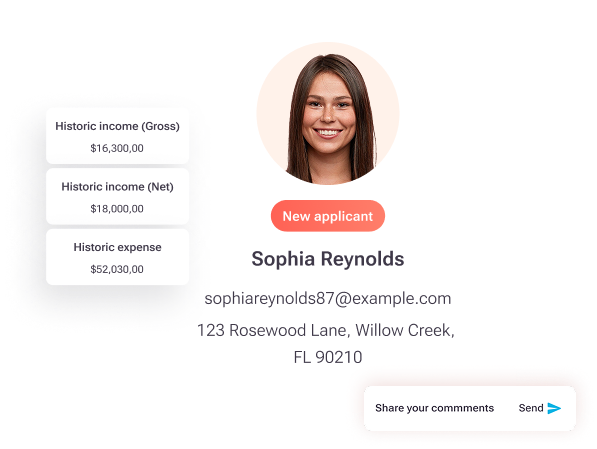
After QuickApprove, boards use a dedicated review and voting dashboard with AI-generated applicant summaries, real-time application tracking, automated communication support, customized approval letters, and a personalized welcome package. QuickApprove results in up to 90% faster approvals and reclaims 4+ hours per week of staff time. The workflow accelerates resident approvals without sacrificing control, compliance, or visibility and supports high-volume seasons and communities with complex onboarding requirements.
Biometric Identity Verification with IDVerify
Traditional screening relies on document uploads that cannot reliably prevent impersonation, synthetic identity fraud, or stolen ID use. Generic verification tools often redirect applicants to external portals, which breaks the screening workflow and introduces friction for CAMs and applicants.
IDVerify is TenantEvaluation’s biometric identity verification layer embedded directly into the screening workflow. It combines government-issued ID validation, AI-powered liveness detection, facial landmark recognition, and biometric selfie-to-ID comparison. All checks run natively inside TenantEvaluation without external portals or workflow disruption. Before IDVerify, communities relied on document review alone with no biometric confirmation. After IDVerify, automated ID authenticity validation, liveness detection, and biometric matching create a standardized fraud-prevention layer that strengthens approval confidence before risk enters the community. IDVerify is configurable per community and per portfolio, which supports different risk profiles without a one-size-fits-all approach.

Lease Tracking and Occupancy Visibility in One System
Lease management across many Florida community associations remains fragmented and heavily manual. Missing or outdated lease copies, manual expiration tracking, disconnected spreadsheets, and no direct connection between applications and active leases create operational blind spots. These gaps slow teams and increase compliance risk tied to incomplete records.
Lease Tracking is a centralized operational capability inside TenantEvaluation that connects resident onboarding, unit data, approvals, and lease documentation into one streamlined, real-time workflow. It delivers real-time lease status visibility across active, pending, expired, or missing leases. It also supports automated lease document collection during onboarding, unit-level tracking, searchable digital history, and audit-ready digital lease records for CAMs, boards, property management companies, and community operations teams. From application to occupancy, every step stays connected. Spreadsheets and scattered email chains give way to one platform where every lease remains searchable, trackable, and ready for audit.
Website and Record Compliance for Chapters 718 and 720
The official records obligations described earlier apply directly to resident screening workflows. Associations that cannot produce complete records on demand face member challenges and regulatory exposure.
TenantEvaluation’s built-in audit trails timestamp every application action, board vote, document upload, and approval decision. Board dashboards give members direct, real-time visibility into application status and historical records. PCI Level 1 compliance, end-to-end encryption, and automatic redaction of sensitive personal information protect associations from data breach liability while preserving the organized digital records that statutory compliance requires.
End-to-End Workflow: From Intake to Audit-Ready Storage
Step 1: Intake. Applicants complete a 100% online application via web or mobile. They upload required documents, and smart form logic rejects incomplete submissions automatically.
Step 2: Biometric Verification. IDVerify validates government-issued ID authenticity, confirms physical presence through AI-powered liveness detection, and completes biometric selfie-to-ID comparison before the application moves to review.
Step 3: Board Review. QuickApprove routes the verified application to the board-ready dashboard with AI-generated summaries and a voting panel. This routing triggers automated communication support and reduces manual follow-ups.
Step 4: Lease Capture. Lease Tracking collects lease documentation during onboarding, connects it to unit and occupancy records, and sets real-time lease status tracking from the moment of approval.
Step 5: Audit-Ready Storage. Every action is timestamped, encrypted, and stored in a searchable digital record that remains accessible for member inspection, regulatory review, or internal audit at any time.
Evaluation Criteria for Florida HOA Compliance Platforms
Platform selection should start with legal and regulatory foundations, then move into security, transparency, and operational impact.
Compliance requirements. Confirm that the platform operates as an FCRA-compliant reseller with direct bureau relationships and automated adverse action workflows. Without this foundation, every screening decision carries liability exposure.
Data handling. Examine how the platform protects sensitive applicant data. PCI Level 1 compliance, end-to-end encryption, and automatic PII redaction reduce breach risk and support member trust. Compliance loses value if a data incident exposes the association to lawsuits.
Auditability. Verify that the platform generates timestamped audit trails for every application action, board vote, and document event. Florida’s expanded records requirements under Sections 718.111 and 720.303 make this capability non-negotiable.
Stakeholder access. Ensure that boards receive a dedicated dashboard with real-time application visibility and a structured voting workflow. Clear access reduces confusion and shortens approval cycles.
Fraud prevention. Look for biometric identity verification that runs inside the screening workflow rather than redirecting applicants to external portals. Native verification keeps the process smooth and strengthens fraud controls.
Turnaround time. Assess whether the platform can reduce approval cycles by up to 70 percent and free meaningful staff hours through automation. Faster decisions improve resident experience and realtor relationships.
Configurability. Confirm that the platform is configurable per community, per portfolio, and for Florida-specific statutory requirements, including 55+ age-restricted communities. Flexible rules help associations stay compliant without custom development.
Comparison Tables
| Feature | TenantEvaluation | ApplyCheck / Verify Screening | Generic PM Software (AppFolio, Buildium) |
|---|---|---|---|
| FCRA reseller status | Direct TransUnion & Equifax reseller | TazWorks white-label; bureau relationship indirect | Varies; not association-specific |
| Automated adverse action workflow | Built-in | Not natively built for associations | Limited or manual |
| Board voting dashboard | Dedicated board panel with AI summaries and voting | Not available | Not available |
| Biometric identity verification | IDVerify native to workflow | Not available | Not available |
| Operational Metric | TenantEvaluation | Manual / Spreadsheet Process | Generic Screening Vendor |
|---|---|---|---|
| Application processing time | 5–10 minutes | 5–10 days | Varies; typically days |
| Approval time reduction | Up to 70% | Baseline | Not reported for associations |
| Staff hours freed | Up to 50 hours/day | Baseline | Not reported for associations |
| Revenue model | Revenue-sharing; no upfront fees | N/A | Monthly subscription or per-report fees |
Frequently Asked Questions
What is the new condo law in Florida 2026?
Florida’s 2026 condo law environment reflects cumulative amendments to Chapter 718 enacted following the 2021 Surfside collapse. Key changes include mandatory structural integrity reserve studies, milestone inspection requirements for buildings three stories or taller, and expanded official records obligations under Section 718.111. Associations must maintain accessible records covering financial statements, meeting minutes, contracts, and resident approval documentation. These requirements increase the operational burden on CAMs and boards that rely on manual record-keeping and highlight the value of platforms that generate audit-ready, searchable digital records automatically.
How do Florida HOAs handle 55+ age verification?
55+ Communities Verification within TenantEvaluation helps Florida condos and HOAs standardize how age-restricted requirements are handled across applications. The Housing for Older Persons Act (HOPA) requires that at least 80% of occupied units be occupied by at least one person 55 or older and that the community publish and follow policies demonstrating intent to be age-restricted housing. Manual handling of these requirements through emails, PDFs, and follow-ups creates inconsistent documentation and growing risk exposure in audits or disputes. TenantEvaluation’s 55+ Communities Verification reduces manual work, standardizes application handling, supports documentation consistency, and improves operational efficiency for CAMs and boards without replacing legal guidance.

What does FCRA compliance mean for Florida community associations conducting resident screening?
FCRA compliance requires associations to obtain proper written consent, use data only for permissible purposes, and provide required adverse action notices when an application is denied or conditioned based on screening results. Associations working with non-compliant data sources or lacking documented adverse action workflows carry direct liability exposure. An FCRA-first platform like TenantEvaluation maintains direct bureau relationships, enforces permissible purpose controls, and automates adverse action documentation to protect associations from this exposure.
How does biometric identity verification reduce fraud risk in HOA communities?
Traditional document-based screening cannot reliably detect stolen IDs, synthetic identities, or impersonation attempts. Biometric identity verification adds a layer that confirms the applicant is physically present and matches their submitted identification. IDVerify within TenantEvaluation combines government ID authentication, AI-powered liveness detection, and facial biometric comparison natively inside the screening workflow. This shift moves communities from document-based review to biometric-backed identity confirmation, which strengthens approval confidence and reduces liability exposure before residents enter the community.
What is the difference between a general property management platform and an HOA compliance management platform for Florida condo associations?
General property management platforms are designed for rental portfolio operations such as rent collection, maintenance requests, and tenant communications. They are not built around the statutory obligations of Florida Chapters 718 and 720, the board governance structures of community associations, or the FCRA requirements specific to association screening. An HOA compliance management platform for Florida condo associations, such as TenantEvaluation, is purpose-built for this environment. It includes board voting dashboards, FCRA-compliant screening with direct bureau relationships, biometric identity verification, lease lifecycle tracking, and audit trails aligned with Florida statutory record-keeping obligations.
Conclusion: Moving Florida HOA Compliance to a Purpose-Built Platform
Florida community associations operating under Chapters 718 and 720 face compliance demands that manual processes cannot reliably cover. Fragmented screening, email-based board approvals, disconnected lease records, and document-only identity verification create administrative burden, fraud exposure, and audit risk that grow as statutory obligations expand in 2026.
TenantEvaluation is a specialized HOA compliance management platform for Florida condo associations, built for community associations and management companies with FCRA compliance at the core. With direct credit bureau reseller relationships, QuickApprove board-ready approval workflows, IDVerify biometric identity verification, centralized Lease Tracking, and built-in audit trails, TenantEvaluation delivers the automation, visibility, and compliance rigor that Florida CAMs and boards require across 5,000+ communities and 100,000+ applications processed annually.
Transform your association’s compliance management and schedule your platform demo today.
