Written by: Luis Teran, Co-founder, CEO, TenantEvaluation
Key Takeaways For Florida Condo And HOA Boards
- Automated tenant background check software for condo and HOA boards digitizes the entire approval workflow, from application intake through board decision and record retention.
- Boards now face rising identity fraud, tighter FCRA compliance expectations, and Florida 55+ documentation mandates that manual email and paper processes rarely satisfy.
- Association-grade platforms provide board voting dashboards, biometric identity verification, structured adverse action workflows, and audit trails that generic screening tools do not include.
- Stakeholders including CAMs, LCAMs, board members, and applicants see fewer delays and stronger compliance when every stage runs inside one governed platform.
- TenantEvaluation combines FCRA-first design, biometric verification, lease tracking, and revenue-share economics for Florida condo and HOA boards.
See the full approval workflow in action
Why Boards Are Moving Off Email Chains In 2026
Florida community associations are shifting away from paper-based and email-driven screening processes because risk and regulatory pressure keep rising.
Identity fraud is the most urgent driver. The FBI’s Internet Crime Complaint Center logged more than 12,000 real estate fraud complaints in 2025, with reported losses exceeding $275 million. At the application level, multifamily application fraud has surged to 1 in 27 applications, with 15% of those cases now involving entirely fabricated synthetic identities. These identities combine real Social Security numbers with fabricated biographic data that pass basic database checks. Traditional document-upload screening rarely detects these attempts. Biometric identity verification now provides the standard response by confirming physical presence and matching a live selfie to a government-issued ID.
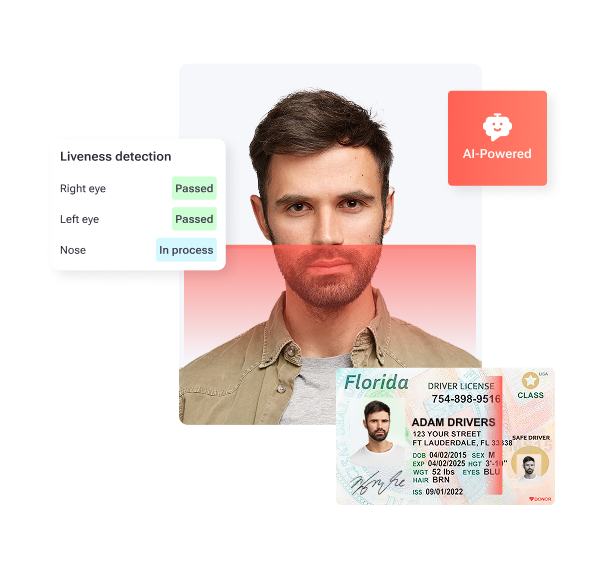
FCRA scrutiny has intensified at the same time. Community associations that use consumer reports to make approval decisions qualify as users of consumer reports under federal law. They must follow permissible purpose requirements, obtain written consent, and follow adverse action notice procedures. Associations that rely on informal email approvals often lack the audit trails needed to demonstrate compliance.
Florida’s 55+ documentation requirements add another layer of obligation. Age-restricted communities must verify that at least 80% of occupied units are occupied by at least one person 55 or older under 24 CFR 100.305, with verification procedures governed by 24 CFR 100.307. Communities must maintain reliable surveys and affidavits and update occupancy records at least every two years. Manual processes make consistent documentation difficult to sustain across a portfolio.

Board expectations have also evolved. Directors now expect real-time visibility into application status, structured voting interfaces, and clear audit trails instead of forwarded email threads. Generic landlord tools, built for single-unit operators, rarely provide these capabilities.
How Governance Pressures Show Up In Daily Operations
These pressures appear in the daily workflow of every stakeholder involved in a resident approval.
Community Association Managers (CAMs) and Licensed Community Association Managers (LCAMs) spend significant time chasing incomplete applications, following up with realtors on missing documents, and manually routing files to board members for review. When a platform does not enforce document completeness at submission, every incomplete application creates a manual follow-up cycle. When board voting happens over email, managers must track responses across inboxes, reconcile conflicting replies, and rebuild a decision record after the fact.
Board members face a different problem. They receive application materials in inconsistent formats, lack a structured way to compare applicants against community criteria, and have no timestamped record of their votes. Email approvals leave only informal records, which may not satisfy FCRA documentation requirements or withstand scrutiny in a fair housing dispute.
Applicants and their realtors feel the impact as delays and uncertainty. Without automated status notifications, applicants call managers for updates. Without clear payment instructions embedded in the application, fee collection becomes a separate manual step that slows approvals.
Board voting dashboards address the board-side problem directly. A centralized interface presents each board member with a summarized applicant report, the community’s screening criteria, and a voting panel. Each vote is timestamped and recorded. The result is a decision record that is auditable, consistent, and independent of any individual board member’s inbox.
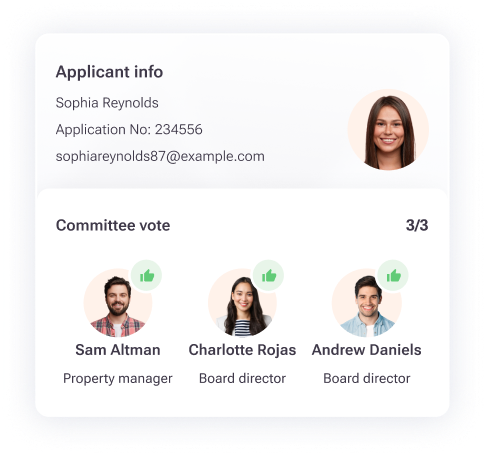
Stakeholder roles such as CAMs, LCAMs, regional directors, board members, applicants, and realtors each require different access levels and different views of the same application. Association-grade platforms configure these roles by design, while generic landlord tools rarely account for this complexity.
Cut manual follow-ups for your managers
FCRA Adverse Action, Audit Trails, And The Governance Line Boards Cannot Cross
The Fair Credit Reporting Act governs every community association that uses a consumer report, including credit, criminal, and eviction reports, to make a housing decision. These obligations are specific and non-negotiable.
Before pulling any consumer report, the association must have a permissible purpose and the applicant’s written consent. For tenant screening, the permissible purpose is evaluating an actual rental application. The consent must be clear, documented, and tied to the specific application.
If the association takes adverse action based in whole or in part on a consumer report, it must provide an adverse action notice. Adverse action is broader than outright denial. Under FCRA Section 615, adverse action includes requiring a co-signer, demanding a larger security deposit, charging higher rent, or offering less favorable lease terms based on screening results. A compliant adverse action notice must contain four elements:
- Notice that adverse action was taken.
- The name, address, and toll-free telephone number of the consumer reporting agency that provided the report.
- A statement that the agency did not make the decision and cannot explain the specific reasons for it.
- Notice of the applicant’s right to obtain a free copy of the report within 60 days and to dispute its accuracy or completeness.
FCRA violations can carry statutory damages of $100 to $1,000 per willful violation, plus attorney’s fees. The separation between the association’s decision-making and the vendor’s data provision remains critical. Audit trails document that separation and show how the association used the data.
TenantEvaluation is built specifically for community associations and management companies, with FCRA compliance as the foundation. As a legitimate reseller of TransUnion and Equifax data, TenantEvaluation operates under strict permissible purpose controls, maintains built-in audit trails for every application, and supports automated adverse action workflows. Associations retain responsibility for their decisions, and TenantEvaluation provides the documented workflow that supports those decisions.
Where Manual Screening Processes Break Down
Screening failures in community associations follow recognizable patterns that stem from manual and semi-manual processes.
Inconsistent processes produce inconsistent records. When different managers handle applications differently, or when board members apply different criteria to different applicants, the association cannot easily demonstrate that its screening standards were applied uniformly. That consistency is a prerequisite for defending against a fair housing complaint.
Manual bottlenecks concentrate risk. When document review, identity verification, and board voting each require separate manual steps, any single step can stall the entire application. During high-volume seasons, the backlog compounds and delays move from days to weeks.
Incomplete applications create gaps. When platforms do not enforce document completeness at submission, managers receive partial files and must chase missing items. Each follow-up cycle adds days to the approval timeline and creates an undocumented exchange outside the platform.
Email-chain approvals leave boards without a reliable audit trail. A board vote conducted over email produces no timestamped, centralized record. If the decision is later challenged, reconstructing the record from individual inboxes becomes time-consuming and unreliable.
Missing lease copies and disconnected payment collection create operational blind spots. When lease documentation is stored outside the screening platform, associations cannot confirm occupancy status in real time. When payment collection is handled separately, managers chase confirmations through phone calls and email.
CFPB research found that tenant screening reports have error rates many times higher than mainstream credit reports, because they are often produced quickly using name-plus-date-of-birth matches without identity verification. When a report contains an error and the association has not maintained a clear adverse action record, the association’s exposure extends beyond the screening vendor’s mistake.
Board Voting Dashboards, Biometric Identity Verification, And Other Association-Grade Features
Each of these breakdowns has a corresponding platform capability that closes the gap. The features that separate association-grade screening platforms from generic landlord tools map directly to the governance obligations and operational realities of Florida condos and HOAs.
Best practices in 2026 include workflow standardization, stronger verification methods, clearer approval structures, better documentation practices, and more secure handling of sensitive information. TenantEvaluation connects each of these practices to a specific capability:

- QuickApprove accelerates resident approvals for CAMs, boards, and property management teams inside one connected platform. It tracks applications in real time, cuts manual follow-ups, and gives boards a ready-made approval process. Automated communications, customized approval letters, and a personalized welcome package keep the experience consistent without sacrificing control, compliance, or visibility.
- IDVerify+ embeds biometric identity verification directly in the screening workflow using government ID validation, AI-powered liveness detection, and selfie-to-ID biometric matching. Communities move from document-based review to biometric-confirmed identity verification before approval decisions.
- 55+ Communities Verification reduces manual work and standardizes application handling for age-restricted communities. Designed for Community Association Managers, it supports documentation consistency, improves operational efficiency, and strengthens internal processes for Florida condos and HOAs.
- Lease Tracking gives boards real-time visibility into every lease from application to occupancy. Built for CAMs, boards, and property management companies, it connects resident onboarding, unit data, approvals, and lease documentation into one platform. Managers see real-time lease status, automated document collection, unit-level tracking, searchable digital history, and audit-ready records.
- TEpayments by Zinc provides a connected payment workflow inside TenantEvaluation that collects application fees and deposits during resident onboarding. Payments go directly to the association’s designated account, and TenantEvaluation never holds the funds.
Compare association-grade capabilities
How To Evaluate Screening Platforms For Your Board
Boards should evaluate automated tenant background check software against governance obligations, not only screening speed. Relevant dimensions include:
- FCRA compliance readiness, including permissible purpose controls, written consent workflows, adverse action automation, and audit trails.
- Board voting capability, with a centralized interface, timestamped votes, summarized reports, and role-based access for directors.
- Identity verification strength, including biometric liveness detection and selfie-to-ID matching rather than document upload alone.
- 55+ documentation support, with structured workflows for age-restricted communities instead of manual PDF collection.
- Lease tracking that connects real-time lease status visibility to the onboarding workflow.
- Payment workflow integration so fee and deposit collection happen inside the application process with direct-to-account payment flow.
- Auditability, with complete, searchable records for every application, decision, and communication.
- Scalability to handle high-volume seasons and multi-community portfolios without adding headcount.
The table below compares the three platform models against the two criteria boards most often overlook, native board voting and 55+ documentation support. Only one model offers both without a bolt-on:
| Platform | Pricing Model | Board Voting Dashboard | 55+ Documentation Support |
|---|---|---|---|
| TenantEvaluation | Revenue-share, applicant-paid per application | Yes, native and timestamped, with summarized applicant reports | Yes, built-in 55+ Communities Verification for Florida condos and HOAs |
| Buildium / AppFolio | Per-screen fees, typically $17 to $35 per screen | No native HOA board voting workflow | No purpose-built 55+ documentation workflow |
| Applycheck / Screening Link | Per-screen background-check pricing | No | No |
TransUnion SmartMove is a standalone pay-as-you-go screening product priced from $25 to $48 per screen. It targets single-unit landlords rather than HOA workflow platforms and does not include board voting, 55+ documentation handling, lease tracking, or revenue-share economics for associations.
TenantEvaluation is the only purpose-built association platform in this group and the strongest fit for Florida condo and HOA boards. It combines FCRA-first design, a direct credit bureau reseller relationship with TransUnion and Equifax, board voting dashboards, biometric identity verification, 55+ documentation support, lease tracking, and a revenue-share model inside one connected workflow.
Frequently Asked Questions
What Do Condo Associations Look For In Background Checks?
Condo associations evaluate applicants across multiple dimensions, not just credit score. A complete association-grade background check addresses:
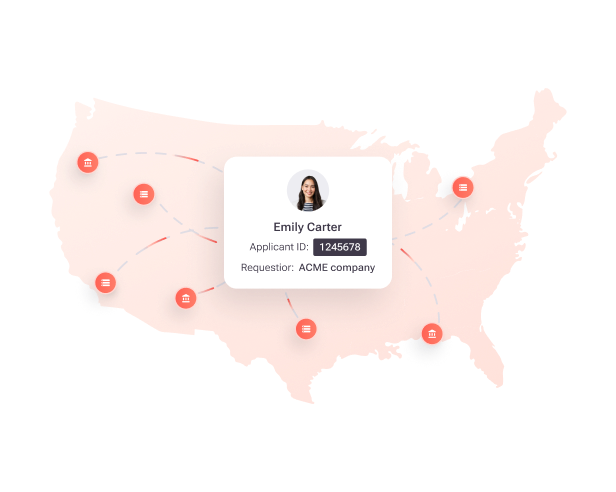
- Criminal history: Nationwide and county-level criminal records, sex offender registry, and FBI Most Wanted checks, evaluated against the community’s specific criteria.
- Eviction history: Civil court records for prior eviction filings, with attention to disposition, since a dismissed case differs from a judgment against the applicant.
- Credit and income thresholds: Credit score, debt-to-income ratio, and income verification against the community’s minimum requirements, which vary by association and appear in the governing documents.
- Occupancy limits: Confirmation that the number of proposed occupants complies with the community’s governing documents.
- 55+ documentation: For age-restricted communities, age verification for at least one occupant per unit using driver’s license, birth certificate, passport, or other reliable documentation as specified under 24 CFR 100.307.
- Identity verification: Biometric confirmation that the applicant is who they claim to be, using government ID validation, liveness detection, and selfie-to-ID matching rather than document upload alone.
How Do Board Voting Dashboards Replace Email Approvals?
A board voting dashboard gives each director access to a centralized interface where they can review a summarized applicant report, evaluate the application against the community’s screening criteria, and cast a timestamped vote inside the screening platform. Every action is recorded automatically, creating an audit trail that documents who reviewed what, when, and how they voted. This replaces the informal, unstructured record produced by email approvals, where responses are scattered across individual inboxes and reconstructing a decision record after the fact is time-consuming and incomplete.
Is There Free Tenant Background Check Software For HOAs?
Free tools exist for single-unit landlords, but they are not designed for community association governance. Free or low-cost landlord screening tools do not include board voting dashboards, FCRA adverse action workflows, 55+ documentation support, lease tracking, or the audit trails that associations need to demonstrate compliance. The cost model that works for associations is applicant-paid screening on a pay-per-application basis, which can offset association costs or generate net rebates through a revenue-share arrangement. Florida caps condominium approval fees at $150 per applicant and cooperative approval fees at $100 per applicant under Florida condominium and cooperative approval-fee caps, and HOA approval fees are not capped under Florida’s Chapter 720. A platform with a revenue-share model allows associations to collect applicant-paid fees within those statutory limits while offsetting or eliminating the cost of the screening platform itself.
How Does Biometric Identity Verification Protect Condo Communities?
Biometric identity verification adds a layer of fraud prevention that document-upload screening cannot provide. Liveness detection confirms that a real, physically present person is completing the verification step rather than a photo, video replay, mask, or deepfake. Selfie-to-ID biometric matching compares the live selfie to the photo on the government-issued ID, confirming the applicant is the same person named on the document. Together, these checks confirm the applicant is real, present, and matched to their identification before any screening files are pulled and before any approval decision is made. This approach directly addresses synthetic identity fraud referenced earlier in this guide.
Can Screening Fees Offset Association Costs Through Revenue-Share Models?
Yes. On a pay-per-application model, applicants pay the screening fee as part of the application process. The platform deducts its service fee and rebates the remainder to the association or management company, creating a cost-neutral or revenue-generating arrangement. Within the Florida fee caps noted above, associations can structure applicant-paid screening to offset platform costs without incurring upfront subscription fees.
About TenantEvaluation And Its Association Focus
Founded in 2007, TenantEvaluation is a pioneer in resident onboarding systems in Florida. The company was created by property managers, board members, and software engineers with more than 50 years of combined experience. The platform serves over 5,000 communities, processes approximately 100,000 applications per year, and has generated $150 million for communities. TenantEvaluation holds a 4.8/5 Google rating. It is a legitimate reseller of TransUnion and Equifax data, operating under strict bureau rules with regular compliance reviews and no gray-market or offshore data sources. FCRA compliance sits at the core of the platform. Partners include RealManage, Castle Group, FirstService Residential, Campbell Property Management, and Associa.
Conclusion: Treat Screening Software As Governance Infrastructure
Automated tenant background check software for condo and HOA boards functions as governance infrastructure. Generic screening tools handle the report, while association-grade platforms handle the decision with board voting, FCRA adverse action workflows, biometric identity verification, 55+ documentation, lease tracking, and revenue-share economics.
The right platform depends on association type and workflow model. Boards that need a structured, auditable, FCRA-first approval process with board voting dashboards, biometric identity verification, 55+ documentation support, and lease lifecycle visibility require a purpose-built association platform rather than a landlord tool adapted for community use.
TenantEvaluation is the only purpose-built, FCRA-first platform in this comparison for Florida condos and HOAs. Use this guide as a foundation for evaluating your own processes and identifying where your current workflow creates governance gaps.
Evaluate your screening infrastructure
