Written by: Luis Teran, Co-founder, CEO, TenantEvaluation
Key Takeaways
- Florida HOAs may screen tenants only when the recorded declaration, bylaws, or articles explicitly grant that authority. Screening without that authority violates FCRA permissible-purpose rules and Florida law.
- Florida law does not create a five-year criminal lookback rule for HOAs. Each association sets its own written lookback period and applies it uniformly.
- FCRA compliance requires a standalone disclosure document, specific written authorization, permissible-purpose certification, and an adverse action notice whenever a consumer report influences a denial or higher deposit.
- Fair housing law bars blanket criminal bans. Associations must complete an individualized assessment that weighs the nature, severity, recency, and relevance of any criminal record to housing safety.
- TenantEvaluation provides FCRA-compliant tenant screening and automated adverse-action workflows built for Florida HOAs. Explore TenantEvaluation’s Florida HOA screening tools.
Does a Florida HOA Have Authority to Screen?
Florida condominium associations may screen prospective tenants only if the recorded declaration, articles, or bylaws grant that authority, and the same principle applies to HOAs governed by Chapter 720. An HOA has no inherent statewide tenant-approval power independent of its governing documents. That means the board must decide whether to approve or deny, while a consumer reporting agency supplies the data behind that decision. Keeping those two roles separate makes the process defensible, so the association owns the decision and TenantEvaluation provides the report.
Florida Statute Chapter 720 governs homeowners’ association operations, including meeting procedures, fining, records, and governance. It does not establish criminal-record lookback windows for tenant screening. Many boards mistakenly treat Chapter 720 as a screening rulebook, but lookback periods come from the association’s own written criteria and fair housing constraints.
Next Action: Review the recorded declaration and confirm the rental-approval and screening authority language before ordering any report.
What Is the 5 Year Rule for HOA in Florida?
Florida HOA law does not contain a universal five-year criminal-lookback rule. No provision of Chapter 720 or Chapter 718 of the Florida Statutes imposes a five-year ban or window on criminal history review for tenant applicants. The phrase “5 year rule” circulates online but has no statutory basis in Florida community association law.
Lookback windows come from the association’s written screening criteria and must still respect fair housing law. Many state and local laws cap criminal-record lookback periods, often five to seven years for felonies and three to five years for misdemeanors, but Florida has not enacted a similar cap for residential tenant screening. The association’s written policy defines the window and the board must apply that policy consistently to every applicant.
Next Action: Put the criminal lookback period in writing and apply the same window to every applicant.
FCRA Requirements for Florida HOA Tenant Screening
Under 15 U.S.C. § 1681b, a consumer report may be obtained only for a permissible purpose the FCRA permits. Tenant screening qualifies as a permissible purpose as a legitimate business need in connection with a transaction initiated by the consumer. Before pulling any report, the association must provide the applicant a clear and conspicuous written disclosure in a document that consists solely of that disclosure. The disclosure page cannot include liability waivers, application language, or any other text.
The authorization may appear on the same document as the disclosure, but it must specifically authorize procurement of the consumer report. A signature on a form stating only that the applicant “understands a report may be obtained” functions as a notification instead of a specific authorization. The distinction matters. The standalone-disclosure requirement is the single largest driver of FCRA class actions. Including extra language on the disclosure form creates a uniform defect that affects every applicant who signed.
Before the report is released, the association must certify to the consumer reporting agency that it has provided the standalone disclosure, obtained written authorization, and will use the report only for the stated permissible purpose. FCRA permissible purpose rules apply to specialty consumer reporting agencies providing residential or tenant history as well as traditional credit bureau reports. TenantEvaluation is a direct reseller of TransUnion and Equifax data, accessed under strict bureau rules, with permissible-purpose controls built into every pull.
Next Action: Confirm that the disclosure and authorization form stands alone, contains specific consent, and is signed before any report is pulled.
See the full FCRA-compliant screening workflow in TenantEvaluation.
Fair Housing and Criminal Records: Individualized Assessment
The federal Fair Housing Act, codified at 42 U.S.C. §§ 3601–3619, protects seven classes: race, color, religion, sex, familial status, national origin, and disability. Florida’s Fair Housing Act, codified at Florida Statutes §§ 760.20–760.37, mirrors those seven federal protected classes. Both statutes apply to community associations and to their tenant-approval decisions.
A blanket “no criminal record, ever” policy remains legally risky because disparate-impact liability is grounded in the Fair Housing Act statute and the Supreme Court’s 2015 decision in Texas Department of Housing and Community Affairs v. Inclusive Communities Project. Courts view individualized assessment as a less-discriminatory alternative to a blanket ban. That assessment approach therefore aligns better with fair housing obligations.
A defensible individualized assessment of criminal history must:
- Exclude arrests that did not lead to a conviction
- Examine the nature and severity of the actual offense and whether it genuinely bears on the safety of residents or property
- Weigh how much time has passed since the offense
- Allow the applicant to supply context such as circumstances, rehabilitation, and references
- Apply the same written standard to every applicant, with the reason for each decision documented
Violent crime and property crime such as burglary, arson, and serious theft are directly relevant to housing safety, while a fifteen-year-old offense with no pattern receives different weight under an individualized assessment framework. The board should complete an assessment form and store it in the applicant file for every applicant whose background check returns a reportable criminal record.
Next Action: Create an individualized assessment form and file it with each application that includes reportable criminal history.
What Must an FCRA Adverse Action Notice Include for a Denied HOA Applicant?
When an association denies an application, charges a higher deposit, or takes any other adverse action based in whole or in part on a consumer report, 15 U.S.C. § 1681m requires the association as the decision-maker to provide an adverse action notice. The notice must include:
- The name, address, and phone number of the consumer reporting agency that furnished the report
- A statement that the agency did not make the decision and cannot explain the specific reasons for it
- Notice of the applicant’s right to obtain a free copy of the report from the agency within 60 days
- Notice of the applicant’s right to dispute inaccurate or incomplete information directly with the agency
Example: An HOA board votes to deny a rental application after reviewing a consumer report showing a recent eviction judgment. The association sends the adverse action notice identifying TenantEvaluation as the reporting agency, stating that TenantEvaluation did not make the denial decision, and informing the applicant of the right to a free report copy and dispute rights. Failing to send an FCRA-compliant adverse action notice exposes the association to actual damages, statutory damages up to $1,000 per incident, and attorney fees.
TenantEvaluation’s platform includes automated adverse action workflows, so the notice sequence becomes part of the process and does not depend on a manual follow-up during a busy approval cycle.
Next Action: Keep proof of delivery of each adverse action notice in the corresponding application file.
Florida Screening Mechanics: Fees, Records, and Enforcement
Florida condominium law caps the lease-approval fee at $150 per applicant. The statute treats spouses and a parent with dependent children as one applicant. It also prohibits charging the fee again when the same tenant renews. Florida Statute 718.112(2)(k) allows a condominium association to charge a lease-approval fee only when the declaration, articles, or bylaws require association approval and authorize a fee. Chapter 720 HOAs have no equivalent statutory fee cap, but the authority to charge must still appear in the governing documents.
Under Florida Statute § 718.111(12)(b), condominium associations must keep foundational records permanently and all other association records for at least seven years. Florida HB 1203 (2024) reaffirmed the seven-year retention floor for HOA official records under § 720.303(5)(a). Rental applications, screening reports, approval and denial decisions, adverse action notices, and individual assessment forms should all be retained within that framework and stored securely with sensitive data redacted.
Florida Commission on Human Relations Enforcement
The Florida Commission on Human Relations (FCHR) enforces Florida’s Fair Housing Act; complaints must be filed within one year of the discriminatory act, filing is free, and no attorney is required. A housing discrimination complaint filed with the FCHR must be filed within one year of the last discriminatory act, while the federal FHA allows two years for a private civil suit, so practitioners often file with both HUD and the FCHR simultaneously. A screening-related complaint, such as a denial based on a blanket criminal ban, can reach the FCHR, HUD, or both and can proceed to a private civil action without exhausting the administrative process first.
Next Action: Align the fee schedule and record-retention schedule with the governing documents, Florida statutory minimums, and FCHR fair housing enforcement risk.
Written Screening Criteria Policy
Objective written criteria protect the association from both FCRA and fair housing claims. The discipline that keeps a housing provider fair-housing-compliant, including written criteria, consistent application, and documented decisions, also supports FCRA compliance. A model written criteria structure for a Florida HOA includes:
- Minimum credit score threshold stated as a specific number
- Income-to-rent ratio requirement, such as gross monthly income of 2.5× to 3× monthly rent
- Rental history lookback period and disqualifying events, such as no eviction judgment in the past five years
- Criminal history lookback period by offense category, with an individual assessment process for every applicant whose report returns a reportable record
- Required documents and the deadline for submission
Vague language such as “not a good fit for the community,” “character concerns,” or “board discretion” does not qualify as a written criterion. That language often appears in fair housing complaints. Every denial should trace to a specific written criterion applied the same way to every applicant. Fair housing testing, in which paired testers with similar financial profiles but different protected characteristics apply to the same unit, is a routine enforcement tool. Consistency across every applicant therefore matters.

Next Action: Adopt the written screening criteria policy by board vote and attach it to the application package.
Explore how TenantEvaluation enforces written criteria across every application.
Common Board Mistakes
The following patterns generate the most FCRA and fair housing exposure for Florida community associations:
- Screening Without Declaration Authority. Ordering a consumer report before confirming that the declaration authorizes rental approval and screening creates a permissible-purpose problem under the FCRA and an ultra vires problem under Florida law.
- Inconsistent Criteria Application. Approving one applicant with a 580 credit score while denying another with a 590 score, without a documented reason tied to a written criterion, creates the factual pattern that supports a disparate-treatment claim.
- Skipping Individual Assessment. Applying a blanket criminal ban instead of the nature-severity-recency-relevance framework exposes the association to disparate-impact liability grounded in the Fair Housing Act statute and the Inclusive Communities decision.
- Mishandling the Adverse Action Notice. The adverse action notice violation is the most frequently cited FCRA infraction in residential landlord enforcement actions. Sending no notice, sending an incomplete notice, or sending it after the decision is final all violate the statute.
- Insecure Record Storage. The FCRA Disposal Rule requires reasonable measures to destroy consumer report information so it cannot be read or reconstructed. Indefinite retention of unredacted screening files in email inboxes or shared drives violates that rule.
Next Action: Audit the last twelve months of application files against this sequence: authority, written criteria, standalone disclosure, written authorization, permissible-purpose certification, consumer report, individualized assessment where applicable, and adverse action notice.
Conclusion and Next Steps
A defensible Florida HOA screening process follows a clear sequence. Confirm declaration authority. Adopt written objective criteria by board vote. Provide a standalone FCRA disclosure and obtain written authorization. Certify the permissible purpose to the consumer reporting agency. Obtain the consumer report. Conduct an individualized assessment of any criminal history. Send an adverse action notice on denial. Retain the complete file for at least seven years.
TenantEvaluation is built specifically for community associations and management companies, with FCRA compliance as the foundation. Founded in 2007, TenantEvaluation serves more than 5,000 communities and processes roughly 100,000 applications per year as a direct reseller of TransUnion and Equifax data. The platform provides built-in audit trails, automated adverse action workflows, and a clear separation between decision-making by the association and data provision by TenantEvaluation, so every step of the sequence above is documented and defensible.
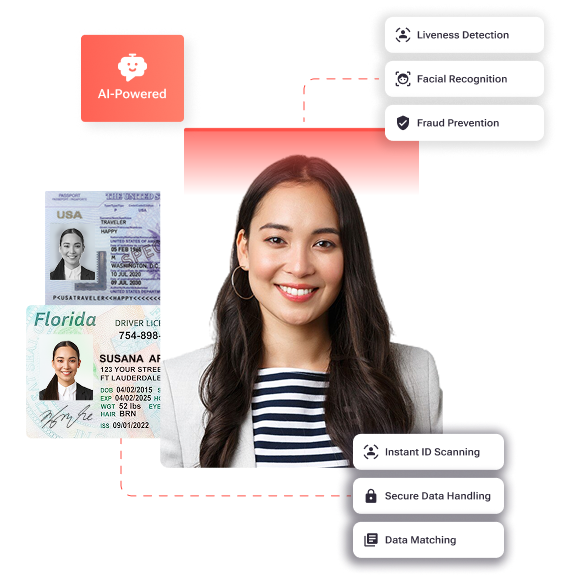
IDVerify+ adds biometric identity verification directly inside the screening workflow, including government ID validation, AI-powered liveness detection, and biometric facial matching. This moves communities from document-based review to verified physical identity confirmation before approval decisions. QuickApprove accelerates resident approvals with real-time application tracking, a board-ready voting dashboard, automated communication support, and customized approval letters while preserving control, compliance, and visibility.
Start your Florida HOA screening audit with TenantEvaluation’s FCRA-first platform.
