Written by: Luis Teran, Co-founder, CEO, TenantEvaluation
Key Takeaways for Faster Florida Board Approvals
- Streamlined board approvals replace email threads, spreadsheets, and manual follow-ups with one connected workflow that moves applications from submission to decision quickly while satisfying Florida Statutes §718.128 and §720.317.
- Common approval delays come from incomplete submissions, communication gaps, manual review burdens, fraud risks, and inconsistent decisions that compound across the review process.
- A 7-step workflow with standardized digital forms, biometric identity verification, automated notifications, board-ready dashboards, authority matrices, digital voting, and automated approval letters cuts cycle times and maintains full compliance and audit trails.
- Consent agendas and pre-meeting socialization allow routine, criteria-compliant applications to be approved quickly while reserving board time for complex or flagged cases that need individual discussion.
- TenantEvaluation’s QuickApprove platform delivers this end-to-end workflow for Florida HOAs and condos; learn more.
The Real Cost of Slow Resident-Application Approvals
Approval delays rarely come from a single failure. They build across several problem areas that interact and compound.
Incomplete submissions often trigger communication gaps as CAMs chase missing documents. Those gaps increase manual review burden because staff juggle multiple incomplete files at once. As volume grows without automated verification, fraud risk rises and manual document review becomes less reliable. When applications finally reach the board, inconsistent criteria can create disputes that send files back through the cycle again.
- Incomplete submissions. Applications arrive missing executed leases, unsigned tax returns, or valid IDs. Each missing item forces a manual return-and-resubmit cycle that can consume weeks before the board ever sees the file.
- Communication gaps. Without automated status notifications, applicants, realtors, and CAMs rely on email chains that stall, get buried, or contradict one another. The number-one homeowner complaint in HOA review processes is receiving no status updates.
- Manual review burden. Self-managed associations can save substantial time by replacing email-based tracking with a structured digital workflow. At higher volumes, the burden scales directly with application count.
- Fraud risk. Traditional document uploads cannot confirm physical presence or prevent synthetic identity fraud. Without biometric verification, boards approve based on documents alone, which increases liability exposure.
- Inconsistent decision-making. Without written criteria and a documented authority matrix, similar applications receive different outcomes depending on which board member reviews them. This inconsistency creates legal exposure and resident disputes.
In some condo buildings, board meeting schedules create approval timelines of several weeks. Every week of delay means lost move-in revenue and a frustrated applicant or realtor. The following 7-step workflow addresses these delay points with automated controls that keep applications moving.
7-Step Workflow to Cut Resident-Application Delays
- Standardize the online application form. Replace paper or PDF submissions with a digital form that enforces completeness before submission, capturing executed leases, valid IDs, income documentation, and required community-specific fields. TenantEvaluation’s intelligent form logic rejects incomplete submissions automatically and removes the return-and-resubmit cycle.
- Verify identity biometrically at intake. Require applicants to complete IDVerify, TenantEvaluation’s biometric identity verification layer, before the application proceeds to review. Government ID validation, AI-powered liveness detection, and biometric facial matching confirm physical presence and identity authenticity upfront. Communities move from document-based review to verified identity confirmation.
- Automate status tracking and notifications. Trigger email notifications at every stage, including submission confirmation, review start, additional information requests, and final decision, for both applicants and board members. Automated notifications prevent applications from stalling and eliminate missed deadlines.
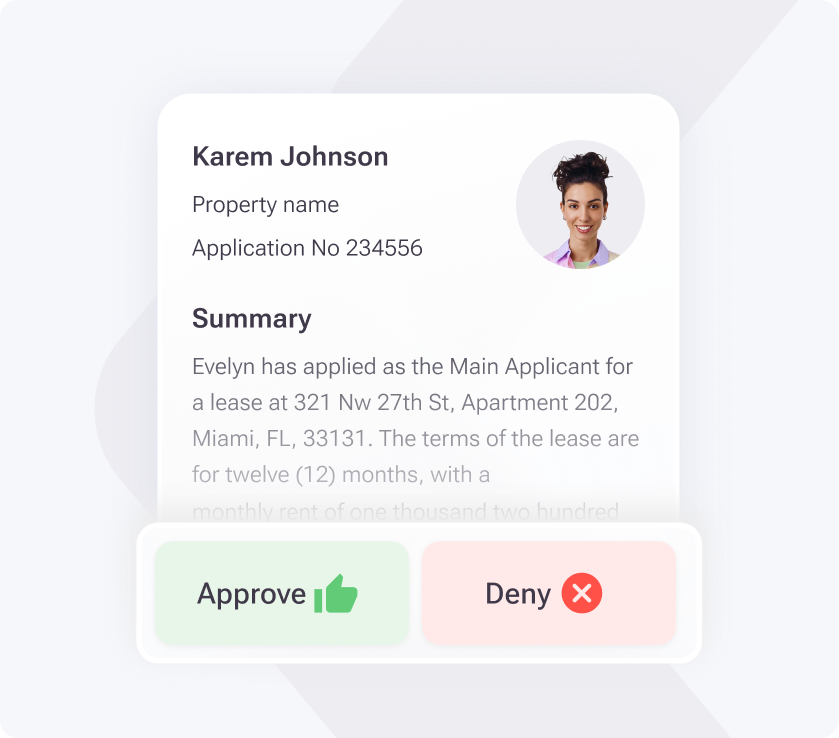
- Route complete applications to the board-ready dashboard. After an application clears intake, QuickApprove surfaces it in the board’s dedicated review panel with AI-generated applicant summaries, all supporting documents, and a voting workflow. This setup replaces email attachments and spreadsheet trackers.
- Apply the authority matrix. Route routine, criteria-compliant applications through CAM-level approval. Escalate applications that require board deliberation, such as denials, conditional approvals, or flagged items, to the full board voting panel. This separation keeps straightforward approvals moving without consuming board meeting time.
- Conduct digital board voting with a full audit trail. Board members cast votes inside the platform. Every vote is timestamped, authenticated, and stored as an official record consistent with the statutory requirements described in the Digital Board Voting section below.
- Deliver the decision with automated approval letters and a welcome package. QuickApprove generates customized approval letters and a personalized welcome package automatically upon decision. This automation removes the manual drafting step that typically follows board votes and completes onboarding inside one connected platform.
Using a Consent Agenda for Routine Resident Applications
A consent agenda bundles routine, non-controversial items into a single collective vote without individual discussion. Items appropriate for a consent agenda include prior meeting minutes, routine vendor invoices within pre-approved spending authority, financial reports, and committee reports requiring no action.
For resident applications, a consent agenda works only for files that are fully complete, meet all screening criteria, carry no flags, and have been reviewed by the CAM in advance. Any application involving a denial, conditional approval, or a board member request for discussion must be pulled from the consent agenda and handled with an individual motion and recorded vote.
Consent Agenda Checklist for Resident Applications:
- Application is 100% complete with all required documents attached
- Background check, credit, and income verification results meet community thresholds
- Identity verified via IDVerify with no flags
- CAM has reviewed and confirmed criteria compliance
- Board packet distributed 3–7 days before the meeting, per consent agenda distribution standards
- No board member has requested separate discussion
Sample Motion Language:
“The board moves to approve the consent agenda as presented, including the resident applications for Units [list unit numbers], each having satisfied all screening criteria and documentation requirements of the association.”
Florida law requires board meeting agendas to be posted at least 48 hours before the meeting, and new business items not listed on the posted agenda cannot be voted on at that meeting. Consent agenda items must be listed specifically enough that any homeowner reading the agenda understands what is being considered.
Building an Authority Matrix for CAM and Board Decisions
An authority matrix defines which role approves each application type at defined thresholds, with clear escalation paths. Effective authority matrices define authority by role and title, not individual names, and include escalation paths with explicit response-time SLAs.
Recommended CAM-Level Authority (no board vote required):
- Renewal applications from existing residents with no screening flags
- Applications that meet all criteria with complete documentation and verified identity
- Routine occupant additions, such as adult children or domestic partners, that meet community standards
Required Board-Level Authority (full vote with recorded outcome):
- Any application the CAM recommends denying
- Conditional approvals with attached requirements
- Applications involving screening flags, incomplete documentation after follow-up, or identity verification concerns
- Age-restricted community applications requiring 55+ Communities Verification review
Implementing an authority framework reduces approval cycle times and clarifies who decides what. Once the authority matrix identifies which applications require board review, pre-meeting socialization keeps those applications moving efficiently.
Pre-Meeting Socialization for Faster Florida Board Decisions
Pre-meeting socialization means distributing complete application packets to board members before the meeting so meeting time focuses on decisions, not first-time reading. Consent agenda materials must be distributed to board members in the board packet 3–7 days in advance of the meeting; if materials were not distributed in advance, the item should not be placed on the consent agenda.
Pre-Meeting Distribution Checklist:
- Applicant summary report, AI-generated inside QuickApprove, distributed 3–7 days before the meeting
- Background check, credit, and income verification results included in the packet
- IDVerify+ biometric confirmation status noted for each applicant
- CAM recommendation, approve, deny, or escalate, included with supporting rationale
- Any flagged items identified with specific governing document references
When board members arrive having already reviewed complete packets, routine applications move to the consent agenda vote in minutes. Complex applications receive focused deliberation instead of consuming time on document review that should have happened earlier.
Digital Board Voting and Electronic Consent for HOAs
Florida explicitly authorizes electronic voting for condominiums under FS §718.128 and for HOAs under FS §720.317. Both statutes require a board resolution authorizing electronic voting, member consent to participate electronically, identity authentication, ballot integrity validation, receipt transmission to each voter, and retention of electronic ballots for recount, inspection, and review.
Key Florida statutory requirements for electronic voting systems:
- Authenticate each member’s identity before voting
- Validate that each electronic vote was not altered in transit
- Transmit a receipt to each voter confirming their vote was recorded
- Permanently separate identifying information from the ballot when secret ballots are required
- Confirm device compatibility at least 14 days before the voting deadline
- Retain electronic ballots for at least one year after the election
Florida HB 913, effective July 1, 2025, eliminates the prior 14-day written notice requirement for condominium boards adopting an electronic-voting resolution under §718.128.
Members must consent to participate in electronic voting.
QuickApprove delivers digital board voting with full audit trails inside TenantEvaluation, supporting Florida statutory compliance requirements without a separate voting platform.
Motion Templates and Metrics to Track Approval Speed
Ready-to-Use Motion Templates:
Approval motion:
“A motion was made by [Director Name] and seconded by [Director Name] to approve the resident application for Unit [number], applicant [name], having met all screening criteria and documentation requirements of the association. The motion passed [X–Y].”
Denial motion:
“A motion was made by [Director Name] and seconded by [Director Name] to deny the resident application for Unit [number] on the basis of [specific criterion reference, e.g., Section 4.2 of the Rules and Regulations, minimum credit score requirement not met]. The motion passed [X–Y].”
Key Metrics to Track Approval Speed:
- Application cycle time: Days from submission to final board decision
- Incomplete-submission rate: Percentage of applications returned for missing documents before reaching review
- Board vote turnaround: Days from application reaching the board dashboard to recorded vote
- Consent agenda utilization rate: Percentage of applications resolved via consent agenda versus individual board vote
- CAM-level resolution rate: Percentage of applications resolved within CAM authority without board escalation
Email and Spreadsheet Workflows vs. a Single Platform
| Capability | Email and Spreadsheet Workflow | TenantEvaluation Single Platform | Impact |
|---|---|---|---|
| Application completeness check | Manual review by CAM, incomplete submissions discovered after receipt | Intelligent form logic rejects incomplete submissions at intake automatically | Removes return-and-resubmit cycles before review begins |
| Identity verification | Document upload only, no biometric confirmation | IDVerify biometric verification with liveness detection and facial matching at intake | Moves communities from document-based to biometric-confirmed identity |
| Board review and voting | Email attachments, reply-all threads, verbal or informal approvals | Dedicated board dashboard inside QuickApprove with AI summaries, voting panel, and timestamped audit trail | Replaces email chains with a connected, auditable approval process |
| Approval letters and onboarding | Manual drafting after board vote, separate welcome communication | Automated customized approval letters and personalized welcome package generated upon decision | Completes onboarding inside one platform without additional manual steps |
How TenantEvaluation’s QuickApprove Speeds Up Approvals
QuickApprove is TenantEvaluation’s accelerated approval workflow built for CAMs, boards, and property management teams. It replaces email chains and spreadsheets with a single connected platform that delivers real-time application tracking, automated communication support, reduced manual follow-ups, customized approval letters, and a personalized welcome package. The workflow supports high-volume seasons and communities with complex onboarding requirements while preserving control, compliance, and visibility.

The board-ready dashboard gives board members direct access to AI-generated applicant summaries, all supporting documents, and a voting workflow. CAMs track application progress in real time and trigger automated communications without leaving the platform. Applicants receive clear status visibility at every stage.
For identity verification, IDVerify embeds biometric KYC verification, including government ID validation, AI-powered liveness detection, and biometric facial matching, directly into the screening workflow. No external portals and no workflow disruption. Verification results appear inside the CAM’s screening report with ID authenticity confirmation, liveness status, and biometric match result.

For age-restricted communities, 55+ Communities Verification standardizes how age-restricted requirements are handled across applications, reduces manual work, improves documentation consistency, and strengthens internal processes for Florida condos and HOAs. The tool is built specifically for Community Association Managers managing 55+ community requirements at scale.

TenantEvaluation has processed more than 100,000 applications annually across over 5,000 communities, generated $150M for communities, and carries a 4.8/5 Google rating, with FCRA compliance as the foundation.
Frequently Asked Questions
What is a board approval workflow for Florida HOA and condo resident applications?
A board approval workflow is the defined sequence of steps that moves a resident application from initial submission through document review, screening, board decision, and final onboarding communication. In Florida HOAs and condos, this workflow must comply with the association’s governing documents, Florida Statutes Chapter 718 for condominiums or Chapter 720 for HOAs, and FCRA requirements for background screening. A well-structured workflow assigns clear responsibilities to the CAM and board, sets response-time standards, documents every decision with a written record, and delivers consistent outcomes regardless of application volume or board meeting schedule.
How long should a Florida HOA or condo board take to approve a resident application?
Florida governing documents typically specify a response window of 30–45 days for resident application reviews. After that period, an application may be deemed approved by default under some association documents. Communities that use digital workflows with pre-socialized board packets and consent agendas for routine applications often reach decisions in under 14 days for straightforward submissions. The main drivers of delay are incomplete submissions, infrequent board meeting schedules, and the absence of real-time tracking. Associations that implement a single connected platform with automated completeness checks, board-ready dashboards, and digital voting consistently reduce cycle times compared with email-and-spreadsheet workflows.
What does Florida law require for electronic voting in HOA and condo board approvals?
Florida Statute §718.128 governs electronic voting for condominiums, and §720.317 governs HOAs. Both require a formal board resolution authorizing electronic voting, individual member consent to participate electronically, and a compliant voting system that authenticates each member’s identity, validates that each vote was not altered in transit, transmits a receipt to each voter, and permanently separates identifying information from the ballot when secret ballots are required. Electronic ballots must be retained for at least one year. Florida HB 913, effective July 1, 2025, allows condominium boards to adopt an electronic voting resolution with 48 hours’ posted notice. HOAs under §720.317 still require 14-day advance notice. Members who do not consent to electronic voting must still receive paper ballots.
What is a consent agenda and when can Florida HOA boards use it for resident applications?
A consent agenda bundles routine, non-controversial items into a single collective vote without individual discussion. For resident applications, a consent agenda is appropriate only when the application is fully complete, all screening criteria are met, identity has been verified, the CAM has reviewed and confirmed compliance, and the board packet was distributed 3–7 days before the meeting. Any application involving a denial, conditional approval, or a board member’s request for discussion must be pulled from the consent agenda and handled with an individual motion, deliberation, and recorded vote. Florida law requires that agenda items be specific enough that any homeowner reading the agenda understands what is being considered, and new business items not listed on the posted agenda cannot be voted on at that meeting.
How does an authority matrix reduce board approval delays for community associations?
An authority matrix defines which role, CAM or board, has decision-making authority for each application type, at what thresholds, and with what escalation path. By authorizing CAMs to approve routine, criteria-compliant applications without a board vote, the matrix removes those applications from the board meeting agenda and accelerates decisions for straightforward cases. Applications requiring board deliberation, such as denials, conditional approvals, or flagged items, are escalated with full documentation already prepared. Board time then focuses on decisions rather than document review. The matrix should be defined by role rather than individual name, documented in writing, and reviewed periodically to reflect changes in governing documents or community standards.
Conclusion: Move Resident Applications from Submission to Decision Faster
The 7-step workflow with standardized online intake, biometric identity verification, automated status tracking, board-ready dashboard routing, authority matrix application, digital voting with audit trails, and automated approval letters replaces the email chains and spreadsheets that cost Florida HOAs and condos weeks of delay and lost revenue. Each step addresses a specific failure point, including incomplete submissions, communication gaps, manual review burden, fraud risk, and inconsistent decision-making.
TenantEvaluation’s QuickApprove delivers every step of this workflow inside one connected platform built for Florida community associations with FCRA compliance as the foundation. From IDVerify biometric verification at intake to the board-ready voting dashboard to customized approval letters and personalized welcome packages at close, the entire approval lifecycle runs inside a single auditable system. The result is a faster, clearer, more consistent process that remains easy to manage while preserving control, compliance, and visibility.
Start streamlining your community’s approval process with QuickApprove.
